
Oracle Critical Patch Update July 2021
Released July 2021 · Oracle's advisory ↗ · ← Critical Patch Update, April 2021 · Critical Patch Update, October 2021 →
231 CVEs in this release, one square each
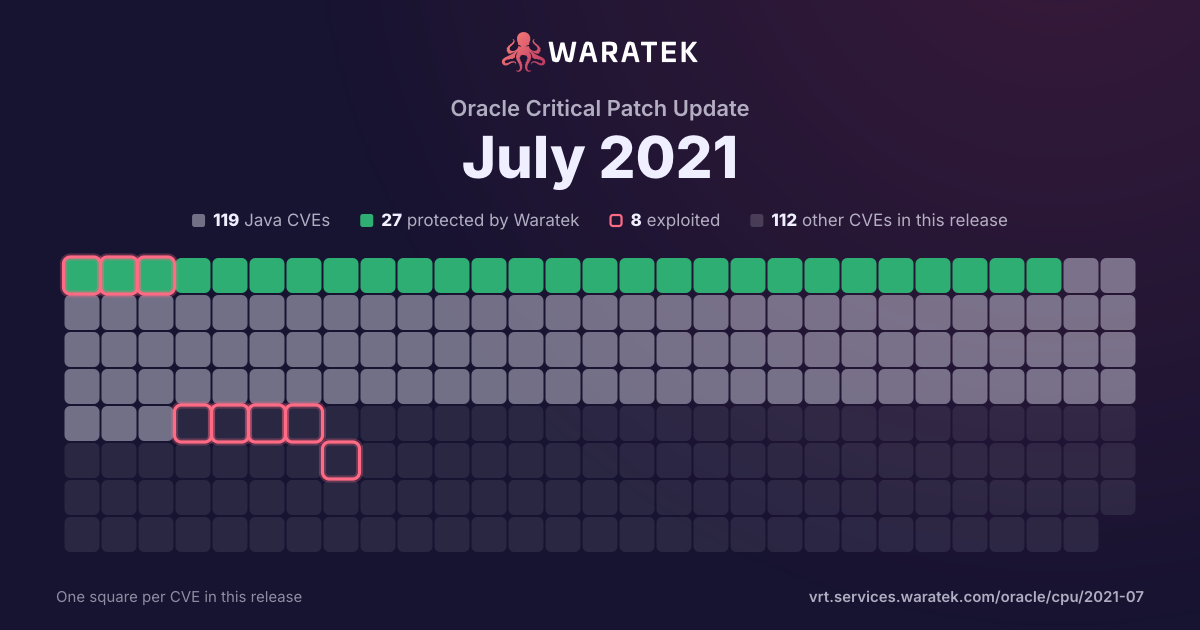
By status
26Protected by Waratek10Mitigation candidate102No exploit published3Outside Waratek scope90Not applicable
8Exploited, marked by the ring
No exploit published. For 68 of them, Oracle's security advisory is the source of public detail.
Protected by Waratek. Waratek RASP can block exploitation of these on systems that have not applied the patch yet.
Overview 12 matches · 0 protected · 1 exploited · 1 CISA KEV · 2 public PoC · 1 EPSS ≥ 0.5
Protected by Waratek
0
0.0%
Rule in development
0
0.0%
Mitigation candidate
2
16.7%
No exploit published
10
83.3%
blocked by ARMR today
0
0.0%
partly blocked
0
0.0%
not blocked
12
100.0%
not established
0
0.0%
unrecorded
0
0.0%
Exploited
1
8.3%
Working exploit published
0
0.0%
Proof of concept only
1
8.3%
Forecast only
0
0.0%
No public exploit
10
83.3%
split by
peak 5 / month
Jan 21Feb 21Mar 21
| CVE | Severity | Published▾ | Status | Exploitation | Description |
|---|---|---|---|---|---|
| CVE-2021-21409 | Medium | 2021-03-30 | No exploit published | No public exploit | Netty is an open-source, asynchronous event-driven network application framework for rapid development of maintainable high performance protocol servers & clients. In Netty (io.netty:netty-codec-http2) before version 4.1.61.Final there is a vulnerability that enables request smuggling. The content-length header is not correctly validated if the request only uses a single Http2HeaderFrame with the endStream set to to true. This could lead to request smuggling if the request is proxied to a remote peer and translated to HTTP/1.1. This is a followup of GHSA-wm47-8v5p-wjpj/CVE-2021-21295 which did miss to fix this one case. This was fixed as part of 4.1.61.Final. |
| CVE-2021-27906 | Medium | 2021-03-19 | No exploit published | No public exploit | A carefully crafted PDF file can trigger an OutOfMemory-Exception while loading the file. This issue affects Apache PDFBox version 2.0.22 and prior 2.0.x versions. |
| CVE-2021-27807 | Medium | 2021-03-19 | No exploit published | No public exploit | A carefully crafted PDF file can trigger an infinite loop while loading the file. This issue affects Apache PDFBox version 2.0.22 and prior 2.0.x versions. |
| CVE-2020-11987 | High | 2021-02-24 | No exploit published | No public exploit | Apache Batik 1.13 is vulnerable to server-side request forgery, caused by improper input validation by the NodePickerPanel. By using a specially-crafted argument, an attacker could exploit this vulnerability to cause the underlying server to make arbitrary GET requests. |
| CVE-2021-22112 | High | 2021-02-23 | No exploit published | No public exploit | Spring Security 5.4.x prior to 5.4.4, 5.3.x prior to 5.3.8.RELEASE, 5.2.x prior to 5.2.9.RELEASE, and older unsupported versions can fail to save the SecurityContext if it is changed more than once in a single request.A malicious user cannot cause the bug to happen (it must be programmed in). However, if the application's intent is to only allow the user to run with elevated privileges in a small portion of the application, the bug can be leveraged to extend those privileges to the rest of the application. |
| CVE-2021-21290 | Medium | 2021-02-08 | No exploit published | No public exploit | Netty is an open-source, asynchronous event-driven network application framework for rapid development of maintainable high performance protocol servers & clients. In Netty before version 4.1.59.Final there is a vulnerability on Unix-like systems involving an insecure temp file. When netty's multipart decoders are used local information disclosure can occur via the local system temporary directory if temporary storing uploads on the disk is enabled. On unix-like systems, the temporary directory is shared between all user. As such, writing to this directory using APIs that do not explicitly set the file/directory permissions can lead to information disclosure. Of note, this does not impact modern MacOS Operating Systems. The method "File.createTempFile" on unix-like systems creates a random file, but, by default will create this file with the permissions "-rw-r--r--". Thus, if sensitive information is written to this file, other local users can read this information. This is the case in netty's "AbstractDiskHttpData" is vulnerable. This has been fixed in version 4.1.59.Final. As a workaround, one may specify your own "java.io.tmpdir" when you start the JVM or use "DefaultHttpDataFactory.setBaseDir(...)" to set the directory to something that is only readable by the current user. |
| CVE-2020-29582 | Medium | 2021-02-03 | No exploit published | No public exploit | In JetBrains Kotlin before 1.4.21, a vulnerable Java API was used for temporary file and folder creation. An attacker was able to read data from such files and list directories due to insecure permissions. |
| CVE-2021-3345 | High | 2021-01-29 | Mitigation candidate | Proof of concept only | _gcry_md_block_write in cipher/hash-common.c in Libgcrypt version 1.9.0 has a heap-based buffer overflow when the digest final function sets a large count value. It is recommended to upgrade to 1.9.1 or later. |
| CVE-2021-26117 | High | 2021-01-27 | No exploit published | No public exploit | The optional ActiveMQ LDAP login module can be configured to use anonymous access to the LDAP server. In this case, for Apache ActiveMQ Artemis prior to version 2.16.0 and Apache ActiveMQ prior to versions 5.16.1 and 5.15.14, the anonymous context is used to verify a valid users password in error, resulting in no check on the password. |
| CVE-2021-3156 | High | 2021-01-26 | Mitigation candidate | Exploited | Sudo before 1.9.5p2 contains an off-by-one error that can result in a heap-based buffer overflow, which allows privilege escalation to root via "sudoedit -s" and a command-line argument that ends with a single backslash character. |
| CVE-2021-20190 | High | 2021-01-19 | No exploit published | No public exploit | A flaw was found in jackson-databind before 2.9.10.7. FasterXML mishandles the interaction between serialization gadgets and typing. The highest threat from this vulnerability is to data confidentiality and integrity as well as system availability. |
| CVE-2021-24122 | Medium | 2021-01-14 | No exploit published | No public exploit | When serving resources from a network location using the NTFS file system, Apache Tomcat versions 10.0.0-M1 to 10.0.0-M9, 9.0.0.M1 to 9.0.39, 8.5.0 to 8.5.59 and 7.0.0 to 7.0.106 were susceptible to JSP source code disclosure in some configurations. The root cause was the unexpected behaviour of the JRE API File.getCanonicalPath() which in turn was caused by the inconsistent behaviour of the Windows API (FindFirstFileW) in some circumstances. |