
Oracle Critical Patch Update July 2021
Released July 2021 · Oracle's advisory ↗ · ← Critical Patch Update, April 2021 · Critical Patch Update, October 2021 →
231 CVEs in this release, one square each
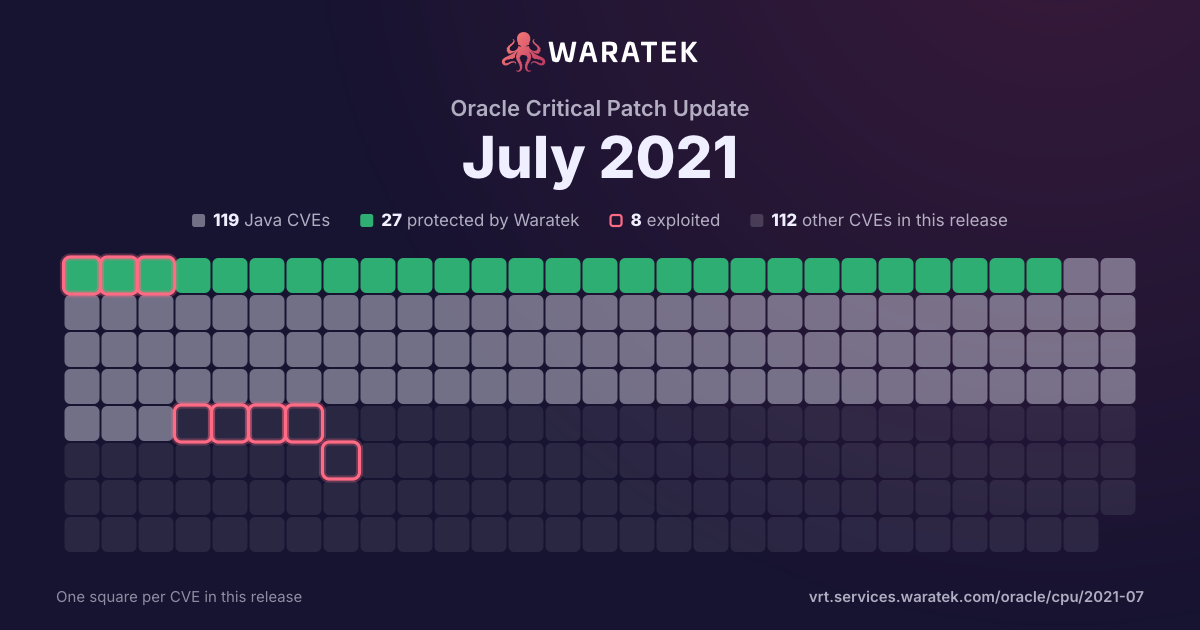
By status
27Protected by Waratek2Mitigation candidate90No exploit published33Outside Waratek scope79Not applicable
8Exploited, marked by the ring
No exploit published. For 70 of them, Oracle's security advisory is the source of public detail.
Protected by Waratek. Waratek RASP can block exploitation of these on systems that have not applied the patch yet.
Overview 4 matches · 0 in Waratek scope · 0 protected · 3 exploited · 1 CISA KEV · 3 EPSS ≥ 0.5
Protected by Waratek
0
0.0%
Rule in development
0
0.0%
Mitigation candidate
0
0.0%
No exploit published
0
0.0%
Outside Waratek scope
4
100.0%
Not applicable
0
0.0%
Withdrawn CVE
0
0.0%
blocked by ARMR today
0
0.0%
partly blocked
0
0.0%
not blocked
4
100.0%
not established
0
0.0%
unrecorded
0
0.0%
Exploited
3
75.0%
Working exploit published
0
0.0%
Proof of concept only
1
25.0%
Forecast only
0
0.0%
No public exploit
0
0.0%
split by
peak 2 / quarter
Q2 19Q3 19Q4 19Q1 20Q2 20Q3 20Q4 20
| CVE | Severity | Published▾ | Status | Exploitation | Description |
|---|---|---|---|---|---|
| CVE-2020-1971 | Medium | 2020-12-08 | Outside Waratek scope | Proof of concept only | The X.509 GeneralName type is a generic type for representing different types of names. One of those name types is known as EDIPartyName. OpenSSL provides a function GENERAL_NAME_cmp which compares different instances of a GENERAL_NAME to see if they are equal or not. This function behaves incorrectly when both GENERAL_NAMEs contain an EDIPARTYNAME. A NULL pointer dereference and a crash may occur leading to a possible denial of service attack. OpenSSL itself uses the GENERAL_NAME_cmp function for two purposes: 1) Comparing CRL distribution point names between an available CRL and a CRL distribution point embedded in an X509 certificate 2) When verifying that a timestamp response token signer matches the timestamp authority name (exposed via the API functions TS_RESP_verify_response and TS_RESP_verify_token) If an attacker can control both items being compared then that attacker could trigger a crash. For example if the attacker can trick a client or server into checking a malicious certificate against a malicious CRL then this may occur. Note that some applications automatically download CRLs based on a URL embedded in a certificate. This checking happens prior to the signatures on the certificate and CRL being verified. OpenSSL's s_server, s_client and verify tools have support for the "-crl_download" option which implements automatic CRL downloading and this attack has been demonstrated to work against those tools. Note that an unrelated bug means that affected versions of OpenSSL cannot parse or construct correct encodings of EDIPARTYNAME. However it is possible to construct a malformed EDIPARTYNAME that OpenSSL's parser will accept and hence trigger this attack. All OpenSSL 1.1.1 and 1.0.2 versions are affected by this issue. Other OpenSSL releases are out of support and have not been checked. Fixed in OpenSSL 1.1.1i (Affected 1.1.1-1.1.1h). Fixed in OpenSSL 1.0.2x (Affected 1.0.2-1.0.2w). |
| CVE-2020-11023 | Medium | 2020-04-29 | Outside Waratek scope | Exploited | In jQuery versions greater than or equal to 1.0.3 and before 3.5.0, passing HTML containing <option> elements from untrusted sources - even after sanitizing it - to one of jQuery's DOM manipulation methods (i.e. .html(), .append(), and others) may execute untrusted code. This problem is patched in jQuery 3.5.0. |
| CVE-2020-11022 | Medium | 2020-04-29 | Outside Waratek scope | Exploited | In jQuery starting with 1.12.0 and before 3.5.0, passing HTML from untrusted sources - even after sanitizing it - to one of jQuery's DOM manipulation methods (i.e. .html(), .append(), and others) may execute untrusted code. This problem is patched in jQuery 3.5.0. |
| CVE-2019-11358 | Medium | 2019-04-20 | Outside Waratek scope | Exploited | jQuery before 3.4.0, as used in Drupal, Backdrop CMS, and other products, mishandles jQuery.extend(true, {}, ...) because of Object.prototype pollution. If an unsanitized source object contained an enumerable __proto__ property, it could extend the native Object.prototype. |