
Oracle Critical Patch Update July 2021
Released July 2021 · Oracle's advisory ↗ · ← Critical Patch Update, April 2021 · Critical Patch Update, October 2021 →
231 CVEs in this release, one square each
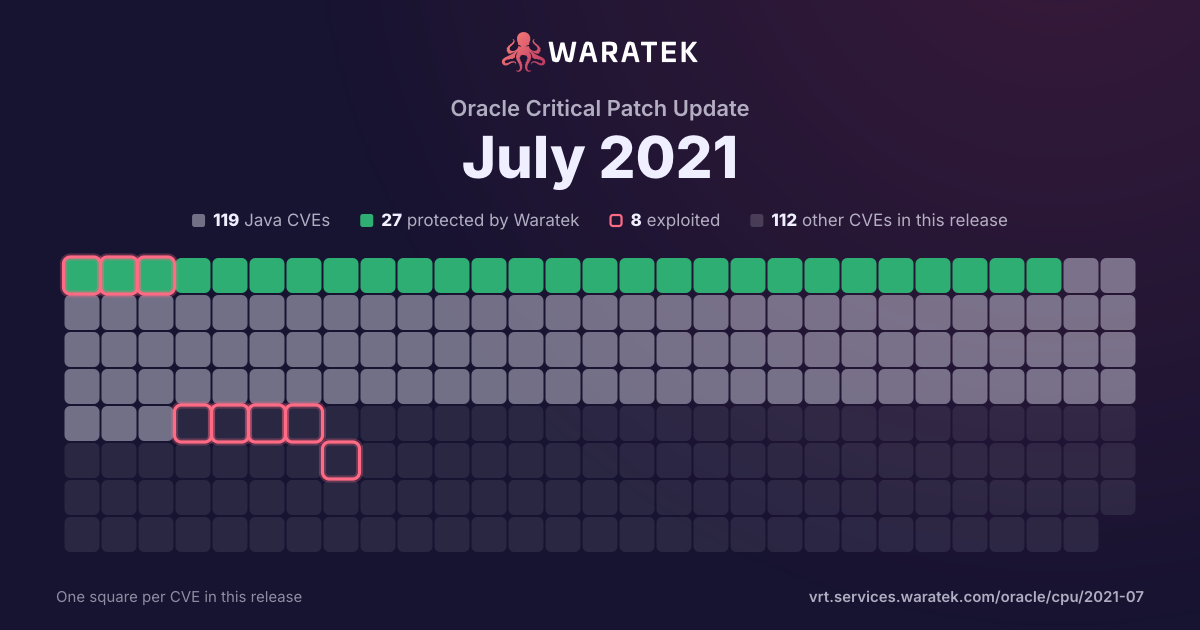
By status
29Protected by Waratek10Mitigation candidate99No exploit published3Outside Waratek scope90Not applicable
8Exploited, marked by the ring
No exploit published. For 72 of them, Oracle's security advisory is the source of public detail.
Protected by Waratek. Waratek RASP can block exploitation of these on systems that have not applied the patch yet.
Overview 215 matches · 128 in Waratek scope · 24 protected · 5 exploited · 4 CISA KEV · 15 public PoC · 15 EPSS ≥ 0.5
215matches
128in Waratek scope59.5%
24protected11.2%
5exploited2.3%
4CISA KEV1.9%
15public PoC7.0%
15EPSS ≥ 0.57.0%
Protected by Waratek
24
11.2%
Rule in development
0
0.0%
Mitigation candidate
8
3.7%
No exploit published
96
44.7%
Outside Waratek scope
2
0.9%
Not applicable
85
39.5%
Withdrawn CVE
0
0.0%
blocked by ARMR today
24
11.2%
partly blocked
0
0.0%
not blocked
191
88.8%
not established
0
0.0%
unrecorded
0
0.0%
split by
peak 131 / quarter
Q3 196
Protected by Waratek2
No exploit published2
Not applicable2
Critical3
High2
Medium1
blocked by ARMR today2
not blocked4
No public exploit6
Q4 195
Protected by Waratek1
Mitigation candidate1
No exploit published1
Not applicable2
Critical2
High1
Medium2
blocked by ARMR today1
not blocked4
Proof of concept only1
No public exploit4
Q1 207
Protected by Waratek2
Mitigation candidate1
No exploit published3
Not applicable1
Critical2
High5
blocked by ARMR today2
not blocked5
Exploited1
Proof of concept only1
No public exploit5
Q2 209
Protected by Waratek3
Mitigation candidate2
No exploit published2
Not applicable2
Critical1
High5
Medium3
blocked by ARMR today3
not blocked6
Exploited2
Working exploit published1
No public exploit6
Q3 2010
Protected by Waratek3
Mitigation candidate1
No exploit published3
Not applicable3
Critical2
High5
Medium3
blocked by ARMR today3
not blocked7
Working exploit published1
No public exploit9
Q4 2023
Protected by Waratek5
No exploit published12
Not applicable6
Critical1
High14
Medium7
Low1
blocked by ARMR today5
not blocked18
Exploited1
Proof of concept only3
No public exploit19
Q1 2120
Protected by Waratek4
Mitigation candidate2
No exploit published9
Not applicable5
Critical2
High9
Medium9
blocked by ARMR today4
not blocked16
Exploited1
Working exploit published1
Proof of concept only2
No public exploit16
Q2 214
Protected by Waratek1
No exploit published1
Not applicable2
Critical2
High2
blocked by ARMR today1
not blocked3
Forecast only1
No public exploit3
Q3 21131
Protected by Waratek3
Mitigation candidate1
No exploit published63
Outside Waratek scope2
Not applicable62
Critical8
High48
Medium65
Low10
blocked by ARMR today3
not blocked128
Proof of concept only2
Forecast only2
No public exploit127
Q3 19Q4 19Q1 20Q2 20Q3 20Q4 20Q1 21Q2 21Q3 21
| CVE | Severity | Published▾ | Status | Exploitation | Description |
|---|---|---|---|---|---|
| CVE-2020-2555 | Critical | 2020-01-15 | Protected by Waratek | Exploited | Vulnerability in the Oracle Coherence product of Oracle Fusion Middleware (component: Caching,CacheStore,Invocation). Supported versions that are affected are 3.7.1.0, 12.1.3.0.0, 12.2.1.3.0 and 12.2.1.4.0. Easily exploitable vulnerability allows unauthenticated attacker with network access via T3 to compromise Oracle Coherence. Successful attacks of this vulnerability can result in takeover of Oracle Coherence. CVSS 3.0 Base Score 9.8 (Confidentiality, Integrity and Availability impacts). CVSS Vector: (CVSS:3.0/AV:N/AC:L/PR:N/UI:N/S:U/C:H/I:H/A:H). |
| CVE-2019-12399 | High | 2020-01-14 | No exploit published | No public exploit | When Connect workers in Apache Kafka 2.0.0, 2.0.1, 2.1.0, 2.1.1, 2.2.0, 2.2.1, or 2.3.0 are configured with one or more config providers, and a connector is created/updated on that Connect cluster to use an externalized secret variable in a substring of a connector configuration property value, then any client can issue a request to the same Connect cluster to obtain the connector's task configuration and the response will contain the plaintext secret rather than the externalized secrets variables. |
| CVE-2019-0219 | Critical | 2020-01-14 | No exploit published | No public exploit | A website running in the InAppBrowser webview on Android could execute arbitrary JavaScript in the main application's webview using a specially crafted gap-iab: URI. |
| CVE-2019-5064 | High | 2020-01-03 | Not applicable | No public exploit | An exploitable heap buffer overflow vulnerability exists in the data structure persistence functionality of OpenCV, before version 4.2.0. A specially crafted JSON file can cause a buffer overflow, resulting in multiple heap corruptions and potentially code execution. An attacker can provide a specially crafted file to trigger this vulnerability. |
| CVE-2019-12415 | Medium | 2019-10-23 | Protected by Waratek | No public exploit | In Apache POI up to 4.1.0, when using the tool XSSFExportToXml to convert user-provided Microsoft Excel documents, a specially crafted document can allow an attacker to read files from the local filesystem or from internal network resources via XML External Entity (XXE) Processing. |
| CVE-2019-2897 | Medium | 2019-10-16 | No exploit published | No public exploit | Vulnerability in the Oracle Business Intelligence Enterprise Edition product of Oracle Fusion Middleware (component: Analytics Actions). Supported versions that are affected are 12.2.1.3.0 and 12.2.1.4.0. Easily exploitable vulnerability allows low privileged attacker with network access via HTTP to compromise Oracle Business Intelligence Enterprise Edition. While the vulnerability is in Oracle Business Intelligence Enterprise Edition, attacks may significantly impact additional products. Successful attacks of this vulnerability can result in unauthorized update, insert or delete access to some of Oracle Business Intelligence Enterprise Edition accessible data as well as unauthorized read access to a subset of Oracle Business Intelligence Enterprise Edition accessible data. CVSS 3.0 Base Score 6.4 (Confidentiality and Integrity impacts). CVSS Vector: (CVSS:3.0/AV:N/AC:L/PR:L/UI:N/S:C/C:L/I:L/A:N). |
| CVE-2019-17195 | Critical | 2019-10-15 | Mitigation candidate | Proof of concept only | Connect2id Nimbus JOSE+JWT before v7.9 can throw various uncaught exceptions while parsing a JWT, which could result in an application crash (potential information disclosure) or a potential authentication bypass. |
| CVE-2019-17545 | Critical | 2019-10-14 | Not applicable | No public exploit | GDAL through 3.0.1 has a poolDestroy double free in OGRExpatRealloc in ogr/ogr_expat.cpp when the 10MB threshold is exceeded. |
| CVE-2019-17543 | High | 2019-10-14 | Not applicable | No public exploit | LZ4 before 1.9.2 has a heap-based buffer overflow in LZ4_write32 (related to LZ4_compress_destSize), affecting applications that call LZ4_compress_fast with a large input. (This issue can also lead to data corruption.) NOTE: the vendor states "only a few specific / uncommon usages of the API are at risk." |
| CVE-2019-3740 | Medium | 2019-09-18 | No exploit published | No public exploit | RSA BSAFE Crypto-J versions prior to 6.2.5 are vulnerable to an Information Exposure Through Timing Discrepancy vulnerabilities during DSA key generation. A malicious remote attacker could potentially exploit those vulnerabilities to recover DSA keys. |
| CVE-2019-12402 | High | 2019-08-30 | No exploit published | No public exploit | The file name encoding algorithm used internally in Apache Commons Compress 1.15 to 1.18 can get into an infinite loop when faced with specially crafted inputs. This can lead to a denial of service attack if an attacker can choose the file names inside of an archive created by Compress. |
| CVE-2019-10746 | Critical | 2019-08-23 | Not applicable | No public exploit | mixin-deep is vulnerable to Prototype Pollution in versions before 1.3.2 and version 2.0.0. The function mixin-deep could be tricked into adding or modifying properties of Object.prototype using a constructor payload. |
| CVE-2019-10086 | High | 2019-08-20 | Protected by Waratek | No public exploit | In Apache Commons Beanutils 1.9.2, a special BeanIntrospector class was added which allows suppressing the ability for an attacker to access the classloader via the class property available on all Java objects. We, however were not using this by default characteristic of the PropertyUtilsBean. |
| CVE-2019-12260 | Critical | 2019-08-09 | Not applicable | No public exploit | Wind River VxWorks 6.9 and vx7 has a Buffer Overflow in the TCP component (issue 2 of 4). This is an IPNET security vulnerability: TCP Urgent Pointer state confusion caused by a malformed TCP AO option. |
| CVE-2019-13990 | Critical | 2019-07-26 | Protected by Waratek | No public exploit | initDocumentParser in xml/XMLSchedulingDataProcessor.java in Terracotta Quartz Scheduler through 2.3.0 allows XXE attacks via a job description. |