
Oracle Critical Patch Update July 2021
Released July 2021 · Oracle's advisory ↗ · ← Critical Patch Update, April 2021 · Critical Patch Update, October 2021 →
231 CVEs in this release, one square each
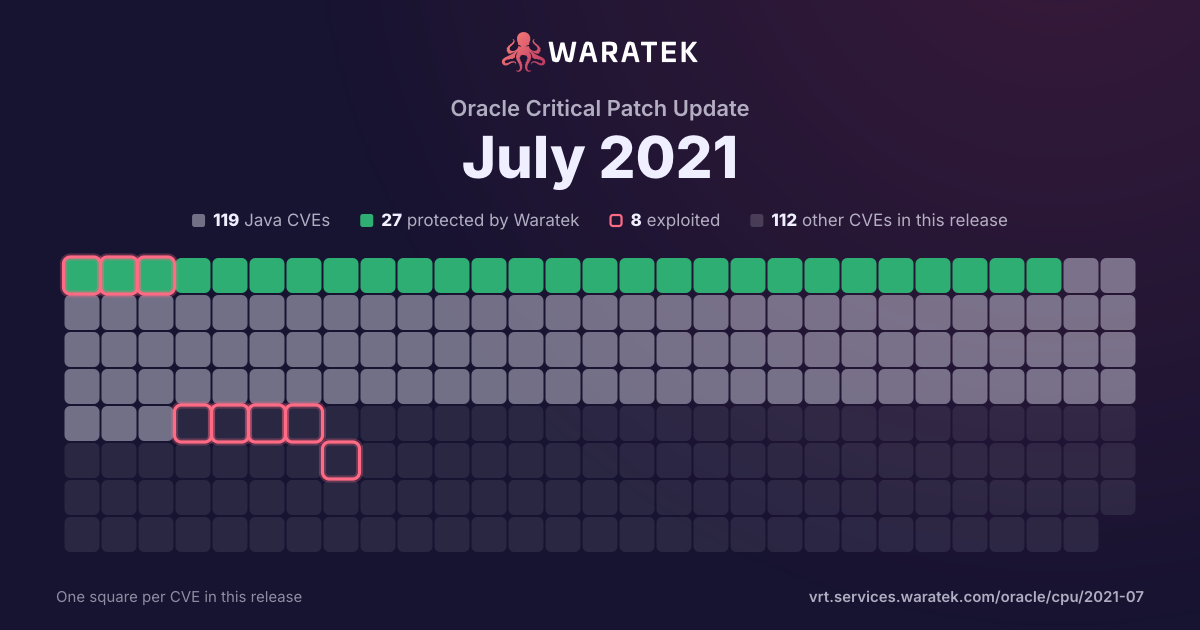
By status
27Protected by Waratek2Mitigation candidate90No exploit published33Outside Waratek scope79Not applicable
8Exploited, marked by the ring
No exploit published. For 70 of them, Oracle's security advisory is the source of public detail.
Protected by Waratek. Waratek RASP can block exploitation of these on systems that have not applied the patch yet.
Overview 204 matches · 92 in Waratek scope · 0 protected · 5 exploited · 2 CISA KEV · 13 public PoC · 13 EPSS ≥ 0.5
204matches
92in Waratek scope45.1%
0protected0.0%
5exploited2.5%
2CISA KEV1.0%
13public PoC6.4%
13EPSS ≥ 0.56.4%
Protected by Waratek
0
0.0%
Rule in development
0
0.0%
Mitigation candidate
2
1.0%
No exploit published
90
44.1%
Outside Waratek scope
33
16.2%
Not applicable
79
38.7%
Withdrawn CVE
0
0.0%
blocked by ARMR today
0
0.0%
partly blocked
0
0.0%
not blocked
204
100.0%
not established
0
0.0%
unrecorded
0
0.0%
split by
peak 128 / quarter
Q2 161
Not applicable1
Medium1
not blocked1
No public exploit1
Q3 160
Q4 160
Q1 170
Q2 172
No exploit published1
Not applicable1
Critical1
High1
not blocked2
No public exploit2
Q3 171
Outside Waratek scope1
Medium1
not blocked1
No public exploit1
Q4 173
No exploit published1
Outside Waratek scope1
Not applicable1
Critical1
High2
not blocked3
Working exploit published1
No public exploit2
Q1 182
Outside Waratek scope1
Not applicable1
Critical1
Medium1
not blocked2
No public exploit2
Q2 180
Q3 180
Q4 181
Outside Waratek scope1
High1
not blocked1
Working exploit published1
Q1 191
Not applicable1
High1
not blocked1
Exploited1
Q2 191
Outside Waratek scope1
Medium1
not blocked1
Exploited1
Q3 195
No exploit published1
Outside Waratek scope3
Not applicable1
Critical3
High1
Medium1
not blocked5
No public exploit5
Q4 194
No exploit published1
Outside Waratek scope1
Not applicable2
Critical2
High1
Medium1
not blocked4
Proof of concept only1
No public exploit3
Q1 205
No exploit published2
Outside Waratek scope2
Not applicable1
Critical1
High4
not blocked5
Proof of concept only1
No public exploit4
Q2 206
Outside Waratek scope6
High3
Medium3
not blocked6
Exploited2
No public exploit4
Q3 207
Mitigation candidate1
No exploit published3
Not applicable3
Critical1
High3
Medium3
not blocked7
Working exploit published1
No public exploit6
Q4 2018
No exploit published8
Outside Waratek scope7
Not applicable3
High11
Medium6
Low1
not blocked18
Proof of concept only3
No public exploit15
Q1 2116
No exploit published9
Outside Waratek scope5
Not applicable2
Critical1
High8
Medium7
not blocked16
Exploited1
Proof of concept only2
No public exploit13
Q2 213
No exploit published1
Outside Waratek scope2
Critical2
High1
not blocked3
Forecast only1
No public exploit2
Q3 21128
Mitigation candidate1
No exploit published63
Outside Waratek scope2
Not applicable62
Critical7
High48
Medium65
Low8
not blocked128
Proof of concept only1
Forecast only2
No public exploit125
Q3 16Q1 17Q3 17Q1 18Q3 18Q1 19Q3 19Q1 20Q3 20Q1 21Q3 21
| CVE | Severity | Published▾ | Status | Exploitation | Description |
|---|---|---|---|---|---|
| CVE-2021-2355 | Critical | 2021-07-21 | No exploit published | No public exploit | Vulnerability in the Oracle Marketing product of Oracle E-Business Suite (component: Marketing Administration). Supported versions that are affected are 12.1.1-12.1.3 and 12.2.3-12.2.10. Easily exploitable vulnerability allows unauthenticated attacker with network access via HTTP to compromise Oracle Marketing. Successful attacks of this vulnerability can result in unauthorized creation, deletion or modification access to critical data or all Oracle Marketing accessible data as well as unauthorized access to critical data or complete access to all Oracle Marketing accessible data. CVSS 3.1 Base Score 9.1 (Confidentiality and Integrity impacts). CVSS Vector: (CVSS:3.1/AV:N/AC:L/PR:N/UI:N/S:U/C:H/I:H/A:N). |
| CVE-2021-2354 | Medium | 2021-07-21 | Not applicable | No public exploit | Vulnerability in the MySQL Server product of Oracle MySQL (component: Server: Federated). Supported versions that are affected are 8.0.25 and prior. Easily exploitable vulnerability allows high privileged attacker with network access via multiple protocols to compromise MySQL Server. Successful attacks of this vulnerability can result in unauthorized ability to cause a hang or frequently repeatable crash (complete DOS) of MySQL Server. CVSS 3.1 Base Score 4.9 (Availability impacts). CVSS Vector: (CVSS:3.1/AV:N/AC:L/PR:H/UI:N/S:U/C:N/I:N/A:H). |
| CVE-2021-2353 | Medium | 2021-07-21 | No exploit published | No public exploit | Vulnerability in the Siebel Core - Server Framework product of Oracle Siebel CRM (component: Loging). Supported versions that are affected are 21.5 and Prior. Easily exploitable vulnerability allows high privileged attacker with logon to the infrastructure where Siebel Core - Server Framework executes to compromise Siebel Core - Server Framework. Successful attacks of this vulnerability can result in unauthorized access to critical data or complete access to all Siebel Core - Server Framework accessible data. CVSS 3.1 Base Score 4.4 (Confidentiality impacts). CVSS Vector: (CVSS:3.1/AV:L/AC:L/PR:H/UI:N/S:U/C:H/I:N/A:N). |
| CVE-2021-2352 | Medium | 2021-07-21 | Not applicable | No public exploit | Vulnerability in the MySQL Server product of Oracle MySQL (component: Server: DDL). Supported versions that are affected are 8.0.25 and prior. Easily exploitable vulnerability allows high privileged attacker with network access via multiple protocols to compromise MySQL Server. Successful attacks of this vulnerability can result in unauthorized ability to cause a hang or frequently repeatable crash (complete DOS) of MySQL Server. CVSS 3.1 Base Score 4.9 (Availability impacts). CVSS Vector: (CVSS:3.1/AV:N/AC:L/PR:H/UI:N/S:U/C:N/I:N/A:H). |
| CVE-2021-2351 | High | 2021-07-21 | No exploit published | No public exploit | Vulnerability in the Advanced Networking Option component of Oracle Database Server. Supported versions that are affected are 12.1.0.2, 12.2.0.1 and 19c. Difficult to exploit vulnerability allows unauthenticated attacker with network access via Oracle Net to compromise Advanced Networking Option. Successful attacks require human interaction from a person other than the attacker and while the vulnerability is in Advanced Networking Option, attacks may significantly impact additional products. Successful attacks of this vulnerability can result in takeover of Advanced Networking Option. Note: The July 2021 Critical Patch Update introduces a number of Native Network Encryption changes to deal with vulnerability CVE-2021-2351 and prevent the use of weaker ciphers. Customers should review: "Changes in Native Network Encryption with the July 2021 Critical Patch Update" (Doc ID 2791571.1). CVSS 3.1 Base Score 8.3 (Confidentiality, Integrity and Availability impacts). CVSS Vector: (CVSS:3.1/AV:N/AC:H/PR:N/UI:R/S:C/C:H/I:H/A:H). |
| CVE-2021-2350 | High | 2021-07-21 | No exploit published | No public exploit | Vulnerability in the Hyperion Essbase Administration Services product of Oracle Essbase (component: EAS Console). Supported versions that are affected are 11.1.2.4 and 21.2. Easily exploitable vulnerability allows unauthenticated attacker with network access via HTTP to compromise Hyperion Essbase Administration Services. Successful attacks of this vulnerability can result in unauthorized access to critical data or complete access to all Hyperion Essbase Administration Services accessible data. CVSS 3.1 Base Score 7.5 (Confidentiality impacts). CVSS Vector: (CVSS:3.1/AV:N/AC:L/PR:N/UI:N/S:U/C:H/I:N/A:N). |
| CVE-2021-2349 | High | 2021-07-21 | No exploit published | No public exploit | Vulnerability in the Hyperion Essbase Administration Services product of Oracle Essbase (component: EAS Console). Supported versions that are affected are 11.1.2.4 and 21.2. Easily exploitable vulnerability allows unauthenticated attacker with network access via HTTP to compromise Hyperion Essbase Administration Services. While the vulnerability is in Hyperion Essbase Administration Services, attacks may significantly impact additional products. Successful attacks of this vulnerability can result in unauthorized access to critical data or complete access to all Hyperion Essbase Administration Services accessible data. CVSS 3.1 Base Score 8.6 (Confidentiality impacts). CVSS Vector: (CVSS:3.1/AV:N/AC:L/PR:N/UI:N/S:C/C:H/I:N/A:N). |
| CVE-2021-2348 | Medium | 2021-07-21 | No exploit published | No public exploit | Vulnerability in the Oracle Commerce Guided Search / Oracle Commerce Experience Manager product of Oracle Commerce (component: Tools and Frameworks). The supported version that is affected is 11.3.1.5. Easily exploitable vulnerability allows low privileged attacker with network access via HTTP to compromise Oracle Commerce Guided Search / Oracle Commerce Experience Manager. Successful attacks of this vulnerability can result in unauthorized read access to a subset of Oracle Commerce Guided Search / Oracle Commerce Experience Manager accessible data. CVSS 3.1 Base Score 4.3 (Confidentiality impacts). CVSS Vector: (CVSS:3.1/AV:N/AC:L/PR:L/UI:N/S:U/C:L/I:N/A:N). |
| CVE-2021-2347 | Medium | 2021-07-21 | No exploit published | No public exploit | Vulnerability in the Hyperion Infrastructure Technology product of Oracle Hyperion (component: Lifecycle Management). The supported version that is affected is 11.2.5.0. Easily exploitable vulnerability allows high privileged attacker with network access via HTTP to compromise Hyperion Infrastructure Technology. Successful attacks require human interaction from a person other than the attacker. Successful attacks of this vulnerability can result in unauthorized access to critical data or complete access to all Hyperion Infrastructure Technology accessible data as well as unauthorized update, insert or delete access to some of Hyperion Infrastructure Technology accessible data. CVSS 3.1 Base Score 5.2 (Confidentiality and Integrity impacts). CVSS Vector: (CVSS:3.1/AV:N/AC:L/PR:H/UI:R/S:U/C:H/I:L/A:N). |
| CVE-2021-2346 | Medium | 2021-07-21 | No exploit published | No public exploit | Vulnerability in the Oracle Commerce Guided Search / Oracle Commerce Experience Manager product of Oracle Commerce (component: Tools and Frameworks). The supported version that is affected is 11.3.1.5. Easily exploitable vulnerability allows low privileged attacker with network access via HTTP to compromise Oracle Commerce Guided Search / Oracle Commerce Experience Manager. Successful attacks require human interaction from a person other than the attacker and while the vulnerability is in Oracle Commerce Guided Search / Oracle Commerce Experience Manager, attacks may significantly impact additional products. Successful attacks of this vulnerability can result in unauthorized update, insert or delete access to some of Oracle Commerce Guided Search / Oracle Commerce Experience Manager accessible data as well as unauthorized read access to a subset of Oracle Commerce Guided Search / Oracle Commerce Experience Manager accessible data. CVSS 3.1 Base Score 5.4 (Confidentiality and Integrity impacts). CVSS Vector: (CVSS:3.1/AV:N/AC:L/PR:L/UI:R/S:C/C:L/I:L/A:N). |
| CVE-2021-2345 | Medium | 2021-07-21 | No exploit published | No public exploit | Vulnerability in the Oracle Commerce Guided Search / Oracle Commerce Experience Manager product of Oracle Commerce (component: Tools and Frameworks). The supported version that is affected is 11.3.1.5. Easily exploitable vulnerability allows low privileged attacker with network access via HTTP to compromise Oracle Commerce Guided Search / Oracle Commerce Experience Manager. Successful attacks require human interaction from a person other than the attacker and while the vulnerability is in Oracle Commerce Guided Search / Oracle Commerce Experience Manager, attacks may significantly impact additional products. Successful attacks of this vulnerability can result in unauthorized update, insert or delete access to some of Oracle Commerce Guided Search / Oracle Commerce Experience Manager accessible data as well as unauthorized read access to a subset of Oracle Commerce Guided Search / Oracle Commerce Experience Manager accessible data. CVSS 3.1 Base Score 5.4 (Confidentiality and Integrity impacts). CVSS Vector: (CVSS:3.1/AV:N/AC:L/PR:L/UI:R/S:C/C:L/I:L/A:N). |
| CVE-2021-2344 | High | 2021-07-21 | No exploit published | No public exploit | Vulnerability in the Oracle Coherence product of Oracle Fusion Middleware (component: Core). Supported versions that are affected are 3.7.1.0, 12.1.3.0.0, 12.2.1.3.0, 12.2.1.4.0 and 14.1.1.0.0. Easily exploitable vulnerability allows unauthenticated attacker with network access via T3, IIOP to compromise Oracle Coherence. Successful attacks of this vulnerability can result in unauthorized ability to cause a hang or frequently repeatable crash (complete DOS) of Oracle Coherence. CVSS 3.1 Base Score 7.5 (Availability impacts). CVSS Vector: (CVSS:3.1/AV:N/AC:L/PR:N/UI:N/S:U/C:N/I:N/A:H). |
| CVE-2021-2343 | Medium | 2021-07-21 | No exploit published | No public exploit | Vulnerability in the Oracle Workflow product of Oracle E-Business Suite (component: Workflow Notification Mailer). Supported versions that are affected are 12.1.3 and 12.2.3-12.2.10. Easily exploitable vulnerability allows low privileged attacker with network access via HTTP to compromise Oracle Workflow. Successful attacks of this vulnerability can result in unauthorized read access to a subset of Oracle Workflow accessible data. CVSS 3.1 Base Score 4.3 (Confidentiality impacts). CVSS Vector: (CVSS:3.1/AV:N/AC:L/PR:L/UI:N/S:U/C:L/I:N/A:N). |
| CVE-2021-2342 | Medium | 2021-07-21 | Not applicable | No public exploit | Vulnerability in the MySQL Server product of Oracle MySQL (component: Server: Optimizer). Supported versions that are affected are 5.7.34 and prior and 8.0.25 and prior. Easily exploitable vulnerability allows high privileged attacker with network access via multiple protocols to compromise MySQL Server. Successful attacks of this vulnerability can result in unauthorized ability to cause a hang or frequently repeatable crash (complete DOS) of MySQL Server. CVSS 3.1 Base Score 4.9 (Availability impacts). CVSS Vector: (CVSS:3.1/AV:N/AC:L/PR:H/UI:N/S:U/C:N/I:N/A:H). |
| CVE-2021-2340 | Low | 2021-07-21 | Not applicable | No public exploit | Vulnerability in the MySQL Server product of Oracle MySQL (component: Server: Memcached). Supported versions that are affected are 8.0.25 and prior. Easily exploitable vulnerability allows high privileged attacker with network access via multiple protocols to compromise MySQL Server. Successful attacks of this vulnerability can result in unauthorized ability to cause a partial denial of service (partial DOS) of MySQL Server. CVSS 3.1 Base Score 2.7 (Availability impacts). CVSS Vector: (CVSS:3.1/AV:N/AC:L/PR:H/UI:N/S:U/C:N/I:N/A:L). |
| CVE-2021-2339 | Medium | 2021-07-21 | Not applicable | No public exploit | Vulnerability in the MySQL Server product of Oracle MySQL (component: Server: DDL). Supported versions that are affected are 8.0.25 and prior. Easily exploitable vulnerability allows high privileged attacker with network access via multiple protocols to compromise MySQL Server. Successful attacks of this vulnerability can result in unauthorized ability to cause a hang or frequently repeatable crash (complete DOS) of MySQL Server. CVSS 3.1 Base Score 4.9 (Availability impacts). CVSS Vector: (CVSS:3.1/AV:N/AC:L/PR:H/UI:N/S:U/C:N/I:N/A:H). |
| CVE-2021-2338 | Medium | 2021-07-21 | No exploit published | No public exploit | Vulnerability in the Siebel Apps - Marketing product of Oracle Siebel CRM (component: Email Marketing Stand-Alone). Supported versions that are affected are 21.5 and Prior. Easily exploitable vulnerability allows unauthenticated attacker with network access via HTTP to compromise Siebel Apps - Marketing. Successful attacks require human interaction from a person other than the attacker and while the vulnerability is in Siebel Apps - Marketing, attacks may significantly impact additional products. Successful attacks of this vulnerability can result in unauthorized update, insert or delete access to some of Siebel Apps - Marketing accessible data as well as unauthorized read access to a subset of Siebel Apps - Marketing accessible data. CVSS 3.1 Base Score 6.1 (Confidentiality and Integrity impacts). CVSS Vector: (CVSS:3.1/AV:N/AC:L/PR:N/UI:R/S:C/C:L/I:L/A:N). |
| CVE-2021-2337 | High | 2021-07-21 | Not applicable | No public exploit | Vulnerability in the Oracle XML DB component of Oracle Database Server. Supported versions that are affected are 12.1.0.2, 12.2.0.1 and 19c. Easily exploitable vulnerability allows high privileged attacker having Create Any Procedure, Create Public Synonym privilege with network access via Oracle Net to compromise Oracle XML DB. Successful attacks of this vulnerability can result in takeover of Oracle XML DB. CVSS 3.1 Base Score 7.2 (Confidentiality, Integrity and Availability impacts). CVSS Vector: (CVSS:3.1/AV:N/AC:L/PR:H/UI:N/S:U/C:H/I:H/A:H). |
| CVE-2021-2336 | Low | 2021-07-21 | Not applicable | No public exploit | Vulnerability in the Oracle Database - Enterprise Edition Data Redaction component of Oracle Database Server. Supported versions that are affected are 12.1.0.2, 12.2.0.1 and 19c. Easily exploitable vulnerability allows low privileged attacker having Create Session privilege with network access via Oracle Net to compromise Oracle Database - Enterprise Edition Data Redaction. Successful attacks require human interaction from a person other than the attacker. Successful attacks of this vulnerability can result in unauthorized update, insert or delete access to some of Oracle Database - Enterprise Edition Data Redaction accessible data. CVSS 3.1 Base Score 3.5 (Integrity impacts). CVSS Vector: (CVSS:3.1/AV:N/AC:L/PR:L/UI:R/S:U/C:N/I:L/A:N). |
| CVE-2021-2335 | Low | 2021-07-21 | Not applicable | No public exploit | Vulnerability in the Oracle Database - Enterprise Edition Data Redaction component of Oracle Database Server. Supported versions that are affected are 12.1.0.2, 12.2.0.1 and 19c. Easily exploitable vulnerability allows low privileged attacker having Create Session privilege with network access via Oracle Net to compromise Oracle Database - Enterprise Edition Data Redaction. Successful attacks require human interaction from a person other than the attacker. Successful attacks of this vulnerability can result in unauthorized update, insert or delete access to some of Oracle Database - Enterprise Edition Data Redaction accessible data. CVSS 3.1 Base Score 3.5 (Integrity impacts). CVSS Vector: (CVSS:3.1/AV:N/AC:L/PR:L/UI:R/S:U/C:N/I:L/A:N). |
| CVE-2021-2334 | Low | 2021-07-21 | Not applicable | No public exploit | Vulnerability in the Oracle Database - Enterprise Edition Data Redaction component of Oracle Database Server. Supported versions that are affected are 12.1.0.2, 12.2.0.1 and 19c. Easily exploitable vulnerability allows low privileged attacker having Create Session privilege with network access via Oracle Net to compromise Oracle Database - Enterprise Edition Data Redaction. Successful attacks require human interaction from a person other than the attacker. Successful attacks of this vulnerability can result in unauthorized update, insert or delete access to some of Oracle Database - Enterprise Edition Data Redaction accessible data. CVSS 3.1 Base Score 3.5 (Integrity impacts). CVSS Vector: (CVSS:3.1/AV:N/AC:L/PR:L/UI:R/S:U/C:N/I:L/A:N). |
| CVE-2021-2333 | Medium | 2021-07-21 | Not applicable | No public exploit | Vulnerability in the Oracle XML DB component of Oracle Database Server. Supported versions that are affected are 12.1.0.2, 12.2.0.1 and 19c. Easily exploitable vulnerability allows high privileged attacker having Alter User privilege with network access via Oracle Net to compromise Oracle XML DB. Successful attacks of this vulnerability can result in unauthorized access to critical data or complete access to all Oracle XML DB accessible data. CVSS 3.1 Base Score 4.9 (Confidentiality impacts). CVSS Vector: (CVSS:3.1/AV:N/AC:L/PR:H/UI:N/S:U/C:H/I:N/A:N). |
| CVE-2021-2330 | Medium | 2021-07-21 | Not applicable | No public exploit | Vulnerability in the Core RDBMS component of Oracle Database Server. The supported version that is affected is 19c. Easily exploitable vulnerability allows low privileged attacker having Create Table privilege with network access via Oracle Net to compromise Core RDBMS. Successful attacks of this vulnerability can result in unauthorized ability to cause a partial denial of service (partial DOS) of Core RDBMS. CVSS 3.1 Base Score 4.3 (Availability impacts). CVSS Vector: (CVSS:3.1/AV:N/AC:L/PR:L/UI:N/S:U/C:N/I:N/A:L). |
| CVE-2021-2329 | High | 2021-07-21 | Not applicable | No public exploit | Vulnerability in the Oracle XML DB component of Oracle Database Server. Supported versions that are affected are 12.1.0.2, 12.2.0.1 and 19c. Easily exploitable vulnerability allows high privileged attacker having Create Any Procedure, Create Public Synonym privilege with network access via Oracle Net to compromise Oracle XML DB. Successful attacks of this vulnerability can result in takeover of Oracle XML DB. CVSS 3.1 Base Score 7.2 (Confidentiality, Integrity and Availability impacts). CVSS Vector: (CVSS:3.1/AV:N/AC:L/PR:H/UI:N/S:U/C:H/I:H/A:H). |
| CVE-2021-2328 | High | 2021-07-21 | Not applicable | No public exploit | Vulnerability in the Oracle Text component of Oracle Database Server. Supported versions that are affected are 12.1.0.2, 12.2.0.1 and 19c. Easily exploitable vulnerability allows high privileged attacker having Create Any Procedure, Alter Any Table privilege with network access via Oracle Net to compromise Oracle Text. Successful attacks of this vulnerability can result in takeover of Oracle Text. CVSS 3.1 Base Score 7.2 (Confidentiality, Integrity and Availability impacts). CVSS Vector: (CVSS:3.1/AV:N/AC:L/PR:H/UI:N/S:U/C:H/I:H/A:H). |
| CVE-2021-2326 | Low | 2021-07-21 | Not applicable | No public exploit | Vulnerability in the Database Vault component of Oracle Database Server. Supported versions that are affected are 12.2.0.1 and 19c. Easily exploitable vulnerability allows high privileged attacker having DBA privilege with network access via Oracle Net to compromise Database Vault. Successful attacks of this vulnerability can result in unauthorized read access to a subset of Database Vault accessible data. CVSS 3.1 Base Score 2.7 (Confidentiality impacts). CVSS Vector: (CVSS:3.1/AV:N/AC:L/PR:H/UI:N/S:U/C:L/I:N/A:N). |
| CVE-2021-2324 | Medium | 2021-07-21 | No exploit published | No public exploit | Vulnerability in the Oracle FLEXCUBE Universal Banking product of Oracle Financial Services Applications (component: Loans And Deposits). Supported versions that are affected are 12.0-12.4, 14.0-14.4 and . Easily exploitable vulnerability allows low privileged attacker with network access via HTTP to compromise Oracle FLEXCUBE Universal Banking. Successful attacks require human interaction from a person other than the attacker. Successful attacks of this vulnerability can result in unauthorized update, insert or delete access to some of Oracle FLEXCUBE Universal Banking accessible data as well as unauthorized read access to a subset of Oracle FLEXCUBE Universal Banking accessible data. CVSS 3.1 Base Score 4.6 (Confidentiality and Integrity impacts). CVSS Vector: (CVSS:3.1/AV:N/AC:L/PR:L/UI:R/S:U/C:L/I:L/A:N). |
| CVE-2021-2323 | Medium | 2021-07-21 | No exploit published | No public exploit | Vulnerability in the Oracle FLEXCUBE Universal Banking product of Oracle Financial Services Applications (component: Flex-Branch). Supported versions that are affected are 12.3, 12.4, 14.0-14.4 and . Difficult to exploit vulnerability allows unauthenticated attacker with network access via HTTP to compromise Oracle FLEXCUBE Universal Banking. Successful attacks of this vulnerability can result in unauthorized access to critical data or complete access to all Oracle FLEXCUBE Universal Banking accessible data. CVSS 3.1 Base Score 5.9 (Confidentiality impacts). CVSS Vector: (CVSS:3.1/AV:N/AC:H/PR:N/UI:N/S:U/C:H/I:N/A:N). |
| CVE-2021-22901 | High | 2021-06-11 | Outside Waratek scope | Forecast only | curl 7.75.0 through 7.76.1 suffers from a use-after-free vulnerability resulting in already freed memory being used when a TLS 1.3 session ticket arrives over a connection. A malicious server can use this in rare unfortunate circumstances to potentially reach remote code execution in the client. When libcurl at run-time sets up support for TLS 1.3 session tickets on a connection using OpenSSL, it stores pointers to the transfer in-memory object for later retrieval when a session ticket arrives. If the connection is used by multiple transfers (like with a reused HTTP/1.1 connection or multiplexed HTTP/2 connection) that first transfer object might be freed before the new session is established on that connection and then the function will access a memory buffer that might be freed. When using that memory, libcurl might even call a function pointer in the object, making it possible for a remote code execution if the server could somehow manage to get crafted memory content into the correct place in memory. |
| CVE-2021-29921 | Critical | 2021-05-06 | Outside Waratek scope | No public exploit | In Python before 3,9,5, the ipaddress library mishandles leading zero characters in the octets of an IP address string. This (in some situations) allows attackers to bypass access control that is based on IP addresses. |
| CVE-2021-2244 | Critical | 2021-04-22 | No exploit published | No public exploit | Vulnerability in the Hyperion Analytic Provider Services product of Oracle Hyperion (component: JAPI) and Essbase Analytic Provider Services product of Oracle Essbase (component: JAPI). Supported versions that are affected are Hyperion Analytic Provider Services 11.1.2.4 and 12.2.1.4, and Essbase Analytic Provider Services 21.2. Easily exploitable vulnerability allows unauthenticated attacker with network access via HTTP to compromise Hyperion Analytic Provider Services. Successful attacks require human interaction from a person other than the attacker and while the vulnerability is in Hyperion Analytic Provider Services, attacks may significantly impact additional products. Successful attacks of this vulnerability can result in takeover of Hyperion Analytic Provider Services. CVSS 3.1 Base Score 10.0 (Confidentiality, Integrity and Availability impacts). CVSS Vector: (CVSS:3.1/AV:N/AC:L/PR:N/UI:N/S:C/C:H/I:H/A:H). |
| CVE-2021-21409 | Medium | 2021-03-30 | No exploit published | No public exploit | Netty is an open-source, asynchronous event-driven network application framework for rapid development of maintainable high performance protocol servers & clients. In Netty (io.netty:netty-codec-http2) before version 4.1.61.Final there is a vulnerability that enables request smuggling. The content-length header is not correctly validated if the request only uses a single Http2HeaderFrame with the endStream set to to true. This could lead to request smuggling if the request is proxied to a remote peer and translated to HTTP/1.1. This is a followup of GHSA-wm47-8v5p-wjpj/CVE-2021-21295 which did miss to fix this one case. This was fixed as part of 4.1.61.Final. |
| CVE-2021-3450 | High | 2021-03-25 | Not applicable | No public exploit | The X509_V_FLAG_X509_STRICT flag enables additional security checks of the certificates present in a certificate chain. It is not set by default. Starting from OpenSSL version 1.1.1h a check to disallow certificates in the chain that have explicitly encoded elliptic curve parameters was added as an additional strict check. An error in the implementation of this check meant that the result of a previous check to confirm that certificates in the chain are valid CA certificates was overwritten. This effectively bypasses the check that non-CA certificates must not be able to issue other certificates. If a "purpose" has been configured then there is a subsequent opportunity for checks that the certificate is a valid CA. All of the named "purpose" values implemented in libcrypto perform this check. Therefore, where a purpose is set the certificate chain will still be rejected even when the strict flag has been used. A purpose is set by default in libssl client and server certificate verification routines, but it can be overridden or removed by an application. In order to be affected, an application must explicitly set the X509_V_FLAG_X509_STRICT verification flag and either not set a purpose for the certificate verification or, in the case of TLS client or server applications, override the default purpose. OpenSSL versions 1.1.1h and newer are affected by this issue. Users of these versions should upgrade to OpenSSL 1.1.1k. OpenSSL 1.0.2 is not impacted by this issue. Fixed in OpenSSL 1.1.1k (Affected 1.1.1h-1.1.1j). |
| CVE-2021-20227 | Medium | 2021-03-23 | Not applicable | No public exploit | A flaw was found in SQLite's SELECT query functionality (src/select.c). This flaw allows an attacker who is capable of running SQL queries locally on the SQLite database to cause a denial of service or possible code execution by triggering a use-after-free. The highest threat from this vulnerability is to system availability. |
| CVE-2021-27906 | Medium | 2021-03-19 | No exploit published | No public exploit | A carefully crafted PDF file can trigger an OutOfMemory-Exception while loading the file. This issue affects Apache PDFBox version 2.0.22 and prior 2.0.x versions. |
| CVE-2021-27807 | Medium | 2021-03-19 | No exploit published | No public exploit | A carefully crafted PDF file can trigger an infinite loop while loading the file. This issue affects Apache PDFBox version 2.0.22 and prior 2.0.x versions. |
| CVE-2021-22884 | High | 2021-03-03 | Outside Waratek scope | No public exploit | Node.js before 10.24.0, 12.21.0, 14.16.0, and 15.10.0 is vulnerable to DNS rebinding attacks as the whitelist includes “localhost6”. When “localhost6” is not present in /etc/hosts, it is just an ordinary domain that is resolved via DNS, i.e., over network. If the attacker controls the victim's DNS server or can spoof its responses, the DNS rebinding protection can be bypassed by using the “localhost6” domain. As long as the attacker uses the “localhost6” domain, they can still apply the attack described in CVE-2018-7160. |
| CVE-2020-11987 | High | 2021-02-24 | No exploit published | No public exploit | Apache Batik 1.13 is vulnerable to server-side request forgery, caused by improper input validation by the NodePickerPanel. By using a specially-crafted argument, an attacker could exploit this vulnerability to cause the underlying server to make arbitrary GET requests. |
| CVE-2021-22112 | High | 2021-02-23 | No exploit published | No public exploit | Spring Security 5.4.x prior to 5.4.4, 5.3.x prior to 5.3.8.RELEASE, 5.2.x prior to 5.2.9.RELEASE, and older unsupported versions can fail to save the SecurityContext if it is changed more than once in a single request.A malicious user cannot cause the bug to happen (it must be programmed in). However, if the application's intent is to only allow the user to run with elevated privileges in a small portion of the application, the bug can be leveraged to extend those privileges to the rest of the application. |
| CVE-2020-29582 | Medium | 2021-02-03 | No exploit published | No public exploit | In JetBrains Kotlin before 1.4.21, a vulnerable Java API was used for temporary file and folder creation. An attacker was able to read data from such files and list directories due to insecure permissions. |
| CVE-2021-3345 | High | 2021-01-29 | Outside Waratek scope | Proof of concept only | _gcry_md_block_write in cipher/hash-common.c in Libgcrypt version 1.9.0 has a heap-based buffer overflow when the digest final function sets a large count value. It is recommended to upgrade to 1.9.1 or later. |
| CVE-2021-26117 | High | 2021-01-27 | No exploit published | No public exploit | The optional ActiveMQ LDAP login module can be configured to use anonymous access to the LDAP server. In this case, for Apache ActiveMQ Artemis prior to version 2.16.0 and Apache ActiveMQ prior to versions 5.16.1 and 5.15.14, the anonymous context is used to verify a valid users password in error, resulting in no check on the password. |
| CVE-2021-3156 | High | 2021-01-26 | Outside Waratek scope | Exploited | Sudo before 1.9.5p2 contains an off-by-one error that can result in a heap-based buffer overflow, which allows privilege escalation to root via "sudoedit -s" and a command-line argument that ends with a single backslash character. |
| CVE-2021-26272 | Medium | 2021-01-26 | Outside Waratek scope | No public exploit | It was possible to execute a ReDoS-type attack inside CKEditor 4 before 4.16 by persuading a victim to paste crafted URL-like text into the editor, and then press Enter or Space (in the Autolink plugin). |
| CVE-2021-3177 | Critical | 2021-01-19 | Outside Waratek scope | Proof of concept only | Python 3.x through 3.9.1 has a buffer overflow in PyCArg_repr in _ctypes/callproc.c, which may lead to remote code execution in certain Python applications that accept floating-point numbers as untrusted input, as demonstrated by a 1e300 argument to c_double.from_param. This occurs because sprintf is used unsafely. |
| CVE-2021-20190 | High | 2021-01-19 | No exploit published | No public exploit | A flaw was found in jackson-databind before 2.9.10.7. FasterXML mishandles the interaction between serialization gadgets and typing. The highest threat from this vulnerability is to data confidentiality and integrity as well as system availability. |
| CVE-2021-24122 | Medium | 2021-01-14 | No exploit published | No public exploit | When serving resources from a network location using the NTFS file system, Apache Tomcat versions 10.0.0-M1 to 10.0.0-M9, 9.0.0.M1 to 9.0.39, 8.5.0 to 8.5.59 and 7.0.0 to 7.0.106 were susceptible to JSP source code disclosure in some configurations. The root cause was the unexpected behaviour of the JRE API File.getCanonicalPath() which in turn was caused by the inconsistent behaviour of the Windows API (FindFirstFileW) in some circumstances. |
| CVE-2020-28052 | High | 2020-12-18 | No exploit published | No public exploit | An issue was discovered in Legion of the Bouncy Castle BC Java 1.65 and 1.66. The OpenBSDBCrypt.checkPassword utility method compared incorrect data when checking the password, allowing incorrect passwords to indicate they were matching with previously hashed ones that were different. |
| CVE-2020-35490 | High | 2020-12-17 | No exploit published | No public exploit | FasterXML jackson-databind 2.x before 2.9.10.8 mishandles the interaction between serialization gadgets and typing, related to org.apache.commons.dbcp2.datasources.PerUserPoolDataSource. |
| CVE-2020-8286 | High | 2020-12-14 | Outside Waratek scope | No public exploit | curl 7.41.0 through 7.73.0 is vulnerable to an improper check for certificate revocation due to insufficient verification of the OCSP response. |
| CVE-2020-8285 | High | 2020-12-14 | Not applicable | Proof of concept only | curl 7.21.0 to and including 7.73.0 is vulnerable to uncontrolled recursion due to a stack overflow issue in FTP wildcard match parsing. |
| CVE-2020-8908 | Low | 2020-12-10 | No exploit published | No public exploit | A temp directory creation vulnerability exists in all versions of Guava, allowing an attacker with access to the machine to potentially access data in a temporary directory created by the Guava API com.google.common.io.Files.createTempDir(). By default, on unix-like systems, the created directory is world-readable (readable by an attacker with access to the system). The method in question has been marked @Deprecated in versions 30.0 and later and should not be used. For Android developers, we recommend choosing a temporary directory API provided by Android, such as context.getCacheDir(). For other Java developers, we recommend migrating to the Java 7 API java.nio.file.Files.createTempDirectory() which explicitly configures permissions of 700, or configuring the Java runtime's java.io.tmpdir system property to point to a location whose permissions are appropriately configured. |
| CVE-2020-1971 | Medium | 2020-12-08 | Outside Waratek scope | Proof of concept only | The X.509 GeneralName type is a generic type for representing different types of names. One of those name types is known as EDIPartyName. OpenSSL provides a function GENERAL_NAME_cmp which compares different instances of a GENERAL_NAME to see if they are equal or not. This function behaves incorrectly when both GENERAL_NAMEs contain an EDIPARTYNAME. A NULL pointer dereference and a crash may occur leading to a possible denial of service attack. OpenSSL itself uses the GENERAL_NAME_cmp function for two purposes: 1) Comparing CRL distribution point names between an available CRL and a CRL distribution point embedded in an X509 certificate 2) When verifying that a timestamp response token signer matches the timestamp authority name (exposed via the API functions TS_RESP_verify_response and TS_RESP_verify_token) If an attacker can control both items being compared then that attacker could trigger a crash. For example if the attacker can trick a client or server into checking a malicious certificate against a malicious CRL then this may occur. Note that some applications automatically download CRLs based on a URL embedded in a certificate. This checking happens prior to the signatures on the certificate and CRL being verified. OpenSSL's s_server, s_client and verify tools have support for the "-crl_download" option which implements automatic CRL downloading and this attack has been demonstrated to work against those tools. Note that an unrelated bug means that affected versions of OpenSSL cannot parse or construct correct encodings of EDIPARTYNAME. However it is possible to construct a malformed EDIPARTYNAME that OpenSSL's parser will accept and hence trigger this attack. All OpenSSL 1.1.1 and 1.0.2 versions are affected by this issue. Other OpenSSL releases are out of support and have not been checked. Fixed in OpenSSL 1.1.1i (Affected 1.1.1-1.1.1h). Fixed in OpenSSL 1.0.2x (Affected 1.0.2-1.0.2w). |
| CVE-2020-17527 | High | 2020-12-03 | No exploit published | No public exploit | While investigating bug 64830 it was discovered that Apache Tomcat 10.0.0-M1 to 10.0.0-M9, 9.0.0-M1 to 9.0.39 and 8.5.0 to 8.5.59 could re-use an HTTP request header value from the previous stream received on an HTTP/2 connection for the request associated with the subsequent stream. While this would most likely lead to an error and the closure of the HTTP/2 connection, it is possible that information could leak between requests. |
| CVE-2020-13956 | Medium | 2020-12-02 | Outside Waratek scope | No public exploit | Apache HttpClient versions prior to version 4.5.13 and 5.0.3 can misinterpret malformed authority component in request URIs passed to the library as java.net.URI object and pick the wrong target host for request execution. |
| CVE-2020-27218 | Medium | 2020-11-28 | No exploit published | No public exploit | In Eclipse Jetty version 9.4.0.RC0 to 9.4.34.v20201102, 10.0.0.alpha0 to 10.0.0.beta2, and 11.0.0.alpha0 to 11.0.0.beta2, if GZIP request body inflation is enabled and requests from different clients are multiplexed onto a single connection, and if an attacker can send a request with a body that is received entirely but not consumed by the application, then a subsequent request on the same connection will see that body prepended to its body. The attacker will not see any data but may inject data into the body of the subsequent request. |
| CVE-2020-28928 | Medium | 2020-11-24 | Outside Waratek scope | No public exploit | In musl libc through 1.2.1, wcsnrtombs mishandles particular combinations of destination buffer size and source character limit, as demonstrated by an invalid write access (buffer overflow). |
| CVE-2020-8277 | High | 2020-11-19 | Not applicable | Proof of concept only | A Node.js application that allows an attacker to trigger a DNS request for a host of their choice could trigger a Denial of Service in versions < 15.2.1, < 14.15.1, and < 12.19.1 by getting the application to resolve a DNS record with a larger number of responses. This is fixed in 15.2.1, 14.15.1, and 12.19.1. |
| CVE-2020-27193 | Medium | 2020-11-12 | Outside Waratek scope | No public exploit | A cross-site scripting (XSS) vulnerability in the Color Dialog plugin for CKEditor 4.15.0 allows remote attackers to run arbitrary web script after persuading a user to copy and paste crafted HTML code into one of editor inputs. |
| CVE-2020-28196 | High | 2020-11-06 | Outside Waratek scope | No public exploit | MIT Kerberos 5 (aka krb5) before 1.17.2 and 1.18.x before 1.18.3 allows unbounded recursion via an ASN.1-encoded Kerberos message because the lib/krb5/asn.1/asn1_encode.c support for BER indefinite lengths lacks a recursion limit. |
| CVE-2020-7760 | High | 2020-10-30 | No exploit published | No public exploit | This affects the package codemirror before 5.58.2; the package org.apache.marmotta.webjars:codemirror before 5.58.2. The vulnerable regular expression is located in https://github.com/codemirror/CodeMirror/blob/cdb228ac736369c685865b122b736cd0d397836c/mode/javascript/javascript.jsL129. The ReDOS vulnerability of the regex is mainly due to the sub-pattern (s|/*.*?*/)* |
| CVE-2020-27216 | High | 2020-10-23 | No exploit published | No public exploit | In Eclipse Jetty versions 1.0 thru 9.4.32.v20200930, 10.0.0.alpha1 thru 10.0.0.beta2, and 11.0.0.alpha1 thru 11.0.0.beta2O, on Unix like systems, the system's temporary directory is shared between all users on that system. A collocated user can observe the process of creating a temporary sub directory in the shared temporary directory and race to complete the creation of the temporary subdirectory. If the attacker wins the race then they will have read and write permission to the subdirectory used to unpack web applications, including their WEB-INF/lib jar files and JSP files. If any code is ever executed out of this temporary directory, this can lead to a local privilege escalation vulnerability. |
| CVE-2020-25648 | High | 2020-10-20 | Outside Waratek scope | No public exploit | A flaw was found in the way NSS handled CCS (ChangeCipherSpec) messages in TLS 1.3. This flaw allows a remote attacker to send multiple CCS messages, causing a denial of service for servers compiled with the NSS library. The highest threat from this vulnerability is to system availability. This flaw affects NSS versions before 3.58. |
| CVE-2020-26870 | Medium | 2020-10-07 | Not applicable | No public exploit | Cure53 DOMPurify before 2.0.17 allows mutation XSS. This occurs because a serialize-parse roundtrip does not necessarily return the original DOM tree, and a namespace can change from HTML to MathML, as demonstrated by nesting of FORM elements. |
| CVE-2020-11979 | High | 2020-10-01 | No exploit published | No public exploit | As mitigation for CVE-2020-1945 Apache Ant 1.10.8 changed the permissions of temporary files it created so that only the current user was allowed to access them. Unfortunately the fixcrlf task deleted the temporary file and created a new one without said protection, effectively nullifying the effort. This would still allow an attacker to inject modified source files into the build process. |
| CVE-2020-5421 | Medium | 2020-09-19 | No exploit published | No public exploit | In Spring Framework versions 5.2.0 - 5.2.8, 5.1.0 - 5.1.17, 5.0.0 - 5.0.18, 4.3.0 - 4.3.28, and older unsupported versions, the protections against RFD attacks from CVE-2015-5211 may be bypassed depending on the browser used through the use of a jsessionid path parameter. |
| CVE-2020-7733 | High | 2020-09-16 | Not applicable | No public exploit | The package ua-parser-js before 0.7.22 are vulnerable to Regular Expression Denial of Service (ReDoS) via the regex for Redmi Phones and Mi Pad Tablets UA. |
| CVE-2020-24553 | Medium | 2020-09-02 | Not applicable | No public exploit | Go before 1.14.8 and 1.15.x before 1.15.1 allows XSS because text/html is the default for CGI/FCGI handlers that lack a Content-Type header. |
| CVE-2020-5413 | Critical | 2020-07-31 | No exploit published | No public exploit | Spring Integration framework provides Kryo Codec implementations as an alternative for Java (de)serialization. When Kryo is configured with default options, all unregistered classes are resolved on demand. This leads to the "deserialization gadgets" exploit when provided data contains malicious code for execution during deserialization. In order to protect against this type of attack, Kryo can be configured to require a set of trusted classes for (de)serialization. Spring Integration should be proactive against blocking unknown "deserialization gadgets" when configuring Kryo in code. |
| CVE-2020-7017 | Medium | 2020-07-27 | No exploit published | No public exploit | In Kibana versions before 6.8.11 and 7.8.1 the region map visualization in contains a stored XSS flaw. An attacker who is able to edit or create a region map visualization could obtain sensitive information or perform destructive actions on behalf of Kibana users who view the region map visualization. |
| CVE-2020-8203 | High | 2020-07-15 | Not applicable | No public exploit | Prototype pollution attack when using _.zipObjectDeep in lodash before 4.17.20. |
| CVE-2020-13935 | High | 2020-07-14 | Mitigation candidate | Working exploit published | The payload length in a WebSocket frame was not correctly validated in Apache Tomcat 10.0.0-M1 to 10.0.0-M6, 9.0.0.M1 to 9.0.36, 8.5.0 to 8.5.56 and 7.0.27 to 7.0.104. Invalid payload lengths could trigger an infinite loop. Multiple requests with invalid payload lengths could lead to a denial of service. |
| CVE-2020-10878 | High | 2020-06-05 | Outside Waratek scope | No public exploit | Perl before 5.30.3 has an integer overflow related to mishandling of a "PL_regkind[OP(n)] == NOTHING" situation. A crafted regular expression could lead to malformed bytecode with a possibility of instruction injection. |
| CVE-2020-10543 | High | 2020-06-05 | Outside Waratek scope | No public exploit | Perl before 5.30.3 on 32-bit platforms allows a heap-based buffer overflow because nested regular expression quantifiers have an integer overflow. |
| CVE-2020-1945 | Medium | 2020-05-14 | Outside Waratek scope | No public exploit | Apache Ant 1.1 to 1.9.14 and 1.10.0 to 1.10.7 uses the default temporary directory identified by the Java system property java.io.tmpdir for several tasks and may thus leak sensitive information. The fixcrlf and replaceregexp tasks also copy files from the temporary directory back into the build tree allowing an attacker to inject modified source files into the build process. |
| CVE-2020-11023 | Medium | 2020-04-29 | Outside Waratek scope | Exploited | In jQuery versions greater than or equal to 1.0.3 and before 3.5.0, passing HTML containing <option> elements from untrusted sources - even after sanitizing it - to one of jQuery's DOM manipulation methods (i.e. .html(), .append(), and others) may execute untrusted code. This problem is patched in jQuery 3.5.0. |
| CVE-2020-11022 | Medium | 2020-04-29 | Outside Waratek scope | Exploited | In jQuery starting with 1.12.0 and before 3.5.0, passing HTML from untrusted sources - even after sanitizing it - to one of jQuery's DOM manipulation methods (i.e. .html(), .append(), and others) may execute untrusted code. This problem is patched in jQuery 3.5.0. |
| CVE-2020-11612 | High | 2020-04-07 | Outside Waratek scope | No public exploit | The ZlibDecoders in Netty 4.1.x before 4.1.46 allow for unbounded memory allocation while decoding a ZlibEncoded byte stream. An attacker could send a large ZlibEncoded byte stream to the Netty server, forcing the server to allocate all of its free memory to a single decoder. |
| CVE-2020-5258 | High | 2020-03-10 | Outside Waratek scope | No public exploit | In affected versions of dojo (NPM package), the deepCopy method is vulnerable to Prototype Pollution. Prototype Pollution refers to the ability to inject properties into existing JavaScript language construct prototypes, such as objects. An attacker manipulates these attributes to overwrite, or pollute, a JavaScript application object prototype of the base object by injecting other values. This has been patched in versions 1.12.8, 1.13.7, 1.14.6, 1.15.3 and 1.16.2 |
| CVE-2020-5398 | High | 2020-01-17 | Outside Waratek scope | Proof of concept only | In Spring Framework, versions 5.2.x prior to 5.2.3, versions 5.1.x prior to 5.1.13, and versions 5.0.x prior to 5.0.16, an application is vulnerable to a reflected file download (RFD) attack when it sets a "Content-Disposition" header in the response where the filename attribute is derived from user supplied input. |
| CVE-2019-12399 | High | 2020-01-14 | No exploit published | No public exploit | When Connect workers in Apache Kafka 2.0.0, 2.0.1, 2.1.0, 2.1.1, 2.2.0, 2.2.1, or 2.3.0 are configured with one or more config providers, and a connector is created/updated on that Connect cluster to use an externalized secret variable in a substring of a connector configuration property value, then any client can issue a request to the same Connect cluster to obtain the connector's task configuration and the response will contain the plaintext secret rather than the externalized secrets variables. |
| CVE-2019-0219 | Critical | 2020-01-14 | No exploit published | No public exploit | A website running in the InAppBrowser webview on Android could execute arbitrary JavaScript in the main application's webview using a specially crafted gap-iab: URI. |
| CVE-2019-5064 | High | 2020-01-03 | Not applicable | No public exploit | An exploitable heap buffer overflow vulnerability exists in the data structure persistence functionality of OpenCV, before version 4.2.0. A specially crafted JSON file can cause a buffer overflow, resulting in multiple heap corruptions and potentially code execution. An attacker can provide a specially crafted file to trigger this vulnerability. |
| CVE-2019-2897 | Medium | 2019-10-16 | No exploit published | No public exploit | Vulnerability in the Oracle Business Intelligence Enterprise Edition product of Oracle Fusion Middleware (component: Analytics Actions). Supported versions that are affected are 12.2.1.3.0 and 12.2.1.4.0. Easily exploitable vulnerability allows low privileged attacker with network access via HTTP to compromise Oracle Business Intelligence Enterprise Edition. While the vulnerability is in Oracle Business Intelligence Enterprise Edition, attacks may significantly impact additional products. Successful attacks of this vulnerability can result in unauthorized update, insert or delete access to some of Oracle Business Intelligence Enterprise Edition accessible data as well as unauthorized read access to a subset of Oracle Business Intelligence Enterprise Edition accessible data. CVSS 3.0 Base Score 6.4 (Confidentiality and Integrity impacts). CVSS Vector: (CVSS:3.0/AV:N/AC:L/PR:L/UI:N/S:C/C:L/I:L/A:N). |
| CVE-2019-17195 | Critical | 2019-10-15 | Outside Waratek scope | Proof of concept only | Connect2id Nimbus JOSE+JWT before v7.9 can throw various uncaught exceptions while parsing a JWT, which could result in an application crash (potential information disclosure) or a potential authentication bypass. |
| CVE-2019-17545 | Critical | 2019-10-14 | Not applicable | No public exploit | GDAL through 3.0.1 has a poolDestroy double free in OGRExpatRealloc in ogr/ogr_expat.cpp when the 10MB threshold is exceeded. |
| CVE-2019-17543 | High | 2019-10-14 | Not applicable | No public exploit | LZ4 before 1.9.2 has a heap-based buffer overflow in LZ4_write32 (related to LZ4_compress_destSize), affecting applications that call LZ4_compress_fast with a large input. (This issue can also lead to data corruption.) NOTE: the vendor states "only a few specific / uncommon usages of the API are at risk." |
| CVE-2019-3740 | Medium | 2019-09-18 | Outside Waratek scope | No public exploit | RSA BSAFE Crypto-J versions prior to 6.2.5 are vulnerable to an Information Exposure Through Timing Discrepancy vulnerabilities during DSA key generation. A malicious remote attacker could potentially exploit those vulnerabilities to recover DSA keys. |
| CVE-2019-12402 | High | 2019-08-30 | No exploit published | No public exploit | The file name encoding algorithm used internally in Apache Commons Compress 1.15 to 1.18 can get into an infinite loop when faced with specially crafted inputs. This can lead to a denial of service attack if an attacker can choose the file names inside of an archive created by Compress. |
| CVE-2019-10746 | Critical | 2019-08-23 | Not applicable | No public exploit | mixin-deep is vulnerable to Prototype Pollution in versions before 1.3.2 and version 2.0.0. The function mixin-deep could be tricked into adding or modifying properties of Object.prototype using a constructor payload. |
| CVE-2019-12260 | Critical | 2019-08-09 | Outside Waratek scope | No public exploit | Wind River VxWorks 6.9 and vx7 has a Buffer Overflow in the TCP component (issue 2 of 4). This is an IPNET security vulnerability: TCP Urgent Pointer state confusion caused by a malformed TCP AO option. |
| CVE-2019-13990 | Critical | 2019-07-26 | Outside Waratek scope | No public exploit | initDocumentParser in xml/XMLSchedulingDataProcessor.java in Terracotta Quartz Scheduler through 2.3.0 allows XXE attacks via a job description. |
| CVE-2019-11358 | Medium | 2019-04-20 | Outside Waratek scope | Exploited | jQuery before 3.4.0, as used in Drupal, Backdrop CMS, and other products, mishandles jQuery.extend(true, {}, ...) because of Object.prototype pollution. If an unsanitized source object contained an enumerable __proto__ property, it could extend the native Object.prototype. |
| CVE-2019-0190 | High | 2019-01-30 | Not applicable | Exploited | A bug exists in the way mod_ssl handled client renegotiations. A remote attacker could send a carefully crafted request that would cause mod_ssl to enter a loop leading to a denial of service. This bug can be only triggered with Apache HTTP Server version 2.4.37 when using OpenSSL version 1.1.1 or later, due to an interaction in changes to handling of renegotiation attempts. |
| CVE-2018-15686 | High | 2018-10-26 | Outside Waratek scope | Working exploit published | A vulnerability in unit_deserialize of systemd allows an attacker to supply arbitrary state across systemd re-execution via NotifyAccess. This can be used to improperly influence systemd execution and possibly lead to root privilege escalation. Affected releases are systemd versions up to and including 239. |
| CVE-2018-0739 | Medium | 2018-03-27 | Not applicable | No public exploit | Constructed ASN.1 types with a recursive definition (such as can be found in PKCS7) could eventually exceed the stack given malicious input with excessive recursion. This could result in a Denial Of Service attack. There are no such structures used within SSL/TLS that come from untrusted sources so this is considered safe. Fixed in OpenSSL 1.1.0h (Affected 1.1.0-1.1.0g). Fixed in OpenSSL 1.0.2o (Affected 1.0.2b-1.0.2n). |
| CVE-2018-7183 | Critical | 2018-03-08 | Outside Waratek scope | No public exploit | Buffer overflow in the decodearr function in ntpq in ntp 4.2.8p6 through 4.2.8p10 allows remote attackers to execute arbitrary code by leveraging an ntpq query and sending a response with a crafted array. |
| CVE-2017-16931 | Critical | 2017-11-23 | Not applicable | No public exploit | parser.c in libxml2 before 2.9.5 mishandles parameter-entity references because the NEXTL macro calls the xmlParserHandlePEReference function in the case of a '%' character in a DTD name. |
| CVE-2012-0881 | High | 2017-10-30 | No exploit published | No public exploit | Apache Xerces2 Java Parser before 2.12.0 allows remote attackers to cause a denial of service (CPU consumption) via a crafted message to an XML service, which triggers hash table collisions. |
| CVE-2017-5637 | High | 2017-10-10 | Outside Waratek scope | Working exploit published | Two four letter word commands "wchp/wchc" are CPU intensive and could cause spike of CPU utilization on Apache ZooKeeper server if abused, which leads to the server unable to serve legitimate client requests. Apache ZooKeeper thru version 3.4.9 and 3.5.2 suffer from this issue, fixed in 3.4.10, 3.5.3, and later. |