
Oracle Critical Patch Update July 2021
Released July 2021 · Oracle's advisory ↗ · ← Critical Patch Update, April 2021 · Critical Patch Update, October 2021 →
231 CVEs in this release, one square each
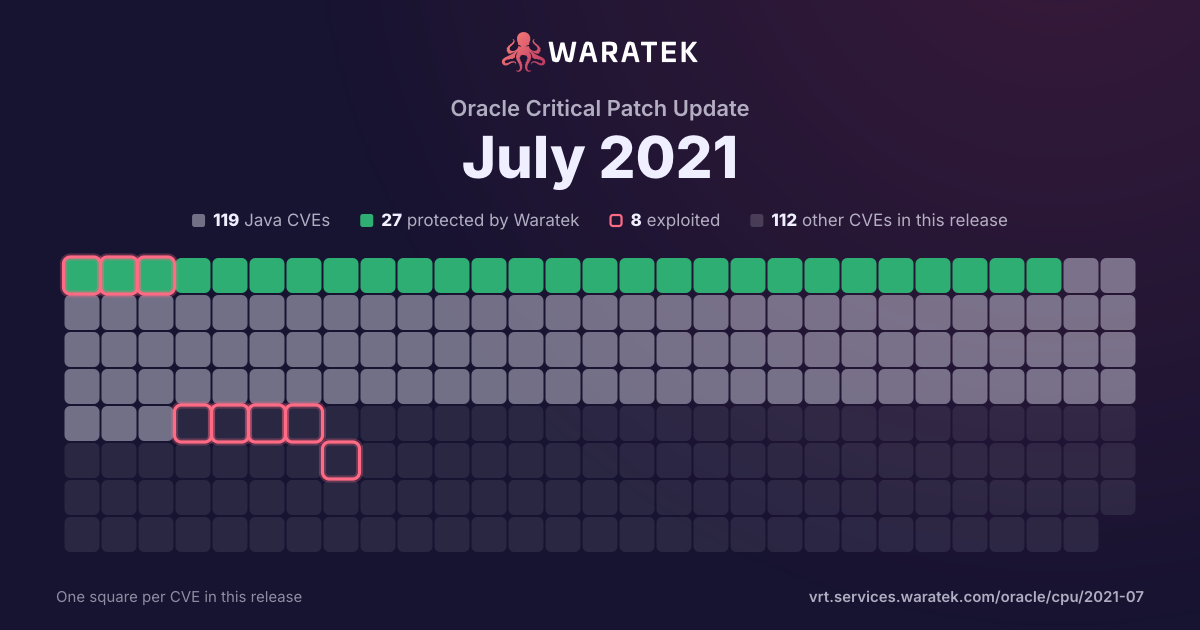
By status
27Protected by Waratek2Mitigation candidate90No exploit published33Outside Waratek scope79Not applicable
8Exploited, marked by the ring
No exploit published. For 70 of them, Oracle's security advisory is the source of public detail.
Protected by Waratek. Waratek RASP can block exploitation of these on systems that have not applied the patch yet.
Overview 108 matches · 20 protected · 0 exploited · 0 CISA KEV · 0 public PoC · 0 EPSS ≥ 0.5
Protected by Waratek
20
18.5%
Rule in development
0
0.0%
Mitigation candidate
0
0.0%
No exploit published
88
81.5%
blocked by ARMR today
20
18.5%
partly blocked
0
0.0%
not blocked
88
81.5%
not established
0
0.0%
unrecorded
0
0.0%
Exploited
0
0.0%
Working exploit published
0
0.0%
Proof of concept only
0
0.0%
Forecast only
0
0.0%
No public exploit
108
100.0%
split by
peak 63 / quarter
Q2 171
No exploit published1
High1
not blocked1
No public exploit1
Q3 171
Protected by Waratek1
Medium1
blocked by ARMR today1
No public exploit1
Q4 171
No exploit published1
High1
not blocked1
No public exploit1
Q1 180
Q2 180
Q3 180
Q4 180
Q1 190
Q2 191
Protected by Waratek1
Critical1
blocked by ARMR today1
No public exploit1
Q3 192
Protected by Waratek1
No exploit published1
High2
blocked by ARMR today1
not blocked1
No public exploit2
Q4 192
Protected by Waratek1
No exploit published1
Medium2
blocked by ARMR today1
not blocked1
No public exploit2
Q1 203
Protected by Waratek1
No exploit published2
Critical1
High2
blocked by ARMR today1
not blocked2
No public exploit3
Q2 202
Protected by Waratek2
Critical1
High1
blocked by ARMR today2
No public exploit2
Q3 206
Protected by Waratek3
No exploit published3
Critical2
High2
Medium2
blocked by ARMR today3
not blocked3
No public exploit6
Q4 2012
Protected by Waratek4
No exploit published8
High9
Medium2
Low1
blocked by ARMR today4
not blocked8
No public exploit12
Q1 2112
Protected by Waratek3
No exploit published9
High5
Medium7
blocked by ARMR today3
not blocked9
No public exploit12
Q2 212
Protected by Waratek1
No exploit published1
Critical1
High1
blocked by ARMR today1
not blocked1
No public exploit2
Q3 2163
Protected by Waratek2
No exploit published61
Critical4
High30
Medium26
Low3
blocked by ARMR today2
not blocked61
No public exploit63
Q3 17Q1 18Q3 18Q1 19Q3 19Q1 20Q3 20Q1 21Q3 21
| CVE | Severity | Published▾ | Status | Exploitation | Description |
|---|---|---|---|---|---|
| CVE-2019-12415 | Medium | 2019-10-23 | Protected by Waratek | No public exploit | In Apache POI up to 4.1.0, when using the tool XSSFExportToXml to convert user-provided Microsoft Excel documents, a specially crafted document can allow an attacker to read files from the local filesystem or from internal network resources via XML External Entity (XXE) Processing. |
| CVE-2019-2897 | Medium | 2019-10-16 | No exploit published | No public exploit | Vulnerability in the Oracle Business Intelligence Enterprise Edition product of Oracle Fusion Middleware (component: Analytics Actions). Supported versions that are affected are 12.2.1.3.0 and 12.2.1.4.0. Easily exploitable vulnerability allows low privileged attacker with network access via HTTP to compromise Oracle Business Intelligence Enterprise Edition. While the vulnerability is in Oracle Business Intelligence Enterprise Edition, attacks may significantly impact additional products. Successful attacks of this vulnerability can result in unauthorized update, insert or delete access to some of Oracle Business Intelligence Enterprise Edition accessible data as well as unauthorized read access to a subset of Oracle Business Intelligence Enterprise Edition accessible data. CVSS 3.0 Base Score 6.4 (Confidentiality and Integrity impacts). CVSS Vector: (CVSS:3.0/AV:N/AC:L/PR:L/UI:N/S:C/C:L/I:L/A:N). |
| CVE-2019-12402 | High | 2019-08-30 | No exploit published | No public exploit | The file name encoding algorithm used internally in Apache Commons Compress 1.15 to 1.18 can get into an infinite loop when faced with specially crafted inputs. This can lead to a denial of service attack if an attacker can choose the file names inside of an archive created by Compress. |
| CVE-2019-10086 | High | 2019-08-20 | Protected by Waratek | No public exploit | In Apache Commons Beanutils 1.9.2, a special BeanIntrospector class was added which allows suppressing the ability for an attacker to access the classloader via the class property available on all Java objects. We, however were not using this by default characteristic of the PropertyUtilsBean. |
| CVE-2019-0228 | Critical | 2019-04-17 | Protected by Waratek | No public exploit | Apache PDFBox 2.0.14 does not properly initialize the XML parser, which allows context-dependent attackers to conduct XML External Entity (XXE) attacks via a crafted XFDF. |
| CVE-2012-0881 | High | 2017-10-30 | No exploit published | No public exploit | Apache Xerces2 Java Parser before 2.12.0 allows remote attackers to cause a denial of service (CPU consumption) via a crafted message to an XML service, which triggers hash table collisions. |
| CVE-2017-14735 | Medium | 2017-09-25 | Protected by Waratek | No public exploit | OWASP AntiSamy before 1.5.7 allows XSS via HTML5 entities, as demonstrated by use of : to construct a javascript: URL. |
| CVE-2017-9735 | High | 2017-06-16 | No exploit published | No public exploit | Jetty through 9.4.x is prone to a timing channel in util/security/Password.java, which makes it easier for remote attackers to obtain access by observing elapsed times before rejection of incorrect passwords. |