
Oracle Critical Patch Update July 2021
Released July 2021 · Oracle's advisory ↗ · ← Critical Patch Update, April 2021 · Critical Patch Update, October 2021 →
231 CVEs in this release, one square each
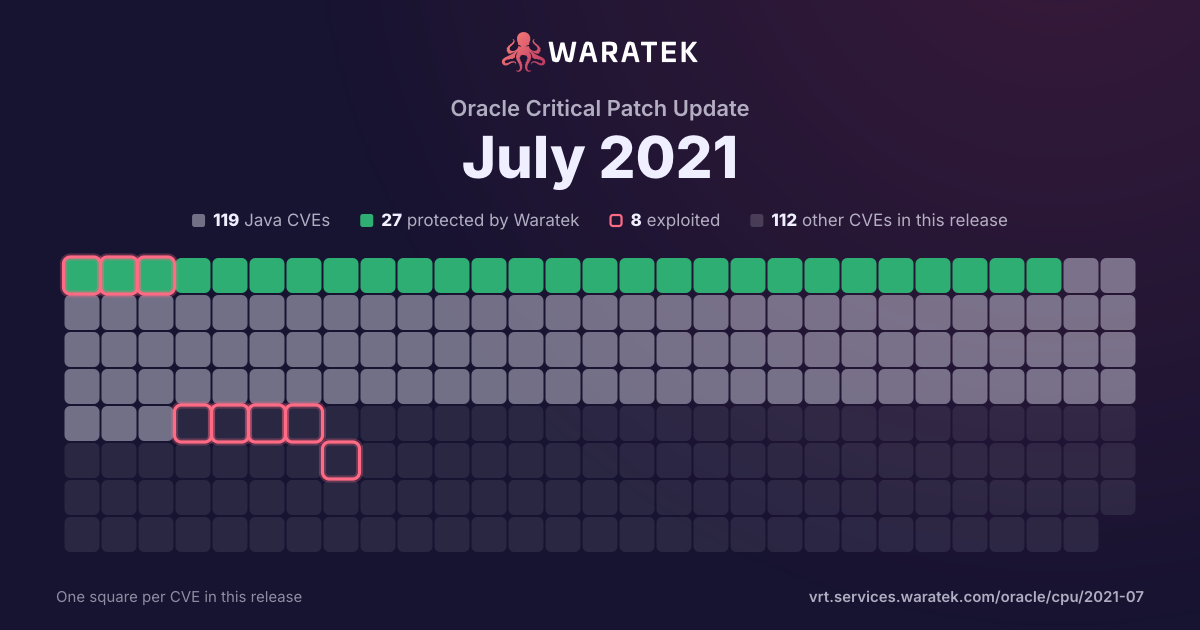
By status
27Protected by Waratek2Mitigation candidate90No exploit published33Outside Waratek scope79Not applicable
8Exploited, marked by the ring
No exploit published. For 70 of them, Oracle's security advisory is the source of public detail.
Protected by Waratek. Waratek RASP can block exploitation of these on systems that have not applied the patch yet.
Overview 13 matches · 4 protected · 0 exploited · 0 CISA KEV · 1 public PoC · 1 EPSS ≥ 0.5
Protected by Waratek
4
30.8%
Rule in development
0
0.0%
Mitigation candidate
0
0.0%
No exploit published
9
69.2%
blocked by ARMR today
4
30.8%
partly blocked
0
0.0%
not blocked
9
69.2%
not established
0
0.0%
unrecorded
0
0.0%
Exploited
0
0.0%
Working exploit published
1
7.7%
Proof of concept only
0
0.0%
Forecast only
0
0.0%
No public exploit
12
92.3%
split by
peak 5 / month
Jan 213
No exploit published3
High2
Medium1
not blocked3
No public exploit3
Feb 215
Protected by Waratek2
No exploit published3
High2
Medium3
blocked by ARMR today2
not blocked3
No public exploit5
Mar 215
Protected by Waratek2
No exploit published3
Critical1
High1
Medium3
blocked by ARMR today2
not blocked3
Working exploit published1
No public exploit4
Jan 21Feb 21Mar 21
| CVE | Severity | Published▾ | Status | Exploitation | Description |
|---|---|---|---|---|---|
| CVE-2021-21409 | Medium | 2021-03-30 | No exploit published | No public exploit | Netty is an open-source, asynchronous event-driven network application framework for rapid development of maintainable high performance protocol servers & clients. In Netty (io.netty:netty-codec-http2) before version 4.1.61.Final there is a vulnerability that enables request smuggling. The content-length header is not correctly validated if the request only uses a single Http2HeaderFrame with the endStream set to to true. This could lead to request smuggling if the request is proxied to a remote peer and translated to HTTP/1.1. This is a followup of GHSA-wm47-8v5p-wjpj/CVE-2021-21295 which did miss to fix this one case. This was fixed as part of 4.1.61.Final. |
| CVE-2021-21345 | Critical | 2021-03-23 | Protected by Waratek | Working exploit published | XStream is a Java library to serialize objects to XML and back again. In XStream before version 1.4.16, there is a vulnerability which may allow a remote attacker who has sufficient rights to execute commands of the host only by manipulating the processed input stream. No user is affected, who followed the recommendation to setup XStream's security framework with a whitelist limited to the minimal required types. If you rely on XStream's default blacklist of the Security Framework, you will have to use at least version 1.4.16. |
| CVE-2021-27906 | Medium | 2021-03-19 | No exploit published | No public exploit | A carefully crafted PDF file can trigger an OutOfMemory-Exception while loading the file. This issue affects Apache PDFBox version 2.0.22 and prior 2.0.x versions. |
| CVE-2021-27807 | Medium | 2021-03-19 | No exploit published | No public exploit | A carefully crafted PDF file can trigger an infinite loop while loading the file. This issue affects Apache PDFBox version 2.0.22 and prior 2.0.x versions. |
| CVE-2021-25122 | High | 2021-03-01 | Protected by Waratek | No public exploit | When responding to new h2c connection requests, Apache Tomcat versions 10.0.0-M1 to 10.0.0, 9.0.0.M1 to 9.0.41 and 8.5.0 to 8.5.61 could duplicate request headers and a limited amount of request body from one request to another meaning user A and user B could both see the results of user A's request. |
| CVE-2020-11987 | High | 2021-02-24 | No exploit published | No public exploit | Apache Batik 1.13 is vulnerable to server-side request forgery, caused by improper input validation by the NodePickerPanel. By using a specially-crafted argument, an attacker could exploit this vulnerability to cause the underlying server to make arbitrary GET requests. |
| CVE-2021-27568 | Medium | 2021-02-23 | Protected by Waratek | No public exploit | An issue was discovered in netplex json-smart-v1 through 2015-10-23 and json-smart-v2 through 2.4. An exception is thrown from a function, but it is not caught, as demonstrated by NumberFormatException. When it is not caught, it may cause programs using the library to crash or expose sensitive information. |
| CVE-2021-22112 | High | 2021-02-23 | No exploit published | No public exploit | Spring Security 5.4.x prior to 5.4.4, 5.3.x prior to 5.3.8.RELEASE, 5.2.x prior to 5.2.9.RELEASE, and older unsupported versions can fail to save the SecurityContext if it is changed more than once in a single request.A malicious user cannot cause the bug to happen (it must be programmed in). However, if the application's intent is to only allow the user to run with elevated privileges in a small portion of the application, the bug can be leveraged to extend those privileges to the rest of the application. |
| CVE-2021-21290 | Medium | 2021-02-08 | Protected by Waratek | No public exploit | Netty is an open-source, asynchronous event-driven network application framework for rapid development of maintainable high performance protocol servers & clients. In Netty before version 4.1.59.Final there is a vulnerability on Unix-like systems involving an insecure temp file. When netty's multipart decoders are used local information disclosure can occur via the local system temporary directory if temporary storing uploads on the disk is enabled. On unix-like systems, the temporary directory is shared between all user. As such, writing to this directory using APIs that do not explicitly set the file/directory permissions can lead to information disclosure. Of note, this does not impact modern MacOS Operating Systems. The method "File.createTempFile" on unix-like systems creates a random file, but, by default will create this file with the permissions "-rw-r--r--". Thus, if sensitive information is written to this file, other local users can read this information. This is the case in netty's "AbstractDiskHttpData" is vulnerable. This has been fixed in version 4.1.59.Final. As a workaround, one may specify your own "java.io.tmpdir" when you start the JVM or use "DefaultHttpDataFactory.setBaseDir(...)" to set the directory to something that is only readable by the current user. |
| CVE-2020-29582 | Medium | 2021-02-03 | No exploit published | No public exploit | In JetBrains Kotlin before 1.4.21, a vulnerable Java API was used for temporary file and folder creation. An attacker was able to read data from such files and list directories due to insecure permissions. |
| CVE-2021-26117 | High | 2021-01-27 | No exploit published | No public exploit | The optional ActiveMQ LDAP login module can be configured to use anonymous access to the LDAP server. In this case, for Apache ActiveMQ Artemis prior to version 2.16.0 and Apache ActiveMQ prior to versions 5.16.1 and 5.15.14, the anonymous context is used to verify a valid users password in error, resulting in no check on the password. |
| CVE-2021-20190 | High | 2021-01-19 | No exploit published | No public exploit | A flaw was found in jackson-databind before 2.9.10.7. FasterXML mishandles the interaction between serialization gadgets and typing. The highest threat from this vulnerability is to data confidentiality and integrity as well as system availability. |
| CVE-2021-24122 | Medium | 2021-01-14 | No exploit published | No public exploit | When serving resources from a network location using the NTFS file system, Apache Tomcat versions 10.0.0-M1 to 10.0.0-M9, 9.0.0.M1 to 9.0.39, 8.5.0 to 8.5.59 and 7.0.0 to 7.0.106 were susceptible to JSP source code disclosure in some configurations. The root cause was the unexpected behaviour of the JRE API File.getCanonicalPath() which in turn was caused by the inconsistent behaviour of the Windows API (FindFirstFileW) in some circumstances. |