
Oracle Critical Patch Update April 2020
Released April 2020 · Oracle's advisory ↗ · ← Critical Patch Update, January 2020 · Critical Patch Update, July 2020 →
300 CVEs in this release, one square each
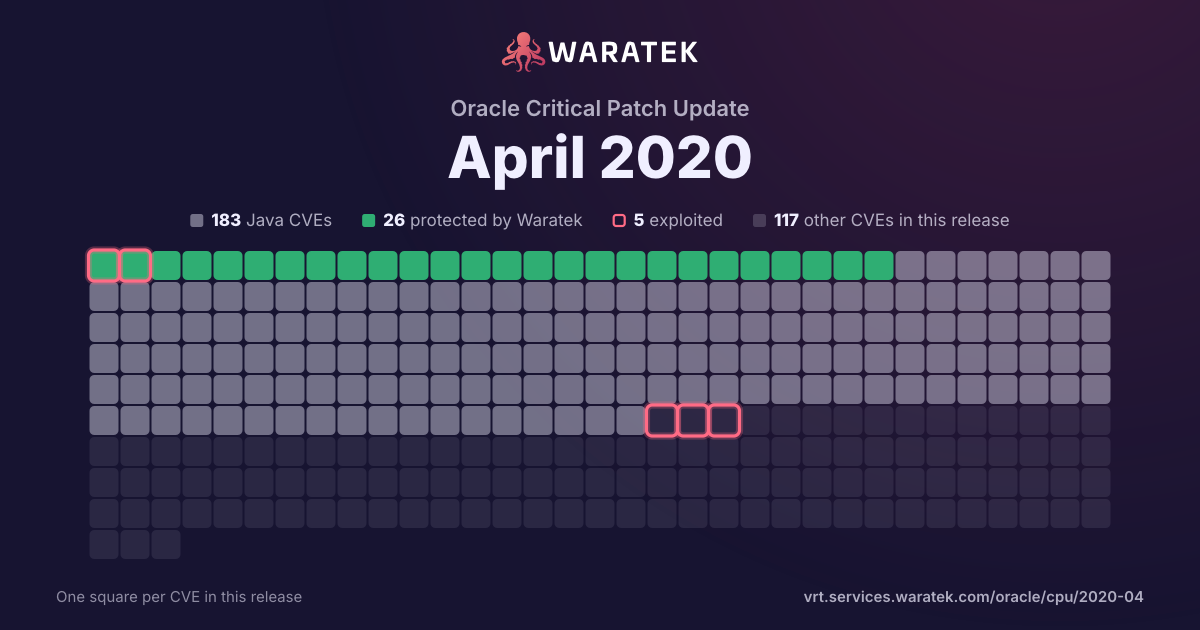
By status
26Protected by Waratek1Mitigation candidate156No exploit published60Outside Waratek scope56Not applicable1Withdrawn CVE
5Exploited, marked by the ring
No exploit published. For 141 of them, Oracle's security advisory is the source of public detail.
Protected by Waratek. Waratek RASP can block exploitation of these on systems that have not applied the patch yet.
Overview 31 matches · 0 in Waratek scope · 0 protected · 0 exploited · 0 CISA KEV · 1 public PoC · 0 EPSS ≥ 0.5
31matches
0in Waratek scope0.0%
0protected0.0%
0exploited0.0%
0CISA KEV0.0%
1public PoC3.2%
0EPSS ≥ 0.50.0%
Protected by Waratek
0
0.0%
Rule in development
0
0.0%
Mitigation candidate
0
0.0%
No exploit published
0
0.0%
Outside Waratek scope
0
0.0%
Not applicable
31
100.0%
Withdrawn CVE
0
0.0%
blocked by ARMR today
0
0.0%
partly blocked
0
0.0%
not blocked
31
100.0%
not established
0
0.0%
unrecorded
0
0.0%
Exploited
0
0.0%
Working exploit published
1
3.2%
Proof of concept only
0
0.0%
Forecast only
0
0.0%
No public exploit
30
96.8%
split by
peak 20 / quarter
Q1 171
Not applicable1
High1
not blocked1
No public exploit1
Q2 170
Q3 170
Q4 170
Q1 183
Not applicable3
High3
not blocked3
No public exploit3
Q2 180
Q3 180
Q4 180
Q1 191
Not applicable1
High1
not blocked1
No public exploit1
Q2 191
Not applicable1
High1
not blocked1
No public exploit1
Q3 192
Not applicable2
High2
not blocked2
No public exploit2
Q4 193
Not applicable3
High3
not blocked3
No public exploit3
Q1 200
Q2 2020
Not applicable20
High20
not blocked20
Working exploit published1
No public exploit19
Q2 17Q4 17Q2 18Q4 18Q2 19Q4 19Q2 20
| CVE | Severity | Published▾ | Status | Exploitation | Description |
|---|---|---|---|---|---|
| CVE-2020-2575 | High | 2020-04-29 | Not applicable | No public exploit | Vulnerability in the Oracle VM VirtualBox product of Oracle Virtualization (component: Core). Supported versions that are affected are Prior to 5.2.40, prior to 6.0.20 and prior to 6.1.6. Difficult to exploit vulnerability allows high privileged attacker with logon to the infrastructure where Oracle VM VirtualBox executes to compromise Oracle VM VirtualBox. While the vulnerability is in Oracle VM VirtualBox, attacks may significantly impact additional products. Successful attacks of this vulnerability can result in takeover of Oracle VM VirtualBox. CVSS 3.0 Base Score 7.5 (Confidentiality, Integrity and Availability impacts). CVSS Vector: (CVSS:3.0/AV:L/AC:H/PR:H/UI:N/S:C/C:H/I:H/A:H). |
| CVE-2020-2959 | High | 2020-04-15 | Not applicable | No public exploit | Vulnerability in the Oracle VM VirtualBox product of Oracle Virtualization (component: Core). Supported versions that are affected are Prior to 5.2.40, prior to 6.0.20 and prior to 6.1.6. Easily exploitable vulnerability allows unauthenticated attacker with network access via MLD to compromise Oracle VM VirtualBox. While the vulnerability is in Oracle VM VirtualBox, attacks may significantly impact additional products. Successful attacks of this vulnerability can result in unauthorized ability to cause a hang or frequently repeatable crash (complete DOS) of Oracle VM VirtualBox. CVSS 3.0 Base Score 8.6 (Availability impacts). CVSS Vector: (CVSS:3.0/AV:N/AC:L/PR:N/UI:N/S:C/C:N/I:N/A:H). |
| CVE-2020-2958 | High | 2020-04-15 | Not applicable | No public exploit | Vulnerability in the Oracle VM VirtualBox product of Oracle Virtualization (component: Core). Supported versions that are affected are Prior to 5.2.40, prior to 6.0.20 and prior to 6.1.6. Difficult to exploit vulnerability allows high privileged attacker with logon to the infrastructure where Oracle VM VirtualBox executes to compromise Oracle VM VirtualBox. While the vulnerability is in Oracle VM VirtualBox, attacks may significantly impact additional products. Successful attacks of this vulnerability can result in takeover of Oracle VM VirtualBox. CVSS 3.0 Base Score 7.5 (Confidentiality, Integrity and Availability impacts). CVSS Vector: (CVSS:3.0/AV:L/AC:H/PR:H/UI:N/S:C/C:H/I:H/A:H). |
| CVE-2020-2944 | High | 2020-04-15 | Not applicable | Working exploit published | Vulnerability in the Oracle Solaris product of Oracle Systems (component: Common Desktop Environment). Supported versions that are affected are 10 and 11. Easily exploitable vulnerability allows low privileged attacker with logon to the infrastructure where Oracle Solaris executes to compromise Oracle Solaris. While the vulnerability is in Oracle Solaris, attacks may significantly impact additional products. Successful attacks of this vulnerability can result in takeover of Oracle Solaris. CVSS 3.0 Base Score 8.8 (Confidentiality, Integrity and Availability impacts). CVSS Vector: (CVSS:3.0/AV:L/AC:L/PR:L/UI:N/S:C/C:H/I:H/A:H). |
| CVE-2020-2929 | High | 2020-04-15 | Not applicable | No public exploit | Vulnerability in the Oracle VM VirtualBox product of Oracle Virtualization (component: Core). Supported versions that are affected are Prior to 5.2.40, prior to 6.0.20 and prior to 6.1.6. Easily exploitable vulnerability allows low privileged attacker with logon to the infrastructure where Oracle VM VirtualBox executes to compromise Oracle VM VirtualBox. Successful attacks of this vulnerability can result in takeover of Oracle VM VirtualBox. CVSS 3.0 Base Score 7.8 (Confidentiality, Integrity and Availability impacts). CVSS Vector: (CVSS:3.0/AV:L/AC:L/PR:L/UI:N/S:U/C:H/I:H/A:H). |
| CVE-2020-2927 | High | 2020-04-15 | Not applicable | No public exploit | Vulnerability in the Oracle Solaris product of Oracle Systems (component: Common Desktop Environment). Supported versions that are affected are 10 and 11. Difficult to exploit vulnerability allows low privileged attacker with logon to the infrastructure where Oracle Solaris executes to compromise Oracle Solaris. While the vulnerability is in Oracle Solaris, attacks may significantly impact additional products. Successful attacks of this vulnerability can result in takeover of Oracle Solaris. CVSS 3.0 Base Score 7.8 (Confidentiality, Integrity and Availability impacts). CVSS Vector: (CVSS:3.0/AV:L/AC:H/PR:L/UI:N/S:C/C:H/I:H/A:H). |
| CVE-2020-2914 | High | 2020-04-15 | Not applicable | No public exploit | Vulnerability in the Oracle VM VirtualBox product of Oracle Virtualization (component: Core). Supported versions that are affected are Prior to 6.0.20 and prior to 6.1.6. Difficult to exploit vulnerability allows low privileged attacker with logon to the infrastructure where Oracle VM VirtualBox executes to compromise Oracle VM VirtualBox. Successful attacks of this vulnerability can result in takeover of Oracle VM VirtualBox. CVSS 3.0 Base Score 7.0 (Confidentiality, Integrity and Availability impacts). CVSS Vector: (CVSS:3.0/AV:L/AC:H/PR:L/UI:N/S:U/C:H/I:H/A:H). |
| CVE-2020-2913 | High | 2020-04-15 | Not applicable | No public exploit | Vulnerability in the Oracle VM VirtualBox product of Oracle Virtualization (component: Core). Supported versions that are affected are Prior to 6.0.20 and prior to 6.1.6. Difficult to exploit vulnerability allows low privileged attacker with logon to the infrastructure where Oracle VM VirtualBox executes to compromise Oracle VM VirtualBox. Successful attacks of this vulnerability can result in takeover of Oracle VM VirtualBox. CVSS 3.0 Base Score 7.0 (Confidentiality, Integrity and Availability impacts). CVSS Vector: (CVSS:3.0/AV:L/AC:H/PR:L/UI:N/S:U/C:H/I:H/A:H). |
| CVE-2020-2911 | High | 2020-04-15 | Not applicable | No public exploit | Vulnerability in the Oracle VM VirtualBox product of Oracle Virtualization (component: Core). Supported versions that are affected are Prior to 5.2.40, prior to 6.0.20 and prior to 6.1.6. Difficult to exploit vulnerability allows high privileged attacker with logon to the infrastructure where Oracle VM VirtualBox executes to compromise Oracle VM VirtualBox. While the vulnerability is in Oracle VM VirtualBox, attacks may significantly impact additional products. Successful attacks of this vulnerability can result in takeover of Oracle VM VirtualBox. CVSS 3.0 Base Score 7.5 (Confidentiality, Integrity and Availability impacts). CVSS Vector: (CVSS:3.0/AV:L/AC:H/PR:H/UI:N/S:C/C:H/I:H/A:H). |
| CVE-2020-2908 | High | 2020-04-15 | Not applicable | No public exploit | Vulnerability in the Oracle VM VirtualBox product of Oracle Virtualization (component: Core). Supported versions that are affected are Prior to 5.2.40, prior to 6.0.20 and prior to 6.1.6. Easily exploitable vulnerability allows high privileged attacker with logon to the infrastructure where Oracle VM VirtualBox executes to compromise Oracle VM VirtualBox. While the vulnerability is in Oracle VM VirtualBox, attacks may significantly impact additional products. Successful attacks of this vulnerability can result in takeover of Oracle VM VirtualBox. CVSS 3.0 Base Score 8.2 (Confidentiality, Integrity and Availability impacts). CVSS Vector: (CVSS:3.0/AV:L/AC:L/PR:H/UI:N/S:C/C:H/I:H/A:H). |
| CVE-2020-2907 | High | 2020-04-15 | Not applicable | No public exploit | Vulnerability in the Oracle VM VirtualBox product of Oracle Virtualization (component: Core). Supported versions that are affected are Prior to 5.2.40, prior to 6.0.20 and prior to 6.1.6. Difficult to exploit vulnerability allows high privileged attacker with logon to the infrastructure where Oracle VM VirtualBox executes to compromise Oracle VM VirtualBox. While the vulnerability is in Oracle VM VirtualBox, attacks may significantly impact additional products. Successful attacks of this vulnerability can result in takeover of Oracle VM VirtualBox. CVSS 3.0 Base Score 7.5 (Confidentiality, Integrity and Availability impacts). CVSS Vector: (CVSS:3.0/AV:L/AC:H/PR:H/UI:N/S:C/C:H/I:H/A:H). |
| CVE-2020-2905 | High | 2020-04-15 | Not applicable | No public exploit | Vulnerability in the Oracle VM VirtualBox product of Oracle Virtualization (component: Core). Supported versions that are affected are Prior to 5.2.40, prior to 6.0.20 and prior to 6.1.6. Easily exploitable vulnerability allows high privileged attacker with logon to the infrastructure where Oracle VM VirtualBox executes to compromise Oracle VM VirtualBox. While the vulnerability is in Oracle VM VirtualBox, attacks may significantly impact additional products. Successful attacks of this vulnerability can result in takeover of Oracle VM VirtualBox. CVSS 3.0 Base Score 8.2 (Confidentiality, Integrity and Availability impacts). CVSS Vector: (CVSS:3.0/AV:L/AC:L/PR:H/UI:N/S:C/C:H/I:H/A:H). |
| CVE-2020-2902 | High | 2020-04-15 | Not applicable | No public exploit | Vulnerability in the Oracle VM VirtualBox product of Oracle Virtualization (component: Core). Supported versions that are affected are Prior to 5.2.40, prior to 6.0.20 and prior to 6.1.6. Easily exploitable vulnerability allows low privileged attacker with logon to the infrastructure where Oracle VM VirtualBox executes to compromise Oracle VM VirtualBox. While the vulnerability is in Oracle VM VirtualBox, attacks may significantly impact additional products. Successful attacks of this vulnerability can result in takeover of Oracle VM VirtualBox. CVSS 3.0 Base Score 8.8 (Confidentiality, Integrity and Availability impacts). CVSS Vector: (CVSS:3.0/AV:L/AC:L/PR:L/UI:N/S:C/C:H/I:H/A:H). |
| CVE-2020-2851 | High | 2020-04-15 | Not applicable | No public exploit | Vulnerability in the Oracle Solaris product of Oracle Systems (component: Common Desktop Environment). Supported versions that are affected are 10 and 11. Difficult to exploit vulnerability allows low privileged attacker with logon to the infrastructure where Oracle Solaris executes to compromise Oracle Solaris. While the vulnerability is in Oracle Solaris, attacks may significantly impact additional products. Successful attacks of this vulnerability can result in takeover of Oracle Solaris. CVSS 3.0 Base Score 7.8 (Confidentiality, Integrity and Availability impacts). CVSS Vector: (CVSS:3.0/AV:L/AC:H/PR:L/UI:N/S:C/C:H/I:H/A:H). |
| CVE-2020-2787 | High | 2020-04-15 | Not applicable | No public exploit | Vulnerability in the Oracle Outside In Technology product of Oracle Fusion Middleware (component: Outside In Filters). Supported versions that is affected is 8.5.4. Easily exploitable vulnerability allows unauthenticated attacker with network access via HTTP to compromise Oracle Outside In Technology. Successful attacks of this vulnerability can result in unauthorized update, insert or delete access to some of Oracle Outside In Technology accessible data as well as unauthorized read access to a subset of Oracle Outside In Technology accessible data and unauthorized ability to cause a partial denial of service (partial DOS) of Oracle Outside In Technology. Note: Outside In Technology is a suite of software development kits (SDKs). The protocol and CVSS score depend on the software that uses the Outside In Technology code. The CVSS score assumes that the software passes data received over a network directly to Outside In Technology code, but if data is not received over a network the CVSS score may be lower. CVSS 3.0 Base Score 7.3 (Confidentiality, Integrity and Availability impacts). CVSS Vector: (CVSS:3.0/AV:N/AC:L/PR:N/UI:N/S:U/C:L/I:L/A:L). |
| CVE-2020-2786 | High | 2020-04-15 | Not applicable | No public exploit | Vulnerability in the Oracle Outside In Technology product of Oracle Fusion Middleware (component: Outside In Filters). Supported versions that is affected is 8.5.4. Easily exploitable vulnerability allows unauthenticated attacker with network access via HTTP to compromise Oracle Outside In Technology. Successful attacks of this vulnerability can result in unauthorized update, insert or delete access to some of Oracle Outside In Technology accessible data as well as unauthorized read access to a subset of Oracle Outside In Technology accessible data and unauthorized ability to cause a partial denial of service (partial DOS) of Oracle Outside In Technology. Note: Outside In Technology is a suite of software development kits (SDKs). The protocol and CVSS score depend on the software that uses the Outside In Technology code. The CVSS score assumes that the software passes data received over a network directly to Outside In Technology code, but if data is not received over a network the CVSS score may be lower. CVSS 3.0 Base Score 7.3 (Confidentiality, Integrity and Availability impacts). CVSS Vector: (CVSS:3.0/AV:N/AC:L/PR:N/UI:N/S:U/C:L/I:L/A:L). |
| CVE-2020-2785 | High | 2020-04-15 | Not applicable | No public exploit | Vulnerability in the Oracle Outside In Technology product of Oracle Fusion Middleware (component: Outside In Filters). Supported versions that is affected is 8.5.4. Easily exploitable vulnerability allows unauthenticated attacker with network access via HTTP to compromise Oracle Outside In Technology. Successful attacks of this vulnerability can result in unauthorized update, insert or delete access to some of Oracle Outside In Technology accessible data as well as unauthorized read access to a subset of Oracle Outside In Technology accessible data and unauthorized ability to cause a partial denial of service (partial DOS) of Oracle Outside In Technology. Note: Outside In Technology is a suite of software development kits (SDKs). The protocol and CVSS score depend on the software that uses the Outside In Technology code. The CVSS score assumes that the software passes data received over a network directly to Outside In Technology code, but if data is not received over a network the CVSS score may be lower. CVSS 3.0 Base Score 7.3 (Confidentiality, Integrity and Availability impacts). CVSS Vector: (CVSS:3.0/AV:N/AC:L/PR:N/UI:N/S:U/C:L/I:L/A:L). |
| CVE-2020-2784 | High | 2020-04-15 | Not applicable | No public exploit | Vulnerability in the Oracle Outside In Technology product of Oracle Fusion Middleware (component: Outside In Filters). The supported version that is affected is 8.5.4. Easily exploitable vulnerability allows unauthenticated attacker with network access via HTTP to compromise Oracle Outside In Technology. Successful attacks of this vulnerability can result in unauthorized update, insert or delete access to some of Oracle Outside In Technology accessible data as well as unauthorized read access to a subset of Oracle Outside In Technology accessible data and unauthorized ability to cause a partial denial of service (partial DOS) of Oracle Outside In Technology. Note: Outside In Technology is a suite of software development kits (SDKs). The protocol and CVSS score depend on the software that uses the Outside In Technology code. The CVSS score assumes that the software passes data received over a network directly to Outside In Technology code, but if data is not received over a network the CVSS score may be lower. CVSS 3.0 Base Score 7.3 (Confidentiality, Integrity and Availability impacts). CVSS Vector: (CVSS:3.0/AV:N/AC:L/PR:N/UI:N/S:U/C:L/I:L/A:L). |
| CVE-2020-2758 | High | 2020-04-15 | Not applicable | No public exploit | Vulnerability in the Oracle VM VirtualBox product of Oracle Virtualization (component: Core). Supported versions that are affected are Prior to 5.2.40, prior to 6.0.20 and prior to 6.1.6. Easily exploitable vulnerability allows high privileged attacker with logon to the infrastructure where Oracle VM VirtualBox executes to compromise Oracle VM VirtualBox. While the vulnerability is in Oracle VM VirtualBox, attacks may significantly impact additional products. Successful attacks of this vulnerability can result in takeover of Oracle VM VirtualBox. CVSS 3.0 Base Score 8.2 (Confidentiality, Integrity and Availability impacts). CVSS Vector: (CVSS:3.0/AV:L/AC:L/PR:H/UI:N/S:C/C:H/I:H/A:H). |
| CVE-2020-2742 | High | 2020-04-15 | Not applicable | No public exploit | Vulnerability in the Oracle VM VirtualBox product of Oracle Virtualization (component: Core). Supported versions that are affected are Prior to 5.2.36, prior to 6.0.16 and prior to 6.1.2. Easily exploitable vulnerability allows high privileged attacker with logon to the infrastructure where Oracle VM VirtualBox executes to compromise Oracle VM VirtualBox. While the vulnerability is in Oracle VM VirtualBox, attacks may significantly impact additional products. Successful attacks of this vulnerability can result in takeover of Oracle VM VirtualBox. CVSS 3.0 Base Score 8.2 (Confidentiality, Integrity and Availability impacts). CVSS Vector: (CVSS:3.0/AV:L/AC:L/PR:H/UI:N/S:C/C:H/I:H/A:H). |
| CVE-2019-14889 | High | 2019-12-10 | Not applicable | No public exploit | A flaw was found with the libssh API function ssh_scp_new() in versions before 0.9.3 and before 0.8.8. When the libssh SCP client connects to a server, the scp command, which includes a user-provided path, is executed on the server-side. In case the library is used in a way where users can influence the third parameter of the function, it would become possible for an attacker to inject arbitrary commands, leading to a compromise of the remote target. |
| CVE-2019-18197 | High | 2019-10-18 | Not applicable | No public exploit | In xsltCopyText in transform.c in libxslt 1.1.33, a pointer variable isn't reset under certain circumstances. If the relevant memory area happened to be freed and reused in a certain way, a bounds check could fail and memory outside a buffer could be written to, or uninitialized data could be disclosed. |
| CVE-2019-15163 | High | 2019-10-03 | Not applicable | No public exploit | rpcapd/daemon.c in libpcap before 1.9.1 allows attackers to cause a denial of service (NULL pointer dereference and daemon crash) if a crypt() call fails. |
| CVE-2019-15903 | High | 2019-09-04 | Not applicable | No public exploit | In libexpat before 2.2.8, crafted XML input could fool the parser into changing from DTD parsing to document parsing too early; a consecutive call to XML_GetCurrentLineNumber (or XML_GetCurrentColumnNumber) then resulted in a heap-based buffer over-read. |
| CVE-2019-2853 | High | 2019-07-23 | Not applicable | No public exploit | Vulnerability in the Oracle Outside In Technology component of Oracle Fusion Middleware (subcomponent: Outside In Filters). The supported version that is affected is 8.5.4. Easily exploitable vulnerability allows unauthenticated attacker with network access via HTTP to compromise Oracle Outside In Technology. Successful attacks of this vulnerability can result in unauthorized update, insert or delete access to some of Oracle Outside In Technology accessible data as well as unauthorized read access to a subset of Oracle Outside In Technology accessible data and unauthorized ability to cause a partial denial of service (partial DOS) of Oracle Outside In Technology. Note: Outside In Technology is a suite of software development kits (SDKs). The protocol and CVSS score depend on the software that uses the Outside In Technology code. The CVSS score assumes that the software passes data received over a network directly to Outside In Technology code, but if data is not received over a network the CVSS score may be lower. CVSS 3.0 Base Score 7.3 (Confidentiality, Integrity and Availability impacts). CVSS Vector: (CVSS:3.0/AV:N/AC:L/PR:N/UI:N/S:U/C:L/I:L/A:L). |
| CVE-2018-20843 | High | 2019-06-24 | Not applicable | No public exploit | In libexpat in Expat before 2.2.7, XML input including XML names that contain a large number of colons could make the XML parser consume a high amount of RAM and CPU resources while processing (enough to be usable for denial-of-service attacks). |
| CVE-2019-1543 | High | 2019-03-06 | Not applicable | No public exploit | ChaCha20-Poly1305 is an AEAD cipher, and requires a unique nonce input for every encryption operation. RFC 7539 specifies that the nonce value (IV) should be 96 bits (12 bytes). OpenSSL allows a variable nonce length and front pads the nonce with 0 bytes if it is less than 12 bytes. However it also incorrectly allows a nonce to be set of up to 16 bytes. In this case only the last 12 bytes are significant and any additional leading bytes are ignored. It is a requirement of using this cipher that nonce values are unique. Messages encrypted using a reused nonce value are susceptible to serious confidentiality and integrity attacks. If an application changes the default nonce length to be longer than 12 bytes and then makes a change to the leading bytes of the nonce expecting the new value to be a new unique nonce then such an application could inadvertently encrypt messages with a reused nonce. Additionally the ignored bytes in a long nonce are not covered by the integrity guarantee of this cipher. Any application that relies on the integrity of these ignored leading bytes of a long nonce may be further affected. Any OpenSSL internal use of this cipher, including in SSL/TLS, is safe because no such use sets such a long nonce value. However user applications that use this cipher directly and set a non-default nonce length to be longer than 12 bytes may be vulnerable. OpenSSL versions 1.1.1 and 1.1.0 are affected by this issue. Due to the limited scope of affected deployments this has been assessed as low severity and therefore we are not creating new releases at this time. Fixed in OpenSSL 1.1.1c (Affected 1.1.1-1.1.1b). Fixed in OpenSSL 1.1.0k (Affected 1.1.0-1.1.0j). |
| CVE-2018-1165 | High | 2018-02-21 | Not applicable | No public exploit | This vulnerability allows local attackers to escalate privileges on vulnerable installations of Joyent SmartOS release-20170803-20170803T064301Z. An attacker must first obtain the ability to execute low-privileged code on the target system in order to exploit this vulnerability. The specific flaw exists within the SMB_IOC_SVCENUM IOCTL. The issue results from the lack of proper validation of the length of user-supplied data prior to copying it to a fixed-length, heap-based buffer. An attacker can leverage this vulnerability to execute code under the context of the host OS. Was ZDI-CAN-4983. |
| CVE-2017-5130 | High | 2018-02-07 | Not applicable | No public exploit | An integer overflow in xmlmemory.c in libxml2 before 2.9.5, as used in Google Chrome prior to 62.0.3202.62 and other products, allowed a remote attacker to potentially exploit heap corruption via a crafted XML file. |
| CVE-2017-3160 | High | 2018-02-01 | Not applicable | No public exploit | After the Android platform is added to Cordova the first time, or after a project is created using the build scripts, the scripts will fetch Gradle on the first build. However, since the default URI is not using https, it is vulnerable to a MiTM and the Gradle executable is not safe. The severity of this issue is high due to the fact that the build scripts immediately start a build after Gradle has been fetched. Developers who are concerned about this issue should install version 6.1.2 or higher of Cordova-Android. If developers are unable to install the latest version, this vulnerability can easily be mitigated by setting the CORDOVA_ANDROID_GRADLE_DISTRIBUTION_URL environment variable to https://services.gradle.org/distributions/gradle-2.14.1-all.zip |
| CVE-2016-10251 | High | 2017-03-15 | Not applicable | No public exploit | Integer overflow in the jpc_pi_nextcprl function in jpc_t2cod.c in JasPer before 1.900.20 allows remote attackers to have unspecified impact via a crafted file, which triggers use of an uninitialized value. |