
Oracle Critical Patch Update April 2020
Released April 2020 · Oracle's advisory ↗ · ← Critical Patch Update, January 2020 · Critical Patch Update, July 2020 →
300 CVEs in this release, one square each
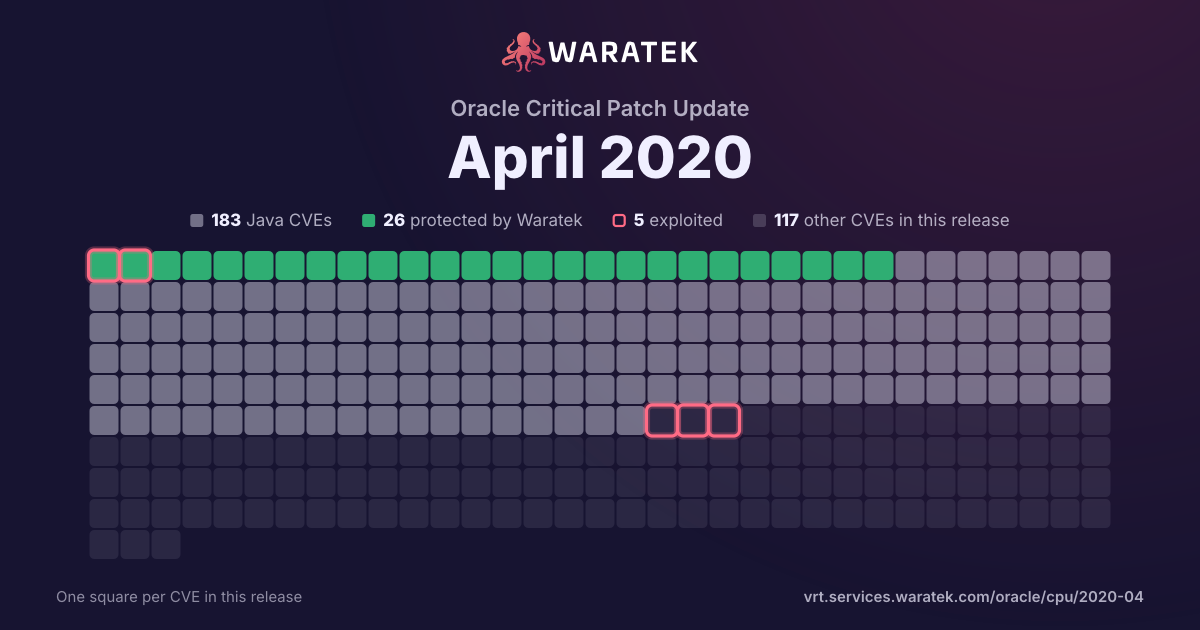
By status
28Protected by Waratek7Mitigation candidate166No exploit published6Outside Waratek scope92Not applicable1Withdrawn CVE
5Exploited, marked by the ring
No exploit published. For 145 of them, Oracle's security advisory is the source of public detail.
Protected by Waratek. Waratek RASP can block exploitation of these on systems that have not applied the patch yet.
Overview 15 matches · 7 in Waratek scope · 4 protected · 0 exploited · 0 CISA KEV · 0 public PoC · 1 EPSS ≥ 0.5
15matches
7in Waratek scope46.7%
4protected26.7%
0exploited0.0%
0CISA KEV0.0%
0public PoC0.0%
1EPSS ≥ 0.56.7%
Protected by Waratek
4
26.7%
Rule in development
0
0.0%
Mitigation candidate
0
0.0%
No exploit published
3
20.0%
Outside Waratek scope
1
6.7%
Not applicable
7
46.7%
Withdrawn CVE
0
0.0%
blocked by ARMR today
4
26.7%
partly blocked
0
0.0%
not blocked
11
73.3%
not established
0
0.0%
unrecorded
0
0.0%
Exploited
0
0.0%
Working exploit published
0
0.0%
Proof of concept only
0
0.0%
Forecast only
1
6.7%
No public exploit
14
93.3%
split by
peak 6 / month
Jul 196
Protected by Waratek3
Outside Waratek scope1
Not applicable2
Critical4
High1
Medium1
blocked by ARMR today3
not blocked3
Forecast only1
No public exploit5
Aug 193
Protected by Waratek1
No exploit published2
High3
blocked by ARMR today1
not blocked2
No public exploit3
Sep 196
No exploit published1
Not applicable5
Critical2
High2
Medium2
not blocked6
No public exploit6
Jul 19Aug 19Sep 19
| CVE | Severity | Published▾ | Status | Exploitation | Description |
|---|---|---|---|---|---|
| CVE-2019-10082 | Critical | 2019-09-26 | No exploit published | No public exploit | In Apache HTTP Server 2.4.18-2.4.39, using fuzzed network input, the http/2 session handling could be made to read memory after being freed, during connection shutdown. |
| CVE-2019-14821 | High | 2019-09-19 | Not applicable | No public exploit | An out-of-bounds access issue was found in the Linux kernel, all versions through 5.3, in the way Linux kernel's KVM hypervisor implements the Coalesced MMIO write operation. It operates on an MMIO ring buffer 'struct kvm_coalesced_mmio' object, wherein write indices 'ring->first' and 'ring->last' value could be supplied by a host user-space process. An unprivileged host user or process with access to '/dev/kvm' device could use this flaw to crash the host kernel, resulting in a denial of service or potentially escalating privileges on the system. |
| CVE-2019-5482 | Critical | 2019-09-16 | Not applicable | No public exploit | Heap buffer overflow in the TFTP protocol handler in cURL 7.19.4 to 7.65.3. |
| CVE-2019-1547 | Medium | 2019-09-10 | Not applicable | No public exploit | Normally in OpenSSL EC groups always have a co-factor present and this is used in side channel resistant code paths. However, in some cases, it is possible to construct a group using explicit parameters (instead of using a named curve). In those cases it is possible that such a group does not have the cofactor present. This can occur even where all the parameters match a known named curve. If such a curve is used then OpenSSL falls back to non-side channel resistant code paths which may result in full key recovery during an ECDSA signature operation. In order to be vulnerable an attacker would have to have the ability to time the creation of a large number of signatures where explicit parameters with no co-factor present are in use by an application using libcrypto. For the avoidance of doubt libssl is not vulnerable because explicit parameters are never used. Fixed in OpenSSL 1.1.1d (Affected 1.1.1-1.1.1c). Fixed in OpenSSL 1.1.0l (Affected 1.1.0-1.1.0k). Fixed in OpenSSL 1.0.2t (Affected 1.0.2-1.0.2s). |
| CVE-2019-16168 | Medium | 2019-09-09 | Not applicable | No public exploit | In SQLite through 3.29.0, whereLoopAddBtreeIndex in sqlite3.c can crash a browser or other application because of missing validation of a sqlite_stat1 sz field, aka a "severe division by zero in the query planner." |
| CVE-2019-15903 | High | 2019-09-04 | Not applicable | No public exploit | In libexpat before 2.2.8, crafted XML input could fool the parser into changing from DTD parsing to document parsing too early; a consecutive call to XML_GetCurrentLineNumber (or XML_GetCurrentColumnNumber) then resulted in a heap-based buffer over-read. |
| CVE-2019-12402 | High | 2019-08-30 | No exploit published | No public exploit | The file name encoding algorithm used internally in Apache Commons Compress 1.15 to 1.18 can get into an infinite loop when faced with specially crafted inputs. This can lead to a denial of service attack if an attacker can choose the file names inside of an archive created by Compress. |
| CVE-2019-10086 | High | 2019-08-20 | Protected by Waratek | No public exploit | In Apache Commons Beanutils 1.9.2, a special BeanIntrospector class was added which allows suppressing the ability for an attacker to access the classloader via the class property available on all Java objects. We, however were not using this by default characteristic of the PropertyUtilsBean. |
| CVE-2019-10088 | High | 2019-08-02 | No exploit published | No public exploit | A carefully crafted or corrupt zip file can cause an OOM in Apache Tika's RecursiveParserWrapper in versions 1.7-1.21. Users should upgrade to 1.22 or later. |
| CVE-2019-14379 | Critical | 2019-07-29 | Protected by Waratek | No public exploit | SubTypeValidator.java in FasterXML jackson-databind before 2.9.9.2 mishandles default typing when ehcache is used (because of net.sf.ehcache.transaction.manager.DefaultTransactionManagerLookup), leading to remote code execution. |
| CVE-2019-13990 | Critical | 2019-07-26 | Protected by Waratek | No public exploit | initDocumentParser in xml/XMLSchedulingDataProcessor.java in Terracotta Quartz Scheduler through 2.3.0 allows XXE attacks via a job description. |
| CVE-2019-2853 | High | 2019-07-23 | Not applicable | No public exploit | Vulnerability in the Oracle Outside In Technology component of Oracle Fusion Middleware (subcomponent: Outside In Filters). The supported version that is affected is 8.5.4. Easily exploitable vulnerability allows unauthenticated attacker with network access via HTTP to compromise Oracle Outside In Technology. Successful attacks of this vulnerability can result in unauthorized update, insert or delete access to some of Oracle Outside In Technology accessible data as well as unauthorized read access to a subset of Oracle Outside In Technology accessible data and unauthorized ability to cause a partial denial of service (partial DOS) of Oracle Outside In Technology. Note: Outside In Technology is a suite of software development kits (SDKs). The protocol and CVSS score depend on the software that uses the Outside In Technology code. The CVSS score assumes that the software passes data received over a network directly to Outside In Technology code, but if data is not received over a network the CVSS score may be lower. CVSS 3.0 Base Score 7.3 (Confidentiality, Integrity and Availability impacts). CVSS Vector: (CVSS:3.0/AV:N/AC:L/PR:N/UI:N/S:U/C:L/I:L/A:L). |
| CVE-2019-10173 | Critical | 2019-07-23 | Protected by Waratek | Forecast only | It was found that xstream API version 1.4.10 before 1.4.11 introduced a regression for a previous deserialization flaw. If the security framework has not been initialized, it may allow a remote attacker to run arbitrary shell commands when unmarshalling XML or any supported format. e.g. JSON. (regression of CVE-2013-7285) |
| CVE-2019-1010238 | Critical | 2019-07-19 | Outside Waratek scope | No public exploit | Gnome Pango 1.42 and later is affected by: Buffer Overflow. The impact is: The heap based buffer overflow can be used to get code execution. The component is: function name: pango_log2vis_get_embedding_levels, assignment of nchars and the loop condition. The attack vector is: Bug can be used when application pass invalid utf-8 strings to functions like pango_itemize. |
| CVE-2018-20852 | Medium | 2019-07-13 | Not applicable | No public exploit | http.cookiejar.DefaultPolicy.domain_return_ok in Lib/http/cookiejar.py in Python before 3.7.3 does not correctly validate the domain: it can be tricked into sending existing cookies to the wrong server. An attacker may abuse this flaw by using a server with a hostname that has another valid hostname as a suffix (e.g., pythonicexample.com to steal cookies for example.com). When a program uses http.cookiejar.DefaultPolicy and tries to do an HTTP connection to an attacker-controlled server, existing cookies can be leaked to the attacker. This affects 2.x through 2.7.16, 3.x before 3.4.10, 3.5.x before 3.5.7, 3.6.x before 3.6.9, and 3.7.x before 3.7.3. |