
Oracle Critical Patch Update April 2020
Released April 2020 · Oracle's advisory ↗ · ← Critical Patch Update, January 2020 · Critical Patch Update, July 2020 →
300 CVEs in this release, one square each
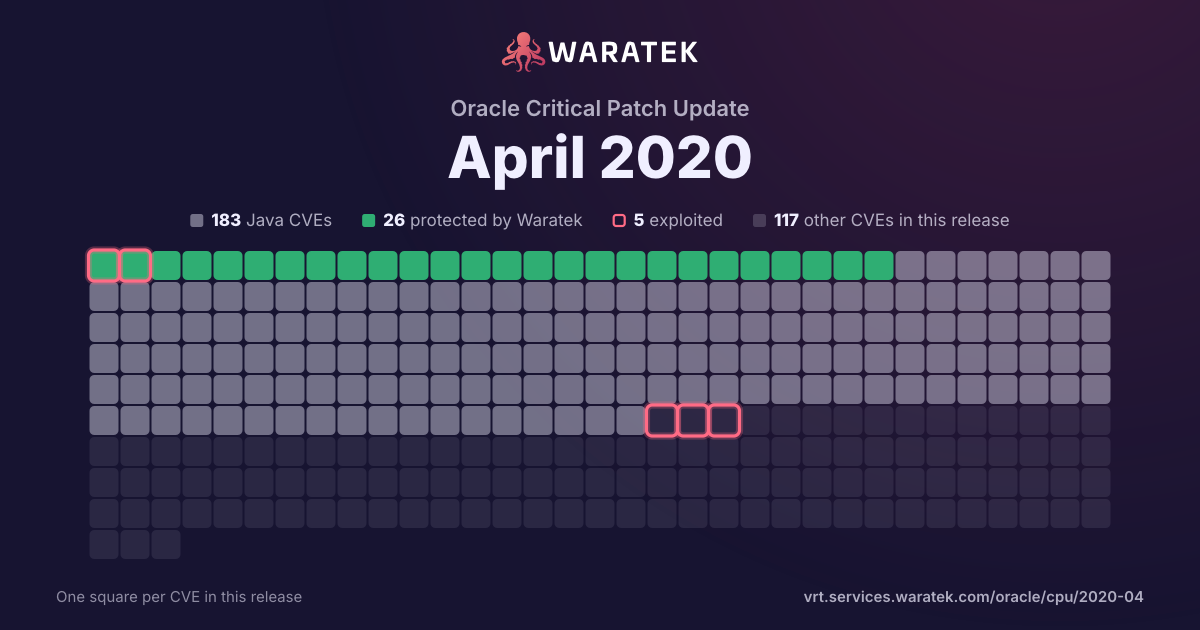
By status
28Protected by Waratek7Mitigation candidate166No exploit published6Outside Waratek scope92Not applicable1Withdrawn CVE
5Exploited, marked by the ring
No exploit published. For 145 of them, Oracle's security advisory is the source of public detail.
Protected by Waratek. Waratek RASP can block exploitation of these on systems that have not applied the patch yet.
Overview 6 matches · 3 in Waratek scope · 3 protected · 0 exploited · 0 CISA KEV · 0 public PoC · 1 EPSS ≥ 0.5
6matches
3in Waratek scope50.0%
3protected50.0%
0exploited0.0%
0CISA KEV0.0%
0public PoC0.0%
1EPSS ≥ 0.516.7%
Protected by Waratek
3
50.0%
Rule in development
0
0.0%
Mitigation candidate
0
0.0%
No exploit published
0
0.0%
Outside Waratek scope
1
16.7%
Not applicable
2
33.3%
Withdrawn CVE
0
0.0%
blocked by ARMR today
3
50.0%
partly blocked
0
0.0%
not blocked
3
50.0%
not established
0
0.0%
unrecorded
0
0.0%
Exploited
0
0.0%
Working exploit published
0
0.0%
Proof of concept only
0
0.0%
Forecast only
1
16.7%
No public exploit
5
83.3%
| CVE | Severity | Published▾ | Status | Exploitation | Description |
|---|---|---|---|---|---|
| CVE-2019-14379 | Critical | 2019-07-29 | Protected by Waratek | No public exploit | SubTypeValidator.java in FasterXML jackson-databind before 2.9.9.2 mishandles default typing when ehcache is used (because of net.sf.ehcache.transaction.manager.DefaultTransactionManagerLookup), leading to remote code execution. |
| CVE-2019-13990 | Critical | 2019-07-26 | Protected by Waratek | No public exploit | initDocumentParser in xml/XMLSchedulingDataProcessor.java in Terracotta Quartz Scheduler through 2.3.0 allows XXE attacks via a job description. |
| CVE-2019-2853 | High | 2019-07-23 | Not applicable | No public exploit | Vulnerability in the Oracle Outside In Technology component of Oracle Fusion Middleware (subcomponent: Outside In Filters). The supported version that is affected is 8.5.4. Easily exploitable vulnerability allows unauthenticated attacker with network access via HTTP to compromise Oracle Outside In Technology. Successful attacks of this vulnerability can result in unauthorized update, insert or delete access to some of Oracle Outside In Technology accessible data as well as unauthorized read access to a subset of Oracle Outside In Technology accessible data and unauthorized ability to cause a partial denial of service (partial DOS) of Oracle Outside In Technology. Note: Outside In Technology is a suite of software development kits (SDKs). The protocol and CVSS score depend on the software that uses the Outside In Technology code. The CVSS score assumes that the software passes data received over a network directly to Outside In Technology code, but if data is not received over a network the CVSS score may be lower. CVSS 3.0 Base Score 7.3 (Confidentiality, Integrity and Availability impacts). CVSS Vector: (CVSS:3.0/AV:N/AC:L/PR:N/UI:N/S:U/C:L/I:L/A:L). |
| CVE-2019-10173 | Critical | 2019-07-23 | Protected by Waratek | Forecast only | It was found that xstream API version 1.4.10 before 1.4.11 introduced a regression for a previous deserialization flaw. If the security framework has not been initialized, it may allow a remote attacker to run arbitrary shell commands when unmarshalling XML or any supported format. e.g. JSON. (regression of CVE-2013-7285) |
| CVE-2019-1010238 | Critical | 2019-07-19 | Outside Waratek scope | No public exploit | Gnome Pango 1.42 and later is affected by: Buffer Overflow. The impact is: The heap based buffer overflow can be used to get code execution. The component is: function name: pango_log2vis_get_embedding_levels, assignment of nchars and the loop condition. The attack vector is: Bug can be used when application pass invalid utf-8 strings to functions like pango_itemize. |
| CVE-2018-20852 | Medium | 2019-07-13 | Not applicable | No public exploit | http.cookiejar.DefaultPolicy.domain_return_ok in Lib/http/cookiejar.py in Python before 3.7.3 does not correctly validate the domain: it can be tricked into sending existing cookies to the wrong server. An attacker may abuse this flaw by using a server with a hostname that has another valid hostname as a suffix (e.g., pythonicexample.com to steal cookies for example.com). When a program uses http.cookiejar.DefaultPolicy and tries to do an HTTP connection to an attacker-controlled server, existing cookies can be leaked to the attacker. This affects 2.x through 2.7.16, 3.x before 3.4.10, 3.5.x before 3.5.7, 3.6.x before 3.6.9, and 3.7.x before 3.7.3. |