
WaratekVRT Sign in

Oracle Critical Patch Update April 2020

Released April 2020 · Oracle's advisory ↗ · ← Critical Patch Update, January 2020 · Critical Patch Update, July 2020 →

300 CVEs in this release, one square each
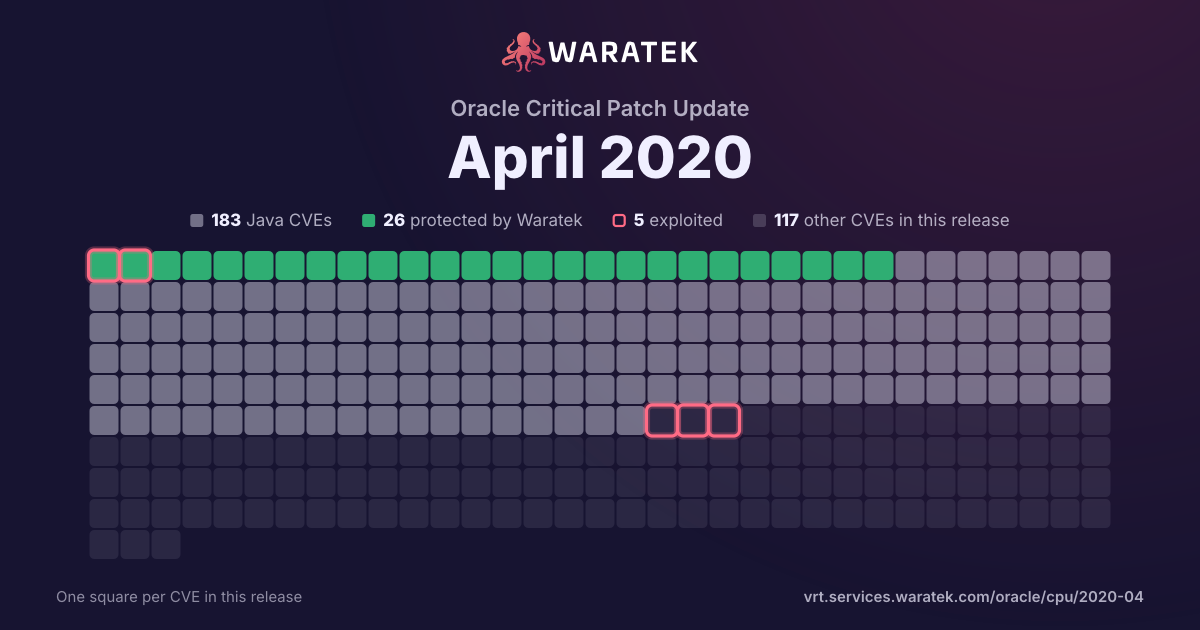
Protected by Waratek, exploitedProtected by Waratek, exploitedProtected by WaratekProtected by WaratekProtected by WaratekProtected by WaratekProtected by WaratekProtected by WaratekProtected by WaratekProtected by WaratekProtected by WaratekProtected by WaratekProtected by WaratekProtected by WaratekProtected by WaratekProtected by WaratekProtected by WaratekProtected by WaratekProtected by WaratekProtected by WaratekProtected by WaratekProtected by WaratekProtected by WaratekProtected by WaratekProtected by WaratekProtected by WaratekMitigation candidate, exploitedMitigation candidate, exploitedMitigation candidate, exploitedMitigation candidateMitigation candidateMitigation candidateMitigation candidateNo exploit publishedNo exploit publishedNo exploit publishedNo exploit publishedNo exploit publishedNo exploit publishedNo exploit publishedNo exploit publishedNo exploit publishedNo exploit publishedNo exploit publishedNo exploit publishedNo exploit publishedNo exploit publishedNo exploit publishedNo exploit publishedNo exploit publishedNo exploit publishedNo exploit publishedNo exploit publishedNo exploit publishedNo exploit publishedNo exploit publishedNo exploit publishedNo exploit publishedNo exploit publishedNo exploit publishedNo exploit publishedNo exploit publishedNo exploit publishedNo exploit publishedNo exploit publishedNo exploit publishedNo exploit publishedNo exploit publishedNo exploit publishedNo exploit publishedNo exploit publishedNo exploit publishedNo exploit publishedNo exploit publishedNo exploit publishedNo exploit publishedNo exploit publishedNo exploit publishedNo exploit publishedNo exploit publishedNo exploit publishedNo exploit publishedNo exploit publishedNo exploit publishedNo exploit publishedNo exploit publishedNo exploit publishedNo exploit publishedNo exploit publishedNo exploit publishedNo exploit publishedNo exploit publishedNo exploit publishedNo exploit publishedNo exploit publishedNo exploit publishedNo exploit publishedNo exploit publishedNo exploit publishedNo exploit publishedNo exploit publishedNo exploit publishedNo exploit publishedNo exploit publishedNo exploit publishedNo exploit publishedNo exploit publishedNo exploit publishedNo exploit publishedNo exploit publishedNo exploit publishedNo exploit publishedNo exploit publishedNo exploit publishedNo exploit publishedNo exploit publishedNo exploit publishedNo exploit publishedNo exploit publishedNo exploit publishedNo exploit publishedNo exploit publishedNo exploit publishedNo exploit publishedNo exploit publishedNo exploit publishedNo exploit publishedNo exploit publishedNo exploit publishedNo exploit publishedNo exploit publishedNo exploit publishedNo exploit publishedNo exploit publishedNo exploit publishedNo exploit publishedNo exploit publishedNo exploit publishedNo exploit publishedNo exploit publishedNo exploit publishedNo exploit publishedNo exploit publishedNo exploit publishedNo exploit publishedNo exploit publishedNo exploit publishedNo exploit publishedNo exploit publishedNo exploit publishedNo exploit publishedNo exploit publishedNo exploit publishedNo exploit publishedNo exploit publishedNo exploit publishedNo exploit publishedNo exploit publishedNo exploit publishedNo exploit publishedNo exploit publishedNo exploit publishedNo exploit publishedNo exploit publishedNo exploit publishedNo exploit publishedNo exploit publishedNo exploit publishedNo exploit publishedNo exploit publishedNo exploit publishedNo exploit publishedNo exploit publishedNo exploit publishedNo exploit publishedNo exploit publishedNo exploit publishedNo exploit publishedNo exploit publishedNo exploit publishedNo exploit publishedNo exploit publishedNo exploit publishedNo exploit publishedNo exploit publishedNo exploit publishedNo exploit publishedNo exploit publishedNo exploit publishedNo exploit publishedNo exploit publishedNo exploit publishedNo exploit publishedNo exploit publishedNo exploit publishedNo exploit publishedNo exploit publishedNo exploit publishedNo exploit publishedNo exploit publishedNo exploit publishedOutside Waratek scopeOutside Waratek scopeOutside Waratek scopeOutside Waratek scopeOutside Waratek scopeOutside Waratek scopeNot applicableNot applicableNot applicableNot applicableNot applicableNot applicableNot applicableNot applicableNot applicableNot applicableNot applicableNot applicableNot applicableNot applicableNot applicableNot applicableNot applicableNot applicableNot applicableNot applicableNot applicableNot applicableNot applicableNot applicableNot applicableNot applicableNot applicableNot applicableNot applicableNot applicableNot applicableNot applicableNot applicableNot applicableNot applicableNot applicableNot applicableNot applicableNot applicableNot applicableNot applicableNot applicableNot applicableNot applicableNot applicableNot applicableNot applicableNot applicableNot applicableNot applicableNot applicableNot applicableNot applicableNot applicableNot applicableNot applicableNot applicableNot applicableNot applicableNot applicableNot applicableNot applicableNot applicableNot applicableNot applicableNot applicableNot applicableNot applicableNot applicableNot applicableNot applicableNot applicableNot applicableNot applicableNot applicableNot applicableNot applicableNot applicableNot applicableNot applicableNot applicableNot applicableNot applicableNot applicableNot applicableNot applicableNot applicableNot applicableNot applicableNot applicableNot applicableNot applicableWithdrawn CVE
Share this chart Oracle Critical Patch Update April 2020, one square per CVE: 201 Java CVEs, 26 protected by Waratek, 5 exploited, 99 other CVEs in this release.

Download the image

By status

No exploit published. For 145 of them, Oracle's security advisory is the source of public detail.

Protected by Waratek. Waratek RASP can block exploitation of these on systems that have not applied the patch yet.

Reset
More filters (2)
Columns
Published from 2019-12-01✕Oracle product: Oracle Fusion Middleware✕
Overview 5 matches · 0 protected · 0 exploited · 0 CISA KEV · 1 public PoC · 1 EPSS ≥ 0.5
5matches 0protected0.0% 0exploited0.0% 0CISA KEV0.0% 1public PoC20.0% 1EPSS ≥ 0.520.0%
Protected by Waratek 0 0.0% Rule in development 0 0.0% Mitigation candidate 1 20.0% No exploit published 4 80.0%
Critical 0 0.0% High 5 100.0% Medium 0 0.0% Low 0 0.0% None 0 0.0% Unknown 0 0.0%
blocked by ARMR today 0 0.0% partly blocked 0 0.0% not blocked 5 100.0% not established 0 0.0% unrecorded 0 0.0%
Exploited 0 0.0% Working exploit published 0 0.0% Proof of concept only 1 20.0% Forecast only 0 0.0% No public exploit 4 80.0%
split by peak 4 / month
No exploit published: 4Mitigation candidate: 1 High: 5 not blocked: 5 No public exploit: 4Proof of concept only: 1
Jan 20Feb 20Mar 20Apr 20
5 matches Sign in to download these CVEs as CSV or JSON, or to follow them in a feed.
CVE Severity Published▾ Status Exploitation Description
CVE-2020-2867 High 2020-04-15 No exploit published No public exploit Vulnerability in the Oracle WebLogic Server product of Oracle Fusion Middleware (component: Web Container). Supported versions that are affected are 12.1.3.0.0, 12.2.1.3.0 and 12.2.1.4.0. Easily exploitable vulnerability allows unauthenticated attacker with network access via HTTP to compromise Oracle WebLogic Server. Successful attacks of this vulnerability can result in unauthorized creation, deletion or modification access to critical data or all Oracle WebLogic Server accessible data as well as unauthorized read access to a subset of Oracle WebLogic Server accessible data. CVSS 3.0 Base Score 8.2 (Confidentiality and Integrity impacts). CVSS Vector: (CVSS:3.0/AV:N/AC:L/PR:N/UI:N/S:U/C:L/I:H/A:N).
CVE-2020-2828 High 2020-04-15 No exploit published No public exploit Vulnerability in the Oracle WebLogic Server product of Oracle Fusion Middleware (component: WLS Web Services). The supported version that is affected is 10.3.6.0.0. Easily exploitable vulnerability allows unauthenticated attacker with network access via IIOP, T3 to compromise Oracle WebLogic Server. Successful attacks of this vulnerability can result in unauthorized access to critical data or complete access to all Oracle WebLogic Server accessible data. CVSS 3.0 Base Score 7.5 (Confidentiality impacts). CVSS Vector: (CVSS:3.0/AV:N/AC:L/PR:N/UI:N/S:U/C:H/I:N/A:N).
CVE-2020-2798 High 2020-04-15 No exploit published No public exploit Vulnerability in the Oracle WebLogic Server product of Oracle Fusion Middleware (component: WLS Web Services). Supported versions that are affected are 10.3.6.0.0, 12.1.3.0.0, 12.2.1.3.0 and 12.2.1.4.0. Easily exploitable vulnerability allows high privileged attacker with network access via IIOP, T3 to compromise Oracle WebLogic Server. Successful attacks of this vulnerability can result in takeover of Oracle WebLogic Server. CVSS 3.0 Base Score 7.2 (Confidentiality, Integrity and Availability impacts). CVSS Vector: (CVSS:3.0/AV:N/AC:L/PR:H/UI:N/S:U/C:H/I:H/A:H).
CVE-2020-2739 High 2020-04-15 No exploit published No public exploit Vulnerability in the Oracle WebCenter Sites product of Oracle Fusion Middleware (component: Advanced UI). The supported version that is affected is 12.2.1.3.0. Easily exploitable vulnerability allows unauthenticated attacker with network access via HTTP to compromise Oracle WebCenter Sites. Successful attacks require human interaction from a person other than the attacker and while the vulnerability is in Oracle WebCenter Sites, attacks may significantly impact additional products. Successful attacks of this vulnerability can result in unauthorized access to critical data or complete access to all Oracle WebCenter Sites accessible data. CVSS 3.0 Base Score 7.4 (Confidentiality impacts). CVSS Vector: (CVSS:3.0/AV:N/AC:L/PR:N/UI:R/S:C/C:H/I:N/A:N).
CVE-2020-5398 High 2020-01-17 Mitigation candidate Proof of concept only In Spring Framework, versions 5.2.x prior to 5.2.3, versions 5.1.x prior to 5.1.13, and versions 5.0.x prior to 5.0.16, an application is vulnerable to a reflected file download (RFD) attack when it sets a "Content-Disposition" header in the response where the filename attribute is derived from user supplied input.