
Oracle Critical Patch Update January 2020
Released January 2020 · Oracle's advisory ↗ · ← Critical Patch Update, October 2019 · Critical Patch Update, April 2020 →
255 CVEs in this release, one square each
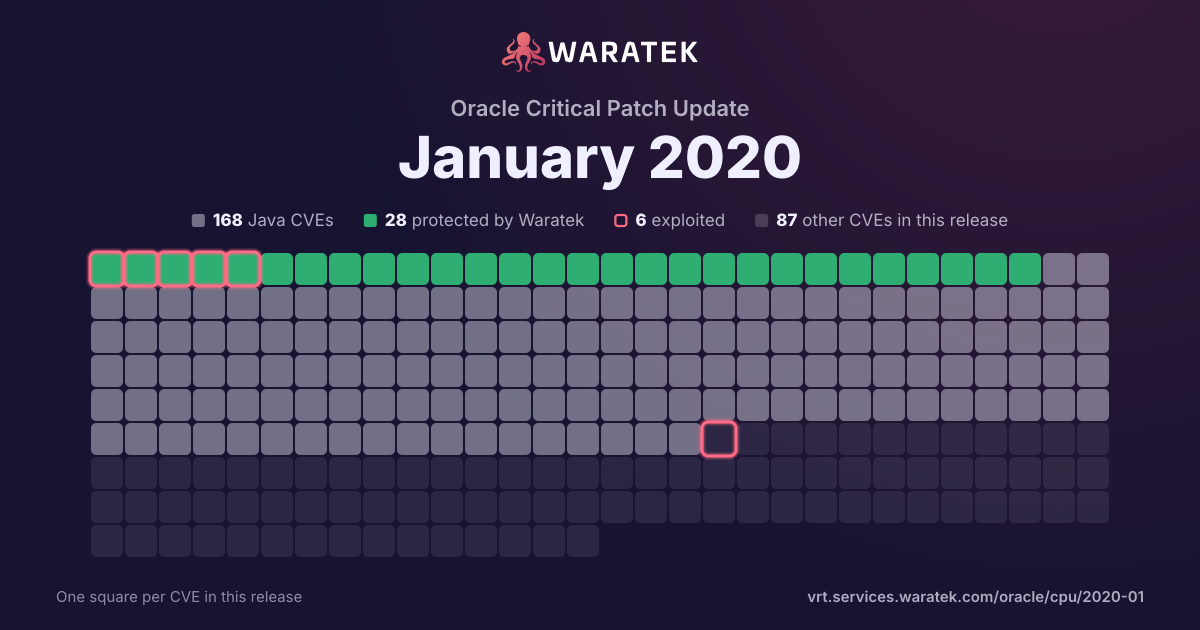
By status
29Protected by Waratek3Mitigation candidate145No exploit published9Outside Waratek scope69Not applicable
6Exploited, marked by the ring
No exploit published. For 135 of them, Oracle's security advisory is the source of public detail.
Protected by Waratek. Waratek RASP can block exploitation of these on systems that have not applied the patch yet.
Overview 9 matches · 0 in Waratek scope · 0 protected · 0 exploited · 0 CISA KEV · 1 public PoC · 1 EPSS ≥ 0.5
9matches
0in Waratek scope0.0%
0protected0.0%
0exploited0.0%
0CISA KEV0.0%
1public PoC11.1%
1EPSS ≥ 0.511.1%
Protected by Waratek
0
0.0%
Rule in development
0
0.0%
Mitigation candidate
0
0.0%
No exploit published
0
0.0%
Outside Waratek scope
0
0.0%
Not applicable
9
100.0%
Withdrawn CVE
0
0.0%
blocked by ARMR today
0
0.0%
partly blocked
0
0.0%
not blocked
9
100.0%
not established
0
0.0%
unrecorded
0
0.0%
Exploited
0
0.0%
Working exploit published
0
0.0%
Proof of concept only
1
11.1%
Forecast only
0
0.0%
No public exploit
8
88.9%
split by
peak 3 / quarter
Q2 171
Not applicable1
High1
not blocked1
No public exploit1
Q3 170
Q4 170
Q1 181
Not applicable1
High1
not blocked1
No public exploit1
Q2 180
Q3 180
Q4 182
Not applicable2
Critical1
Medium1
not blocked2
No public exploit2
Q1 193
Not applicable3
Critical2
Medium1
not blocked3
No public exploit3
Q2 192
Not applicable2
Critical1
High1
not blocked2
Proof of concept only1
No public exploit1
Q2 17Q3 17Q4 17Q1 18Q2 18Q3 18Q4 18Q1 19Q2 19
| CVE | Severity | Published▾ | Status | Exploitation | Description |
|---|---|---|---|---|---|
| CVE-2019-11477 | High | 2019-06-19 | Not applicable | Proof of concept only | Jonathan Looney discovered that the TCP_SKB_CB(skb)->tcp_gso_segs value was subject to an integer overflow in the Linux kernel when handling TCP Selective Acknowledgments (SACKs). A remote attacker could use this to cause a denial of service. This has been fixed in stable kernel releases 4.4.182, 4.9.182, 4.14.127, 4.19.52, 5.1.11, and is fixed in commit 3b4929f65b0d8249f19a50245cd88ed1a2f78cff. |
| CVE-2019-8457 | Critical | 2019-05-30 | Not applicable | No public exploit | SQLite3 from 3.6.0 to and including 3.27.2 is vulnerable to heap out-of-bound read in the rtreenode() function when handling invalid rtree tables. |
| CVE-2019-3862 | Critical | 2019-03-21 | Not applicable | No public exploit | An out of bounds read flaw was discovered in libssh2 before 1.8.1 in the way SSH_MSG_CHANNEL_REQUEST packets with an exit status message and no payload are parsed. A remote attacker who compromises a SSH server may be able to cause a Denial of Service or read data in the client memory. |
| CVE-2019-9636 | Critical | 2019-03-08 | Not applicable | No public exploit | Python 2.7.x through 2.7.16 and 3.x through 3.7.2 is affected by: Improper Handling of Unicode Encoding (with an incorrect netloc) during NFKC normalization. The impact is: Information disclosure (credentials, cookies, etc. that are cached against a given hostname). The components are: urllib.parse.urlsplit, urllib.parse.urlparse. The attack vector is: A specially crafted URL could be incorrectly parsed to locate cookies or authentication data and send that information to a different host than when parsed correctly. This is fixed in: v2.7.17, v2.7.17rc1, v2.7.18, v2.7.18rc1; v3.5.10, v3.5.10rc1, v3.5.7, v3.5.8, v3.5.8rc1, v3.5.8rc2, v3.5.9; v3.6.10, v3.6.10rc1, v3.6.11, v3.6.11rc1, v3.6.12, v3.6.9, v3.6.9rc1; v3.7.3, v3.7.3rc1, v3.7.4, v3.7.4rc1, v3.7.4rc2, v3.7.5, v3.7.5rc1, v3.7.6, v3.7.6rc1, v3.7.7, v3.7.7rc1, v3.7.8, v3.7.8rc1, v3.7.9. |
| CVE-2019-1559 | Medium | 2019-02-27 | Not applicable | No public exploit | If an application encounters a fatal protocol error and then calls SSL_shutdown() twice (once to send a close_notify, and once to receive one) then OpenSSL can respond differently to the calling application if a 0 byte record is received with invalid padding compared to if a 0 byte record is received with an invalid MAC. If the application then behaves differently based on that in a way that is detectable to the remote peer, then this amounts to a padding oracle that could be used to decrypt data. In order for this to be exploitable "non-stitched" ciphersuites must be in use. Stitched ciphersuites are optimised implementations of certain commonly used ciphersuites. Also the application must call SSL_shutdown() twice even if a protocol error has occurred (applications should not do this but some do anyway). Fixed in OpenSSL 1.0.2r (Affected 1.0.2-1.0.2q). |
| CVE-2018-16395 | Critical | 2018-11-16 | Not applicable | No public exploit | An issue was discovered in the OpenSSL library in Ruby before 2.3.8, 2.4.x before 2.4.5, 2.5.x before 2.5.2, and 2.6.x before 2.6.0-preview3. When two OpenSSL::X509::Name objects are compared using ==, depending on the ordering, non-equal objects may return true. When the first argument is one character longer than the second, or the second argument contains a character that is one less than a character in the same position of the first argument, the result of == will be true. This could be leveraged to create an illegitimate certificate that may be accepted as legitimate and then used in signing or encryption operations. |
| CVE-2018-0734 | Medium | 2018-10-30 | Not applicable | No public exploit | The OpenSSL DSA signature algorithm has been shown to be vulnerable to a timing side channel attack. An attacker could use variations in the signing algorithm to recover the private key. Fixed in OpenSSL 1.1.1a (Affected 1.1.1). Fixed in OpenSSL 1.1.0j (Affected 1.1.0-1.1.0i). Fixed in OpenSSL 1.0.2q (Affected 1.0.2-1.0.2p). |
| CVE-2018-6829 | High | 2018-02-07 | Not applicable | No public exploit | cipher/elgamal.c in Libgcrypt through 1.8.2, when used to encrypt messages directly, improperly encodes plaintexts, which allows attackers to obtain sensitive information by reading ciphertext data (i.e., it does not have semantic security in face of a ciphertext-only attack). The Decisional Diffie-Hellman (DDH) assumption does not hold for Libgcrypt's ElGamal implementation. |
| CVE-2017-1000376 | High | 2017-06-19 | Not applicable | No public exploit | libffi requests an executable stack allowing attackers to more easily trigger arbitrary code execution by overwriting the stack. Please note that libffi is used by a number of other libraries. It was previously stated that this affects libffi version 3.2.1 but this appears to be incorrect. libffi prior to version 3.1 on 32 bit x86 systems was vulnerable, and upstream is believed to have fixed this issue in version 3.1. |