
Oracle Critical Patch Update January 2020
Released January 2020 · Oracle's advisory ↗ · ← Critical Patch Update, October 2019 · Critical Patch Update, April 2020 →
255 CVEs in this release, one square each
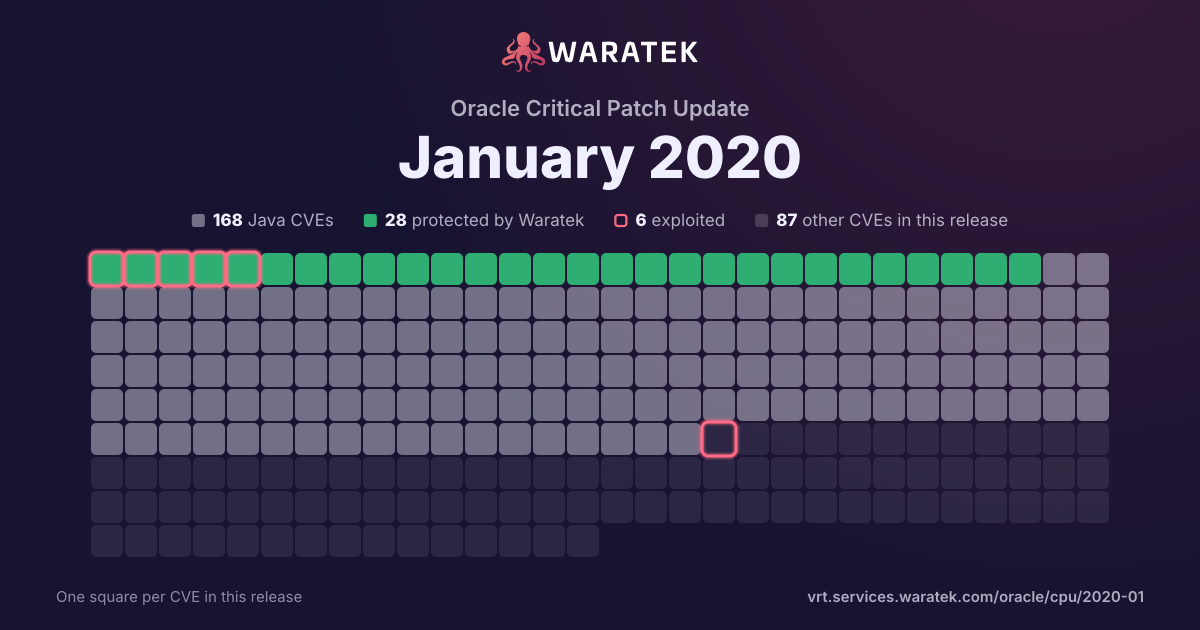
By status
29Protected by Waratek3Mitigation candidate145No exploit published9Outside Waratek scope69Not applicable
6Exploited, marked by the ring
No exploit published. For 135 of them, Oracle's security advisory is the source of public detail.
Protected by Waratek. Waratek RASP can block exploitation of these on systems that have not applied the patch yet.
Overview 3 matches · 1 in Waratek scope · 1 protected · 0 exploited · 0 CISA KEV · 0 public PoC · 0 EPSS ≥ 0.5
3matches
1in Waratek scope33.3%
1protected33.3%
0exploited0.0%
0CISA KEV0.0%
0public PoC0.0%
0EPSS ≥ 0.50.0%
Protected by Waratek
1
33.3%
Rule in development
0
0.0%
Mitigation candidate
0
0.0%
No exploit published
0
0.0%
Outside Waratek scope
0
0.0%
Not applicable
2
66.7%
Withdrawn CVE
0
0.0%
blocked by ARMR today
1
33.3%
partly blocked
0
0.0%
not blocked
2
66.7%
not established
0
0.0%
unrecorded
0
0.0%
Exploited
0
0.0%
Working exploit published
0
0.0%
Proof of concept only
0
0.0%
Forecast only
0
0.0%
No public exploit
3
100.0%
split by
peak 3 / month
Jul 19
| CVE | Severity | Published▾ | Status | Exploitation | Description |
|---|---|---|---|---|---|
| CVE-2019-14379 | Critical | 2019-07-29 | Protected by Waratek | No public exploit | SubTypeValidator.java in FasterXML jackson-databind before 2.9.9.2 mishandles default typing when ehcache is used (because of net.sf.ehcache.transaction.manager.DefaultTransactionManagerLookup), leading to remote code execution. |
| CVE-2019-13118 | Medium | 2019-07-01 | Not applicable | No public exploit | In numbers.c in libxslt 1.1.33, a type holding grouping characters of an xsl:number instruction was too narrow and an invalid character/length combination could be passed to xsltNumberFormatDecimal, leading to a read of uninitialized stack data. |
| CVE-2019-13117 | Medium | 2019-07-01 | Not applicable | No public exploit | In numbers.c in libxslt 1.1.33, an xsl:number with certain format strings could lead to a uninitialized read in xsltNumberFormatInsertNumbers. This could allow an attacker to discern whether a byte on the stack contains the characters A, a, I, i, or 0, or any other character. |