
Oracle Critical Patch Update January 2020
Released January 2020 · Oracle's advisory ↗ · ← Critical Patch Update, October 2019 · Critical Patch Update, April 2020 →
255 CVEs in this release, one square each
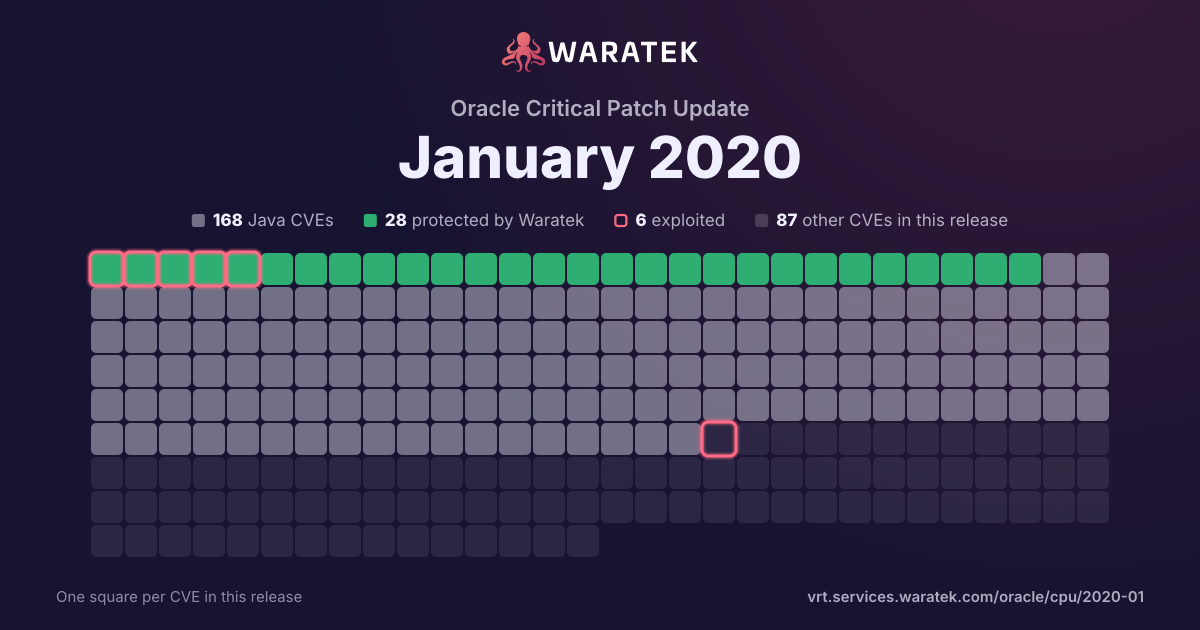
By status
28Protected by Waratek140No exploit published35Outside Waratek scope52Not applicable
6Exploited, marked by the ring
No exploit published. For 132 of them, Oracle's security advisory is the source of public detail.
Protected by Waratek. Waratek RASP can block exploitation of these on systems that have not applied the patch yet.
Overview 12 matches · 5 in Waratek scope · 0 protected · 0 exploited · 0 CISA KEV · 0 public PoC · 0 EPSS ≥ 0.5
12matches
5in Waratek scope41.7%
0protected0.0%
0exploited0.0%
0CISA KEV0.0%
0public PoC0.0%
0EPSS ≥ 0.50.0%
Protected by Waratek
0
0.0%
Rule in development
0
0.0%
Mitigation candidate
0
0.0%
No exploit published
5
41.7%
Outside Waratek scope
3
25.0%
Not applicable
4
33.3%
Withdrawn CVE
0
0.0%
blocked by ARMR today
0
0.0%
partly blocked
0
0.0%
not blocked
12
100.0%
not established
0
0.0%
unrecorded
0
0.0%
Exploited
0
0.0%
Working exploit published
0
0.0%
Proof of concept only
0
0.0%
Forecast only
0
0.0%
No public exploit
12
100.0%
split by
peak 3 / quarter
Q1 181
Outside Waratek scope1
Critical1
not blocked1
No public exploit1
Q2 180
Q3 181
Outside Waratek scope1
Critical1
not blocked1
No public exploit1
Q4 181
Not applicable1
Critical1
not blocked1
No public exploit1
Q1 192
Not applicable2
Critical2
not blocked2
No public exploit2
Q2 191
Not applicable1
Critical1
not blocked1
No public exploit1
Q3 191
Outside Waratek scope1
Critical1
not blocked1
No public exploit1
Q4 193
No exploit published3
Critical3
not blocked3
No public exploit3
Q1 202
No exploit published2
Critical2
not blocked2
No public exploit2
Q1 18Q2 18Q3 18Q4 18Q1 19Q2 19Q3 19Q4 19Q1 20
| CVE | Severity | Published▾ | Status | Exploitation | Description |
|---|---|---|---|---|---|
| CVE-2020-2587 | Critical | 2020-01-15 | No exploit published | No public exploit | Vulnerability in the Oracle Human Resources product of Oracle E-Business Suite (component: Hierarchy Diagrammers). Supported versions that are affected are 12.1.1-12.1.3 and 12.2.3-12.2.9. Easily exploitable vulnerability allows low privileged attacker with network access via HTTPS to compromise Oracle Human Resources. While the vulnerability is in Oracle Human Resources, attacks may significantly impact additional products. Successful attacks of this vulnerability can result in unauthorized creation, deletion or modification access to critical data or all Oracle Human Resources accessible data as well as unauthorized access to critical data or complete access to all Oracle Human Resources accessible data and unauthorized ability to cause a partial denial of service (partial DOS) of Oracle Human Resources. CVSS 3.0 Base Score 9.9 (Confidentiality, Integrity and Availability impacts). CVSS Vector: (CVSS:3.0/AV:N/AC:L/PR:L/UI:N/S:C/C:H/I:H/A:L). |
| CVE-2020-2586 | Critical | 2020-01-15 | No exploit published | No public exploit | Vulnerability in the Oracle Human Resources product of Oracle E-Business Suite (component: Hierarchy Diagrammers). Supported versions that are affected are 12.1.1-12.1.3 and 12.2.3-12.2.9. Easily exploitable vulnerability allows low privileged attacker with network access via HTTPS to compromise Oracle Human Resources. While the vulnerability is in Oracle Human Resources, attacks may significantly impact additional products. Successful attacks of this vulnerability can result in unauthorized creation, deletion or modification access to critical data or all Oracle Human Resources accessible data as well as unauthorized access to critical data or complete access to all Oracle Human Resources accessible data and unauthorized ability to cause a partial denial of service (partial DOS) of Oracle Human Resources. CVSS 3.0 Base Score 9.9 (Confidentiality, Integrity and Availability impacts). CVSS Vector: (CVSS:3.0/AV:N/AC:L/PR:L/UI:N/S:C/C:H/I:H/A:L). |
| CVE-2019-12419 | Critical | 2019-11-06 | No exploit published | No public exploit | Apache CXF before 3.3.4 and 3.2.11 provides all of the components that are required to build a fully fledged OpenId Connect service. There is a vulnerability in the access token services, where it does not validate that the authenticated principal is equal to that of the supplied clientId parameter in the request. If a malicious client was able to somehow steal an authorization code issued to another client, then they could exploit this vulnerability to obtain an access token for the other client. |
| CVE-2019-2904 | Critical | 2019-10-16 | No exploit published | No public exploit | Vulnerability in the Oracle JDeveloper and ADF product of Oracle Fusion Middleware (component: ADF Faces). Supported versions that are affected are 11.1.1.9.0, 12.1.3.0.0 and 12.2.1.3.0. Easily exploitable vulnerability allows unauthenticated attacker with network access via HTTP to compromise Oracle JDeveloper and ADF. Successful attacks of this vulnerability can result in takeover of Oracle JDeveloper and ADF. CVSS 3.0 Base Score 9.8 (Confidentiality, Integrity and Availability impacts). CVSS Vector: (CVSS:3.0/AV:N/AC:L/PR:N/UI:N/S:U/C:H/I:H/A:H). |
| CVE-2019-16943 | Critical | 2019-10-01 | No exploit published | No public exploit | A Polymorphic Typing issue was discovered in FasterXML jackson-databind 2.0.0 through 2.9.10. When Default Typing is enabled (either globally or for a specific property) for an externally exposed JSON endpoint and the service has the p6spy (3.8.6) jar in the classpath, and an attacker can find an RMI service endpoint to access, it is possible to make the service execute a malicious payload. This issue exists because of com.p6spy.engine.spy.P6DataSource mishandling. |
| CVE-2019-5482 | Critical | 2019-09-16 | Outside Waratek scope | No public exploit | Heap buffer overflow in the TFTP protocol handler in cURL 7.19.4 to 7.65.3. |
| CVE-2019-8457 | Critical | 2019-05-30 | Not applicable | No public exploit | SQLite3 from 3.6.0 to and including 3.27.2 is vulnerable to heap out-of-bound read in the rtreenode() function when handling invalid rtree tables. |
| CVE-2019-3862 | Critical | 2019-03-21 | Not applicable | No public exploit | An out of bounds read flaw was discovered in libssh2 before 1.8.1 in the way SSH_MSG_CHANNEL_REQUEST packets with an exit status message and no payload are parsed. A remote attacker who compromises a SSH server may be able to cause a Denial of Service or read data in the client memory. |
| CVE-2019-9636 | Critical | 2019-03-08 | Not applicable | No public exploit | Python 2.7.x through 2.7.16 and 3.x through 3.7.2 is affected by: Improper Handling of Unicode Encoding (with an incorrect netloc) during NFKC normalization. The impact is: Information disclosure (credentials, cookies, etc. that are cached against a given hostname). The components are: urllib.parse.urlsplit, urllib.parse.urlparse. The attack vector is: A specially crafted URL could be incorrectly parsed to locate cookies or authentication data and send that information to a different host than when parsed correctly. This is fixed in: v2.7.17, v2.7.17rc1, v2.7.18, v2.7.18rc1; v3.5.10, v3.5.10rc1, v3.5.7, v3.5.8, v3.5.8rc1, v3.5.8rc2, v3.5.9; v3.6.10, v3.6.10rc1, v3.6.11, v3.6.11rc1, v3.6.12, v3.6.9, v3.6.9rc1; v3.7.3, v3.7.3rc1, v3.7.4, v3.7.4rc1, v3.7.4rc2, v3.7.5, v3.7.5rc1, v3.7.6, v3.7.6rc1, v3.7.7, v3.7.7rc1, v3.7.8, v3.7.8rc1, v3.7.9. |
| CVE-2018-16395 | Critical | 2018-11-16 | Not applicable | No public exploit | An issue was discovered in the OpenSSL library in Ruby before 2.3.8, 2.4.x before 2.4.5, 2.5.x before 2.5.2, and 2.6.x before 2.6.0-preview3. When two OpenSSL::X509::Name objects are compared using ==, depending on the ordering, non-equal objects may return true. When the first argument is one character longer than the second, or the second argument contains a character that is one less than a character in the same position of the first argument, the result of == will be true. This could be leveraged to create an illegitimate certificate that may be accepted as legitimate and then used in signing or encryption operations. |
| CVE-2018-11058 | Critical | 2018-09-14 | Outside Waratek scope | No public exploit | RSA BSAFE Micro Edition Suite, versions prior to 4.0.11 (in 4.0.x) and prior to 4.1.6 (in 4.1.x), and RSA BSAFE Crypto-C Micro Edition, version prior to 4.0.5.3 (in 4.0.x) contain a Buffer Over-Read vulnerability when parsing ASN.1 data. A remote attacker could use maliciously constructed ASN.1 data that would result in such issue. |
| CVE-2016-6814 | Critical | 2018-01-18 | Outside Waratek scope | No public exploit | When an application with unsupported Codehaus versions of Groovy from 1.7.0 to 2.4.3, Apache Groovy 2.4.4 to 2.4.7 on classpath uses standard Java serialization mechanisms, e.g. to communicate between servers or to store local data, it was possible for an attacker to bake a special serialized object that will execute code directly when deserialized. All applications which rely on serialization and do not isolate the code which deserializes objects were subject to this vulnerability. |