
Oracle Critical Patch Update January 2020
Released January 2020 · Oracle's advisory ↗ · ← Critical Patch Update, October 2019 · Critical Patch Update, April 2020 →
255 CVEs in this release, one square each
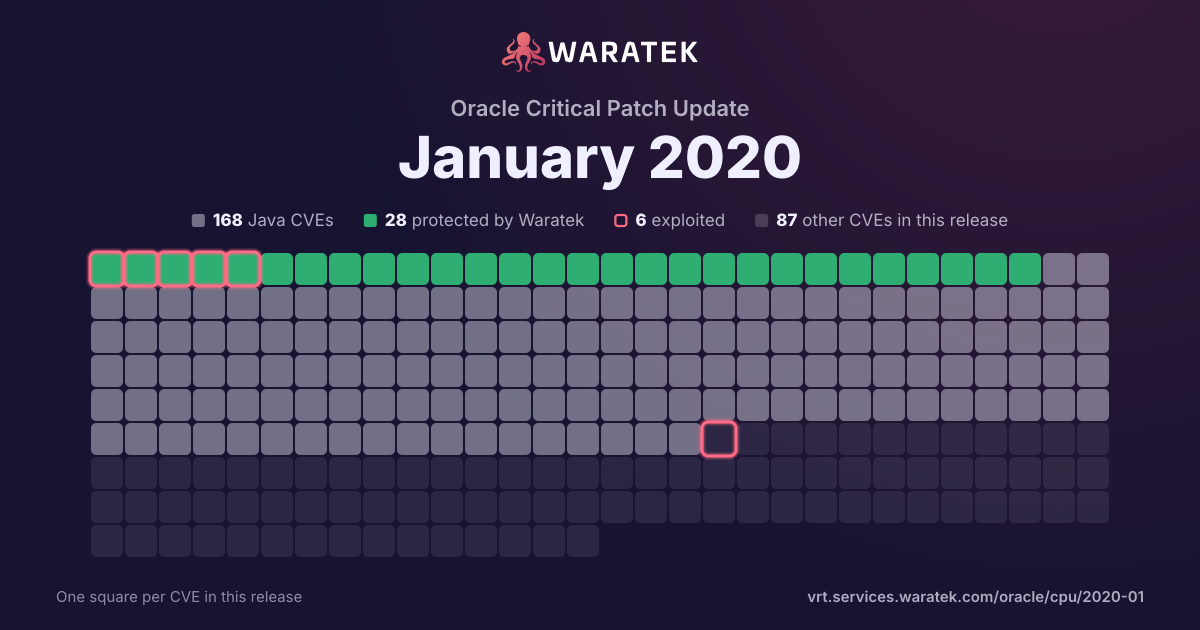
By status
28Protected by Waratek140No exploit published35Outside Waratek scope52Not applicable
6Exploited, marked by the ring
No exploit published. For 132 of them, Oracle's security advisory is the source of public detail.
Protected by Waratek. Waratek RASP can block exploitation of these on systems that have not applied the patch yet.
Overview 8 matches · 4 in Waratek scope · 0 protected · 0 exploited · 0 CISA KEV · 0 public PoC · 0 EPSS ≥ 0.5
8matches
4in Waratek scope50.0%
0protected0.0%
0exploited0.0%
0CISA KEV0.0%
0public PoC0.0%
0EPSS ≥ 0.50.0%
Protected by Waratek
0
0.0%
Rule in development
0
0.0%
Mitigation candidate
0
0.0%
No exploit published
4
50.0%
Outside Waratek scope
2
25.0%
Not applicable
2
25.0%
Withdrawn CVE
0
0.0%
blocked by ARMR today
0
0.0%
partly blocked
0
0.0%
not blocked
8
100.0%
not established
0
0.0%
unrecorded
0
0.0%
Exploited
0
0.0%
Working exploit published
0
0.0%
Proof of concept only
0
0.0%
Forecast only
0
0.0%
No public exploit
8
100.0%
split by
peak 6 / year
2012201320142015201620172018
| CVE | Severity | Published▾ | Status | Exploitation | Description |
|---|---|---|---|---|---|
| CVE-2018-11058 | Critical | 2018-09-14 | Outside Waratek scope | No public exploit | RSA BSAFE Micro Edition Suite, versions prior to 4.0.11 (in 4.0.x) and prior to 4.1.6 (in 4.1.x), and RSA BSAFE Crypto-C Micro Edition, version prior to 4.0.5.3 (in 4.0.x) contain a Buffer Over-Read vulnerability when parsing ASN.1 data. A remote attacker could use maliciously constructed ASN.1 data that would result in such issue. |
| CVE-2018-8039 | High | 2018-07-02 | No exploit published | No public exploit | It is possible to configure Apache CXF to use the com.sun.net.ssl implementation via 'System.setProperty("java.protocol.handler.pkgs", "com.sun.net.ssl.internal.www.protocol");'. When this system property is set, CXF uses some reflection to try to make the HostnameVerifier work with the old com.sun.net.ssl.HostnameVerifier interface. However, the default HostnameVerifier implementation in CXF does not implement the method in this interface, and an exception is thrown. However, in Apache CXF prior to 3.2.5 and 3.1.16 the exception is caught in the reflection code and not properly propagated. What this means is that if you are using the com.sun.net.ssl stack with CXF, an error with TLS hostname verification will not be thrown, leaving a CXF client subject to man-in-the-middle attacks. |
| CVE-2018-1258 | High | 2018-05-11 | No exploit published | No public exploit | Spring Framework version 5.0.5 when used in combination with any versions of Spring Security contains an authorization bypass when using method security. An unauthorized malicious user can gain unauthorized access to methods that should be restricted. |
| CVE-2018-6829 | High | 2018-02-07 | Not applicable | No public exploit | cipher/elgamal.c in Libgcrypt through 1.8.2, when used to encrypt messages directly, improperly encodes plaintexts, which allows attackers to obtain sensitive information by reading ciphertext data (i.e., it does not have semantic security in face of a ciphertext-only attack). The Decisional Diffie-Hellman (DDH) assumption does not hold for Libgcrypt's ElGamal implementation. |
| CVE-2017-12626 | High | 2018-01-29 | No exploit published | No public exploit | Apache POI in versions prior to release 3.17 are vulnerable to Denial of Service Attacks: 1) Infinite Loops while parsing crafted WMF, EMF, MSG and macros (POI bugs 61338 and 61294), and 2) Out of Memory Exceptions while parsing crafted DOC, PPT and XLS (POI bugs 52372 and 61295). |
| CVE-2016-6814 | Critical | 2018-01-18 | Outside Waratek scope | No public exploit | When an application with unsupported Codehaus versions of Groovy from 1.7.0 to 2.4.3, Apache Groovy 2.4.4 to 2.4.7 on classpath uses standard Java serialization mechanisms, e.g. to communicate between servers or to store local data, it was possible for an attacker to bake a special serialized object that will execute code directly when deserialized. All applications which rely on serialization and do not isolate the code which deserializes objects were subject to this vulnerability. |
| CVE-2017-1000376 | High | 2017-06-19 | Not applicable | No public exploit | libffi requests an executable stack allowing attackers to more easily trigger arbitrary code execution by overwriting the stack. Please note that libffi is used by a number of other libraries. It was previously stated that this affects libffi version 3.2.1 but this appears to be incorrect. libffi prior to version 3.1 on 32 bit x86 systems was vulnerable, and upstream is believed to have fixed this issue in version 3.1. |
| CVE-2012-1695 | Medium | 2012-05-03 | No exploit published | No public exploit | Unspecified vulnerability in the Oracle JRockit component in Oracle Fusion Middleware 28.2.2 and earlier, and JDK/JRE 5 and 6 27.7.1 and earlier, allows remote attackers to affect confidentiality, integrity, and availability via unknown vectors. |