
Oracle Critical Patch Update January 2020
Released January 2020 · Oracle's advisory ↗ · ← Critical Patch Update, October 2019 · Critical Patch Update, April 2020 →
255 CVEs in this release, one square each
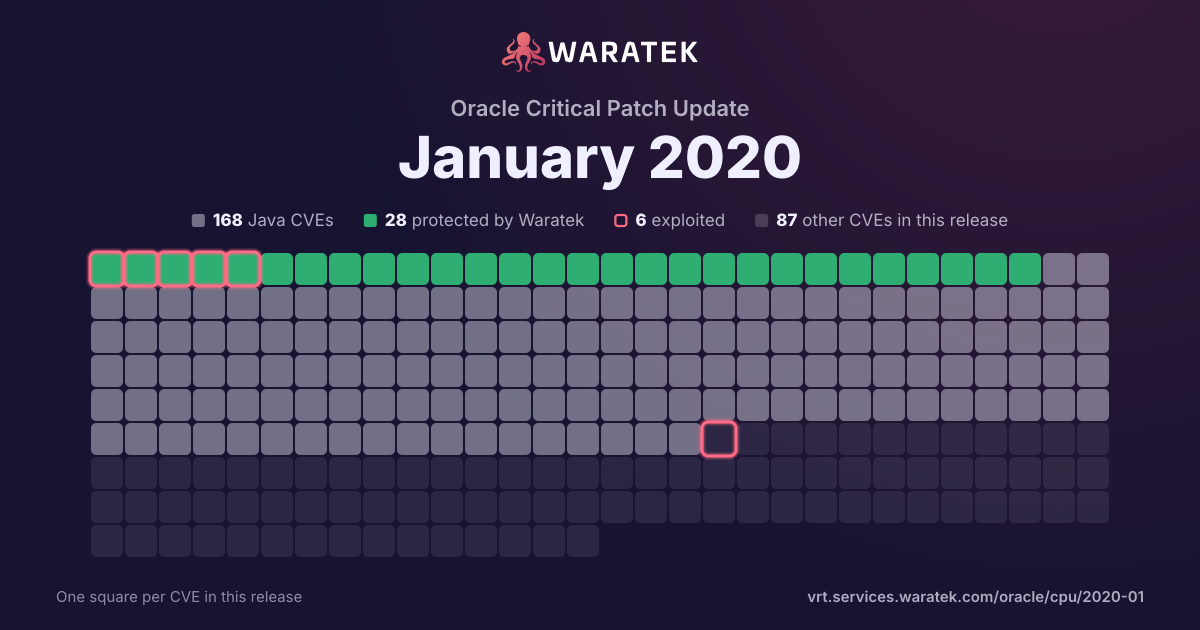
By status
29Protected by Waratek3Mitigation candidate145No exploit published9Outside Waratek scope69Not applicable
6Exploited, marked by the ring
No exploit published. For 135 of them, Oracle's security advisory is the source of public detail.
Protected by Waratek. Waratek RASP can block exploitation of these on systems that have not applied the patch yet.
Overview 226 matches · 156 in Waratek scope · 17 protected · 3 exploited · 2 CISA KEV · 9 public PoC · 6 EPSS ≥ 0.5
226matches
156in Waratek scope69.0%
17protected7.5%
3exploited1.3%
2CISA KEV0.9%
9public PoC4.0%
6EPSS ≥ 0.52.7%
Protected by Waratek
17
7.5%
Rule in development
0
0.0%
Mitigation candidate
1
0.4%
No exploit published
138
61.1%
Outside Waratek scope
9
4.0%
Not applicable
61
27.0%
Withdrawn CVE
0
0.0%
blocked by ARMR today
17
7.5%
partly blocked
0
0.0%
not blocked
209
92.5%
not established
0
0.0%
unrecorded
0
0.0%
split by
peak 203 / quarter
Q2 194
Protected by Waratek2
No exploit published1
Not applicable1
Critical1
High2
Medium1
blocked by ARMR today2
not blocked2
Exploited1
Proof of concept only2
Forecast only1
Q3 199
Protected by Waratek2
Mitigation candidate1
No exploit published1
Not applicable5
Critical3
High1
Medium5
blocked by ARMR today2
not blocked7
Working exploit published1
Proof of concept only1
No public exploit7
Q4 198
Protected by Waratek2
No exploit published4
Not applicable2
Critical3
High2
Medium3
blocked by ARMR today2
not blocked6
No public exploit8
Q1 20203
Protected by Waratek10
No exploit published132
Outside Waratek scope9
Not applicable52
Critical5
High39
Medium145
Low14
blocked by ARMR today10
not blocked193
Exploited2
Proof of concept only1
No public exploit200
Q2 200
Q3 200
Q4 200
Q1 210
Q2 211
Protected by Waratek1
Medium1
blocked by ARMR today1
Working exploit published1
Q3 210
Q4 210
Q1 220
Q2 220
Q3 220
Q4 221
Not applicable1
High1
not blocked1
No public exploit1
Q2 19Q4 19Q2 20Q4 20Q2 21Q4 21Q2 22Q4 22
| CVE | Severity | Published▾ | Status | Exploitation | Description |
|---|---|---|---|---|---|
| CVE-2020-2516 | Low | 2020-01-15 | Outside Waratek scope | No public exploit | Vulnerability in the Core RDBMS component of Oracle Database Server. Supported versions that are affected are 12.1.0.2, 12.2.0.1, 18c and 19c. Easily exploitable vulnerability allows high privileged attacker having Create Materialized View, Create Table privilege with network access via OracleNet to compromise Core RDBMS. Successful attacks require human interaction from a person other than the attacker. Successful attacks of this vulnerability can result in unauthorized update, insert or delete access to some of Core RDBMS accessible data. CVSS 3.0 Base Score 2.4 (Integrity impacts). CVSS Vector: (CVSS:3.0/AV:N/AC:L/PR:H/UI:R/S:U/C:N/I:L/A:N). |
| CVE-2020-2515 | Medium | 2020-01-15 | Outside Waratek scope | No public exploit | Vulnerability in the Database Gateway for ODBC component of Oracle Database Server. Supported versions that are affected are 11.2.0.4, 12.1.0.2, 12.2.0.1, 18c and 19c. Difficult to exploit vulnerability allows low privileged attacker having Create Session privilege with network access via OracleNet to compromise Database Gateway for ODBC. Successful attacks of this vulnerability can result in unauthorized update, insert or delete access to some of Database Gateway for ODBC accessible data as well as unauthorized read access to a subset of Database Gateway for ODBC accessible data and unauthorized ability to cause a partial denial of service (partial DOS) of Database Gateway for ODBC. CVSS 3.0 Base Score 5.0 (Confidentiality, Integrity and Availability impacts). CVSS Vector: (CVSS:3.0/AV:N/AC:H/PR:L/UI:N/S:U/C:L/I:L/A:L). |
| CVE-2020-2512 | Medium | 2020-01-15 | Outside Waratek scope | No public exploit | Vulnerability in the Database Gateway for ODBC component of Oracle Database Server. Supported versions that are affected are 11.2.0.4, 12.1.0.2, 12.2.0.1, 18c and 19c. Difficult to exploit vulnerability allows unauthenticated attacker with network access via OracleNet to compromise Database Gateway for ODBC. Successful attacks of this vulnerability can result in unauthorized ability to cause a hang or frequently repeatable crash (complete DOS) of Database Gateway for ODBC. CVSS 3.0 Base Score 5.9 (Availability impacts). CVSS Vector: (CVSS:3.0/AV:N/AC:H/PR:N/UI:N/S:U/C:N/I:N/A:H). |
| CVE-2020-2511 | High | 2020-01-15 | Outside Waratek scope | No public exploit | Vulnerability in the Core RDBMS component of Oracle Database Server. Supported versions that are affected are 12.1.0.2, 12.2.0.1, 18c and 19c. Easily exploitable vulnerability allows low privileged attacker having Create Session privilege with network access via OracleNet to compromise Core RDBMS. While the vulnerability is in Core RDBMS, attacks may significantly impact additional products. Successful attacks of this vulnerability can result in unauthorized ability to cause a hang or frequently repeatable crash (complete DOS) of Core RDBMS. CVSS 3.0 Base Score 7.7 (Availability impacts). CVSS Vector: (CVSS:3.0/AV:N/AC:L/PR:L/UI:N/S:C/C:N/I:N/A:H). |
| CVE-2020-2510 | High | 2020-01-15 | Outside Waratek scope | No public exploit | Vulnerability in the Core RDBMS component of Oracle Database Server. Supported versions that are affected are 11.2.0.4, 12.1.0.2, 12.2.0.1, 18c and 19c. Difficult to exploit vulnerability allows unauthenticated attacker with network access via OracleNet to compromise Core RDBMS. Successful attacks require human interaction from a person other than the attacker. Successful attacks of this vulnerability can result in takeover of Core RDBMS. CVSS 3.0 Base Score 7.5 (Confidentiality, Integrity and Availability impacts). CVSS Vector: (CVSS:3.0/AV:N/AC:H/PR:N/UI:R/S:U/C:H/I:H/A:H). |
| CVE-2019-16776 | High | 2019-12-13 | Not applicable | No public exploit | Versions of the npm CLI prior to 6.13.3 are vulnerable to an Arbitrary File Write. It fails to prevent access to folders outside of the intended node_modules folder through the bin field. A properly constructed entry in the package.json bin field would allow a package publisher to modify and/or gain access to arbitrary files on a user's system when the package is installed. This behavior is still possible through install scripts. This vulnerability bypasses a user using the --ignore-scripts install option. |
| CVE-2019-15845 | Medium | 2019-11-26 | Not applicable | No public exploit | Ruby through 2.4.7, 2.5.x through 2.5.6, and 2.6.x through 2.6.4 mishandles path checking within File.fnmatch functions. |
| CVE-2019-12419 | Critical | 2019-11-06 | No exploit published | No public exploit | Apache CXF before 3.3.4 and 3.2.11 provides all of the components that are required to build a fully fledged OpenId Connect service. There is a vulnerability in the access token services, where it does not validate that the authenticated principal is equal to that of the supplied clientId parameter in the request. If a malicious client was able to somehow steal an authorization code issued to another client, then they could exploit this vulnerability to obtain an access token for the other client. |
| CVE-2019-12415 | Medium | 2019-10-23 | Protected by Waratek | No public exploit | In Apache POI up to 4.1.0, when using the tool XSSFExportToXml to convert user-provided Microsoft Excel documents, a specially crafted document can allow an attacker to read files from the local filesystem or from internal network resources via XML External Entity (XXE) Processing. |
| CVE-2019-2904 | Critical | 2019-10-16 | No exploit published | No public exploit | Vulnerability in the Oracle JDeveloper and ADF product of Oracle Fusion Middleware (component: ADF Faces). Supported versions that are affected are 11.1.1.9.0, 12.1.3.0.0 and 12.2.1.3.0. Easily exploitable vulnerability allows unauthenticated attacker with network access via HTTP to compromise Oracle JDeveloper and ADF. Successful attacks of this vulnerability can result in takeover of Oracle JDeveloper and ADF. CVSS 3.0 Base Score 9.8 (Confidentiality, Integrity and Availability impacts). CVSS Vector: (CVSS:3.0/AV:N/AC:L/PR:N/UI:N/S:U/C:H/I:H/A:H). |
| CVE-2019-17359 | High | 2019-10-08 | No exploit published | No public exploit | The ASN.1 parser in Bouncy Castle Crypto (aka BC Java) 1.63 can trigger a large attempted memory allocation, and resultant OutOfMemoryError error, via crafted ASN.1 data. This is fixed in 1.64. |
| CVE-2019-17091 | Medium | 2019-10-02 | Protected by Waratek | No public exploit | faces/context/PartialViewContextImpl.java in Eclipse Mojarra, as used in Mojarra for Eclipse EE4J before 2.3.10 and Mojarra JavaServer Faces before 2.2.20, allows Reflected XSS because a client window field is mishandled. |
| CVE-2019-16943 | Critical | 2019-10-01 | No exploit published | No public exploit | A Polymorphic Typing issue was discovered in FasterXML jackson-databind 2.0.0 through 2.9.10. When Default Typing is enabled (either globally or for a specific property) for an externally exposed JSON endpoint and the service has the p6spy (3.8.6) jar in the classpath, and an attacker can find an RMI service endpoint to access, it is possible to make the service execute a malicious payload. This issue exists because of com.p6spy.engine.spy.P6DataSource mishandling. |
| CVE-2019-10092 | Medium | 2019-09-26 | Mitigation candidate | Working exploit published | In Apache HTTP Server 2.4.0-2.4.39, a limited cross-site scripting issue was reported affecting the mod_proxy error page. An attacker could cause the link on the error page to be malformed and instead point to a page of their choice. This would only be exploitable where a server was set up with proxying enabled but was misconfigured in such a way that the Proxy Error page was displayed. |
| CVE-2019-5482 | Critical | 2019-09-16 | Not applicable | No public exploit | Heap buffer overflow in the TFTP protocol handler in cURL 7.19.4 to 7.65.3. |
| CVE-2019-14540 | Critical | 2019-09-15 | Protected by Waratek | Proof of concept only | A Polymorphic Typing issue was discovered in FasterXML jackson-databind before 2.9.10. It is related to com.zaxxer.hikari.HikariConfig. |
| CVE-2019-1547 | Medium | 2019-09-10 | Not applicable | No public exploit | Normally in OpenSSL EC groups always have a co-factor present and this is used in side channel resistant code paths. However, in some cases, it is possible to construct a group using explicit parameters (instead of using a named curve). In those cases it is possible that such a group does not have the cofactor present. This can occur even where all the parameters match a known named curve. If such a curve is used then OpenSSL falls back to non-side channel resistant code paths which may result in full key recovery during an ECDSA signature operation. In order to be vulnerable an attacker would have to have the ability to time the creation of a large number of signatures where explicit parameters with no co-factor present are in use by an application using libcrypto. For the avoidance of doubt libssl is not vulnerable because explicit parameters are never used. Fixed in OpenSSL 1.1.1d (Affected 1.1.1-1.1.1c). Fixed in OpenSSL 1.1.0l (Affected 1.1.0-1.1.0k). Fixed in OpenSSL 1.0.2t (Affected 1.0.2-1.0.2s). |
| CVE-2019-16168 | Medium | 2019-09-09 | Not applicable | No public exploit | In SQLite through 3.29.0, whereLoopAddBtreeIndex in sqlite3.c can crash a browser or other application because of missing validation of a sqlite_stat1 sz field, aka a "severe division by zero in the query planner." |
| CVE-2019-10088 | High | 2019-08-02 | No exploit published | No public exploit | A carefully crafted or corrupt zip file can cause an OOM in Apache Tika's RecursiveParserWrapper in versions 1.7-1.21. Users should upgrade to 1.22 or later. |
| CVE-2019-14379 | Critical | 2019-07-29 | Protected by Waratek | No public exploit | SubTypeValidator.java in FasterXML jackson-databind before 2.9.9.2 mishandles default typing when ehcache is used (because of net.sf.ehcache.transaction.manager.DefaultTransactionManagerLookup), leading to remote code execution. |
| CVE-2019-13118 | Medium | 2019-07-01 | Not applicable | No public exploit | In numbers.c in libxslt 1.1.33, a type holding grouping characters of an xsl:number instruction was too narrow and an invalid character/length combination could be passed to xsltNumberFormatDecimal, leading to a read of uninitialized stack data. |
| CVE-2019-13117 | Medium | 2019-07-01 | Not applicable | No public exploit | In numbers.c in libxslt 1.1.33, an xsl:number with certain format strings could lead to a uninitialized read in xsltNumberFormatInsertNumbers. This could allow an attacker to discern whether a byte on the stack contains the characters A, a, I, i, or 0, or any other character. |
| CVE-2019-10072 | High | 2019-06-21 | No exploit published | Forecast only | The fix for CVE-2019-0199 was incomplete and did not address HTTP/2 connection window exhaustion on write in Apache Tomcat versions 9.0.0.M1 to 9.0.19 and 8.5.0 to 8.5.40 . By not sending WINDOW_UPDATE messages for the connection window (stream 0) clients were able to cause server-side threads to block eventually leading to thread exhaustion and a DoS. |
| CVE-2019-2729 | Critical | 2019-06-19 | Protected by Waratek | Exploited | Vulnerability in the Oracle WebLogic Server component of Oracle Fusion Middleware (subcomponent: Web Services). Supported versions that are affected are 10.3.6.0.0, 12.1.3.0.0 and 12.2.1.3.0. Easily exploitable vulnerability allows unauthenticated attacker with network access via HTTP to compromise Oracle WebLogic Server. Successful attacks of this vulnerability can result in takeover of Oracle WebLogic Server. CVSS 3.0 Base Score 9.8 (Confidentiality, Integrity and Availability impacts). CVSS Vector: (CVSS:3.0/AV:N/AC:L/PR:N/UI:N/S:U/C:H/I:H/A:H). |
| CVE-2019-12814 | Medium | 2019-06-19 | Protected by Waratek | Proof of concept only | A Polymorphic Typing issue was discovered in FasterXML jackson-databind 2.x through 2.9.9. When Default Typing is enabled (either globally or for a specific property) for an externally exposed JSON endpoint and the service has JDOM 1.x or 2.x jar in the classpath, an attacker can send a specifically crafted JSON message that allows them to read arbitrary local files on the server. |
| CVE-2019-11477 | High | 2019-06-19 | Not applicable | Proof of concept only | Jonathan Looney discovered that the TCP_SKB_CB(skb)->tcp_gso_segs value was subject to an integer overflow in the Linux kernel when handling TCP Selective Acknowledgments (SACKs). A remote attacker could use this to cause a denial of service. This has been fixed in stable kernel releases 4.4.182, 4.9.182, 4.14.127, 4.19.52, 5.1.11, and is fixed in commit 3b4929f65b0d8249f19a50245cd88ed1a2f78cff. |