
Oracle Critical Patch Update January 2020
Released January 2020 · Oracle's advisory ↗ · ← Critical Patch Update, October 2019 · Critical Patch Update, April 2020 →
255 CVEs in this release, one square each
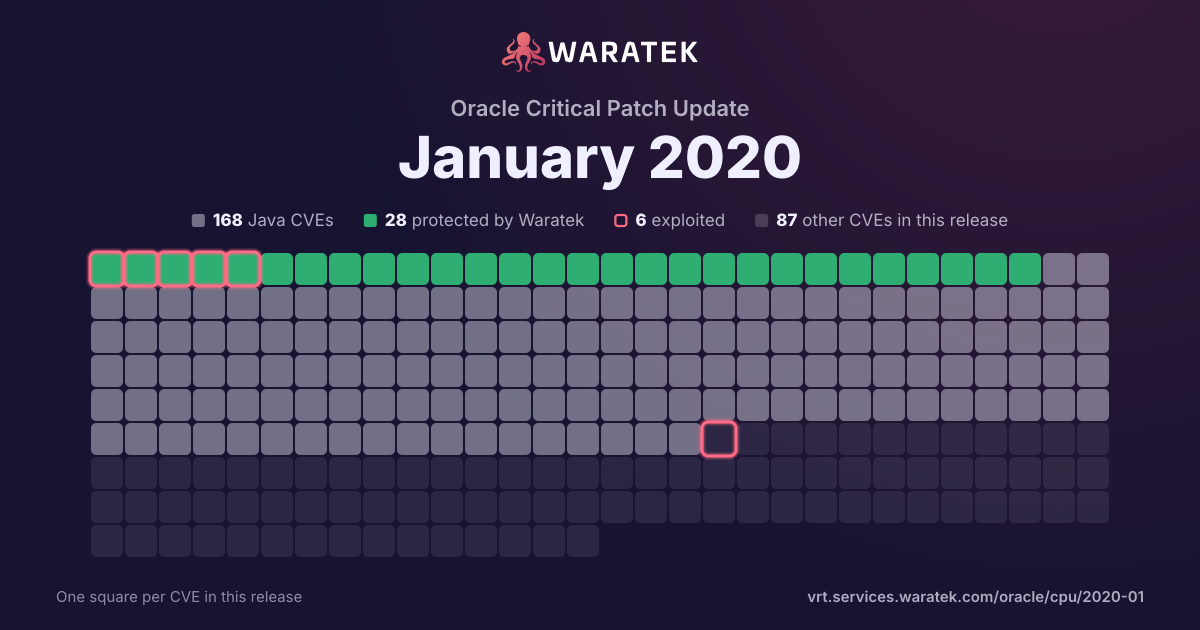
By status
28Protected by Waratek140No exploit published35Outside Waratek scope52Not applicable
6Exploited, marked by the ring
No exploit published. For 132 of them, Oracle's security advisory is the source of public detail.
Protected by Waratek. Waratek RASP can block exploitation of these on systems that have not applied the patch yet.
Overview 162 matches · 110 in Waratek scope · 8 protected · 1 exploited · 0 CISA KEV · 5 public PoC · 2 EPSS ≥ 0.5
162matches
110in Waratek scope67.9%
8protected4.9%
1exploited0.6%
0CISA KEV0.0%
5public PoC3.1%
2EPSS ≥ 0.51.2%
Protected by Waratek
8
4.9%
Rule in development
0
0.0%
Mitigation candidate
0
0.0%
No exploit published
102
63.0%
Outside Waratek scope
20
12.3%
Not applicable
32
19.8%
Withdrawn CVE
0
0.0%
blocked by ARMR today
8
4.9%
partly blocked
0
0.0%
not blocked
154
95.1%
not established
0
0.0%
unrecorded
0
0.0%
split by
peak 145 / year
20121
No exploit published1
Medium1
not blocked1
No public exploit1
20130
20141
Protected by Waratek1
Medium1
blocked by ARMR today1
Working exploit published1
20150
20160
20171
Protected by Waratek1
Medium1
blocked by ARMR today1
No public exploit1
20181
Outside Waratek scope1
Medium1
not blocked1
No public exploit1
201912
Protected by Waratek3
No exploit published1
Outside Waratek scope3
Not applicable5
Medium12
blocked by ARMR today3
not blocked9
Exploited1
Working exploit published1
Proof of concept only1
No public exploit9
2020145
Protected by Waratek2
No exploit published100
Outside Waratek scope16
Not applicable27
Medium145
blocked by ARMR today2
not blocked143
No public exploit145
20211
Protected by Waratek1
Medium1
blocked by ARMR today1
Working exploit published1
2012201320142015201620172018201920202021
| CVE | Severity | Published▾ | Status | Exploitation | Description |
|---|---|---|---|---|---|
| CVE-2020-2597 | Medium | 2020-01-15 | No exploit published | No public exploit | Vulnerability in the Oracle One-to-One Fulfillment product of Oracle E-Business Suite (component: Call Phone Number Page). Supported versions that are affected are 12.1.1-12.1.3 and 12.2.3-12.2.9. Easily exploitable vulnerability allows unauthenticated attacker with network access via HTTPS to compromise Oracle One-to-One Fulfillment. Successful attacks require human interaction from a person other than the attacker and while the vulnerability is in Oracle One-to-One Fulfillment, attacks may significantly impact additional products. Successful attacks of this vulnerability can result in unauthorized update, insert or delete access to some of Oracle One-to-One Fulfillment accessible data. CVSS 3.0 Base Score 4.7 (Integrity impacts). CVSS Vector: (CVSS:3.0/AV:N/AC:L/PR:N/UI:R/S:C/C:N/I:L/A:N). |
| CVE-2020-2596 | Medium | 2020-01-15 | No exploit published | No public exploit | Vulnerability in the Oracle CRM Technical Foundation product of Oracle E-Business Suite (component: Message Hooks). Supported versions that are affected are 12.1.3 and 12.2.3-12.2.9. Easily exploitable vulnerability allows unauthenticated attacker with network access via HTTPS to compromise Oracle CRM Technical Foundation. Successful attacks require human interaction from a person other than the attacker and while the vulnerability is in Oracle CRM Technical Foundation, attacks may significantly impact additional products. Successful attacks of this vulnerability can result in unauthorized update, insert or delete access to some of Oracle CRM Technical Foundation accessible data. CVSS 3.0 Base Score 4.7 (Integrity impacts). CVSS Vector: (CVSS:3.0/AV:N/AC:L/PR:N/UI:R/S:C/C:N/I:L/A:N). |
| CVE-2020-2595 | Medium | 2020-01-15 | No exploit published | No public exploit | Vulnerability in the Oracle GraalVM Enterprise Edition product of Oracle GraalVM (component: GraalVM Compiler). The supported version that is affected is 19.3.0.2. Easily exploitable vulnerability allows unauthenticated attacker with network access via multiple protocols to compromise Oracle GraalVM Enterprise Edition. While the vulnerability is in Oracle GraalVM Enterprise Edition, attacks may significantly impact additional products. Successful attacks of this vulnerability can result in unauthorized read access to a subset of Oracle GraalVM Enterprise Edition accessible data. CVSS 3.0 Base Score 5.8 (Confidentiality impacts). CVSS Vector: (CVSS:3.0/AV:N/AC:L/PR:N/UI:N/S:C/C:L/I:N/A:N). |
| CVE-2020-2593 | Medium | 2020-01-15 | Protected by Waratek | No public exploit | Vulnerability in the Java SE, Java SE Embedded product of Oracle Java SE (component: Networking). Supported versions that are affected are Java SE: 7u241, 8u231, 11.0.5 and 13.0.1; Java SE Embedded: 8u231. Difficult to exploit vulnerability allows unauthenticated attacker with network access via multiple protocols to compromise Java SE, Java SE Embedded. Successful attacks of this vulnerability can result in unauthorized update, insert or delete access to some of Java SE, Java SE Embedded accessible data as well as unauthorized read access to a subset of Java SE, Java SE Embedded accessible data. Note: This vulnerability applies to Java deployments, typically in clients running sandboxed Java Web Start applications or sandboxed Java applets (in Java SE 8), that load and run untrusted code (e.g., code that comes from the internet) and rely on the Java sandbox for security. This vulnerability can also be exploited by using APIs in the specified Component, e.g., through a web service which supplies data to the APIs. CVSS 3.0 Base Score 4.8 (Confidentiality and Integrity impacts). CVSS Vector: (CVSS:3.0/AV:N/AC:H/PR:N/UI:N/S:U/C:L/I:L/A:N). |
| CVE-2020-2592 | Medium | 2020-01-15 | Not applicable | No public exploit | Vulnerability in the Oracle AutoVue product of Oracle Supply Chain (component: Security). The supported version that is affected is 21.0.2. Easily exploitable vulnerability allows unauthenticated attacker with network access via HTTP to compromise Oracle AutoVue. Successful attacks of this vulnerability can result in unauthorized read access to a subset of Oracle AutoVue accessible data. CVSS 3.0 Base Score 5.3 (Confidentiality impacts). CVSS Vector: (CVSS:3.0/AV:N/AC:L/PR:N/UI:N/S:U/C:L/I:N/A:N). |
| CVE-2020-2589 | Medium | 2020-01-15 | Outside Waratek scope | No public exploit | Vulnerability in the MySQL Server product of Oracle MySQL (component: InnoDB). Supported versions that are affected are 5.7.28 and prior and 8.0.17 and prior. Easily exploitable vulnerability allows high privileged attacker with network access via multiple protocols to compromise MySQL Server. Successful attacks of this vulnerability can result in unauthorized ability to cause a hang or frequently repeatable crash (complete DOS) of MySQL Server. CVSS 3.0 Base Score 4.9 (Availability impacts). CVSS Vector: (CVSS:3.0/AV:N/AC:L/PR:H/UI:N/S:U/C:N/I:N/A:H). |
| CVE-2020-2588 | Medium | 2020-01-15 | Outside Waratek scope | No public exploit | Vulnerability in the MySQL Server product of Oracle MySQL (component: Server: DML). Supported versions that are affected are 8.0.18 and prior. Easily exploitable vulnerability allows high privileged attacker with network access via multiple protocols to compromise MySQL Server. Successful attacks of this vulnerability can result in unauthorized ability to cause a hang or frequently repeatable crash (complete DOS) of MySQL Server. CVSS 3.0 Base Score 4.9 (Availability impacts). CVSS Vector: (CVSS:3.0/AV:N/AC:L/PR:H/UI:N/S:U/C:N/I:N/A:H). |
| CVE-2020-2585 | Medium | 2020-01-15 | No exploit published | No public exploit | Vulnerability in the Java SE product of Oracle Java SE (component: JavaFX). The supported version that is affected is Java SE: 8u231. Difficult to exploit vulnerability allows unauthenticated attacker with network access via multiple protocols to compromise Java SE. Successful attacks of this vulnerability can result in unauthorized creation, deletion or modification access to critical data or all Java SE accessible data. Note: This vulnerability applies to Java deployments, typically in clients running sandboxed Java Web Start applications or sandboxed Java applets (in Java SE 8), that load and run untrusted code (e.g., code that comes from the internet) and rely on the Java sandbox for security. This vulnerability can also be exploited by using APIs in the specified Component, e.g., through a web service which supplies data to the APIs. CVSS 3.0 Base Score 5.9 (Integrity impacts). CVSS Vector: (CVSS:3.0/AV:N/AC:H/PR:N/UI:N/S:U/C:N/I:H/A:N). |
| CVE-2020-2584 | Medium | 2020-01-15 | Outside Waratek scope | No public exploit | Vulnerability in the MySQL Server product of Oracle MySQL (component: Server: Options). Supported versions that are affected are 5.7.28 and prior and 8.0.18 and prior. Difficult to exploit vulnerability allows high privileged attacker with network access via multiple protocols to compromise MySQL Server. Successful attacks of this vulnerability can result in unauthorized access to critical data or complete access to all MySQL Server accessible data. CVSS 3.0 Base Score 4.4 (Confidentiality impacts). CVSS Vector: (CVSS:3.0/AV:N/AC:H/PR:H/UI:N/S:U/C:H/I:N/A:N). |
| CVE-2020-2581 | Medium | 2020-01-15 | No exploit published | No public exploit | Vulnerability in the Oracle GraalVM Enterprise Edition product of Oracle GraalVM (component: LLVM Interpreter). The supported version that is affected is 19.3.0.2. Easily exploitable vulnerability allows unauthenticated attacker with logon to the infrastructure where Oracle GraalVM Enterprise Edition executes to compromise Oracle GraalVM Enterprise Edition. Successful attacks of this vulnerability can result in unauthorized ability to cause a partial denial of service (partial DOS) of Oracle GraalVM Enterprise Edition. CVSS 3.0 Base Score 4.0 (Availability impacts). CVSS Vector: (CVSS:3.0/AV:L/AC:L/PR:N/UI:N/S:U/C:N/I:N/A:L). |
| CVE-2020-2580 | Medium | 2020-01-15 | Outside Waratek scope | No public exploit | Vulnerability in the MySQL Server product of Oracle MySQL (component: Server: DDL). Supported versions that are affected are 8.0.17 and prior. Easily exploitable vulnerability allows high privileged attacker with network access via multiple protocols to compromise MySQL Server. Successful attacks of this vulnerability can result in unauthorized ability to cause a hang or frequently repeatable crash (complete DOS) of MySQL Server. CVSS 3.0 Base Score 4.9 (Availability impacts). CVSS Vector: (CVSS:3.0/AV:N/AC:L/PR:H/UI:N/S:U/C:N/I:N/A:H). |
| CVE-2020-2579 | Medium | 2020-01-15 | Outside Waratek scope | No public exploit | Vulnerability in the MySQL Server product of Oracle MySQL (component: Server: Optimizer). Supported versions that are affected are 5.6.46 and prior, 5.7.28 and prior and 8.0.18 and prior. Easily exploitable vulnerability allows low privileged attacker with network access via multiple protocols to compromise MySQL Server. Successful attacks of this vulnerability can result in unauthorized ability to cause a hang or frequently repeatable crash (complete DOS) of MySQL Server. CVSS 3.0 Base Score 6.5 (Availability impacts). CVSS Vector: (CVSS:3.0/AV:N/AC:L/PR:L/UI:N/S:U/C:N/I:N/A:H). |
| CVE-2020-2578 | Medium | 2020-01-15 | Not applicable | No public exploit | Vulnerability in the Oracle Solaris product of Oracle Systems (component: Kernel). The supported version that is affected is 11. Easily exploitable vulnerability allows unauthenticated attacker with network access via SMB to compromise Oracle Solaris. While the vulnerability is in Oracle Solaris, attacks may significantly impact additional products. Successful attacks of this vulnerability can result in unauthorized ability to cause a partial denial of service (partial DOS) of Oracle Solaris. CVSS 3.0 Base Score 5.8 (Availability impacts). CVSS Vector: (CVSS:3.0/AV:N/AC:L/PR:N/UI:N/S:C/C:N/I:N/A:L). |
| CVE-2020-2577 | Medium | 2020-01-15 | Outside Waratek scope | No public exploit | Vulnerability in the MySQL Server product of Oracle MySQL (component: InnoDB). Supported versions that are affected are 5.7.28 and prior and 8.0.18 and prior. Easily exploitable vulnerability allows high privileged attacker with network access via multiple protocols to compromise MySQL Server. Successful attacks of this vulnerability can result in unauthorized ability to cause a hang or frequently repeatable crash (complete DOS) of MySQL Server. CVSS 3.0 Base Score 4.9 (Availability impacts). CVSS Vector: (CVSS:3.0/AV:N/AC:L/PR:H/UI:N/S:U/C:N/I:N/A:H). |
| CVE-2020-2576 | Medium | 2020-01-15 | Not applicable | No public exploit | Vulnerability in the Oracle Outside In Technology product of Oracle Fusion Middleware (component: Outside In Filters). The supported version that is affected is 8.5.4. Easily exploitable vulnerability allows unauthenticated attacker with network access via HTTP to compromise Oracle Outside In Technology. Successful attacks of this vulnerability can result in unauthorized update, insert or delete access to some of Oracle Outside In Technology accessible data and unauthorized ability to cause a partial denial of service (partial DOS) of Oracle Outside In Technology. Note: Outside In Technology is a suite of software development kits (SDKs). The protocol and CVSS score depend on the software that uses the Outside In Technology code. The CVSS score assumes that the software passes data received over a network directly to Outside In Technology code, but if data is not received over a network the CVSS score may be lower. CVSS 3.0 Base Score 6.5 (Integrity and Availability impacts). CVSS Vector: (CVSS:3.0/AV:N/AC:L/PR:N/UI:N/S:U/C:N/I:L/A:L). |
| CVE-2020-2574 | Medium | 2020-01-15 | Outside Waratek scope | No public exploit | Vulnerability in the MySQL Client product of Oracle MySQL (component: C API). Supported versions that are affected are 5.6.46 and prior, 5.7.28 and prior and 8.0.18 and prior. Difficult to exploit vulnerability allows unauthenticated attacker with network access via multiple protocols to compromise MySQL Client. Successful attacks of this vulnerability can result in unauthorized ability to cause a hang or frequently repeatable crash (complete DOS) of MySQL Client. CVSS 3.0 Base Score 5.9 (Availability impacts). CVSS Vector: (CVSS:3.0/AV:N/AC:H/PR:N/UI:N/S:U/C:N/I:N/A:H). |
| CVE-2020-2573 | Medium | 2020-01-15 | Outside Waratek scope | No public exploit | Vulnerability in the MySQL Client product of Oracle MySQL (component: C API). Supported versions that are affected are 5.7.28 and prior and 8.0.18 and prior. Difficult to exploit vulnerability allows unauthenticated attacker with network access via multiple protocols to compromise MySQL Client. Successful attacks of this vulnerability can result in unauthorized ability to cause a hang or frequently repeatable crash (complete DOS) of MySQL Client. CVSS 3.0 Base Score 5.9 (Availability impacts). CVSS Vector: (CVSS:3.0/AV:N/AC:H/PR:N/UI:N/S:U/C:N/I:N/A:H). |
| CVE-2020-2570 | Medium | 2020-01-15 | Not applicable | No public exploit | Vulnerability in the MySQL Client product of Oracle MySQL (component: C API). Supported versions that are affected are 5.7.28 and prior and 8.0.18 and prior. Difficult to exploit vulnerability allows unauthenticated attacker with network access via multiple protocols to compromise MySQL Client. Successful attacks of this vulnerability can result in unauthorized ability to cause a hang or frequently repeatable crash (complete DOS) of MySQL Client. CVSS 3.0 Base Score 5.9 (Availability impacts). CVSS Vector: (CVSS:3.0/AV:N/AC:H/PR:N/UI:N/S:U/C:N/I:N/A:H). |
| CVE-2020-2567 | Medium | 2020-01-15 | No exploit published | No public exploit | Vulnerability in the Oracle Retail Customer Management and Segmentation Foundation product of Oracle Retail Applications (component: Security). The supported version that is affected is 18.0. Easily exploitable vulnerability allows high privileged attacker with network access via HTTP to compromise Oracle Retail Customer Management and Segmentation Foundation. Successful attacks require human interaction from a person other than the attacker and while the vulnerability is in Oracle Retail Customer Management and Segmentation Foundation, attacks may significantly impact additional products. Successful attacks of this vulnerability can result in unauthorized update, insert or delete access to some of Oracle Retail Customer Management and Segmentation Foundation accessible data as well as unauthorized read access to a subset of Oracle Retail Customer Management and Segmentation Foundation accessible data. CVSS 3.0 Base Score 4.8 (Confidentiality and Integrity impacts). CVSS Vector: (CVSS:3.0/AV:N/AC:L/PR:H/UI:R/S:C/C:L/I:L/A:N). |
| CVE-2020-2566 | Medium | 2020-01-15 | No exploit published | No public exploit | Vulnerability in the Oracle Applications Framework product of Oracle E-Business Suite (component: Attachments / File Upload). Supported versions that are affected are 12.1.3 and 12.2.3-12.2.9. Easily exploitable vulnerability allows unauthenticated attacker with network access via HTTPS to compromise Oracle Applications Framework. Successful attacks require human interaction from a person other than the attacker and while the vulnerability is in Oracle Applications Framework, attacks may significantly impact additional products. Successful attacks of this vulnerability can result in unauthorized update, insert or delete access to some of Oracle Applications Framework accessible data. CVSS 3.0 Base Score 4.7 (Integrity impacts). CVSS Vector: (CVSS:3.0/AV:N/AC:L/PR:N/UI:R/S:C/C:N/I:L/A:N). |
| CVE-2020-2564 | Medium | 2020-01-15 | No exploit published | No public exploit | Vulnerability in the Siebel UI Framework product of Oracle Siebel CRM (component: EAI). Supported versions that are affected are 19.10 and prior. Easily exploitable vulnerability allows unauthenticated attacker with network access via HTTP to compromise Siebel UI Framework. Successful attacks of this vulnerability can result in unauthorized read access to a subset of Siebel UI Framework accessible data. CVSS 3.0 Base Score 5.3 (Confidentiality impacts). CVSS Vector: (CVSS:3.0/AV:N/AC:L/PR:N/UI:N/S:U/C:L/I:N/A:N). |
| CVE-2020-2563 | Medium | 2020-01-15 | No exploit published | No public exploit | Vulnerability in the Hyperion Financial Close Management product of Oracle Hyperion (component: Close Manager). The supported version that is affected is 11.1.2.4. Difficult to exploit vulnerability allows high privileged attacker with network access via HTTP to compromise Hyperion Financial Close Management. Successful attacks require human interaction from a person other than the attacker. Successful attacks of this vulnerability can result in unauthorized creation, deletion or modification access to critical data or all Hyperion Financial Close Management accessible data. CVSS 3.0 Base Score 4.2 (Integrity impacts). CVSS Vector: (CVSS:3.0/AV:N/AC:H/PR:H/UI:R/S:U/C:N/I:H/A:N). |
| CVE-2020-2561 | Medium | 2020-01-15 | No exploit published | No public exploit | Vulnerability in the PeopleSoft Enterprise HCM Human Resources product of Oracle PeopleSoft (component: Company Dir / Org Chart Viewer). The supported version that is affected is 9.2. Easily exploitable vulnerability allows low privileged attacker with network access via HTTP to compromise PeopleSoft Enterprise HCM Human Resources. Successful attacks of this vulnerability can result in unauthorized read access to a subset of PeopleSoft Enterprise HCM Human Resources accessible data. CVSS 3.0 Base Score 4.3 (Confidentiality impacts). CVSS Vector: (CVSS:3.0/AV:N/AC:L/PR:L/UI:N/S:U/C:L/I:N/A:N). |
| CVE-2020-2560 | Medium | 2020-01-15 | No exploit published | No public exploit | Vulnerability in the Siebel UI Framework product of Oracle Siebel CRM (component: SWSE Server). Supported versions that are affected are 19.10 and prior. Easily exploitable vulnerability allows unauthenticated attacker with network access via HTTP to compromise Siebel UI Framework. Successful attacks require human interaction from a person other than the attacker and while the vulnerability is in Siebel UI Framework, attacks may significantly impact additional products. Successful attacks of this vulnerability can result in unauthorized read access to a subset of Siebel UI Framework accessible data. CVSS 3.0 Base Score 4.7 (Confidentiality impacts). CVSS Vector: (CVSS:3.0/AV:N/AC:L/PR:N/UI:R/S:C/C:L/I:N/A:N). |
| CVE-2020-2559 | Medium | 2020-01-15 | No exploit published | No public exploit | Vulnerability in the Siebel UI Framework product of Oracle Siebel CRM (component: UIF Open UI). Supported versions that are affected are 19.7 and prior. Easily exploitable vulnerability allows unauthenticated attacker with network access via HTTP to compromise Siebel UI Framework. Successful attacks of this vulnerability can result in unauthorized read access to a subset of Siebel UI Framework accessible data. CVSS 3.0 Base Score 5.3 (Confidentiality impacts). CVSS Vector: (CVSS:3.0/AV:N/AC:L/PR:N/UI:N/S:U/C:L/I:N/A:N). |
| CVE-2020-2558 | Medium | 2020-01-15 | Not applicable | No public exploit | Vulnerability in the Oracle Solaris product of Oracle Systems (component: Kernel). The supported version that is affected is 11. Easily exploitable vulnerability allows unauthenticated attacker with network access via SMB to compromise Oracle Solaris. While the vulnerability is in Oracle Solaris, attacks may significantly impact additional products. Successful attacks of this vulnerability can result in unauthorized ability to cause a partial denial of service (partial DOS) of Oracle Solaris. CVSS 3.0 Base Score 5.8 (Availability impacts). CVSS Vector: (CVSS:3.0/AV:N/AC:L/PR:N/UI:N/S:C/C:N/I:N/A:L). |
| CVE-2020-2557 | Medium | 2020-01-15 | No exploit published | No public exploit | Vulnerability in the Oracle Demantra Demand Management product of Oracle Supply Chain (component: Security). Supported versions that are affected are 12.2.4, 12.2.4.1, 12.2.5 and 12.2.5.1. Easily exploitable vulnerability allows unauthenticated attacker with network access via HTTP to compromise Oracle Demantra Demand Management. Successful attacks require human interaction from a person other than the attacker and while the vulnerability is in Oracle Demantra Demand Management, attacks may significantly impact additional products. Successful attacks of this vulnerability can result in unauthorized update, insert or delete access to some of Oracle Demantra Demand Management accessible data. CVSS 3.0 Base Score 4.7 (Integrity impacts). CVSS Vector: (CVSS:3.0/AV:N/AC:L/PR:N/UI:R/S:C/C:N/I:L/A:N). |
| CVE-2020-2552 | Medium | 2020-01-15 | No exploit published | No public exploit | Vulnerability in the Oracle WebLogic Server product of Oracle Fusion Middleware (component: WLS Core Components). Supported versions that are affected are 10.3.6.0.0 and 12.1.3.0.0. Easily exploitable vulnerability allows high privileged attacker with network access via HTTP to compromise Oracle WebLogic Server. Successful attacks require human interaction from a person other than the attacker and while the vulnerability is in Oracle WebLogic Server, attacks may significantly impact additional products. Successful attacks of this vulnerability can result in unauthorized update, insert or delete access to some of Oracle WebLogic Server accessible data as well as unauthorized read access to a subset of Oracle WebLogic Server accessible data. CVSS 3.0 Base Score 4.8 (Confidentiality and Integrity impacts). CVSS Vector: (CVSS:3.0/AV:N/AC:L/PR:H/UI:R/S:C/C:L/I:L/A:N). |
| CVE-2020-2550 | Medium | 2020-01-15 | No exploit published | No public exploit | Vulnerability in the Oracle WebLogic Server product of Oracle Fusion Middleware (component: WLS Core Components). Supported versions that are affected are 10.3.6.0.0, 12.1.3.0.0, 12.2.1.3.0 and 12.2.1.4.0. Easily exploitable vulnerability allows high privileged attacker with logon to the infrastructure where Oracle WebLogic Server executes to compromise Oracle WebLogic Server. Successful attacks of this vulnerability can result in unauthorized access to critical data or complete access to all Oracle WebLogic Server accessible data as well as unauthorized update, insert or delete access to some of Oracle WebLogic Server accessible data. CVSS 3.0 Base Score 5.1 (Confidentiality and Integrity impacts). CVSS Vector: (CVSS:3.0/AV:L/AC:L/PR:H/UI:N/S:U/C:H/I:L/A:N). |
| CVE-2020-2548 | Medium | 2020-01-15 | No exploit published | No public exploit | Vulnerability in the Oracle WebLogic Server product of Oracle Fusion Middleware (component: WLS Core Components). The supported version that is affected is 10.3.6.0.0. Easily exploitable vulnerability allows high privileged attacker with network access via HTTP to compromise Oracle WebLogic Server. Successful attacks require human interaction from a person other than the attacker and while the vulnerability is in Oracle WebLogic Server, attacks may significantly impact additional products. Successful attacks of this vulnerability can result in unauthorized update, insert or delete access to some of Oracle WebLogic Server accessible data as well as unauthorized read access to a subset of Oracle WebLogic Server accessible data. CVSS 3.0 Base Score 4.8 (Confidentiality and Integrity impacts). CVSS Vector: (CVSS:3.0/AV:N/AC:L/PR:H/UI:R/S:C/C:L/I:L/A:N). |
| CVE-2020-2547 | Medium | 2020-01-15 | No exploit published | No public exploit | Vulnerability in the Oracle WebLogic Server product of Oracle Fusion Middleware (component: Console). Supported versions that are affected are 10.3.6.0.0, 12.1.3.0.0, 12.2.1.3.0 and 12.2.1.4.0. Easily exploitable vulnerability allows high privileged attacker with network access via HTTP to compromise Oracle WebLogic Server. Successful attacks require human interaction from a person other than the attacker and while the vulnerability is in Oracle WebLogic Server, attacks may significantly impact additional products. Successful attacks of this vulnerability can result in unauthorized update, insert or delete access to some of Oracle WebLogic Server accessible data as well as unauthorized read access to a subset of Oracle WebLogic Server accessible data. CVSS 3.0 Base Score 4.8 (Confidentiality and Integrity impacts). CVSS Vector: (CVSS:3.0/AV:N/AC:L/PR:H/UI:R/S:C/C:L/I:L/A:N). |
| CVE-2020-2545 | Medium | 2020-01-15 | No exploit published | No public exploit | Vulnerability in the Oracle HTTP Server product of Oracle Fusion Middleware (component: OSSL Module). Supported versions that are affected are 11.1.1.9.0, 12.1.3.0.0 and 12.2.1.3.0. Easily exploitable vulnerability allows unauthenticated attacker with network access via HTTPS to compromise Oracle HTTP Server. Successful attacks of this vulnerability can result in unauthorized ability to cause a partial denial of service (partial DOS) of Oracle HTTP Server. CVSS 3.0 Base Score 5.3 (Availability impacts). CVSS Vector: (CVSS:3.0/AV:N/AC:L/PR:N/UI:N/S:U/C:N/I:N/A:L). |
| CVE-2020-2544 | Medium | 2020-01-15 | No exploit published | No public exploit | Vulnerability in the Oracle WebLogic Server product of Oracle Fusion Middleware (component: Console). Supported versions that are affected are 10.3.6.0.0, 12.1.3.0.0, 12.2.1.3.0 and 12.2.1.4.0. Easily exploitable vulnerability allows unauthenticated attacker with network access via HTTP to compromise Oracle WebLogic Server. Successful attacks require human interaction from a person other than the attacker. Successful attacks of this vulnerability can result in unauthorized update, insert or delete access to some of Oracle WebLogic Server accessible data. CVSS 3.0 Base Score 4.3 (Integrity impacts). CVSS Vector: (CVSS:3.0/AV:N/AC:L/PR:N/UI:R/S:U/C:N/I:L/A:N). |
| CVE-2020-2542 | Medium | 2020-01-15 | Not applicable | No public exploit | Vulnerability in the Oracle Outside In Technology product of Oracle Fusion Middleware (component: Outside In Filters). The supported version that is affected is 8.5.4. Easily exploitable vulnerability allows unauthenticated attacker with network access via HTTP to compromise Oracle Outside In Technology. Successful attacks of this vulnerability can result in unauthorized update, insert or delete access to some of Oracle Outside In Technology accessible data and unauthorized ability to cause a partial denial of service (partial DOS) of Oracle Outside In Technology. Note: Outside In Technology is a suite of software development kits (SDKs). The protocol and CVSS score depend on the software that uses the Outside In Technology code. The CVSS score assumes that the software passes data received over a network directly to Outside In Technology code, but if data is not received over a network the CVSS score may be lower. CVSS 3.0 Base Score 6.5 (Integrity and Availability impacts). CVSS Vector: (CVSS:3.0/AV:N/AC:L/PR:N/UI:N/S:U/C:N/I:L/A:L). |
| CVE-2020-2541 | Medium | 2020-01-15 | Not applicable | No public exploit | Vulnerability in the Oracle Outside In Technology product of Oracle Fusion Middleware (component: Outside In Filters). The supported version that is affected is 8.5.4. Easily exploitable vulnerability allows unauthenticated attacker with network access via HTTP to compromise Oracle Outside In Technology. Successful attacks of this vulnerability can result in unauthorized update, insert or delete access to some of Oracle Outside In Technology accessible data and unauthorized ability to cause a partial denial of service (partial DOS) of Oracle Outside In Technology. Note: Outside In Technology is a suite of software development kits (SDKs). The protocol and CVSS score depend on the software that uses the Outside In Technology code. The CVSS score assumes that the software passes data received over a network directly to Outside In Technology code, but if data is not received over a network the CVSS score may be lower. CVSS 3.0 Base Score 6.5 (Integrity and Availability impacts). CVSS Vector: (CVSS:3.0/AV:N/AC:L/PR:N/UI:N/S:U/C:N/I:L/A:L). |
| CVE-2020-2540 | Medium | 2020-01-15 | Not applicable | No public exploit | Vulnerability in the Oracle Outside In Technology product of Oracle Fusion Middleware (component: Outside In Filters). The supported version that is affected is 8.5.4. Easily exploitable vulnerability allows unauthenticated attacker with network access via HTTP to compromise Oracle Outside In Technology. Successful attacks of this vulnerability can result in unauthorized update, insert or delete access to some of Oracle Outside In Technology accessible data and unauthorized ability to cause a partial denial of service (partial DOS) of Oracle Outside In Technology. Note: Outside In Technology is a suite of software development kits (SDKs). The protocol and CVSS score depend on the software that uses the Outside In Technology code. The CVSS score assumes that the software passes data received over a network directly to Outside In Technology code, but if data is not received over a network the CVSS score may be lower. CVSS 3.0 Base Score 6.5 (Integrity and Availability impacts). CVSS Vector: (CVSS:3.0/AV:N/AC:L/PR:N/UI:N/S:U/C:N/I:L/A:L). |
| CVE-2020-2539 | Medium | 2020-01-15 | No exploit published | No public exploit | Vulnerability in the Oracle WebCenter Sites product of Oracle Fusion Middleware (component: Advanced UI). The supported version that is affected is 12.2.1.3.0. Easily exploitable vulnerability allows unauthenticated attacker with network access via HTTP to compromise Oracle WebCenter Sites. Successful attacks require human interaction from a person other than the attacker and while the vulnerability is in Oracle WebCenter Sites, attacks may significantly impact additional products. Successful attacks of this vulnerability can result in unauthorized update, insert or delete access to some of Oracle WebCenter Sites accessible data as well as unauthorized read access to a subset of Oracle WebCenter Sites accessible data. CVSS 3.0 Base Score 6.1 (Confidentiality and Integrity impacts). CVSS Vector: (CVSS:3.0/AV:N/AC:L/PR:N/UI:R/S:C/C:L/I:L/A:N). |
| CVE-2020-2536 | Medium | 2020-01-15 | Not applicable | No public exploit | Vulnerability in the Oracle Outside In Technology product of Oracle Fusion Middleware (component: Outside In Filters). The supported version that is affected is 8.5.4. Easily exploitable vulnerability allows unauthenticated attacker with network access via HTTP to compromise Oracle Outside In Technology. Successful attacks require human interaction from a person other than the attacker. Successful attacks of this vulnerability can result in unauthorized update, insert or delete access to some of Oracle Outside In Technology accessible data as well as unauthorized read access to a subset of Oracle Outside In Technology accessible data. Note: Outside In Technology is a suite of software development kits (SDKs). The protocol and CVSS score depend on the software that uses the Outside In Technology code. The CVSS score assumes that the software passes data received over a network directly to Outside In Technology code, but if data is not received over a network the CVSS score may be lower. CVSS 3.0 Base Score 5.4 (Confidentiality and Integrity impacts). CVSS Vector: (CVSS:3.0/AV:N/AC:L/PR:N/UI:R/S:U/C:L/I:L/A:N). |
| CVE-2020-2535 | Medium | 2020-01-15 | No exploit published | No public exploit | Vulnerability in the Oracle Business Intelligence Enterprise Edition product of Oracle Fusion Middleware (component: Analytics Server). Supported versions that are affected are 12.2.1.3.0 and 12.2.1.4.0. Easily exploitable vulnerability allows unauthenticated attacker with network access via HTTP to compromise Oracle Business Intelligence Enterprise Edition. Successful attacks require human interaction from a person other than the attacker and while the vulnerability is in Oracle Business Intelligence Enterprise Edition, attacks may significantly impact additional products. Successful attacks of this vulnerability can result in unauthorized read access to a subset of Oracle Business Intelligence Enterprise Edition accessible data. CVSS 3.0 Base Score 4.7 (Confidentiality impacts). CVSS Vector: (CVSS:3.0/AV:N/AC:L/PR:N/UI:R/S:C/C:L/I:N/A:N). |
| CVE-2020-2534 | Medium | 2020-01-15 | No exploit published | No public exploit | Vulnerability in the Oracle Reports Developer product of Oracle Fusion Middleware (component: Security and Authentication). Supported versions that are affected are 12.2.1.3.0 and 12.2.1.4.0. Easily exploitable vulnerability allows unauthenticated attacker with network access via HTTP to compromise Oracle Reports Developer. Successful attacks require human interaction from a person other than the attacker and while the vulnerability is in Oracle Reports Developer, attacks may significantly impact additional products. Successful attacks of this vulnerability can result in unauthorized update, insert or delete access to some of Oracle Reports Developer accessible data as well as unauthorized read access to a subset of Oracle Reports Developer accessible data. CVSS 3.0 Base Score 6.1 (Confidentiality and Integrity impacts). CVSS Vector: (CVSS:3.0/AV:N/AC:L/PR:N/UI:R/S:C/C:L/I:L/A:N). |
| CVE-2020-2533 | Medium | 2020-01-15 | No exploit published | No public exploit | Vulnerability in the Oracle Reports Developer product of Oracle Fusion Middleware (component: Security and Authentication). Supported versions that are affected are 12.2.1.3.0 and 12.2.1.4.0. Easily exploitable vulnerability allows unauthenticated attacker with network access via HTTP to compromise Oracle Reports Developer. Successful attacks require human interaction from a person other than the attacker and while the vulnerability is in Oracle Reports Developer, attacks may significantly impact additional products. Successful attacks of this vulnerability can result in unauthorized update, insert or delete access to some of Oracle Reports Developer accessible data as well as unauthorized read access to a subset of Oracle Reports Developer accessible data. CVSS 3.0 Base Score 6.1 (Confidentiality and Integrity impacts). CVSS Vector: (CVSS:3.0/AV:N/AC:L/PR:N/UI:R/S:C/C:L/I:L/A:N). |
| CVE-2020-2530 | Medium | 2020-01-15 | No exploit published | No public exploit | Vulnerability in the Oracle HTTP Server product of Oracle Fusion Middleware (component: Web Listener). Supported versions that are affected are 11.1.1.9.0, 12.1.3.0.0 and 12.2.1.3.0. Easily exploitable vulnerability allows unauthenticated attacker with network access via HTTP to compromise Oracle HTTP Server. Successful attacks require human interaction from a person other than the attacker and while the vulnerability is in Oracle HTTP Server, attacks may significantly impact additional products. Successful attacks of this vulnerability can result in unauthorized update, insert or delete access to some of Oracle HTTP Server accessible data as well as unauthorized read access to a subset of Oracle HTTP Server accessible data. CVSS 3.0 Base Score 6.1 (Confidentiality and Integrity impacts). CVSS Vector: (CVSS:3.0/AV:N/AC:L/PR:N/UI:R/S:C/C:L/I:L/A:N). |
| CVE-2020-2527 | Medium | 2020-01-15 | Outside Waratek scope | No public exploit | Vulnerability in the Core RDBMS component of Oracle Database Server. Supported versions that are affected are 12.1.0.2, 12.2.0.1, 18c and 19c. Easily exploitable vulnerability allows high privileged attacker having Create Index, Create Table privilege with network access via OracleNet to compromise Core RDBMS. While the vulnerability is in Core RDBMS, attacks may significantly impact additional products. Successful attacks of this vulnerability can result in unauthorized read access to a subset of Core RDBMS accessible data. CVSS 3.0 Base Score 4.1 (Confidentiality impacts). CVSS Vector: (CVSS:3.0/AV:N/AC:L/PR:H/UI:N/S:C/C:L/I:N/A:N). |
| CVE-2020-2519 | Medium | 2020-01-15 | No exploit published | No public exploit | Vulnerability in the Oracle WebLogic Server product of Oracle Fusion Middleware (component: Console). Supported versions that are affected are 10.3.6.0.0, 12.1.3.0.0, 12.2.1.3.0 and 12.2.1.4.0. Easily exploitable vulnerability allows unauthenticated attacker with network access via HTTP to compromise Oracle WebLogic Server. Successful attacks require human interaction from a person other than the attacker. Successful attacks of this vulnerability can result in unauthorized ability to cause a partial denial of service (partial DOS) of Oracle WebLogic Server. CVSS 3.0 Base Score 4.3 (Availability impacts). CVSS Vector: (CVSS:3.0/AV:N/AC:L/PR:N/UI:R/S:U/C:N/I:N/A:L). |
| CVE-2020-2515 | Medium | 2020-01-15 | Outside Waratek scope | No public exploit | Vulnerability in the Database Gateway for ODBC component of Oracle Database Server. Supported versions that are affected are 11.2.0.4, 12.1.0.2, 12.2.0.1, 18c and 19c. Difficult to exploit vulnerability allows low privileged attacker having Create Session privilege with network access via OracleNet to compromise Database Gateway for ODBC. Successful attacks of this vulnerability can result in unauthorized update, insert or delete access to some of Database Gateway for ODBC accessible data as well as unauthorized read access to a subset of Database Gateway for ODBC accessible data and unauthorized ability to cause a partial denial of service (partial DOS) of Database Gateway for ODBC. CVSS 3.0 Base Score 5.0 (Confidentiality, Integrity and Availability impacts). CVSS Vector: (CVSS:3.0/AV:N/AC:H/PR:L/UI:N/S:U/C:L/I:L/A:L). |
| CVE-2020-2512 | Medium | 2020-01-15 | Outside Waratek scope | No public exploit | Vulnerability in the Database Gateway for ODBC component of Oracle Database Server. Supported versions that are affected are 11.2.0.4, 12.1.0.2, 12.2.0.1, 18c and 19c. Difficult to exploit vulnerability allows unauthenticated attacker with network access via OracleNet to compromise Database Gateway for ODBC. Successful attacks of this vulnerability can result in unauthorized ability to cause a hang or frequently repeatable crash (complete DOS) of Database Gateway for ODBC. CVSS 3.0 Base Score 5.9 (Availability impacts). CVSS Vector: (CVSS:3.0/AV:N/AC:H/PR:N/UI:N/S:U/C:N/I:N/A:H). |
| CVE-2019-15845 | Medium | 2019-11-26 | Not applicable | No public exploit | Ruby through 2.4.7, 2.5.x through 2.5.6, and 2.6.x through 2.6.4 mishandles path checking within File.fnmatch functions. |
| CVE-2019-12415 | Medium | 2019-10-23 | Protected by Waratek | No public exploit | In Apache POI up to 4.1.0, when using the tool XSSFExportToXml to convert user-provided Microsoft Excel documents, a specially crafted document can allow an attacker to read files from the local filesystem or from internal network resources via XML External Entity (XXE) Processing. |
| CVE-2019-17091 | Medium | 2019-10-02 | Protected by Waratek | No public exploit | faces/context/PartialViewContextImpl.java in Eclipse Mojarra, as used in Mojarra for Eclipse EE4J before 2.3.10 and Mojarra JavaServer Faces before 2.2.20, allows Reflected XSS because a client window field is mishandled. |
| CVE-2019-10092 | Medium | 2019-09-26 | Outside Waratek scope | Working exploit published | In Apache HTTP Server 2.4.0-2.4.39, a limited cross-site scripting issue was reported affecting the mod_proxy error page. An attacker could cause the link on the error page to be malformed and instead point to a page of their choice. This would only be exploitable where a server was set up with proxying enabled but was misconfigured in such a way that the Proxy Error page was displayed. |
| CVE-2019-1547 | Medium | 2019-09-10 | Not applicable | No public exploit | Normally in OpenSSL EC groups always have a co-factor present and this is used in side channel resistant code paths. However, in some cases, it is possible to construct a group using explicit parameters (instead of using a named curve). In those cases it is possible that such a group does not have the cofactor present. This can occur even where all the parameters match a known named curve. If such a curve is used then OpenSSL falls back to non-side channel resistant code paths which may result in full key recovery during an ECDSA signature operation. In order to be vulnerable an attacker would have to have the ability to time the creation of a large number of signatures where explicit parameters with no co-factor present are in use by an application using libcrypto. For the avoidance of doubt libssl is not vulnerable because explicit parameters are never used. Fixed in OpenSSL 1.1.1d (Affected 1.1.1-1.1.1c). Fixed in OpenSSL 1.1.0l (Affected 1.1.0-1.1.0k). Fixed in OpenSSL 1.0.2t (Affected 1.0.2-1.0.2s). |
| CVE-2019-16168 | Medium | 2019-09-09 | Not applicable | No public exploit | In SQLite through 3.29.0, whereLoopAddBtreeIndex in sqlite3.c can crash a browser or other application because of missing validation of a sqlite_stat1 sz field, aka a "severe division by zero in the query planner." |
| CVE-2019-13118 | Medium | 2019-07-01 | Not applicable | No public exploit | In numbers.c in libxslt 1.1.33, a type holding grouping characters of an xsl:number instruction was too narrow and an invalid character/length combination could be passed to xsltNumberFormatDecimal, leading to a read of uninitialized stack data. |
| CVE-2019-13117 | Medium | 2019-07-01 | Not applicable | No public exploit | In numbers.c in libxslt 1.1.33, an xsl:number with certain format strings could lead to a uninitialized read in xsltNumberFormatInsertNumbers. This could allow an attacker to discern whether a byte on the stack contains the characters A, a, I, i, or 0, or any other character. |
| CVE-2019-12814 | Medium | 2019-06-19 | Protected by Waratek | Proof of concept only | A Polymorphic Typing issue was discovered in FasterXML jackson-databind 2.x through 2.9.9. When Default Typing is enabled (either globally or for a specific property) for an externally exposed JSON endpoint and the service has JDOM 1.x or 2.x jar in the classpath, an attacker can send a specifically crafted JSON message that allows them to read arbitrary local files on the server. |
| CVE-2019-10247 | Medium | 2019-04-22 | No exploit published | No public exploit | In Eclipse Jetty version 7.x, 8.x, 9.2.27 and older, 9.3.26 and older, and 9.4.16 and older, the server running on any OS and Jetty version combination will reveal the configured fully qualified directory base resource location on the output of the 404 error for not finding a Context that matches the requested path. The default server behavior on jetty-distribution and jetty-home will include at the end of the Handler tree a DefaultHandler, which is responsible for reporting this 404 error, it presents the various configured contexts as HTML for users to click through to. This produced HTML includes output that contains the configured fully qualified directory base resource location for each context. |
| CVE-2019-11358 | Medium | 2019-04-20 | Outside Waratek scope | Exploited | jQuery before 3.4.0, as used in Drupal, Backdrop CMS, and other products, mishandles jQuery.extend(true, {}, ...) because of Object.prototype pollution. If an unsanitized source object contained an enumerable __proto__ property, it could extend the native Object.prototype. |
| CVE-2019-1559 | Medium | 2019-02-27 | Outside Waratek scope | No public exploit | If an application encounters a fatal protocol error and then calls SSL_shutdown() twice (once to send a close_notify, and once to receive one) then OpenSSL can respond differently to the calling application if a 0 byte record is received with invalid padding compared to if a 0 byte record is received with an invalid MAC. If the application then behaves differently based on that in a way that is detectable to the remote peer, then this amounts to a padding oracle that could be used to decrypt data. In order for this to be exploitable "non-stitched" ciphersuites must be in use. Stitched ciphersuites are optimised implementations of certain commonly used ciphersuites. Also the application must call SSL_shutdown() twice even if a protocol error has occurred (applications should not do this but some do anyway). Fixed in OpenSSL 1.0.2r (Affected 1.0.2-1.0.2q). |
| CVE-2018-0734 | Medium | 2018-10-30 | Outside Waratek scope | No public exploit | The OpenSSL DSA signature algorithm has been shown to be vulnerable to a timing side channel attack. An attacker could use variations in the signing algorithm to recover the private key. Fixed in OpenSSL 1.1.1a (Affected 1.1.1). Fixed in OpenSSL 1.1.0j (Affected 1.1.0-1.1.0i). Fixed in OpenSSL 1.0.2q (Affected 1.0.2-1.0.2p). |
| CVE-2017-14735 | Medium | 2017-09-25 | Protected by Waratek | No public exploit | OWASP AntiSamy before 1.5.7 allows XSS via HTML5 entities, as demonstrated by use of : to construct a javascript: URL. |
| CVE-2014-3004 | Medium | 2014-06-11 | Protected by Waratek | Working exploit published | The default configuration for the Xerces SAX Parser in Castor before 1.3.3 allows context-dependent attackers to conduct XML External Entity (XXE) attacks via a crafted XML document. |
| CVE-2012-1695 | Medium | 2012-05-03 | No exploit published | No public exploit | Unspecified vulnerability in the Oracle JRockit component in Oracle Fusion Middleware 28.2.2 and earlier, and JDK/JRE 5 and 6 27.7.1 and earlier, allows remote attackers to affect confidentiality, integrity, and availability via unknown vectors. |