
Oracle Critical Patch Update January 2020
Released January 2020 · Oracle's advisory ↗ · ← Critical Patch Update, October 2019 · Critical Patch Update, April 2020 →
255 CVEs in this release, one square each
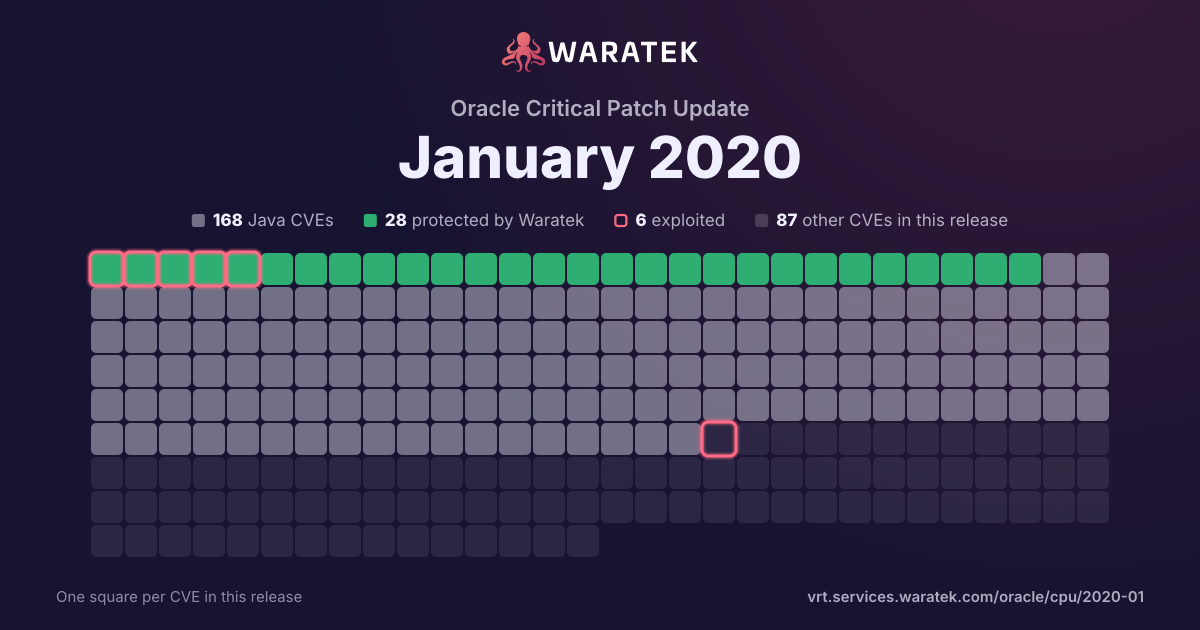
By status
29Protected by Waratek1Mitigation candidate142No exploit published10Outside Waratek scope73Not applicable
6Exploited, marked by the ring
No exploit published. For 130 of them, Oracle's security advisory is the source of public detail.
Protected by Waratek. Waratek RASP can block exploitation of these on systems that have not applied the patch yet.
Overview 26 matches · 0 protected · 0 exploited · 0 CISA KEV · 0 public PoC · 0 EPSS ≥ 0.5
26matches
0protected0.0%
0exploited0.0%
0CISA KEV0.0%
0public PoC0.0%
0EPSS ≥ 0.50.0%
Protected by Waratek
0
0.0%
Rule in development
0
0.0%
Mitigation candidate
0
0.0%
No exploit published
26
100.0%
blocked by ARMR today
0
0.0%
partly blocked
0
0.0%
not blocked
26
100.0%
not established
0
0.0%
unrecorded
0
0.0%
Exploited
0
0.0%
Working exploit published
0
0.0%
Proof of concept only
0
0.0%
Forecast only
0
0.0%
No public exploit
26
100.0%
| CVE | Severity | Published▾ | Status | Exploitation | Description |
|---|---|---|---|---|---|
| CVE-2020-2730 | Medium | 2020-01-15 | No exploit published | No public exploit | Vulnerability in the Oracle Financial Services Revenue Management and Billing product of Oracle Financial Services Applications (component: File Upload). Supported versions that are affected are 2.7.0.0, 2.7.0.1 and 2.8.0.0. Easily exploitable vulnerability allows low privileged attacker with network access via HTTP to compromise Oracle Financial Services Revenue Management and Billing. Successful attacks require human interaction from a person other than the attacker and while the vulnerability is in Oracle Financial Services Revenue Management and Billing, attacks may significantly impact additional products. Successful attacks of this vulnerability can result in unauthorized update, insert or delete access to some of Oracle Financial Services Revenue Management and Billing accessible data as well as unauthorized read access to a subset of Oracle Financial Services Revenue Management and Billing accessible data. CVSS 3.0 Base Score 5.4 (Confidentiality and Integrity impacts). CVSS Vector: (CVSS:3.0/AV:N/AC:L/PR:L/UI:R/S:C/C:L/I:L/A:N). |
| CVE-2020-2724 | Medium | 2020-01-15 | No exploit published | No public exploit | Vulnerability in the Oracle FLEXCUBE Investor Servicing product of Oracle Financial Services Applications (component: Infrastructure). Supported versions that are affected are 12.1.0-12.4.0 and 14.0.0-14.1.0. Easily exploitable vulnerability allows low privileged attacker with network access via HTTP to compromise Oracle FLEXCUBE Investor Servicing. Successful attacks of this vulnerability can result in unauthorized read access to a subset of Oracle FLEXCUBE Investor Servicing accessible data. CVSS 3.0 Base Score 4.3 (Confidentiality impacts). CVSS Vector: (CVSS:3.0/AV:N/AC:L/PR:L/UI:N/S:U/C:L/I:N/A:N). |
| CVE-2020-2723 | High | 2020-01-15 | No exploit published | No public exploit | Vulnerability in the Oracle FLEXCUBE Investor Servicing product of Oracle Financial Services Applications (component: Infrastructure). Supported versions that are affected are 12.1.0-12.4.0 and 14.0.0-14.1.0. Easily exploitable vulnerability allows low privileged attacker with network access via HTTP to compromise Oracle FLEXCUBE Investor Servicing. Successful attacks of this vulnerability can result in unauthorized access to critical data or complete access to all Oracle FLEXCUBE Investor Servicing accessible data as well as unauthorized update, insert or delete access to some of Oracle FLEXCUBE Investor Servicing accessible data. CVSS 3.0 Base Score 7.1 (Confidentiality and Integrity impacts). CVSS Vector: (CVSS:3.0/AV:N/AC:L/PR:L/UI:N/S:U/C:H/I:L/A:N). |
| CVE-2020-2722 | Medium | 2020-01-15 | No exploit published | No public exploit | Vulnerability in the Oracle FLEXCUBE Investor Servicing product of Oracle Financial Services Applications (component: Infrastructure). Supported versions that are affected are 12.1.0-12.4.0 and 14.0.0-14.1.0. Easily exploitable vulnerability allows unauthenticated attacker with network access via HTTP to compromise Oracle FLEXCUBE Investor Servicing. Successful attacks require human interaction from a person other than the attacker. Successful attacks of this vulnerability can result in unauthorized update, insert or delete access to some of Oracle FLEXCUBE Investor Servicing accessible data as well as unauthorized read access to a subset of Oracle FLEXCUBE Investor Servicing accessible data. CVSS 3.0 Base Score 5.4 (Confidentiality and Integrity impacts). CVSS Vector: (CVSS:3.0/AV:N/AC:L/PR:N/UI:R/S:U/C:L/I:L/A:N). |
| CVE-2020-2721 | Medium | 2020-01-15 | No exploit published | No public exploit | Vulnerability in the Oracle FLEXCUBE Investor Servicing product of Oracle Financial Services Applications (component: Infrastructure). Supported versions that are affected are 12.1.0-12.4.0 and 14.0.0-14.1.0. Easily exploitable vulnerability allows low privileged attacker with network access via HTTP to compromise Oracle FLEXCUBE Investor Servicing. Successful attacks of this vulnerability can result in unauthorized access to critical data or complete access to all Oracle FLEXCUBE Investor Servicing accessible data. CVSS 3.0 Base Score 6.5 (Confidentiality impacts). CVSS Vector: (CVSS:3.0/AV:N/AC:L/PR:L/UI:N/S:U/C:H/I:N/A:N). |
| CVE-2020-2720 | Medium | 2020-01-15 | No exploit published | No public exploit | Vulnerability in the Oracle FLEXCUBE Investor Servicing product of Oracle Financial Services Applications (component: Infrastructure). Supported versions that are affected are 12.1.0-12.4.0 and 14.0.0-14.1.0. Easily exploitable vulnerability allows low privileged attacker with network access via HTTP to compromise Oracle FLEXCUBE Investor Servicing. Successful attacks of this vulnerability can result in unauthorized update, insert or delete access to some of Oracle FLEXCUBE Investor Servicing accessible data as well as unauthorized read access to a subset of Oracle FLEXCUBE Investor Servicing accessible data. CVSS 3.0 Base Score 5.4 (Confidentiality and Integrity impacts). CVSS Vector: (CVSS:3.0/AV:N/AC:L/PR:L/UI:N/S:U/C:L/I:L/A:N). |
| CVE-2020-2719 | Medium | 2020-01-15 | No exploit published | No public exploit | Vulnerability in the Oracle Banking Corporate Lending product of Oracle Financial Services Applications (component: Core). Supported versions that are affected are 12.3.0-12.4.0 and 14.0.0-14.3.0. Easily exploitable vulnerability allows low privileged attacker with network access via HTTP to compromise Oracle Banking Corporate Lending. Successful attacks of this vulnerability can result in unauthorized read access to a subset of Oracle Banking Corporate Lending accessible data. CVSS 3.0 Base Score 4.3 (Confidentiality impacts). CVSS Vector: (CVSS:3.0/AV:N/AC:L/PR:L/UI:N/S:U/C:L/I:N/A:N). |
| CVE-2020-2718 | High | 2020-01-15 | No exploit published | No public exploit | Vulnerability in the Oracle Banking Corporate Lending product of Oracle Financial Services Applications (component: Core). Supported versions that are affected are 12.3.0-12.4.0 and 14.0.0-14.3.0. Easily exploitable vulnerability allows low privileged attacker with network access via HTTP to compromise Oracle Banking Corporate Lending. Successful attacks of this vulnerability can result in unauthorized access to critical data or complete access to all Oracle Banking Corporate Lending accessible data as well as unauthorized update, insert or delete access to some of Oracle Banking Corporate Lending accessible data. CVSS 3.0 Base Score 7.1 (Confidentiality and Integrity impacts). CVSS Vector: (CVSS:3.0/AV:N/AC:L/PR:L/UI:N/S:U/C:H/I:L/A:N). |
| CVE-2020-2717 | Medium | 2020-01-15 | No exploit published | No public exploit | Vulnerability in the Oracle Banking Corporate Lending product of Oracle Financial Services Applications (component: Core). Supported versions that are affected are 12.3.0-12.4.0 and 14.0.0-14.3.0. Easily exploitable vulnerability allows unauthenticated attacker with network access via HTTP to compromise Oracle Banking Corporate Lending. Successful attacks require human interaction from a person other than the attacker. Successful attacks of this vulnerability can result in unauthorized update, insert or delete access to some of Oracle Banking Corporate Lending accessible data as well as unauthorized read access to a subset of Oracle Banking Corporate Lending accessible data. CVSS 3.0 Base Score 5.4 (Confidentiality and Integrity impacts). CVSS Vector: (CVSS:3.0/AV:N/AC:L/PR:N/UI:R/S:U/C:L/I:L/A:N). |
| CVE-2020-2716 | Medium | 2020-01-15 | No exploit published | No public exploit | Vulnerability in the Oracle Banking Corporate Lending product of Oracle Financial Services Applications (component: Core). Supported versions that are affected are 12.3.0-12.4.0 and 14.0.0-14.3.0. Easily exploitable vulnerability allows low privileged attacker with network access via HTTP to compromise Oracle Banking Corporate Lending. Successful attacks of this vulnerability can result in unauthorized access to critical data or complete access to all Oracle Banking Corporate Lending accessible data. CVSS 3.0 Base Score 6.5 (Confidentiality impacts). CVSS Vector: (CVSS:3.0/AV:N/AC:L/PR:L/UI:N/S:U/C:H/I:N/A:N). |
| CVE-2020-2715 | Medium | 2020-01-15 | No exploit published | No public exploit | Vulnerability in the Oracle Banking Corporate Lending product of Oracle Financial Services Applications (component: Core). Supported versions that are affected are 12.3.0-12.4.0 and 14.0.0-14.3.0. Easily exploitable vulnerability allows low privileged attacker with network access via HTTP to compromise Oracle Banking Corporate Lending. Successful attacks of this vulnerability can result in unauthorized update, insert or delete access to some of Oracle Banking Corporate Lending accessible data as well as unauthorized read access to a subset of Oracle Banking Corporate Lending accessible data. CVSS 3.0 Base Score 5.4 (Confidentiality and Integrity impacts). CVSS Vector: (CVSS:3.0/AV:N/AC:L/PR:L/UI:N/S:U/C:L/I:L/A:N). |
| CVE-2020-2714 | Medium | 2020-01-15 | No exploit published | No public exploit | Vulnerability in the Oracle Banking Payments product of Oracle Financial Services Applications (component: Core). Supported versions that are affected are 14.1.0-14.3.0. Easily exploitable vulnerability allows low privileged attacker with network access via HTTP to compromise Oracle Banking Payments. Successful attacks of this vulnerability can result in unauthorized read access to a subset of Oracle Banking Payments accessible data. CVSS 3.0 Base Score 4.3 (Confidentiality impacts). CVSS Vector: (CVSS:3.0/AV:N/AC:L/PR:L/UI:N/S:U/C:L/I:N/A:N). |
| CVE-2020-2713 | High | 2020-01-15 | No exploit published | No public exploit | Vulnerability in the Oracle Banking Payments product of Oracle Financial Services Applications (component: Core). Supported versions that are affected are 14.1.0-14.3.0. Easily exploitable vulnerability allows low privileged attacker with network access via HTTP to compromise Oracle Banking Payments. Successful attacks of this vulnerability can result in unauthorized access to critical data or complete access to all Oracle Banking Payments accessible data as well as unauthorized update, insert or delete access to some of Oracle Banking Payments accessible data. CVSS 3.0 Base Score 7.1 (Confidentiality and Integrity impacts). CVSS Vector: (CVSS:3.0/AV:N/AC:L/PR:L/UI:N/S:U/C:H/I:L/A:N). |
| CVE-2020-2712 | Medium | 2020-01-15 | No exploit published | No public exploit | Vulnerability in the Oracle Banking Payments product of Oracle Financial Services Applications (component: Core). Supported versions that are affected are 14.1.0-14.3.0. Easily exploitable vulnerability allows unauthenticated attacker with network access via HTTP to compromise Oracle Banking Payments. Successful attacks require human interaction from a person other than the attacker. Successful attacks of this vulnerability can result in unauthorized update, insert or delete access to some of Oracle Banking Payments accessible data as well as unauthorized read access to a subset of Oracle Banking Payments accessible data. CVSS 3.0 Base Score 5.4 (Confidentiality and Integrity impacts). CVSS Vector: (CVSS:3.0/AV:N/AC:L/PR:N/UI:R/S:U/C:L/I:L/A:N). |
| CVE-2020-2711 | Medium | 2020-01-15 | No exploit published | No public exploit | Vulnerability in the Oracle Banking Payments product of Oracle Financial Services Applications (component: Core). Supported versions that are affected are 14.1.0-14.3.0. Easily exploitable vulnerability allows low privileged attacker with network access via HTTP to compromise Oracle Banking Payments. Successful attacks of this vulnerability can result in unauthorized access to critical data or complete access to all Oracle Banking Payments accessible data. CVSS 3.0 Base Score 6.5 (Confidentiality impacts). CVSS Vector: (CVSS:3.0/AV:N/AC:L/PR:L/UI:N/S:U/C:H/I:N/A:N). |
| CVE-2020-2710 | Medium | 2020-01-15 | No exploit published | No public exploit | Vulnerability in the Oracle Banking Payments product of Oracle Financial Services Applications (component: Core). Supported versions that are affected are 14.1.0-14.3.0. Easily exploitable vulnerability allows low privileged attacker with network access via HTTP to compromise Oracle Banking Payments. Successful attacks of this vulnerability can result in unauthorized update, insert or delete access to some of Oracle Banking Payments accessible data as well as unauthorized read access to a subset of Oracle Banking Payments accessible data. CVSS 3.0 Base Score 5.4 (Confidentiality and Integrity impacts). CVSS Vector: (CVSS:3.0/AV:N/AC:L/PR:L/UI:N/S:U/C:L/I:L/A:N). |
| CVE-2020-2700 | Medium | 2020-01-15 | No exploit published | No public exploit | Vulnerability in the Oracle FLEXCUBE Universal Banking product of Oracle Financial Services Applications (component: Infrastructure). Supported versions that are affected are 12.0.1-12.4.0 and 14.0.0-14.3.0. Easily exploitable vulnerability allows low privileged attacker with network access via HTTP to compromise Oracle FLEXCUBE Universal Banking. Successful attacks of this vulnerability can result in unauthorized read access to a subset of Oracle FLEXCUBE Universal Banking accessible data. CVSS 3.0 Base Score 4.3 (Confidentiality impacts). CVSS Vector: (CVSS:3.0/AV:N/AC:L/PR:L/UI:N/S:U/C:L/I:N/A:N). |
| CVE-2020-2699 | High | 2020-01-15 | No exploit published | No public exploit | Vulnerability in the Oracle FLEXCUBE Universal Banking product of Oracle Financial Services Applications (component: Infrastructure). Supported versions that are affected are 12.0.1-12.4.0 and 14.0.0-14.3.0. Easily exploitable vulnerability allows low privileged attacker with network access via HTTP to compromise Oracle FLEXCUBE Universal Banking. Successful attacks of this vulnerability can result in unauthorized access to critical data or complete access to all Oracle FLEXCUBE Universal Banking accessible data as well as unauthorized update, insert or delete access to some of Oracle FLEXCUBE Universal Banking accessible data. CVSS 3.0 Base Score 7.1 (Confidentiality and Integrity impacts). CVSS Vector: (CVSS:3.0/AV:N/AC:L/PR:L/UI:N/S:U/C:H/I:L/A:N). |
| CVE-2020-2688 | High | 2020-01-15 | No exploit published | No public exploit | Vulnerability in the Oracle Financial Services Analytical Applications Infrastructure product of Oracle Financial Services Applications (component: Object Migration). Supported versions that are affected are 8.0.4-8.0.8. Easily exploitable vulnerability allows low privileged attacker with network access via HTTP to compromise Oracle Financial Services Analytical Applications Infrastructure. Successful attacks of this vulnerability can result in unauthorized access to critical data or complete access to all Oracle Financial Services Analytical Applications Infrastructure accessible data as well as unauthorized update, insert or delete access to some of Oracle Financial Services Analytical Applications Infrastructure accessible data. CVSS 3.0 Base Score 7.1 (Confidentiality and Integrity impacts). CVSS Vector: (CVSS:3.0/AV:N/AC:L/PR:L/UI:N/S:U/C:H/I:L/A:N). |
| CVE-2020-2685 | Medium | 2020-01-15 | No exploit published | No public exploit | Vulnerability in the Oracle FLEXCUBE Universal Banking product of Oracle Financial Services Applications (component: Infrastructure). Supported versions that are affected are 12.0.1-12.4.0 and 14.0.0-14.3.0. Easily exploitable vulnerability allows unauthenticated attacker with network access via HTTP to compromise Oracle FLEXCUBE Universal Banking. Successful attacks require human interaction from a person other than the attacker. Successful attacks of this vulnerability can result in unauthorized update, insert or delete access to some of Oracle FLEXCUBE Universal Banking accessible data as well as unauthorized read access to a subset of Oracle FLEXCUBE Universal Banking accessible data. CVSS 3.0 Base Score 5.4 (Confidentiality and Integrity impacts). CVSS Vector: (CVSS:3.0/AV:N/AC:L/PR:N/UI:R/S:U/C:L/I:L/A:N). |
| CVE-2020-2684 | Medium | 2020-01-15 | No exploit published | No public exploit | Vulnerability in the Oracle FLEXCUBE Universal Banking product of Oracle Financial Services Applications (component: Infrastructure). Supported versions that are affected are 12.0.1-12.4.0 and 14.0.0-14.3.0. Easily exploitable vulnerability allows low privileged attacker with network access via HTTP to compromise Oracle FLEXCUBE Universal Banking. Successful attacks of this vulnerability can result in unauthorized access to critical data or complete access to all Oracle FLEXCUBE Universal Banking accessible data. CVSS 3.0 Base Score 6.5 (Confidentiality impacts). CVSS Vector: (CVSS:3.0/AV:N/AC:L/PR:L/UI:N/S:U/C:H/I:N/A:N). |
| CVE-2020-2683 | Medium | 2020-01-15 | No exploit published | No public exploit | Vulnerability in the Oracle FLEXCUBE Universal Banking product of Oracle Financial Services Applications (component: Infrastructure). Supported versions that are affected are 12.0.1-12.4.0 and 14.0.0-14.3.0. Easily exploitable vulnerability allows low privileged attacker with network access via HTTPS to compromise Oracle FLEXCUBE Universal Banking. Successful attacks of this vulnerability can result in unauthorized update, insert or delete access to some of Oracle FLEXCUBE Universal Banking accessible data as well as unauthorized read access to a subset of Oracle FLEXCUBE Universal Banking accessible data. CVSS 3.0 Base Score 5.4 (Confidentiality and Integrity impacts). CVSS Vector: (CVSS:3.0/AV:N/AC:L/PR:L/UI:N/S:U/C:L/I:L/A:N). |
| CVE-2019-12419 | Critical | 2019-11-06 | No exploit published | No public exploit | Apache CXF before 3.3.4 and 3.2.11 provides all of the components that are required to build a fully fledged OpenId Connect service. There is a vulnerability in the access token services, where it does not validate that the authenticated principal is equal to that of the supplied clientId parameter in the request. If a malicious client was able to somehow steal an authorization code issued to another client, then they could exploit this vulnerability to obtain an access token for the other client. |
| CVE-2019-2904 | Critical | 2019-10-16 | No exploit published | No public exploit | Vulnerability in the Oracle JDeveloper and ADF product of Oracle Fusion Middleware (component: ADF Faces). Supported versions that are affected are 11.1.1.9.0, 12.1.3.0.0 and 12.2.1.3.0. Easily exploitable vulnerability allows unauthenticated attacker with network access via HTTP to compromise Oracle JDeveloper and ADF. Successful attacks of this vulnerability can result in takeover of Oracle JDeveloper and ADF. CVSS 3.0 Base Score 9.8 (Confidentiality, Integrity and Availability impacts). CVSS Vector: (CVSS:3.0/AV:N/AC:L/PR:N/UI:N/S:U/C:H/I:H/A:H). |
| CVE-2019-17359 | High | 2019-10-08 | No exploit published | No public exploit | The ASN.1 parser in Bouncy Castle Crypto (aka BC Java) 1.63 can trigger a large attempted memory allocation, and resultant OutOfMemoryError error, via crafted ASN.1 data. This is fixed in 1.64. |
| CVE-2019-16943 | Critical | 2019-10-01 | No exploit published | No public exploit | A Polymorphic Typing issue was discovered in FasterXML jackson-databind 2.0.0 through 2.9.10. When Default Typing is enabled (either globally or for a specific property) for an externally exposed JSON endpoint and the service has the p6spy (3.8.6) jar in the classpath, and an attacker can find an RMI service endpoint to access, it is possible to make the service execute a malicious payload. This issue exists because of com.p6spy.engine.spy.P6DataSource mishandling. |