
Oracle Critical Patch Update January 2020
Released January 2020 · Oracle's advisory ↗ · ← Critical Patch Update, October 2019 · Critical Patch Update, April 2020 →
255 CVEs in this release, one square each
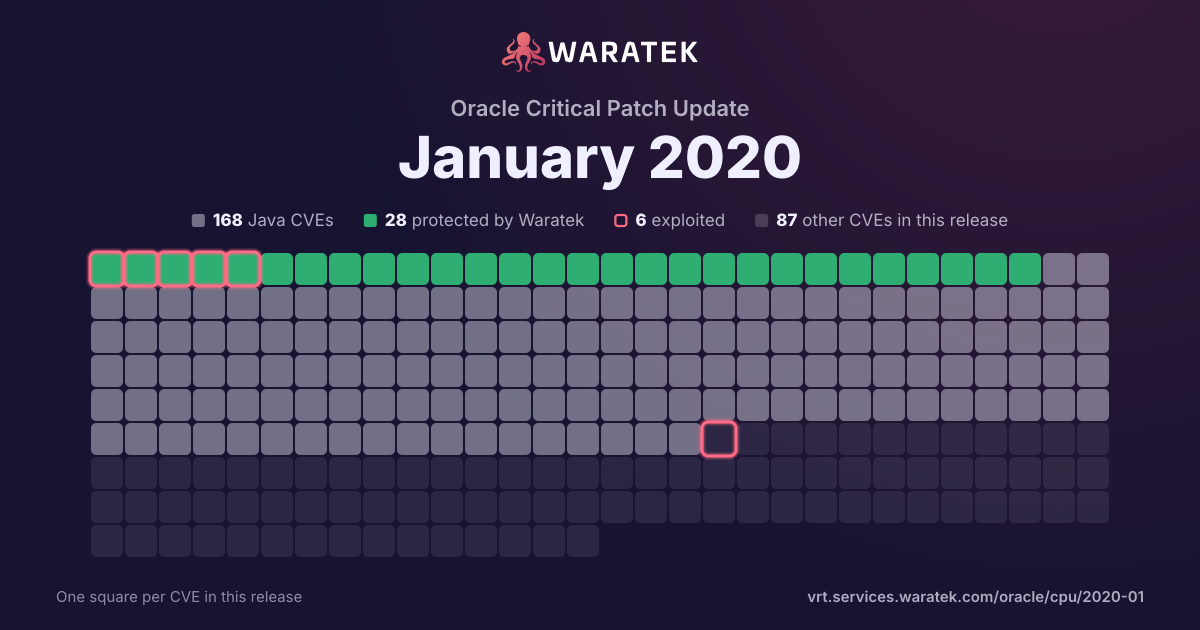
By status
28Protected by Waratek140No exploit published35Outside Waratek scope52Not applicable
6Exploited, marked by the ring
No exploit published. For 132 of them, Oracle's security advisory is the source of public detail.
Protected by Waratek. Waratek RASP can block exploitation of these on systems that have not applied the patch yet.
Overview 5 matches · 0 protected · 0 exploited · 0 CISA KEV · 0 public PoC · 0 EPSS ≥ 0.5
5matches
0protected0.0%
0exploited0.0%
0CISA KEV0.0%
0public PoC0.0%
0EPSS ≥ 0.50.0%
Protected by Waratek
0
0.0%
Rule in development
0
0.0%
Mitigation candidate
0
0.0%
No exploit published
5
100.0%
blocked by ARMR today
0
0.0%
partly blocked
0
0.0%
not blocked
5
100.0%
not established
0
0.0%
unrecorded
0
0.0%
Exploited
0
0.0%
Working exploit published
0
0.0%
Proof of concept only
0
0.0%
Forecast only
0
0.0%
No public exploit
5
100.0%
split by
peak 3 / year
20122013201420152016201720182019
| CVE | Severity | Published▾ | Status | Exploitation | Description |
|---|---|---|---|---|---|
| CVE-2019-10247 | Medium | 2019-04-22 | No exploit published | No public exploit | In Eclipse Jetty version 7.x, 8.x, 9.2.27 and older, 9.3.26 and older, and 9.4.16 and older, the server running on any OS and Jetty version combination will reveal the configured fully qualified directory base resource location on the output of the 404 error for not finding a Context that matches the requested path. The default server behavior on jetty-distribution and jetty-home will include at the end of the Handler tree a DefaultHandler, which is responsible for reporting this 404 error, it presents the various configured contexts as HTML for users to click through to. This produced HTML includes output that contains the configured fully qualified directory base resource location for each context. |
| CVE-2018-8039 | High | 2018-07-02 | No exploit published | No public exploit | It is possible to configure Apache CXF to use the com.sun.net.ssl implementation via 'System.setProperty("java.protocol.handler.pkgs", "com.sun.net.ssl.internal.www.protocol");'. When this system property is set, CXF uses some reflection to try to make the HostnameVerifier work with the old com.sun.net.ssl.HostnameVerifier interface. However, the default HostnameVerifier implementation in CXF does not implement the method in this interface, and an exception is thrown. However, in Apache CXF prior to 3.2.5 and 3.1.16 the exception is caught in the reflection code and not properly propagated. What this means is that if you are using the com.sun.net.ssl stack with CXF, an error with TLS hostname verification will not be thrown, leaving a CXF client subject to man-in-the-middle attacks. |
| CVE-2018-1258 | High | 2018-05-11 | No exploit published | No public exploit | Spring Framework version 5.0.5 when used in combination with any versions of Spring Security contains an authorization bypass when using method security. An unauthorized malicious user can gain unauthorized access to methods that should be restricted. |
| CVE-2017-12626 | High | 2018-01-29 | No exploit published | No public exploit | Apache POI in versions prior to release 3.17 are vulnerable to Denial of Service Attacks: 1) Infinite Loops while parsing crafted WMF, EMF, MSG and macros (POI bugs 61338 and 61294), and 2) Out of Memory Exceptions while parsing crafted DOC, PPT and XLS (POI bugs 52372 and 61295). |
| CVE-2012-1695 | Medium | 2012-05-03 | No exploit published | No public exploit | Unspecified vulnerability in the Oracle JRockit component in Oracle Fusion Middleware 28.2.2 and earlier, and JDK/JRE 5 and 6 27.7.1 and earlier, allows remote attackers to affect confidentiality, integrity, and availability via unknown vectors. |