
Oracle Critical Patch Update October 2019
Released October 2019 · Oracle's advisory ↗ · ← Critical Patch Update, July 2019 · Critical Patch Update, January 2020 →
180 CVEs in this release, one square each
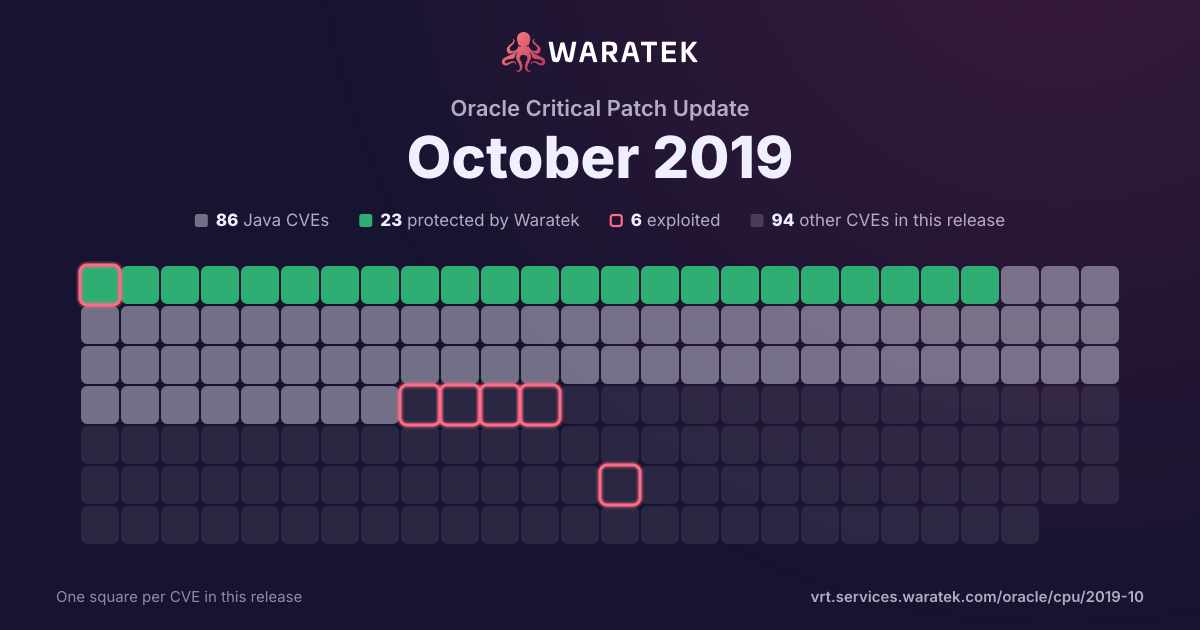
By status
24Protected by Waratek5Mitigation candidate65No exploit published17Outside Waratek scope69Not applicable
6Exploited, marked by the ring
No exploit published. For 56 of them, Oracle's security advisory is the source of public detail.
Protected by Waratek. Waratek RASP can block exploitation of these on systems that have not applied the patch yet.
Overview 6 matches · 4 in Waratek scope · 0 protected · 2 exploited · 0 CISA KEV · 2 public PoC · 1 EPSS ≥ 0.5
6matches
4in Waratek scope66.7%
0protected0.0%
2exploited33.3%
0CISA KEV0.0%
2public PoC33.3%
1EPSS ≥ 0.516.7%
Protected by Waratek
0
0.0%
Rule in development
0
0.0%
Mitigation candidate
2
33.3%
No exploit published
2
33.3%
Outside Waratek scope
0
0.0%
Not applicable
2
33.3%
Withdrawn CVE
0
0.0%
blocked by ARMR today
0
0.0%
partly blocked
0
0.0%
not blocked
6
100.0%
not established
0
0.0%
unrecorded
0
0.0%
Exploited
2
33.3%
Working exploit published
1
16.7%
Proof of concept only
0
0.0%
Forecast only
0
0.0%
No public exploit
3
50.0%
split by
peak 1 / quarter
Q1 171
No exploit published1
Medium1
not blocked1
No public exploit1
Q2 170
Q3 170
Q4 171
Not applicable1
Medium1
not blocked1
No public exploit1
Q1 181
Mitigation candidate1
Medium1
not blocked1
Exploited1
Q2 180
Q3 181
No exploit published1
Medium1
not blocked1
No public exploit1
Q4 181
Mitigation candidate1
Medium1
not blocked1
Working exploit published1
Q1 191
Not applicable1
Medium1
not blocked1
Exploited1
Q1 17Q2 17Q3 17Q4 17Q1 18Q2 18Q3 18Q4 18Q1 19
| CVE | Severity | Published▾ | Status | Exploitation | Description |
|---|---|---|---|---|---|
| CVE-2019-6109 | Medium | 2019-01-31 | Not applicable | Exploited | An issue was discovered in OpenSSH 7.9. Due to missing character encoding in the progress display, a malicious server (or Man-in-The-Middle attacker) can employ crafted object names to manipulate the client output, e.g., by using ANSI control codes to hide additional files being transferred. This affects refresh_progress_meter() in progressmeter.c. |
| CVE-2018-11784 | Medium | 2018-10-04 | Mitigation candidate | Working exploit published | When the default servlet in Apache Tomcat versions 9.0.0.M1 to 9.0.11, 8.5.0 to 8.5.33 and 7.0.23 to 7.0.90 returned a redirect to a directory (e.g. redirecting to '/foo/' when the user requested '/foo') a specially crafted URL could be used to cause the redirect to be generated to any URI of the attackers choice. |
| CVE-2018-8037 | Medium | 2018-08-02 | No exploit published | No public exploit | If an async request was completed by the application at the same time as the container triggered the async timeout, a race condition existed that could result in a user seeing a response intended for a different user. An additional issue was present in the NIO and NIO2 connectors that did not correctly track the closure of the connection when an async request was completed by the application and timed out by the container at the same time. This could also result in a user seeing a response intended for another user. Versions Affected: Apache Tomcat 9.0.0.M9 to 9.0.9 and 8.5.5 to 8.5.31. |
| CVE-2015-9251 | Medium | 2018-01-18 | Mitigation candidate | Exploited | jQuery before 3.0.0 is vulnerable to Cross-site Scripting (XSS) attacks when a cross-domain Ajax request is performed without the dataType option, causing text/javascript responses to be executed. |
| CVE-2017-17558 | Medium | 2017-12-12 | Not applicable | No public exploit | The usb_destroy_configuration function in drivers/usb/core/config.c in the USB core subsystem in the Linux kernel through 4.14.5 does not consider the maximum number of configurations and interfaces before attempting to release resources, which allows local users to cause a denial of service (out-of-bounds write access) or possibly have unspecified other impact via a crafted USB device. |
| CVE-2016-7103 | Medium | 2017-03-15 | No exploit published | No public exploit | Cross-site scripting (XSS) vulnerability in jQuery UI before 1.12.0 might allow remote attackers to inject arbitrary web script or HTML via the closeText parameter of the dialog function. |