
Oracle Critical Patch Update October 2019
Released October 2019 · Oracle's advisory ↗ · ← Critical Patch Update, July 2019 · Critical Patch Update, January 2020 →
180 CVEs in this release, one square each
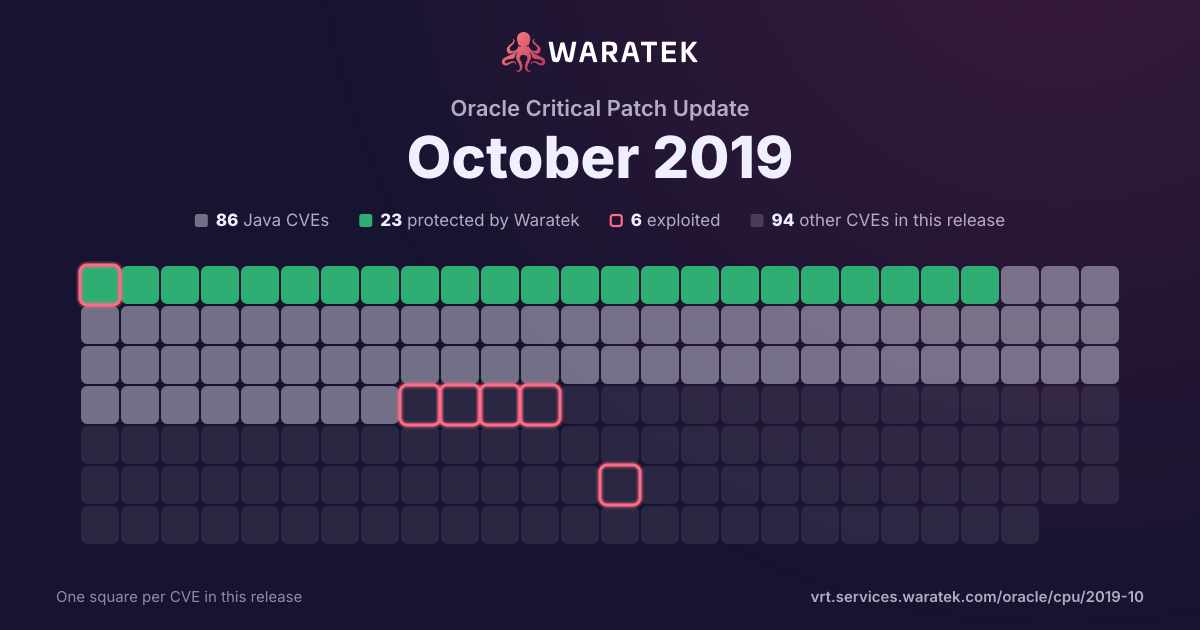
By status
24Protected by Waratek5Mitigation candidate65No exploit published17Outside Waratek scope69Not applicable
6Exploited, marked by the ring
No exploit published. For 56 of them, Oracle's security advisory is the source of public detail.
Protected by Waratek. Waratek RASP can block exploitation of these on systems that have not applied the patch yet.
Overview 33 matches · 19 in Waratek scope · 1 protected · 1 exploited · 1 CISA KEV · 2 public PoC · 2 EPSS ≥ 0.5
33matches
19in Waratek scope57.6%
1protected3.0%
1exploited3.0%
1CISA KEV3.0%
2public PoC6.1%
2EPSS ≥ 0.56.1%
Protected by Waratek
1
3.0%
Rule in development
0
0.0%
Mitigation candidate
0
0.0%
No exploit published
18
54.5%
Outside Waratek scope
0
0.0%
Not applicable
14
42.4%
Withdrawn CVE
0
0.0%
blocked by ARMR today
1
3.0%
partly blocked
0
0.0%
not blocked
32
97.0%
not established
0
0.0%
unrecorded
0
0.0%
Exploited
1
3.0%
Working exploit published
0
0.0%
Proof of concept only
1
3.0%
Forecast only
2
6.1%
No public exploit
29
87.9%
split by
peak 29 / month
Jun 191
No exploit published1
High1
not blocked1
Forecast only1
Jul 191
Not applicable1
High1
not blocked1
No public exploit1
Aug 192
Not applicable2
High2
not blocked2
Forecast only1
No public exploit1
Sep 190
Oct 1929
Protected by Waratek1
No exploit published17
Not applicable11
High29
blocked by ARMR today1
not blocked28
Exploited1
Proof of concept only1
No public exploit27
Jun 19Jul 19Aug 19Sep 19Oct 19
| CVE | Severity | Published▾ | Status | Exploitation | Description |
|---|---|---|---|---|---|
| CVE-2019-3028 | High | 2019-10-16 | Not applicable | No public exploit | Vulnerability in the Oracle VM VirtualBox product of Oracle Virtualization (component: Core). Supported versions that are affected are Prior to 5.2.34 and prior to 6.0.14. Easily exploitable vulnerability allows low privileged attacker with logon to the infrastructure where Oracle VM VirtualBox executes to compromise Oracle VM VirtualBox. While the vulnerability is in Oracle VM VirtualBox, attacks may significantly impact additional products. Successful attacks of this vulnerability can result in takeover of Oracle VM VirtualBox. CVSS 3.0 Base Score 8.8 (Confidentiality, Integrity and Availability impacts). CVSS Vector: (CVSS:3.0/AV:L/AC:L/PR:L/UI:N/S:C/C:H/I:H/A:H). |
| CVE-2019-3017 | High | 2019-10-16 | Not applicable | No public exploit | Vulnerability in the Oracle VM VirtualBox product of Oracle Virtualization (component: Core). Supported versions that are affected are Prior to 5.2.34 and prior to 6.0.14. Easily exploitable vulnerability allows high privileged attacker with logon to the infrastructure where Oracle VM VirtualBox executes to compromise Oracle VM VirtualBox. While the vulnerability is in Oracle VM VirtualBox, attacks may significantly impact additional products. Successful attacks of this vulnerability can result in takeover of Oracle VM VirtualBox. CVSS 3.0 Base Score 8.2 (Confidentiality, Integrity and Availability impacts). CVSS Vector: (CVSS:3.0/AV:L/AC:L/PR:H/UI:N/S:C/C:H/I:H/A:H). |
| CVE-2019-3010 | High | 2019-10-16 | Not applicable | Exploited | Vulnerability in the Oracle Solaris product of Oracle Systems (component: XScreenSaver). The supported version that is affected is 11. Easily exploitable vulnerability allows low privileged attacker with logon to the infrastructure where Oracle Solaris executes to compromise Oracle Solaris. While the vulnerability is in Oracle Solaris, attacks may significantly impact additional products. Successful attacks of this vulnerability can result in takeover of Oracle Solaris. CVSS 3.0 Base Score 8.8 (Confidentiality, Integrity and Availability impacts). CVSS Vector: (CVSS:3.0/AV:L/AC:L/PR:L/UI:N/S:C/C:H/I:H/A:H). |
| CVE-2019-3000 | High | 2019-10-16 | No exploit published | No public exploit | Vulnerability in the Oracle Marketing product of Oracle E-Business Suite (component: Marketing Administration). Supported versions that are affected are 12.1.1-12.1.3 and 12.2.3-12.2.9. Easily exploitable vulnerability allows unauthenticated attacker with network access via HTTP to compromise Oracle Marketing. Successful attacks require human interaction from a person other than the attacker and while the vulnerability is in Oracle Marketing, attacks may significantly impact additional products. Successful attacks of this vulnerability can result in unauthorized access to critical data or complete access to all Oracle Marketing accessible data as well as unauthorized update, insert or delete access to some of Oracle Marketing accessible data. CVSS 3.0 Base Score 8.2 (Confidentiality and Integrity impacts). CVSS Vector: (CVSS:3.0/AV:N/AC:L/PR:N/UI:R/S:C/C:H/I:L/A:N). |
| CVE-2019-2995 | High | 2019-10-16 | No exploit published | No public exploit | Vulnerability in the Oracle Marketing product of Oracle E-Business Suite (component: Marketing Administration). Supported versions that are affected are 12.1.1-12.1.3 and 12.2.3-12.2.9. Easily exploitable vulnerability allows unauthenticated attacker with network access via HTTP to compromise Oracle Marketing. Successful attacks require human interaction from a person other than the attacker and while the vulnerability is in Oracle Marketing, attacks may significantly impact additional products. Successful attacks of this vulnerability can result in unauthorized access to critical data or complete access to all Oracle Marketing accessible data as well as unauthorized update, insert or delete access to some of Oracle Marketing accessible data. CVSS 3.0 Base Score 8.2 (Confidentiality and Integrity impacts). CVSS Vector: (CVSS:3.0/AV:N/AC:L/PR:N/UI:R/S:C/C:H/I:L/A:N). |
| CVE-2019-2994 | High | 2019-10-16 | No exploit published | No public exploit | Vulnerability in the Oracle Marketing product of Oracle E-Business Suite (component: Marketing Administration). Supported versions that are affected are 12.1.1-12.1.3. Easily exploitable vulnerability allows unauthenticated attacker with network access via HTTP to compromise Oracle Marketing. Successful attacks require human interaction from a person other than the attacker and while the vulnerability is in Oracle Marketing, attacks may significantly impact additional products. Successful attacks of this vulnerability can result in unauthorized access to critical data or complete access to all Oracle Marketing accessible data as well as unauthorized update, insert or delete access to some of Oracle Marketing accessible data. CVSS 3.0 Base Score 8.2 (Confidentiality and Integrity impacts). CVSS Vector: (CVSS:3.0/AV:N/AC:L/PR:N/UI:R/S:C/C:H/I:L/A:N). |
| CVE-2019-2990 | High | 2019-10-16 | No exploit published | No public exploit | Vulnerability in the Oracle iStore product of Oracle E-Business Suite (component: Order Tracker). Supported versions that are affected are 12.1.1-12.1.3 and 12.2.3-12.2.9. Easily exploitable vulnerability allows unauthenticated attacker with network access via HTTP to compromise Oracle iStore. Successful attacks require human interaction from a person other than the attacker and while the vulnerability is in Oracle iStore, attacks may significantly impact additional products. Successful attacks of this vulnerability can result in unauthorized access to critical data or complete access to all Oracle iStore accessible data as well as unauthorized update, insert or delete access to some of Oracle iStore accessible data. CVSS 3.0 Base Score 8.2 (Confidentiality and Integrity impacts). CVSS Vector: (CVSS:3.0/AV:N/AC:L/PR:N/UI:R/S:C/C:H/I:L/A:N). |
| CVE-2019-2986 | High | 2019-10-16 | No exploit published | No public exploit | Vulnerability in the Oracle GraalVM Enterprise Edition product of Oracle GraalVM (component: LLVM Interpreter). The supported version that is affected is 19.2.0. Easily exploitable vulnerability allows low privileged attacker with network access via multiple protocols to compromise Oracle GraalVM Enterprise Edition. While the vulnerability is in Oracle GraalVM Enterprise Edition, attacks may significantly impact additional products. Successful attacks of this vulnerability can result in unauthorized ability to cause a hang or frequently repeatable crash (complete DOS) of Oracle GraalVM Enterprise Edition. CVSS 3.0 Base Score 7.7 (Availability impacts). CVSS Vector: (CVSS:3.0/AV:N/AC:L/PR:L/UI:N/S:C/C:N/I:N/A:H). |
| CVE-2019-2972 | High | 2019-10-16 | Not applicable | No public exploit | Vulnerability in the Oracle Outside In Technology product of Oracle Fusion Middleware (component: Outside In Filters). The supported version that is affected is 8.5.4. Easily exploitable vulnerability allows unauthenticated attacker with network access via HTTP to compromise Oracle Outside In Technology. Successful attacks of this vulnerability can result in unauthorized update, insert or delete access to some of Oracle Outside In Technology accessible data as well as unauthorized read access to a subset of Oracle Outside In Technology accessible data and unauthorized ability to cause a partial denial of service (partial DOS) of Oracle Outside In Technology. Note: Outside In Technology is a suite of software development kits (SDKs). The protocol and CVSS score depend on the software that uses the Outside In Technology code. The CVSS score assumes that the software passes data received over a network directly to Outside In Technology code, but if data is not received over a network the CVSS score may be lower. CVSS 3.0 Base Score 7.3 (Confidentiality, Integrity and Availability impacts). CVSS Vector: (CVSS:3.0/AV:N/AC:L/PR:N/UI:N/S:U/C:L/I:L/A:L). |
| CVE-2019-2971 | High | 2019-10-16 | Not applicable | No public exploit | Vulnerability in the Oracle Outside In Technology product of Oracle Fusion Middleware (component: Outside In Filters). The supported version that is affected is 8.5.4. Easily exploitable vulnerability allows unauthenticated attacker with network access via HTTP to compromise Oracle Outside In Technology. Successful attacks of this vulnerability can result in unauthorized update, insert or delete access to some of Oracle Outside In Technology accessible data as well as unauthorized read access to a subset of Oracle Outside In Technology accessible data and unauthorized ability to cause a partial denial of service (partial DOS) of Oracle Outside In Technology. Note: Outside In Technology is a suite of software development kits (SDKs). The protocol and CVSS score depend on the software that uses the Outside In Technology code. The CVSS score assumes that the software passes data received over a network directly to Outside In Technology code, but if data is not received over a network the CVSS score may be lower. CVSS 3.0 Base Score 7.3 (Confidentiality, Integrity and Availability impacts). CVSS Vector: (CVSS:3.0/AV:N/AC:L/PR:N/UI:N/S:U/C:L/I:L/A:L). |
| CVE-2019-2970 | High | 2019-10-16 | Not applicable | No public exploit | Vulnerability in the Oracle Outside In Technology product of Oracle Fusion Middleware (component: Outside In Filters). The supported version that is affected is 8.5.4. Easily exploitable vulnerability allows unauthenticated attacker with network access via HTTP to compromise Oracle Outside In Technology. Successful attacks of this vulnerability can result in unauthorized update, insert or delete access to some of Oracle Outside In Technology accessible data as well as unauthorized read access to a subset of Oracle Outside In Technology accessible data and unauthorized ability to cause a partial denial of service (partial DOS) of Oracle Outside In Technology. Note: Outside In Technology is a suite of software development kits (SDKs). The protocol and CVSS score depend on the software that uses the Outside In Technology code. The CVSS score assumes that the software passes data received over a network directly to Outside In Technology code, but if data is not received over a network the CVSS score may be lower. CVSS 3.0 Base Score 7.3 (Confidentiality, Integrity and Availability impacts). CVSS Vector: (CVSS:3.0/AV:N/AC:L/PR:N/UI:N/S:U/C:L/I:L/A:L). |
| CVE-2019-2965 | High | 2019-10-16 | No exploit published | No public exploit | Vulnerability in the Siebel Core - DB Deployment and Configuration product of Oracle Siebel CRM (component: Install - Configuration). Supported versions that are affected are 19.8 and prior. Easily exploitable vulnerability allows unauthenticated attacker with network access via HTTP to compromise Siebel Core - DB Deployment and Configuration. Successful attacks of this vulnerability can result in unauthorized access to critical data or complete access to all Siebel Core - DB Deployment and Configuration accessible data. CVSS 3.0 Base Score 7.5 (Confidentiality impacts). CVSS Vector: (CVSS:3.0/AV:N/AC:L/PR:N/UI:N/S:U/C:H/I:N/A:N). |
| CVE-2019-2953 | High | 2019-10-16 | Not applicable | No public exploit | Vulnerability in the Oracle Hospitality Cruise Dining Room Management product of Oracle Hospitality Applications (component: Web Service). The supported version that is affected is 8.0.80. Easily exploitable vulnerability allows low privileged attacker with network access via HTTP to compromise Oracle Hospitality Cruise Dining Room Management. Successful attacks of this vulnerability can result in unauthorized access to critical data or complete access to all Oracle Hospitality Cruise Dining Room Management accessible data as well as unauthorized update, insert or delete access to some of Oracle Hospitality Cruise Dining Room Management accessible data. CVSS 3.0 Base Score 7.1 (Confidentiality and Integrity impacts). CVSS Vector: (CVSS:3.0/AV:N/AC:L/PR:L/UI:N/S:U/C:H/I:L/A:N). |
| CVE-2019-2947 | High | 2019-10-16 | No exploit published | No public exploit | Vulnerability in the Oracle Hospitality Reporting and Analytics component of Oracle Food and Beverage Applications. The supported version that is affected is 9.1.0. Easily exploitable vulnerability allows low privileged attacker having Inventory Integration privilege with network access via HTTP to compromise Oracle Hospitality Reporting and Analytics. Successful attacks of this vulnerability can result in unauthorized access to critical data or complete access to all Oracle Hospitality Reporting and Analytics accessible data as well as unauthorized update, insert or delete access to some of Oracle Hospitality Reporting and Analytics accessible data. CVSS 3.0 Base Score 7.1 (Confidentiality and Integrity impacts). CVSS Vector: (CVSS:3.0/AV:N/AC:L/PR:L/UI:N/S:U/C:H/I:L/A:N). |
| CVE-2019-2944 | High | 2019-10-16 | Not applicable | No public exploit | Vulnerability in the Oracle VM VirtualBox product of Oracle Virtualization (component: Core). Supported versions that are affected are Prior to 5.2.34 and prior to 6.0.14. Easily exploitable vulnerability allows high privileged attacker with logon to the infrastructure where Oracle VM VirtualBox executes to compromise Oracle VM VirtualBox. While the vulnerability is in Oracle VM VirtualBox, attacks may significantly impact additional products. Successful attacks of this vulnerability can result in unauthorized ability to cause a hang or frequently repeatable crash (complete DOS) of Oracle VM VirtualBox as well as unauthorized update, insert or delete access to some of Oracle VM VirtualBox accessible data and unauthorized read access to a subset of Oracle VM VirtualBox accessible data. CVSS 3.0 Base Score 7.3 (Confidentiality, Integrity and Availability impacts). CVSS Vector: (CVSS:3.0/AV:L/AC:L/PR:H/UI:N/S:C/C:L/I:L/A:H). |
| CVE-2019-2942 | High | 2019-10-16 | No exploit published | No public exploit | Vulnerability in the Oracle Advanced Outbound Telephony product of Oracle E-Business Suite (component: User Interface). Supported versions that are affected are 12.1.1-12.1.3 and 12.2.3-12.2.8. Easily exploitable vulnerability allows unauthenticated attacker with network access via HTTP to compromise Oracle Advanced Outbound Telephony. Successful attacks require human interaction from a person other than the attacker and while the vulnerability is in Oracle Advanced Outbound Telephony, attacks may significantly impact additional products. Successful attacks of this vulnerability can result in unauthorized access to critical data or complete access to all Oracle Advanced Outbound Telephony accessible data as well as unauthorized update, insert or delete access to some of Oracle Advanced Outbound Telephony accessible data. CVSS 3.0 Base Score 8.2 (Confidentiality and Integrity impacts). CVSS Vector: (CVSS:3.0/AV:N/AC:L/PR:N/UI:R/S:C/C:H/I:L/A:N). |
| CVE-2019-2937 | High | 2019-10-16 | No exploit published | No public exploit | Vulnerability in the Oracle Hospitality Reporting and Analytics component of Oracle Food and Beverage Applications. The supported version that is affected is 9.1.0. Easily exploitable vulnerability allows low privileged attacker having Admin - Configuration privilege with network access via HTTP to compromise Oracle Hospitality Reporting and Analytics. Successful attacks of this vulnerability can result in unauthorized creation, deletion or modification access to critical data or all Oracle Hospitality Reporting and Analytics accessible data as well as unauthorized access to critical data or complete access to all Oracle Hospitality Reporting and Analytics accessible data. CVSS 3.0 Base Score 8.1 (Confidentiality and Integrity impacts). CVSS Vector: (CVSS:3.0/AV:N/AC:L/PR:L/UI:N/S:U/C:H/I:H/A:N). |
| CVE-2019-2934 | High | 2019-10-16 | No exploit published | No public exploit | Vulnerability in the Oracle Hospitality Reporting and Analytics component of Oracle Food and Beverage Applications. The supported version that is affected is 9.1.0. Easily exploitable vulnerability allows low privileged attacker having Admin - Configuration privilege with network access via HTTP to compromise Oracle Hospitality Reporting and Analytics. Successful attacks of this vulnerability can result in unauthorized creation, deletion or modification access to critical data or all Oracle Hospitality Reporting and Analytics accessible data as well as unauthorized access to critical data or complete access to all Oracle Hospitality Reporting and Analytics accessible data. CVSS 3.0 Base Score 8.1 (Confidentiality and Integrity impacts). CVSS Vector: (CVSS:3.0/AV:N/AC:L/PR:L/UI:N/S:U/C:H/I:H/A:N). |
| CVE-2019-2932 | High | 2019-10-16 | No exploit published | No public exploit | Vulnerability in the PeopleSoft Enterprise PeopleTools product of Oracle PeopleSoft (component: Tree Manager). Supported versions that are affected are 8.56 and 8.57. Easily exploitable vulnerability allows low privileged attacker with network access via HTTP to compromise PeopleSoft Enterprise PeopleTools. While the vulnerability is in PeopleSoft Enterprise PeopleTools, attacks may significantly impact additional products. Successful attacks of this vulnerability can result in unauthorized access to critical data or complete access to all PeopleSoft Enterprise PeopleTools accessible data. CVSS 3.0 Base Score 7.7 (Confidentiality impacts). CVSS Vector: (CVSS:3.0/AV:N/AC:L/PR:L/UI:N/S:C/C:H/I:N/A:N). |
| CVE-2019-2907 | High | 2019-10-16 | No exploit published | No public exploit | Vulnerability in the Oracle Web Services product of Oracle Fusion Middleware (component: SOAP with Attachments API for Java). The supported version that is affected is 12.2.1.3.0. Easily exploitable vulnerability allows unauthenticated attacker with network access via HTTP to compromise Oracle Web Services. While the vulnerability is in Oracle Web Services, attacks may significantly impact additional products. Successful attacks of this vulnerability can result in unauthorized update, insert or delete access to some of Oracle Web Services accessible data as well as unauthorized read access to a subset of Oracle Web Services accessible data. CVSS 3.0 Base Score 7.2 (Confidentiality and Integrity impacts). CVSS Vector: (CVSS:3.0/AV:N/AC:L/PR:N/UI:N/S:C/C:L/I:L/A:N). |
| CVE-2019-2906 | High | 2019-10-16 | No exploit published | No public exploit | Vulnerability in the BI Publisher (formerly XML Publisher) product of Oracle Fusion Middleware (component: Mobile Service). Supported versions that are affected are 11.1.1.9.0, 12.2.1.3.0 and 12.2.1.4.0. Easily exploitable vulnerability allows unauthenticated attacker with network access via HTTP to compromise BI Publisher (formerly XML Publisher). Successful attacks require human interaction from a person other than the attacker and while the vulnerability is in BI Publisher (formerly XML Publisher), attacks may significantly impact additional products. Successful attacks of this vulnerability can result in unauthorized access to critical data or complete access to all BI Publisher (formerly XML Publisher) accessible data as well as unauthorized update, insert or delete access to some of BI Publisher (formerly XML Publisher) accessible data. CVSS 3.0 Base Score 8.2 (Confidentiality and Integrity impacts). CVSS Vector: (CVSS:3.0/AV:N/AC:L/PR:N/UI:R/S:C/C:H/I:L/A:N). |
| CVE-2019-2905 | High | 2019-10-16 | No exploit published | No public exploit | Vulnerability in the Oracle Business Intelligence Enterprise Edition product of Oracle Fusion Middleware (component: Installation). Supported versions that are affected are 12.2.1.3.0 and 12.2.1.4.0. Easily exploitable vulnerability allows unauthenticated attacker with network access via HTTP to compromise Oracle Business Intelligence Enterprise Edition. While the vulnerability is in Oracle Business Intelligence Enterprise Edition, attacks may significantly impact additional products. Successful attacks of this vulnerability can result in unauthorized access to critical data or complete access to all Oracle Business Intelligence Enterprise Edition accessible data. CVSS 3.0 Base Score 8.6 (Confidentiality impacts). CVSS Vector: (CVSS:3.0/AV:N/AC:L/PR:N/UI:N/S:C/C:H/I:N/A:N). |
| CVE-2019-2903 | High | 2019-10-16 | Not applicable | No public exploit | Vulnerability in the Oracle Outside In Technology product of Oracle Fusion Middleware (component: Outside In Filters). The supported version that is affected is 8.5.4. Easily exploitable vulnerability allows unauthenticated attacker with network access via HTTP to compromise Oracle Outside In Technology. Successful attacks of this vulnerability can result in unauthorized update, insert or delete access to some of Oracle Outside In Technology accessible data as well as unauthorized read access to a subset of Oracle Outside In Technology accessible data and unauthorized ability to cause a partial denial of service (partial DOS) of Oracle Outside In Technology. Note: Outside In Technology is a suite of software development kits (SDKs). The protocol and CVSS score depend on the software that uses the Outside In Technology code. The CVSS score assumes that the software passes data received over a network directly to Outside In Technology code, but if data is not received over a network the CVSS score may be lower. CVSS 3.0 Base Score 7.3 (Confidentiality, Integrity and Availability impacts). CVSS Vector: (CVSS:3.0/AV:N/AC:L/PR:N/UI:N/S:U/C:L/I:L/A:L). |
| CVE-2019-2902 | High | 2019-10-16 | Not applicable | No public exploit | Vulnerability in the Oracle Outside In Technology product of Oracle Fusion Middleware (component: Outside In Filters). The supported version that is affected is 8.5.4. Easily exploitable vulnerability allows unauthenticated attacker with network access via HTTP to compromise Oracle Outside In Technology. Successful attacks of this vulnerability can result in unauthorized update, insert or delete access to some of Oracle Outside In Technology accessible data as well as unauthorized read access to a subset of Oracle Outside In Technology accessible data and unauthorized ability to cause a partial denial of service (partial DOS) of Oracle Outside In Technology. Note: Outside In Technology is a suite of software development kits (SDKs). The protocol and CVSS score depend on the software that uses the Outside In Technology code. The CVSS score assumes that the software passes data received over a network directly to Outside In Technology code, but if data is not received over a network the CVSS score may be lower. CVSS 3.0 Base Score 7.3 (Confidentiality, Integrity and Availability impacts). CVSS Vector: (CVSS:3.0/AV:N/AC:L/PR:N/UI:N/S:U/C:L/I:L/A:L). |
| CVE-2019-2901 | High | 2019-10-16 | Not applicable | No public exploit | Vulnerability in the Oracle Outside In Technology product of Oracle Fusion Middleware (component: Outside In Filters). The supported version that is affected is 8.5.4. Easily exploitable vulnerability allows unauthenticated attacker with network access via HTTP to compromise Oracle Outside In Technology. Successful attacks of this vulnerability can result in unauthorized update, insert or delete access to some of Oracle Outside In Technology accessible data as well as unauthorized read access to a subset of Oracle Outside In Technology accessible data and unauthorized ability to cause a partial denial of service (partial DOS) of Oracle Outside In Technology. Note: Outside In Technology is a suite of software development kits (SDKs). The protocol and CVSS score depend on the software that uses the Outside In Technology code. The CVSS score assumes that the software passes data received over a network directly to Outside In Technology code, but if data is not received over a network the CVSS score may be lower. CVSS 3.0 Base Score 7.3 (Confidentiality, Integrity and Availability impacts). CVSS Vector: (CVSS:3.0/AV:N/AC:L/PR:N/UI:N/S:U/C:L/I:L/A:L). |
| CVE-2019-2900 | High | 2019-10-16 | No exploit published | No public exploit | Vulnerability in the Oracle Business Intelligence Enterprise Edition product of Oracle Fusion Middleware (component: Analytics Actions). Supported versions that are affected are 12.2.1.3.0 and 12.2.1.4.0. Easily exploitable vulnerability allows unauthenticated attacker with network access via HTTP to compromise Oracle Business Intelligence Enterprise Edition. Successful attacks of this vulnerability can result in unauthorized access to critical data or complete access to all Oracle Business Intelligence Enterprise Edition accessible data. CVSS 3.0 Base Score 7.5 (Confidentiality impacts). CVSS Vector: (CVSS:3.0/AV:N/AC:L/PR:N/UI:N/S:U/C:H/I:N/A:N). |
| CVE-2019-2895 | High | 2019-10-16 | No exploit published | No public exploit | Vulnerability in the Enterprise Manager for Exadata product of Oracle Enterprise Manager (component: Exadata Plug-In Deploy and Ins). Supported versions that are affected are 12.1.0.5.0, 13.2.2.0.0, 13.3.1.0.0 and 13.3.2.0.0. Difficult to exploit vulnerability allows low privileged attacker with network access via HTTP to compromise Enterprise Manager for Exadata. Successful attacks of this vulnerability can result in takeover of Enterprise Manager for Exadata. CVSS 3.0 Base Score 7.5 (Confidentiality, Integrity and Availability impacts). CVSS Vector: (CVSS:3.0/AV:N/AC:H/PR:L/UI:N/S:U/C:H/I:H/A:H). |
| CVE-2019-2891 | High | 2019-10-16 | No exploit published | No public exploit | Vulnerability in the Oracle WebLogic Server product of Oracle Fusion Middleware (component: Console). Supported versions that are affected are 10.3.6.0.0, 12.1.3.0.0 and 12.2.1.3.0. Difficult to exploit vulnerability allows unauthenticated attacker with network access via HTTP to compromise Oracle WebLogic Server. Successful attacks of this vulnerability can result in takeover of Oracle WebLogic Server. CVSS 3.0 Base Score 8.1 (Confidentiality, Integrity and Availability impacts). CVSS Vector: (CVSS:3.0/AV:N/AC:H/PR:N/UI:N/S:U/C:H/I:H/A:H). |
| CVE-2019-2890 | High | 2019-10-16 | Protected by Waratek | Proof of concept only | Vulnerability in the Oracle WebLogic Server product of Oracle Fusion Middleware (component: Web Services). Supported versions that are affected are 10.3.6.0.0, 12.1.3.0.0 and 12.2.1.3.0. Easily exploitable vulnerability allows high privileged attacker with network access via T3 to compromise Oracle WebLogic Server. Successful attacks of this vulnerability can result in takeover of Oracle WebLogic Server. CVSS 3.0 Base Score 7.2 (Confidentiality, Integrity and Availability impacts). CVSS Vector: (CVSS:3.0/AV:N/AC:L/PR:H/UI:N/S:U/C:H/I:H/A:H). |
| CVE-2019-9517 | High | 2019-08-13 | Not applicable | No public exploit | Some HTTP/2 implementations are vulnerable to unconstrained interal data buffering, potentially leading to a denial of service. The attacker opens the HTTP/2 window so the peer can send without constraint; however, they leave the TCP window closed so the peer cannot actually write (many of) the bytes on the wire. The attacker then sends a stream of requests for a large response object. Depending on how the servers queue the responses, this can consume excess memory, CPU, or both. |
| CVE-2019-9511 | High | 2019-08-13 | Not applicable | Forecast only | Some HTTP/2 implementations are vulnerable to window size manipulation and stream prioritization manipulation, potentially leading to a denial of service. The attacker requests a large amount of data from a specified resource over multiple streams. They manipulate window size and stream priority to force the server to queue the data in 1-byte chunks. Depending on how efficiently this data is queued, this can consume excess CPU, memory, or both. |
| CVE-2019-5443 | High | 2019-07-02 | Not applicable | No public exploit | A non-privileged user or program can put code and a config file in a known non-privileged path (under C:/usr/local/) that will make curl <= 7.65.1 automatically run the code (as an openssl "engine") on invocation. If that curl is invoked by a privileged user it can do anything it wants. |
| CVE-2019-10072 | High | 2019-06-21 | No exploit published | Forecast only | The fix for CVE-2019-0199 was incomplete and did not address HTTP/2 connection window exhaustion on write in Apache Tomcat versions 9.0.0.M1 to 9.0.19 and 8.5.0 to 8.5.40 . By not sending WINDOW_UPDATE messages for the connection window (stream 0) clients were able to cause server-side threads to block eventually leading to thread exhaustion and a DoS. |