
Oracle Critical Patch Update October 2019
Released October 2019 · Oracle's advisory ↗ · ← Critical Patch Update, July 2019 · Critical Patch Update, January 2020 →
180 CVEs in this release, one square each
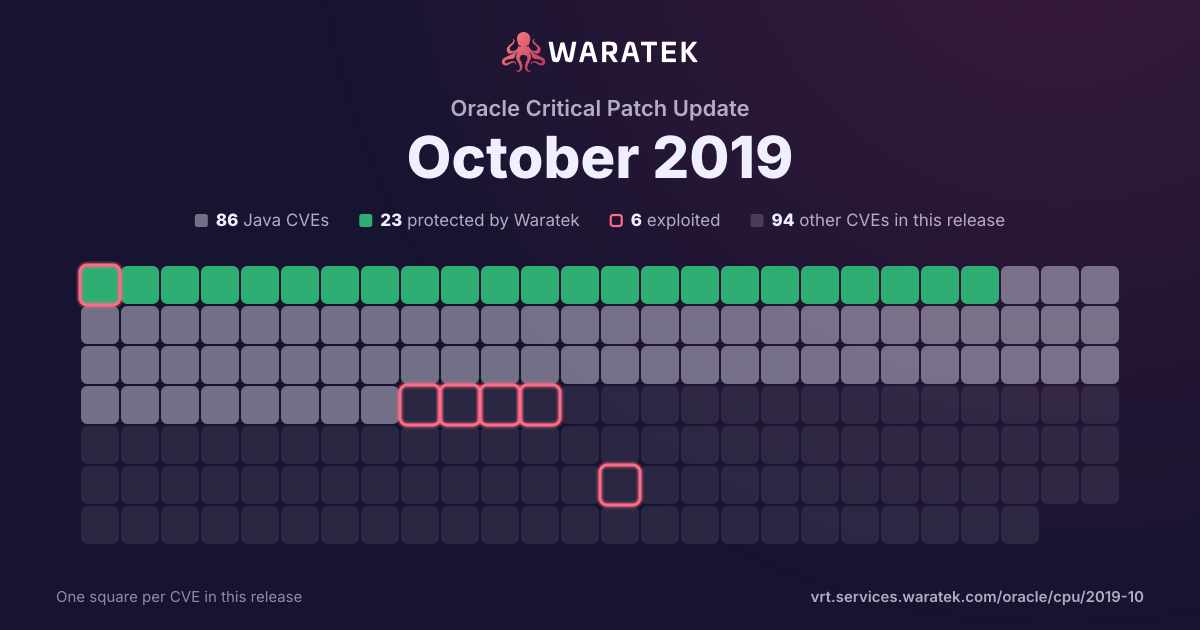
By status
24Protected by Waratek5Mitigation candidate65No exploit published17Outside Waratek scope69Not applicable
6Exploited, marked by the ring
No exploit published. For 56 of them, Oracle's security advisory is the source of public detail.
Protected by Waratek. Waratek RASP can block exploitation of these on systems that have not applied the patch yet.
Overview 6 matches · 2 in Waratek scope · 2 protected · 1 exploited · 0 CISA KEV · 0 public PoC · 0 EPSS ≥ 0.5
6matches
2in Waratek scope33.3%
2protected33.3%
1exploited16.7%
0CISA KEV0.0%
0public PoC0.0%
0EPSS ≥ 0.50.0%
Protected by Waratek
2
33.3%
Rule in development
0
0.0%
Mitigation candidate
0
0.0%
No exploit published
0
0.0%
Outside Waratek scope
0
0.0%
Not applicable
4
66.7%
Withdrawn CVE
0
0.0%
blocked by ARMR today
2
33.3%
partly blocked
0
0.0%
not blocked
4
66.7%
not established
0
0.0%
unrecorded
0
0.0%
Exploited
1
16.7%
Working exploit published
0
0.0%
Proof of concept only
0
0.0%
Forecast only
0
0.0%
No public exploit
5
83.3%
split by
peak 3 / month
Jan 19Feb 19Mar 19
| CVE | Severity | Published▾ | Status | Exploitation | Description |
|---|---|---|---|---|---|
| CVE-2019-3862 | Critical | 2019-03-21 | Not applicable | No public exploit | An out of bounds read flaw was discovered in libssh2 before 1.8.1 in the way SSH_MSG_CHANNEL_REQUEST packets with an exit status message and no payload are parsed. A remote attacker who compromises a SSH server may be able to cause a Denial of Service or read data in the client memory. |
| CVE-2019-1543 | High | 2019-03-06 | Not applicable | No public exploit | ChaCha20-Poly1305 is an AEAD cipher, and requires a unique nonce input for every encryption operation. RFC 7539 specifies that the nonce value (IV) should be 96 bits (12 bytes). OpenSSL allows a variable nonce length and front pads the nonce with 0 bytes if it is less than 12 bytes. However it also incorrectly allows a nonce to be set of up to 16 bytes. In this case only the last 12 bytes are significant and any additional leading bytes are ignored. It is a requirement of using this cipher that nonce values are unique. Messages encrypted using a reused nonce value are susceptible to serious confidentiality and integrity attacks. If an application changes the default nonce length to be longer than 12 bytes and then makes a change to the leading bytes of the nonce expecting the new value to be a new unique nonce then such an application could inadvertently encrypt messages with a reused nonce. Additionally the ignored bytes in a long nonce are not covered by the integrity guarantee of this cipher. Any application that relies on the integrity of these ignored leading bytes of a long nonce may be further affected. Any OpenSSL internal use of this cipher, including in SSL/TLS, is safe because no such use sets such a long nonce value. However user applications that use this cipher directly and set a non-default nonce length to be longer than 12 bytes may be vulnerable. OpenSSL versions 1.1.1 and 1.1.0 are affected by this issue. Due to the limited scope of affected deployments this has been assessed as low severity and therefore we are not creating new releases at this time. Fixed in OpenSSL 1.1.1c (Affected 1.1.1-1.1.1b). Fixed in OpenSSL 1.1.0k (Affected 1.1.0-1.1.0j). |
| CVE-2019-1559 | Medium | 2019-02-27 | Not applicable | No public exploit | If an application encounters a fatal protocol error and then calls SSL_shutdown() twice (once to send a close_notify, and once to receive one) then OpenSSL can respond differently to the calling application if a 0 byte record is received with invalid padding compared to if a 0 byte record is received with an invalid MAC. If the application then behaves differently based on that in a way that is detectable to the remote peer, then this amounts to a padding oracle that could be used to decrypt data. In order for this to be exploitable "non-stitched" ciphersuites must be in use. Stitched ciphersuites are optimised implementations of certain commonly used ciphersuites. Also the application must call SSL_shutdown() twice even if a protocol error has occurred (applications should not do this but some do anyway). Fixed in OpenSSL 1.0.2r (Affected 1.0.2-1.0.2q). |
| CVE-2019-6109 | Medium | 2019-01-31 | Not applicable | Exploited | An issue was discovered in OpenSSH 7.9. Due to missing character encoding in the progress display, a malicious server (or Man-in-The-Middle attacker) can employ crafted object names to manipulate the client output, e.g., by using ANSI control codes to hide additional files being transferred. This affects refresh_progress_meter() in progressmeter.c. |
| CVE-2018-19362 | Critical | 2019-01-02 | Protected by Waratek | No public exploit | FasterXML jackson-databind 2.x before 2.9.8 might allow attackers to have unspecified impact by leveraging failure to block the jboss-common-core class from polymorphic deserialization. |
| CVE-2018-14721 | Critical | 2019-01-02 | Protected by Waratek | No public exploit | FasterXML jackson-databind 2.x before 2.9.7 might allow remote attackers to conduct server-side request forgery (SSRF) attacks by leveraging failure to block the axis2-jaxws class from polymorphic deserialization. |