
Oracle Critical Patch Update October 2019
Released October 2019 · Oracle's advisory ↗ · ← Critical Patch Update, July 2019 · Critical Patch Update, January 2020 →
180 CVEs in this release, one square each
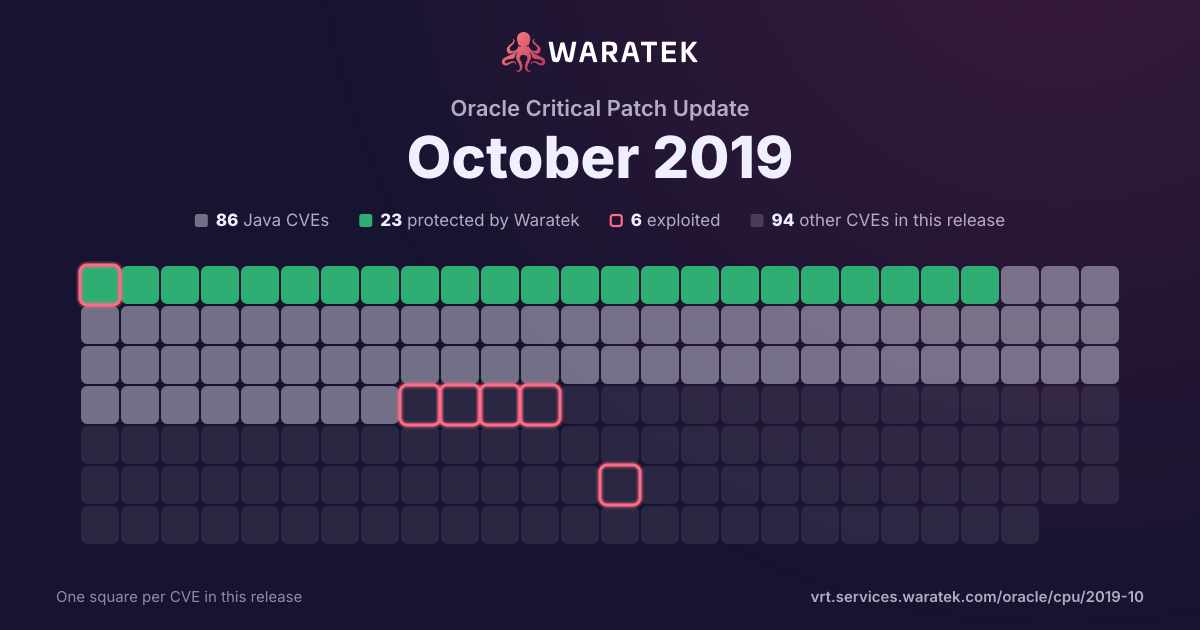
By status
23Protected by Waratek63No exploit published57Outside Waratek scope37Not applicable
6Exploited, marked by the ring
No exploit published. For 56 of them, Oracle's security advisory is the source of public detail.
Protected by Waratek. Waratek RASP can block exploitation of these on systems that have not applied the patch yet.
Overview 6 matches · 0 exploited · 0 CISA KEV · 2 public PoC · 0 EPSS ≥ 0.5
Protected by Waratek
6
100.0%
Rule in development
0
0.0%
Mitigation candidate
0
0.0%
No exploit published
0
0.0%
Outside Waratek scope
0
0.0%
Not applicable
0
0.0%
Withdrawn CVE
0
0.0%
blocked by ARMR today
6
100.0%
partly blocked
0
0.0%
not blocked
0
0.0%
not established
0
0.0%
unrecorded
0
0.0%
Exploited
0
0.0%
Working exploit published
0
0.0%
Proof of concept only
2
33.3%
Forecast only
0
0.0%
No public exploit
4
66.7%
split by
peak 5 / month
Jun 19Jul 19Aug 19Sep 19Oct 19
| CVE | Severity | Published▾ | Status | Exploitation | Description |
|---|---|---|---|---|---|
| CVE-2019-2989 | Medium | 2019-10-16 | Protected by Waratek | No public exploit | Vulnerability in the Java SE, Java SE Embedded product of Oracle Java SE (component: Networking). Supported versions that are affected are Java SE: 7u231, 8u221, 11.0.4 and 13; Java SE Embedded: 8u221. Difficult to exploit vulnerability allows unauthenticated attacker with network access via multiple protocols to compromise Java SE, Java SE Embedded. While the vulnerability is in Java SE, Java SE Embedded, attacks may significantly impact additional products. Successful attacks of this vulnerability can result in unauthorized creation, deletion or modification access to critical data or all Java SE, Java SE Embedded accessible data. Note: This vulnerability applies to Java deployments, typically in clients running sandboxed Java Web Start applications or sandboxed Java applets (in Java SE 8), that load and run untrusted code (e.g., code that comes from the internet) and rely on the Java sandbox for security. This vulnerability can also be exploited by using APIs in the specified Component, e.g., through a web service which supplies data to the APIs. CVSS v3.0 Base Score 6.8 (Integrity impacts). CVSS Vector: (CVSS:3.0/AV:N/AC:H/PR:N/UI:N/S:C/C:N/I:H/A:N). |
| CVE-2019-2975 | Medium | 2019-10-16 | Protected by Waratek | No public exploit | Vulnerability in the Java SE, Java SE Embedded product of Oracle Java SE (component: Scripting). Supported versions that are affected are Java SE: 8u221, 11.0.4 and 13; Java SE Embedded: 8u221. Difficult to exploit vulnerability allows unauthenticated attacker with network access via multiple protocols to compromise Java SE, Java SE Embedded. Successful attacks of this vulnerability can result in unauthorized update, insert or delete access to some of Java SE, Java SE Embedded accessible data and unauthorized ability to cause a partial denial of service (partial DOS) of Java SE, Java SE Embedded. Note: This vulnerability applies to Java deployments, typically in clients running sandboxed Java Web Start applications or sandboxed Java applets (in Java SE 8), that load and run untrusted code (e.g., code that comes from the internet) and rely on the Java sandbox for security. This vulnerability can also be exploited by using APIs in the specified Component, e.g., through a web service which supplies data to the APIs. CVSS 3.0 Base Score 4.8 (Integrity and Availability impacts). CVSS Vector: (CVSS:3.0/AV:N/AC:H/PR:N/UI:N/S:U/C:N/I:L/A:L). |
| CVE-2019-2958 | Medium | 2019-10-16 | Protected by Waratek | No public exploit | Vulnerability in the Java SE, Java SE Embedded product of Oracle Java SE (component: Libraries). Supported versions that are affected are Java SE: 7u231, 8u221, 11.0.4 and 13; Java SE Embedded: 8u221. Difficult to exploit vulnerability allows unauthenticated attacker with network access via multiple protocols to compromise Java SE, Java SE Embedded. Successful attacks of this vulnerability can result in unauthorized creation, deletion or modification access to critical data or all Java SE, Java SE Embedded accessible data. Note: This vulnerability applies to Java deployments, typically in clients running sandboxed Java Web Start applications or sandboxed Java applets (in Java SE 8), that load and run untrusted code (e.g., code that comes from the internet) and rely on the Java sandbox for security. This vulnerability can also be exploited by using APIs in the specified Component, e.g., through a web service which supplies data to the APIs. CVSS 3.0 Base Score 5.9 (Integrity impacts). CVSS Vector: (CVSS:3.0/AV:N/AC:H/PR:N/UI:N/S:U/C:N/I:H/A:N). |
| CVE-2019-2888 | Medium | 2019-10-16 | Protected by Waratek | Proof of concept only | Vulnerability in the Oracle WebLogic Server product of Oracle Fusion Middleware (component: EJB Container). Supported versions that are affected are 10.3.6.0.0, 12.1.3.0.0 and 12.2.1.3.0. Easily exploitable vulnerability allows unauthenticated attacker with network access via HTTP to compromise Oracle WebLogic Server. Successful attacks of this vulnerability can result in unauthorized read access to a subset of Oracle WebLogic Server accessible data. CVSS 3.0 Base Score 5.3 (Confidentiality impacts). CVSS Vector: (CVSS:3.0/AV:N/AC:L/PR:N/UI:N/S:U/C:L/I:N/A:N). |
| CVE-2019-17091 | Medium | 2019-10-02 | Protected by Waratek | No public exploit | faces/context/PartialViewContextImpl.java in Eclipse Mojarra, as used in Mojarra for Eclipse EE4J before 2.3.10 and Mojarra JavaServer Faces before 2.2.20, allows Reflected XSS because a client window field is mishandled. |
| CVE-2019-12814 | Medium | 2019-06-19 | Protected by Waratek | Proof of concept only | A Polymorphic Typing issue was discovered in FasterXML jackson-databind 2.x through 2.9.9. When Default Typing is enabled (either globally or for a specific property) for an externally exposed JSON endpoint and the service has JDOM 1.x or 2.x jar in the classpath, an attacker can send a specifically crafted JSON message that allows them to read arbitrary local files on the server. |