
Oracle Critical Patch Update October 2019
Released October 2019 · Oracle's advisory ↗ · ← Critical Patch Update, July 2019 · Critical Patch Update, January 2020 →
180 CVEs in this release, one square each
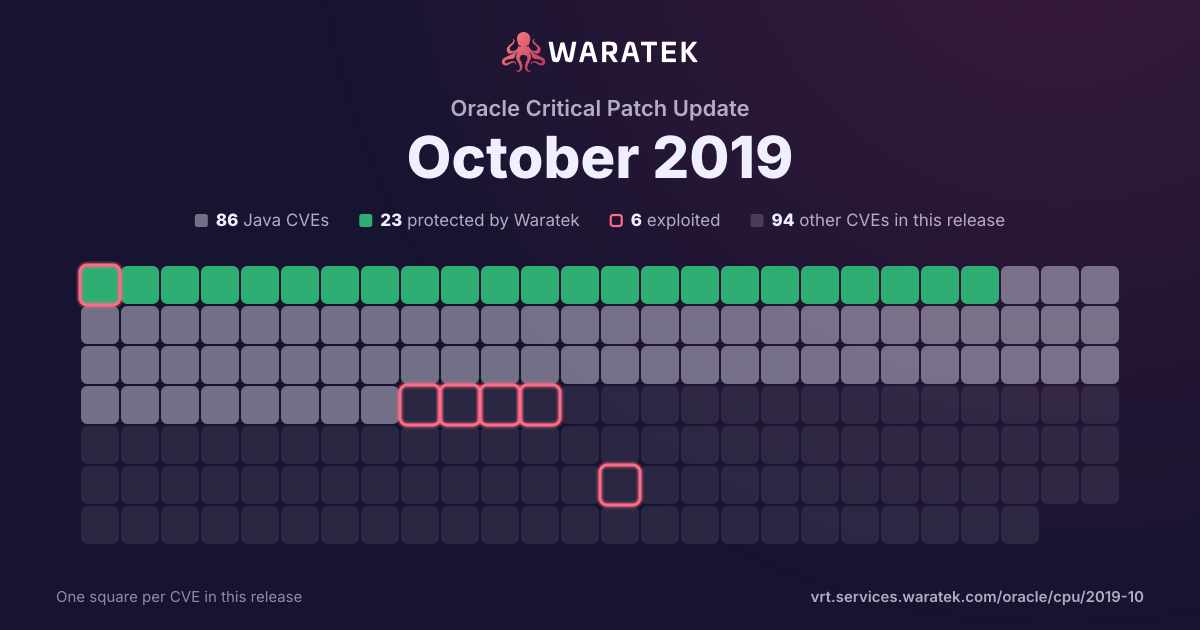
By status
24Protected by Waratek5Mitigation candidate65No exploit published17Outside Waratek scope69Not applicable
6Exploited, marked by the ring
No exploit published. For 56 of them, Oracle's security advisory is the source of public detail.
Protected by Waratek. Waratek RASP can block exploitation of these on systems that have not applied the patch yet.
Overview 27 matches · 13 in Waratek scope · 8 protected · 0 exploited · 0 CISA KEV · 0 public PoC · 0 EPSS ≥ 0.5
27matches
13in Waratek scope48.1%
8protected29.6%
0exploited0.0%
0CISA KEV0.0%
0public PoC0.0%
0EPSS ≥ 0.50.0%
Protected by Waratek
8
29.6%
Rule in development
0
0.0%
Mitigation candidate
0
0.0%
No exploit published
5
18.5%
Outside Waratek scope
1
3.7%
Not applicable
13
48.1%
Withdrawn CVE
0
0.0%
blocked by ARMR today
8
29.6%
partly blocked
0
0.0%
not blocked
19
70.4%
not established
0
0.0%
unrecorded
0
0.0%
Exploited
0
0.0%
Working exploit published
0
0.0%
Proof of concept only
0
0.0%
Forecast only
0
0.0%
No public exploit
27
100.0%
split by
peak 6 / quarter
Q2 161
Not applicable1
Critical1
not blocked1
No public exploit1
Q3 160
Q4 161
Protected by Waratek1
Critical1
blocked by ARMR today1
No public exploit1
Q1 172
No exploit published1
Not applicable1
High1
Medium1
not blocked2
No public exploit2
Q2 171
Not applicable1
High1
not blocked1
No public exploit1
Q3 171
Protected by Waratek1
Critical1
blocked by ARMR today1
No public exploit1
Q4 171
Not applicable1
Medium1
not blocked1
No public exploit1
Q1 184
Protected by Waratek1
No exploit published1
Outside Waratek scope1
Not applicable1
Critical2
High2
blocked by ARMR today1
not blocked3
No public exploit4
Q2 181
Not applicable1
High1
not blocked1
No public exploit1
Q3 181
No exploit published1
Medium1
not blocked1
No public exploit1
Q4 181
No exploit published1
High1
not blocked1
No public exploit1
Q1 195
Protected by Waratek2
Not applicable3
Critical3
High1
Medium1
blocked by ARMR today2
not blocked3
No public exploit5
Q2 196
Protected by Waratek2
No exploit published1
Not applicable3
Critical2
High2
Medium2
blocked by ARMR today2
not blocked4
No public exploit6
Q3 192
Protected by Waratek1
Not applicable1
Critical1
High1
blocked by ARMR today1
not blocked1
No public exploit2
Q3 16Q1 17Q3 17Q1 18Q3 18Q1 19Q3 19
| CVE | Severity | Published▾ | Status | Exploitation | Description |
|---|---|---|---|---|---|
| CVE-2019-14379 | Critical | 2019-07-29 | Protected by Waratek | No public exploit | SubTypeValidator.java in FasterXML jackson-databind before 2.9.9.2 mishandles default typing when ehcache is used (because of net.sf.ehcache.transaction.manager.DefaultTransactionManagerLookup), leading to remote code execution. |
| CVE-2019-5443 | High | 2019-07-02 | Not applicable | No public exploit | A non-privileged user or program can put code and a config file in a known non-privileged path (under C:/usr/local/) that will make curl <= 7.65.1 automatically run the code (as an openssl "engine") on invocation. If that curl is invoked by a privileged user it can do anything it wants. |
| CVE-2019-8457 | Critical | 2019-05-30 | Not applicable | No public exploit | SQLite3 from 3.6.0 to and including 3.27.2 is vulnerable to heap out-of-bound read in the rtreenode() function when handling invalid rtree tables. |
| CVE-2019-0188 | High | 2019-05-28 | Protected by Waratek | No public exploit | Apache Camel prior to 2.24.0 contains an XML external entity injection (XXE) vulnerability (CWE-611) due to using an outdated vulnerable JSON-lib library. This affects only the camel-xmljson component, which was removed. |
| CVE-2019-12086 | High | 2019-05-17 | Protected by Waratek | No public exploit | A Polymorphic Typing issue was discovered in FasterXML jackson-databind 2.x before 2.9.9. When Default Typing is enabled (either globally or for a specific property) for an externally exposed JSON endpoint, the service has the mysql-connector-java jar (8.0.14 or earlier) in the classpath, and an attacker can host a crafted MySQL server reachable by the victim, an attacker can send a crafted JSON message that allows them to read arbitrary local files on the server. This occurs because of missing com.mysql.cj.jdbc.admin.MiniAdmin validation. |
| CVE-2018-12404 | Medium | 2019-05-02 | Not applicable | No public exploit | A cached side channel attack during handshakes using RSA encryption could allow for the decryption of encrypted content. This is a variant of the Adaptive Chosen Ciphertext attack (AKA Bleichenbacher attack) and affects all NSS versions prior to NSS 3.41. |
| CVE-2019-10247 | Medium | 2019-04-22 | No exploit published | No public exploit | In Eclipse Jetty version 7.x, 8.x, 9.2.27 and older, 9.3.26 and older, and 9.4.16 and older, the server running on any OS and Jetty version combination will reveal the configured fully qualified directory base resource location on the output of the 404 error for not finding a Context that matches the requested path. The default server behavior on jetty-distribution and jetty-home will include at the end of the Handler tree a DefaultHandler, which is responsible for reporting this 404 error, it presents the various configured contexts as HTML for users to click through to. This produced HTML includes output that contains the configured fully qualified directory base resource location for each context. |
| CVE-2019-11068 | Critical | 2019-04-10 | Not applicable | No public exploit | libxslt through 1.1.33 allows bypass of a protection mechanism because callers of xsltCheckRead and xsltCheckWrite permit access even upon receiving a -1 error code. xsltCheckRead can return -1 for a crafted URL that is not actually invalid and is subsequently loaded. |
| CVE-2019-3862 | Critical | 2019-03-21 | Not applicable | No public exploit | An out of bounds read flaw was discovered in libssh2 before 1.8.1 in the way SSH_MSG_CHANNEL_REQUEST packets with an exit status message and no payload are parsed. A remote attacker who compromises a SSH server may be able to cause a Denial of Service or read data in the client memory. |
| CVE-2019-1543 | High | 2019-03-06 | Not applicable | No public exploit | ChaCha20-Poly1305 is an AEAD cipher, and requires a unique nonce input for every encryption operation. RFC 7539 specifies that the nonce value (IV) should be 96 bits (12 bytes). OpenSSL allows a variable nonce length and front pads the nonce with 0 bytes if it is less than 12 bytes. However it also incorrectly allows a nonce to be set of up to 16 bytes. In this case only the last 12 bytes are significant and any additional leading bytes are ignored. It is a requirement of using this cipher that nonce values are unique. Messages encrypted using a reused nonce value are susceptible to serious confidentiality and integrity attacks. If an application changes the default nonce length to be longer than 12 bytes and then makes a change to the leading bytes of the nonce expecting the new value to be a new unique nonce then such an application could inadvertently encrypt messages with a reused nonce. Additionally the ignored bytes in a long nonce are not covered by the integrity guarantee of this cipher. Any application that relies on the integrity of these ignored leading bytes of a long nonce may be further affected. Any OpenSSL internal use of this cipher, including in SSL/TLS, is safe because no such use sets such a long nonce value. However user applications that use this cipher directly and set a non-default nonce length to be longer than 12 bytes may be vulnerable. OpenSSL versions 1.1.1 and 1.1.0 are affected by this issue. Due to the limited scope of affected deployments this has been assessed as low severity and therefore we are not creating new releases at this time. Fixed in OpenSSL 1.1.1c (Affected 1.1.1-1.1.1b). Fixed in OpenSSL 1.1.0k (Affected 1.1.0-1.1.0j). |
| CVE-2019-1559 | Medium | 2019-02-27 | Not applicable | No public exploit | If an application encounters a fatal protocol error and then calls SSL_shutdown() twice (once to send a close_notify, and once to receive one) then OpenSSL can respond differently to the calling application if a 0 byte record is received with invalid padding compared to if a 0 byte record is received with an invalid MAC. If the application then behaves differently based on that in a way that is detectable to the remote peer, then this amounts to a padding oracle that could be used to decrypt data. In order for this to be exploitable "non-stitched" ciphersuites must be in use. Stitched ciphersuites are optimised implementations of certain commonly used ciphersuites. Also the application must call SSL_shutdown() twice even if a protocol error has occurred (applications should not do this but some do anyway). Fixed in OpenSSL 1.0.2r (Affected 1.0.2-1.0.2q). |
| CVE-2018-19362 | Critical | 2019-01-02 | Protected by Waratek | No public exploit | FasterXML jackson-databind 2.x before 2.9.8 might allow attackers to have unspecified impact by leveraging failure to block the jboss-common-core class from polymorphic deserialization. |
| CVE-2018-14721 | Critical | 2019-01-02 | Protected by Waratek | No public exploit | FasterXML jackson-databind 2.x before 2.9.7 might allow remote attackers to conduct server-side request forgery (SSRF) attacks by leveraging failure to block the axis2-jaxws class from polymorphic deserialization. |
| CVE-2018-15756 | High | 2018-10-18 | No exploit published | No public exploit | Spring Framework, version 5.1, versions 5.0.x prior to 5.0.10, versions 4.3.x prior to 4.3.20, and older unsupported versions on the 4.2.x branch provide support for range requests when serving static resources through the ResourceHttpRequestHandler, or starting in 5.0 when an annotated controller returns an org.springframework.core.io.Resource. A malicious user (or attacker) can add a range header with a high number of ranges, or with wide ranges that overlap, or both, for a denial of service attack. This vulnerability affects applications that depend on either spring-webmvc or spring-webflux. Such applications must also have a registration for serving static resources (e.g. JS, CSS, images, and others), or have an annotated controller that returns an org.springframework.core.io.Resource. Spring Boot applications that depend on spring-boot-starter-web or spring-boot-starter-webflux are ready to serve static resources out of the box and are therefore vulnerable. |
| CVE-2018-8037 | Medium | 2018-08-02 | No exploit published | No public exploit | If an async request was completed by the application at the same time as the container triggered the async timeout, a race condition existed that could result in a user seeing a response intended for a different user. An additional issue was present in the NIO and NIO2 connectors that did not correctly track the closure of the connection when an async request was completed by the application and timed out by the container at the same time. This could also result in a user seeing a response intended for another user. Versions Affected: Apache Tomcat 9.0.0.M9 to 9.0.9 and 8.5.5 to 8.5.31. |
| CVE-2018-0732 | High | 2018-06-12 | Not applicable | No public exploit | During key agreement in a TLS handshake using a DH(E) based ciphersuite a malicious server can send a very large prime value to the client. This will cause the client to spend an unreasonably long period of time generating a key for this prime resulting in a hang until the client has finished. This could be exploited in a Denial Of Service attack. Fixed in OpenSSL 1.1.0i-dev (Affected 1.1.0-1.1.0h). Fixed in OpenSSL 1.0.2p-dev (Affected 1.0.2-1.0.2o). |
| CVE-2018-7185 | High | 2018-03-06 | Outside Waratek scope | No public exploit | The protocol engine in ntp 4.2.6 before 4.2.8p11 allows a remote attackers to cause a denial of service (disruption) by continually sending a packet with a zero-origin timestamp and source IP address of the "other side" of an interleaved association causing the victim ntpd to reset its association. |
| CVE-2017-12626 | High | 2018-01-29 | No exploit published | No public exploit | Apache POI in versions prior to release 3.17 are vulnerable to Denial of Service Attacks: 1) Infinite Loops while parsing crafted WMF, EMF, MSG and macros (POI bugs 61338 and 61294), and 2) Out of Memory Exceptions while parsing crafted DOC, PPT and XLS (POI bugs 52372 and 61295). |
| CVE-2018-1000007 | Critical | 2018-01-24 | Not applicable | No public exploit | libcurl 7.1 through 7.57.0 might accidentally leak authentication data to third parties. When asked to send custom headers in its HTTP requests, libcurl will send that set of headers first to the host in the initial URL but also, if asked to follow redirects and a 30X HTTP response code is returned, to the host mentioned in URL in the `Location:` response header value. Sending the same set of headers to subsequent hosts is in particular a problem for applications that pass on custom `Authorization:` headers, as this header often contains privacy sensitive information or data that could allow others to impersonate the libcurl-using client's request. |
| CVE-2016-6814 | Critical | 2018-01-18 | Protected by Waratek | No public exploit | When an application with unsupported Codehaus versions of Groovy from 1.7.0 to 2.4.3, Apache Groovy 2.4.4 to 2.4.7 on classpath uses standard Java serialization mechanisms, e.g. to communicate between servers or to store local data, it was possible for an attacker to bake a special serialized object that will execute code directly when deserialized. All applications which rely on serialization and do not isolate the code which deserializes objects were subject to this vulnerability. |
| CVE-2017-17558 | Medium | 2017-12-12 | Not applicable | No public exploit | The usb_destroy_configuration function in drivers/usb/core/config.c in the USB core subsystem in the Linux kernel through 4.14.5 does not consider the maximum number of configurations and interfaces before attempting to release resources, which allows local users to cause a denial of service (out-of-bounds write access) or possibly have unspecified other impact via a crafted USB device. |
| CVE-2016-4000 | Critical | 2017-07-06 | Protected by Waratek | No public exploit | Jython before 2.7.1rc1 allows attackers to execute arbitrary code via a crafted serialized PyFunction object. |
| CVE-2015-5180 | High | 2017-06-27 | Not applicable | No public exploit | res_query in libresolv in glibc before 2.25 allows remote attackers to cause a denial of service (NULL pointer dereference and process crash). |
| CVE-2016-7103 | Medium | 2017-03-15 | No exploit published | No public exploit | Cross-site scripting (XSS) vulnerability in jQuery UI before 1.12.0 might allow remote attackers to inject arbitrary web script or HTML via the closeText parameter of the dialog function. |
| CVE-2017-6056 | High | 2017-02-17 | Not applicable | No public exploit | It was discovered that a programming error in the processing of HTTPS requests in the Apache Tomcat servlet and JSP engine may result in denial of service via an infinite loop. The denial of service is easily achievable as a consequence of backporting a CVE-2016-6816 fix but not backporting the fix for Tomcat bug 57544. Distributions affected by this backporting issue include Debian (before 7.0.56-3+deb8u8 and 8.0.14-1+deb8u7 in jessie) and Ubuntu. |
| CVE-2016-1000031 | Critical | 2016-10-25 | Protected by Waratek | No public exploit | Apache Commons FileUpload before 1.3.3 DiskFileItem File Manipulation Remote Code Execution |
| CVE-2016-0729 | Critical | 2016-04-07 | Not applicable | No public exploit | Multiple buffer overflows in (1) internal/XMLReader.cpp, (2) util/XMLURL.cpp, and (3) util/XMLUri.cpp in the XML Parser library in Apache Xerces-C before 3.1.3 allow remote attackers to cause a denial of service (segmentation fault or memory corruption) or possibly execute arbitrary code via a crafted document. |