
Oracle Critical Patch Update October 2019
Released October 2019 · Oracle's advisory ↗ · ← Critical Patch Update, July 2019 · Critical Patch Update, January 2020 →
180 CVEs in this release, one square each
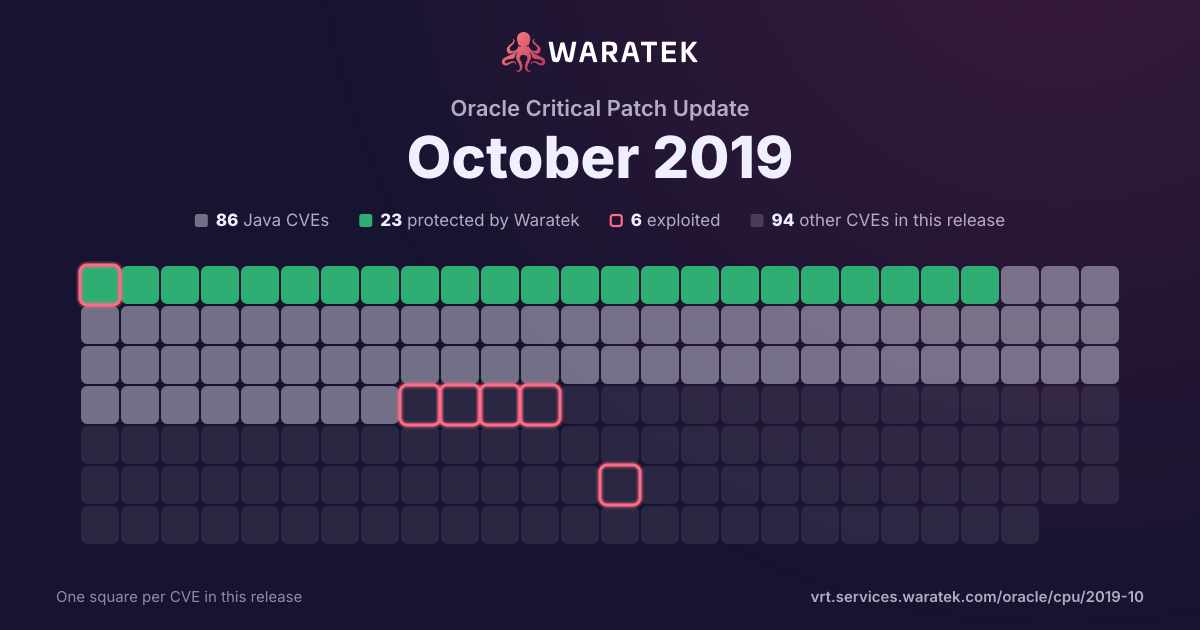
By status
24Protected by Waratek5Mitigation candidate65No exploit published17Outside Waratek scope69Not applicable
6Exploited, marked by the ring
No exploit published. For 56 of them, Oracle's security advisory is the source of public detail.
Protected by Waratek. Waratek RASP can block exploitation of these on systems that have not applied the patch yet.
Overview 9 matches · 0 protected · 0 exploited · 0 CISA KEV · 0 public PoC · 1 EPSS ≥ 0.5
Protected by Waratek
0
0.0%
Rule in development
0
0.0%
Mitigation candidate
0
0.0%
No exploit published
9
100.0%
blocked by ARMR today
0
0.0%
partly blocked
0
0.0%
not blocked
9
100.0%
not established
0
0.0%
unrecorded
0
0.0%
Exploited
0
0.0%
Working exploit published
0
0.0%
Proof of concept only
0
0.0%
Forecast only
1
11.1%
No public exploit
8
88.9%
split by
peak 6 / month
Oct 181
No exploit published1
High1
not blocked1
No public exploit1
Nov 180
Dec 180
Jan 190
Feb 190
Mar 190
Apr 191
No exploit published1
Medium1
not blocked1
No public exploit1
May 190
Jun 191
No exploit published1
High1
not blocked1
Forecast only1
Jul 190
Aug 190
Sep 190
Oct 196
No exploit published6
Critical1
Medium4
Low1
not blocked6
No public exploit6
Oct 18Dec 18Feb 19Apr 19Jun 19Aug 19Oct 19
| CVE | Severity | Published▾ | Status | Exploitation | Description |
|---|---|---|---|---|---|
| CVE-2019-2904 | Critical | 2019-10-16 | No exploit published | No public exploit | Vulnerability in the Oracle JDeveloper and ADF product of Oracle Fusion Middleware (component: ADF Faces). Supported versions that are affected are 11.1.1.9.0, 12.1.3.0.0 and 12.2.1.3.0. Easily exploitable vulnerability allows unauthenticated attacker with network access via HTTP to compromise Oracle JDeveloper and ADF. Successful attacks of this vulnerability can result in takeover of Oracle JDeveloper and ADF. CVSS 3.0 Base Score 9.8 (Confidentiality, Integrity and Availability impacts). CVSS Vector: (CVSS:3.0/AV:N/AC:L/PR:N/UI:N/S:U/C:H/I:H/A:H). |
| CVE-2019-2896 | Medium | 2019-10-16 | No exploit published | No public exploit | Vulnerability in the MICROS Relate CRM Software product of Oracle Retail Applications (component: Internal Operations). Supported versions that are affected are 7.1.0, 15.0.0, 16.0.0, 17.0.0, and 18.0.0. Difficult to exploit vulnerability allows unauthenticated attacker with network access via HTTP to compromise MICROS Relate CRM Software. Successful attacks of this vulnerability can result in unauthorized access to critical data or complete access to all MICROS Relate CRM Software accessible data. CVSS 3.0 Base Score 5.9 (Confidentiality impacts). CVSS Vector: (CVSS:3.0/AV:N/AC:H/PR:N/UI:N/S:U/C:H/I:N/A:N). |
| CVE-2019-2884 | Medium | 2019-10-16 | No exploit published | No public exploit | Vulnerability in the Oracle Retail Customer Management and Segmentation Foundation product of Oracle Retail Applications (component: Segment). The supported version that is affected is 17.0. Difficult to exploit vulnerability allows unauthenticated attacker with network access via HTTP to compromise Oracle Retail Customer Management and Segmentation Foundation. Successful attacks of this vulnerability can result in unauthorized access to critical data or complete access to all Oracle Retail Customer Management and Segmentation Foundation accessible data. CVSS 3.0 Base Score 5.9 (Confidentiality impacts). CVSS Vector: (CVSS:3.0/AV:N/AC:H/PR:N/UI:N/S:U/C:H/I:N/A:N). |
| CVE-2019-2883 | Medium | 2019-10-16 | No exploit published | No public exploit | Vulnerability in the Oracle Retail Customer Management and Segmentation Foundation product of Oracle Retail Applications (component: Segment). The supported version that is affected is 17.0. Easily exploitable vulnerability allows low privileged attacker with network access via HTTP to compromise Oracle Retail Customer Management and Segmentation Foundation. Successful attacks require human interaction from a person other than the attacker. Successful attacks of this vulnerability can result in unauthorized update, insert or delete access to some of Oracle Retail Customer Management and Segmentation Foundation accessible data as well as unauthorized read access to a subset of Oracle Retail Customer Management and Segmentation Foundation accessible data. CVSS 3.0 Base Score 4.6 (Confidentiality and Integrity impacts). CVSS Vector: (CVSS:3.0/AV:N/AC:L/PR:L/UI:R/S:U/C:L/I:L/A:N). |
| CVE-2019-2872 | Low | 2019-10-16 | No exploit published | No public exploit | Vulnerability in the Oracle Retail Xstore Point of Service product of Oracle Retail Applications (component: Point of Sale). Supported versions that are affected are 17.0.3, 18.0.1 and 19.0.0. Difficult to exploit vulnerability allows physical access to compromise Oracle Retail Xstore Point of Service. Successful attacks require human interaction from a person other than the attacker. Successful attacks of this vulnerability can result in unauthorized update, insert or delete access to some of Oracle Retail Xstore Point of Service accessible data as well as unauthorized read access to a subset of Oracle Retail Xstore Point of Service accessible data. CVSS 3.0 Base Score 2.7 (Confidentiality and Integrity impacts). CVSS Vector: (CVSS:3.0/AV:P/AC:H/PR:H/UI:R/S:U/C:L/I:L/A:N). |
| CVE-2018-3300 | Medium | 2019-10-16 | No exploit published | No public exploit | Vulnerability in the Oracle Retail Xstore Office product of Oracle Retail Applications (component: Internal Operations). The supported version that is affected is 7.1. Easily exploitable vulnerability allows low privileged attacker with network access via HTTP to compromise Oracle Retail Xstore Office. Successful attacks of this vulnerability can result in unauthorized update, insert or delete access to some of Oracle Retail Xstore Office accessible data as well as unauthorized read access to a subset of Oracle Retail Xstore Office accessible data. CVSS 3.0 Base Score 5.4 (Confidentiality and Integrity impacts). CVSS Vector: (CVSS:3.0/AV:N/AC:L/PR:L/UI:N/S:U/C:L/I:L/A:N). |
| CVE-2019-10072 | High | 2019-06-21 | No exploit published | Forecast only | The fix for CVE-2019-0199 was incomplete and did not address HTTP/2 connection window exhaustion on write in Apache Tomcat versions 9.0.0.M1 to 9.0.19 and 8.5.0 to 8.5.40 . By not sending WINDOW_UPDATE messages for the connection window (stream 0) clients were able to cause server-side threads to block eventually leading to thread exhaustion and a DoS. |
| CVE-2019-10247 | Medium | 2019-04-22 | No exploit published | No public exploit | In Eclipse Jetty version 7.x, 8.x, 9.2.27 and older, 9.3.26 and older, and 9.4.16 and older, the server running on any OS and Jetty version combination will reveal the configured fully qualified directory base resource location on the output of the 404 error for not finding a Context that matches the requested path. The default server behavior on jetty-distribution and jetty-home will include at the end of the Handler tree a DefaultHandler, which is responsible for reporting this 404 error, it presents the various configured contexts as HTML for users to click through to. This produced HTML includes output that contains the configured fully qualified directory base resource location for each context. |
| CVE-2018-15756 | High | 2018-10-18 | No exploit published | No public exploit | Spring Framework, version 5.1, versions 5.0.x prior to 5.0.10, versions 4.3.x prior to 4.3.20, and older unsupported versions on the 4.2.x branch provide support for range requests when serving static resources through the ResourceHttpRequestHandler, or starting in 5.0 when an annotated controller returns an org.springframework.core.io.Resource. A malicious user (or attacker) can add a range header with a high number of ranges, or with wide ranges that overlap, or both, for a denial of service attack. This vulnerability affects applications that depend on either spring-webmvc or spring-webflux. Such applications must also have a registration for serving static resources (e.g. JS, CSS, images, and others), or have an annotated controller that returns an org.springframework.core.io.Resource. Spring Boot applications that depend on spring-boot-starter-web or spring-boot-starter-webflux are ready to serve static resources out of the box and are therefore vulnerable. |