
Oracle Critical Patch Update October 2019
Released October 2019 · Oracle's advisory ↗ · ← Critical Patch Update, July 2019 · Critical Patch Update, January 2020 →
180 CVEs in this release, one square each
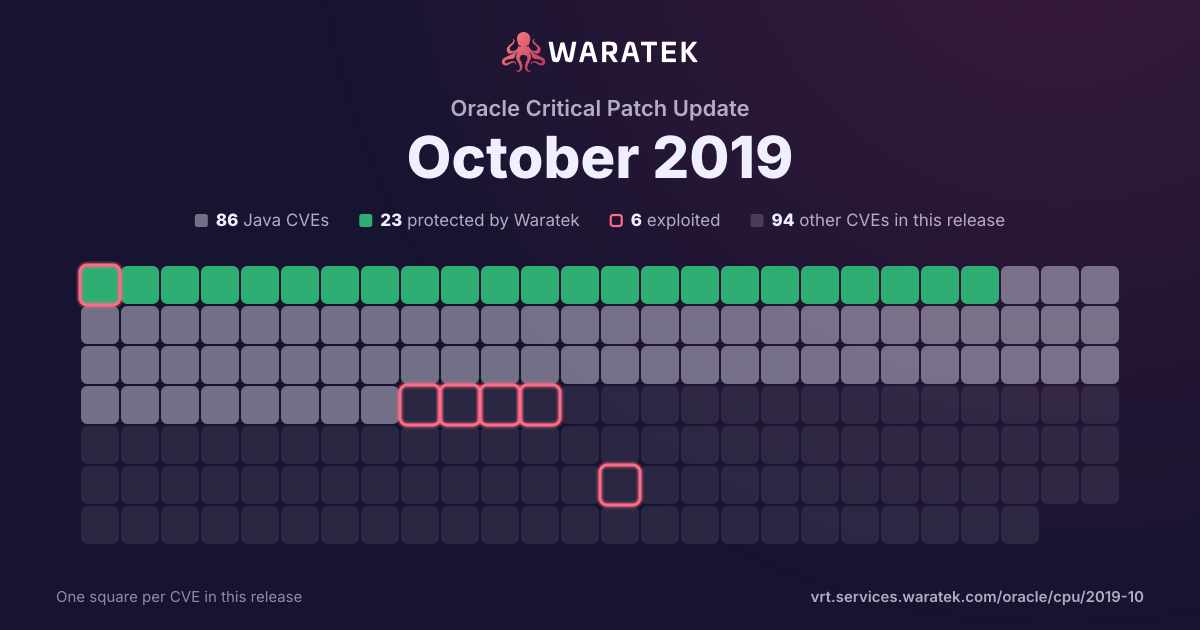
By status
23Protected by Waratek63No exploit published57Outside Waratek scope37Not applicable
6Exploited, marked by the ring
No exploit published. For 56 of them, Oracle's security advisory is the source of public detail.
Protected by Waratek. Waratek RASP can block exploitation of these on systems that have not applied the patch yet.
Overview 2 matches · 1 in Waratek scope · 0 protected · 0 exploited · 0 CISA KEV · 0 public PoC
Protected by Waratek
0
0.0%
Rule in development
0
0.0%
Mitigation candidate
0
0.0%
No exploit published
1
50.0%
Outside Waratek scope
1
50.0%
Not applicable
0
0.0%
Withdrawn CVE
0
0.0%
blocked by ARMR today
0
0.0%
partly blocked
0
0.0%
not blocked
2
100.0%
not established
0
0.0%
unrecorded
0
0.0%
Exploited
0
0.0%
Working exploit published
0
0.0%
Proof of concept only
0
0.0%
Forecast only
2
100.0%
No public exploit
0
0.0%
split by
peak 1 / month
Jun 19Jul 19Aug 19
| CVE | Severity | Published▾ | Status | Exploitation | Description |
|---|---|---|---|---|---|
| CVE-2019-9511 | High | 2019-08-13 | Outside Waratek scope | Forecast only | Some HTTP/2 implementations are vulnerable to window size manipulation and stream prioritization manipulation, potentially leading to a denial of service. The attacker requests a large amount of data from a specified resource over multiple streams. They manipulate window size and stream priority to force the server to queue the data in 1-byte chunks. Depending on how efficiently this data is queued, this can consume excess CPU, memory, or both. |
| CVE-2019-10072 | High | 2019-06-21 | No exploit published | Forecast only | The fix for CVE-2019-0199 was incomplete and did not address HTTP/2 connection window exhaustion on write in Apache Tomcat versions 9.0.0.M1 to 9.0.19 and 8.5.0 to 8.5.40 . By not sending WINDOW_UPDATE messages for the connection window (stream 0) clients were able to cause server-side threads to block eventually leading to thread exhaustion and a DoS. |