
Oracle Critical Patch Update July 2019
Released July 2019 · Oracle's advisory ↗ · ← Critical Patch Update, April 2019 · Critical Patch Update, October 2019 →
207 CVEs in this release, one square each
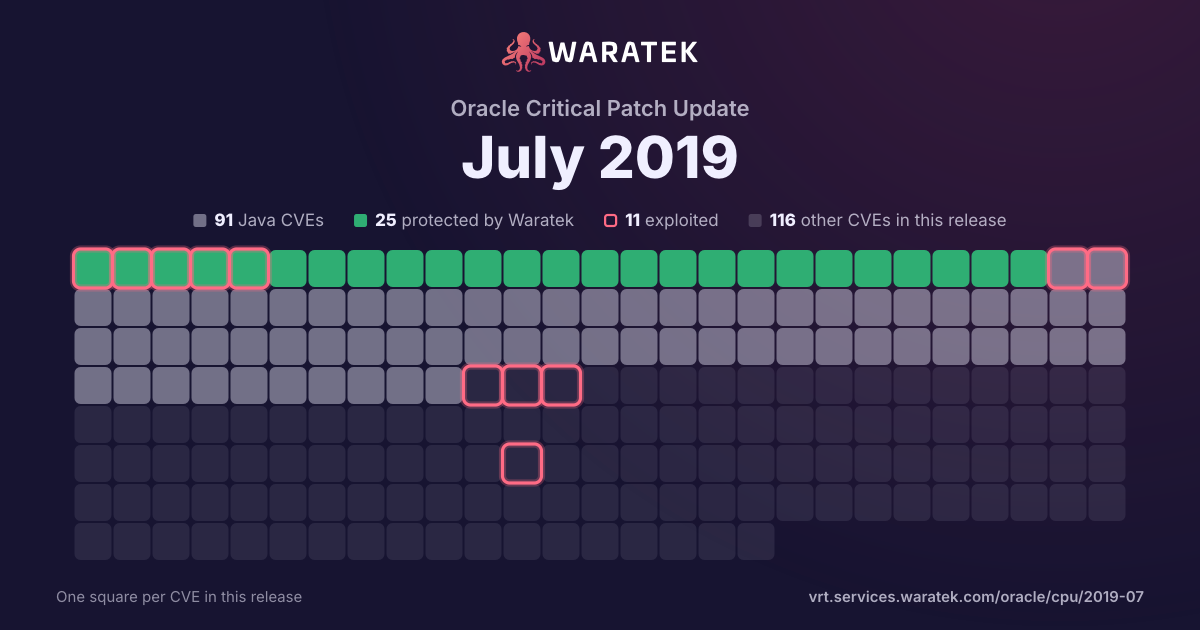
By status
25Protected by Waratek2Mitigation candidate64No exploit published55Outside Waratek scope61Not applicable
11Exploited, marked by the ring
No exploit published. For 58 of them, Oracle's security advisory is the source of public detail.
Protected by Waratek. Waratek RASP can block exploitation of these on systems that have not applied the patch yet.
Overview 31 matches · 0 in Waratek scope · 0 protected · 1 exploited · 0 CISA KEV · 0 public PoC · 1 EPSS ≥ 0.5
31matches
0in Waratek scope0.0%
0protected0.0%
1exploited3.2%
0CISA KEV0.0%
0public PoC0.0%
1EPSS ≥ 0.53.2%
Protected by Waratek
0
0.0%
Rule in development
0
0.0%
Mitigation candidate
0
0.0%
No exploit published
0
0.0%
Outside Waratek scope
0
0.0%
Not applicable
31
100.0%
Withdrawn CVE
0
0.0%
blocked by ARMR today
0
0.0%
partly blocked
0
0.0%
not blocked
31
100.0%
not established
0
0.0%
unrecorded
0
0.0%
Exploited
1
3.2%
Working exploit published
0
0.0%
Proof of concept only
0
0.0%
Forecast only
0
0.0%
No public exploit
30
96.8%
split by
peak 27 / month
Jun 181
Not applicable1
High1
not blocked1
No public exploit1
Jul 180
Aug 180
Sep 180
Oct 180
Nov 180
Dec 180
Jan 191
Not applicable1
High1
not blocked1
Exploited1
Feb 190
Mar 191
Not applicable1
High1
not blocked1
No public exploit1
Apr 190
May 191
Not applicable1
High1
not blocked1
No public exploit1
Jun 190
Jul 1927
Not applicable27
High27
not blocked27
No public exploit27
Jul 18Sep 18Nov 18Jan 19Mar 19May 19Jul 19
| CVE | Severity | Published▾ | Status | Exploitation | Description |
|---|---|---|---|---|---|
| CVE-2019-2871 | High | 2019-07-23 | Not applicable | No public exploit | Vulnerability in the Data Store component of Oracle Berkeley DB. Supported versions that are affected are 12.1.6.1.23, 12.1.6.1.26, 12.1.6.1.29, 12.1.6.1.36, 12.1.6.2.23 and 12.1.6.2.32. Difficult to exploit vulnerability allows unauthenticated attacker with logon to the infrastructure where Data Store executes to compromise Data Store. Successful attacks require human interaction from a person other than the attacker. Successful attacks of this vulnerability can result in takeover of Data Store. CVSS 3.0 Base Score 7.0 (Confidentiality, Integrity and Availability impacts). CVSS Vector: (CVSS:3.0/AV:L/AC:H/PR:N/UI:R/S:U/C:H/I:H/A:H). |
| CVE-2019-2870 | High | 2019-07-23 | Not applicable | No public exploit | Vulnerability in the Data Store component of Oracle Berkeley DB. Supported versions that are affected are 12.1.6.1.23, 12.1.6.1.26, 12.1.6.1.29, 12.1.6.1.36, 12.1.6.2.23 and 12.1.6.2.32. Difficult to exploit vulnerability allows unauthenticated attacker with logon to the infrastructure where Data Store executes to compromise Data Store. Successful attacks require human interaction from a person other than the attacker. Successful attacks of this vulnerability can result in takeover of Data Store. CVSS 3.0 Base Score 7.0 (Confidentiality, Integrity and Availability impacts). CVSS Vector: (CVSS:3.0/AV:L/AC:H/PR:N/UI:R/S:U/C:H/I:H/A:H). |
| CVE-2019-2869 | High | 2019-07-23 | Not applicable | No public exploit | Vulnerability in the Data Store component of Oracle Berkeley DB. Supported versions that are affected are 12.1.6.1.23, 12.1.6.1.26, 12.1.6.1.29, 12.1.6.1.36, 12.1.6.2.23 and 12.1.6.2.32. Difficult to exploit vulnerability allows unauthenticated attacker with logon to the infrastructure where Data Store executes to compromise Data Store. Successful attacks require human interaction from a person other than the attacker. Successful attacks of this vulnerability can result in takeover of Data Store. CVSS 3.0 Base Score 7.0 (Confidentiality, Integrity and Availability impacts). CVSS Vector: (CVSS:3.0/AV:L/AC:H/PR:N/UI:R/S:U/C:H/I:H/A:H). |
| CVE-2019-2868 | High | 2019-07-23 | Not applicable | No public exploit | Vulnerability in the Data Store component of Oracle Berkeley DB. Supported versions that are affected are 12.1.6.1.23, 12.1.6.1.26, 12.1.6.1.29, 12.1.6.1.36, 12.1.6.2.23 and 12.1.6.2.32. Difficult to exploit vulnerability allows unauthenticated attacker with logon to the infrastructure where Data Store executes to compromise Data Store. Successful attacks require human interaction from a person other than the attacker. Successful attacks of this vulnerability can result in takeover of Data Store. CVSS 3.0 Base Score 7.0 (Confidentiality, Integrity and Availability impacts). CVSS Vector: (CVSS:3.0/AV:L/AC:H/PR:N/UI:R/S:U/C:H/I:H/A:H). |
| CVE-2019-2867 | High | 2019-07-23 | Not applicable | No public exploit | Vulnerability in the Oracle VM VirtualBox component of Oracle Virtualization (subcomponent: Core). Supported versions that are affected are Prior to 5.2.32 and prior to 6.0.10. Easily exploitable vulnerability allows high privileged attacker with logon to the infrastructure where Oracle VM VirtualBox executes to compromise Oracle VM VirtualBox. While the vulnerability is in Oracle VM VirtualBox, attacks may significantly impact additional products. Successful attacks of this vulnerability can result in takeover of Oracle VM VirtualBox. CVSS 3.0 Base Score 8.2 (Confidentiality, Integrity and Availability impacts). CVSS Vector: (CVSS:3.0/AV:L/AC:L/PR:H/UI:N/S:C/C:H/I:H/A:H). |
| CVE-2019-2866 | High | 2019-07-23 | Not applicable | No public exploit | Vulnerability in the Oracle VM VirtualBox component of Oracle Virtualization (subcomponent: Core). Supported versions that are affected are Prior to 5.2.32 and prior to 6.0.10. Easily exploitable vulnerability allows high privileged attacker with logon to the infrastructure where Oracle VM VirtualBox executes to compromise Oracle VM VirtualBox. While the vulnerability is in Oracle VM VirtualBox, attacks may significantly impact additional products. Successful attacks of this vulnerability can result in takeover of Oracle VM VirtualBox. CVSS 3.0 Base Score 8.2 (Confidentiality, Integrity and Availability impacts). CVSS Vector: (CVSS:3.0/AV:L/AC:L/PR:H/UI:N/S:C/C:H/I:H/A:H). |
| CVE-2019-2865 | High | 2019-07-23 | Not applicable | No public exploit | Vulnerability in the Oracle VM VirtualBox component of Oracle Virtualization (subcomponent: Core). Supported versions that are affected are Prior to 5.2.32 and prior to 6.0.10. Difficult to exploit vulnerability allows high privileged attacker with logon to the infrastructure where Oracle VM VirtualBox executes to compromise Oracle VM VirtualBox. While the vulnerability is in Oracle VM VirtualBox, attacks may significantly impact additional products. Successful attacks of this vulnerability can result in takeover of Oracle VM VirtualBox. CVSS 3.0 Base Score 7.5 (Confidentiality, Integrity and Availability impacts). CVSS Vector: (CVSS:3.0/AV:L/AC:H/PR:H/UI:N/S:C/C:H/I:H/A:H). |
| CVE-2019-2864 | High | 2019-07-23 | Not applicable | No public exploit | Vulnerability in the Oracle VM VirtualBox component of Oracle Virtualization (subcomponent: Core). Supported versions that are affected are Prior to 5.2.32 and prior to 6.0.10. Difficult to exploit vulnerability allows high privileged attacker with logon to the infrastructure where Oracle VM VirtualBox executes to compromise Oracle VM VirtualBox. While the vulnerability is in Oracle VM VirtualBox, attacks may significantly impact additional products. Successful attacks of this vulnerability can result in takeover of Oracle VM VirtualBox. CVSS 3.0 Base Score 7.5 (Confidentiality, Integrity and Availability impacts). CVSS Vector: (CVSS:3.0/AV:L/AC:H/PR:H/UI:N/S:C/C:H/I:H/A:H). |
| CVE-2019-2859 | High | 2019-07-23 | Not applicable | No public exploit | Vulnerability in the Oracle VM VirtualBox component of Oracle Virtualization (subcomponent: Core). Supported versions that are affected are Prior to 5.2.32 and prior to 6.0.10. Easily exploitable vulnerability allows low privileged attacker with logon to the infrastructure where Oracle VM VirtualBox executes to compromise Oracle VM VirtualBox. While the vulnerability is in Oracle VM VirtualBox, attacks may significantly impact additional products. Successful attacks of this vulnerability can result in takeover of Oracle VM VirtualBox. CVSS 3.0 Base Score 8.8 (Confidentiality, Integrity and Availability impacts). CVSS Vector: (CVSS:3.0/AV:L/AC:L/PR:L/UI:N/S:C/C:H/I:H/A:H). |
| CVE-2019-2855 | High | 2019-07-23 | Not applicable | No public exploit | Vulnerability in the Oracle Outside In Technology component of Oracle Fusion Middleware (subcomponent: Outside In Filters). The supported version that is affected is 8.5.4. Easily exploitable vulnerability allows unauthenticated attacker with network access via HTTP to compromise Oracle Outside In Technology. Successful attacks of this vulnerability can result in unauthorized update, insert or delete access to some of Oracle Outside In Technology accessible data as well as unauthorized read access to a subset of Oracle Outside In Technology accessible data and unauthorized ability to cause a partial denial of service (partial DOS) of Oracle Outside In Technology. Note: Outside In Technology is a suite of software development kits (SDKs). The protocol and CVSS score depend on the software that uses the Outside In Technology code. The CVSS score assumes that the software passes data received over a network directly to Outside In Technology code, but if data is not received over a network the CVSS score may be lower. CVSS 3.0 Base Score 7.3 (Confidentiality, Integrity and Availability impacts). CVSS Vector: (CVSS:3.0/AV:N/AC:L/PR:N/UI:N/S:U/C:L/I:L/A:L). |
| CVE-2019-2854 | High | 2019-07-23 | Not applicable | No public exploit | Vulnerability in the Oracle Outside In Technology component of Oracle Fusion Middleware (subcomponent: Outside In Filters). The supported version that is affected is 8.5.4. Easily exploitable vulnerability allows unauthenticated attacker with network access via HTTP to compromise Oracle Outside In Technology. Successful attacks of this vulnerability can result in unauthorized update, insert or delete access to some of Oracle Outside In Technology accessible data as well as unauthorized read access to a subset of Oracle Outside In Technology accessible data and unauthorized ability to cause a partial denial of service (partial DOS) of Oracle Outside In Technology. Note: Outside In Technology is a suite of software development kits (SDKs). The protocol and CVSS score depend on the software that uses the Outside In Technology code. The CVSS score assumes that the software passes data received over a network directly to Outside In Technology code, but if data is not received over a network the CVSS score may be lower. CVSS 3.0 Base Score 7.3 (Confidentiality, Integrity and Availability impacts). CVSS Vector: (CVSS:3.0/AV:N/AC:L/PR:N/UI:N/S:U/C:L/I:L/A:L). |
| CVE-2019-2853 | High | 2019-07-23 | Not applicable | No public exploit | Vulnerability in the Oracle Outside In Technology component of Oracle Fusion Middleware (subcomponent: Outside In Filters). The supported version that is affected is 8.5.4. Easily exploitable vulnerability allows unauthenticated attacker with network access via HTTP to compromise Oracle Outside In Technology. Successful attacks of this vulnerability can result in unauthorized update, insert or delete access to some of Oracle Outside In Technology accessible data as well as unauthorized read access to a subset of Oracle Outside In Technology accessible data and unauthorized ability to cause a partial denial of service (partial DOS) of Oracle Outside In Technology. Note: Outside In Technology is a suite of software development kits (SDKs). The protocol and CVSS score depend on the software that uses the Outside In Technology code. The CVSS score assumes that the software passes data received over a network directly to Outside In Technology code, but if data is not received over a network the CVSS score may be lower. CVSS 3.0 Base Score 7.3 (Confidentiality, Integrity and Availability impacts). CVSS Vector: (CVSS:3.0/AV:N/AC:L/PR:N/UI:N/S:U/C:L/I:L/A:L). |
| CVE-2019-2852 | High | 2019-07-23 | Not applicable | No public exploit | Vulnerability in the Oracle Outside In Technology component of Oracle Fusion Middleware (subcomponent: Outside In Filters). The supported version that is affected is 8.5.4. Easily exploitable vulnerability allows unauthenticated attacker with network access via HTTP to compromise Oracle Outside In Technology. Successful attacks of this vulnerability can result in unauthorized update, insert or delete access to some of Oracle Outside In Technology accessible data as well as unauthorized read access to a subset of Oracle Outside In Technology accessible data and unauthorized ability to cause a partial denial of service (partial DOS) of Oracle Outside In Technology. Note: Outside In Technology is a suite of software development kits (SDKs). The protocol and CVSS score depend on the software that uses the Outside In Technology code. The CVSS score assumes that the software passes data received over a network directly to Outside In Technology code, but if data is not received over a network the CVSS score may be lower. CVSS 3.0 Base Score 7.3 (Confidentiality, Integrity and Availability impacts). CVSS Vector: (CVSS:3.0/AV:N/AC:L/PR:N/UI:N/S:U/C:L/I:L/A:L). |
| CVE-2019-2844 | High | 2019-07-23 | Not applicable | No public exploit | Vulnerability in the Oracle Solaris component of Oracle Sun Systems Products Suite (subcomponent: LDAP Client Tools). The supported version that is affected is 11.4. Easily exploitable vulnerability allows low privileged attacker with logon to the infrastructure where Oracle Solaris executes to compromise Oracle Solaris. While the vulnerability is in Oracle Solaris, attacks may significantly impact additional products. Successful attacks of this vulnerability can result in takeover of Oracle Solaris. CVSS 3.0 Base Score 8.8 (Confidentiality, Integrity and Availability impacts). CVSS Vector: (CVSS:3.0/AV:L/AC:L/PR:L/UI:N/S:C/C:H/I:H/A:H). |
| CVE-2019-2838 | High | 2019-07-23 | Not applicable | No public exploit | Vulnerability in the Oracle Solaris component of Oracle Sun Systems Products Suite (subcomponent: Kernel). The supported version that is affected is 11.4. Easily exploitable vulnerability allows unauthenticated attacker with network access via NFS to compromise Oracle Solaris. Successful attacks of this vulnerability can result in unauthorized creation, deletion or modification access to critical data or all Oracle Solaris accessible data. CVSS 3.0 Base Score 7.5 (Integrity impacts). CVSS Vector: (CVSS:3.0/AV:N/AC:L/PR:N/UI:N/S:U/C:N/I:H/A:N). |
| CVE-2019-2836 | High | 2019-07-23 | Not applicable | No public exploit | Vulnerability in the Oracle Hospitality Simphony component of Oracle Food and Beverage Applications. The supported version that is affected is 18.2.1. Easily exploitable vulnerability allows unauthenticated attacker with network access via HTTP to compromise Oracle Hospitality Simphony. Successful attacks of this vulnerability can result in unauthorized access to critical data or complete access to all Oracle Hospitality Simphony accessible data. CVSS 3.0 Base Score 7.5 (Confidentiality impacts). CVSS Vector: (CVSS:3.0/AV:N/AC:L/PR:N/UI:N/S:U/C:H/I:N/A:N). |
| CVE-2019-2835 | High | 2019-07-23 | Not applicable | No public exploit | Vulnerability in the Oracle Outside In Technology component of Oracle Fusion Middleware (subcomponent: Outside In Filters). The supported version that is affected is 8.5.4. Easily exploitable vulnerability allows unauthenticated attacker with network access via HTTP to compromise Oracle Outside In Technology. Successful attacks of this vulnerability can result in unauthorized update, insert or delete access to some of Oracle Outside In Technology accessible data as well as unauthorized read access to a subset of Oracle Outside In Technology accessible data and unauthorized ability to cause a partial denial of service (partial DOS) of Oracle Outside In Technology. Note: Outside In Technology is a suite of software development kits (SDKs). The protocol and CVSS score depend on the software that uses the Outside In Technology code. The CVSS score assumes that the software passes data received over a network directly to Outside In Technology code, but if data is not received over a network the CVSS score may be lower. CVSS 3.0 Base Score 7.3 (Confidentiality, Integrity and Availability impacts). CVSS Vector: (CVSS:3.0/AV:N/AC:L/PR:N/UI:N/S:U/C:L/I:L/A:L). |
| CVE-2019-2833 | High | 2019-07-23 | Not applicable | No public exploit | Vulnerability in the Oracle Hospitality Simphony component of Oracle Food and Beverage Applications. The supported version that is affected is 18.2.1. Easily exploitable vulnerability allows low privileged attacker having Import/Export privilege with network access via HTTP to compromise Oracle Hospitality Simphony. While the vulnerability is in Oracle Hospitality Simphony, attacks may significantly impact additional products. Successful attacks of this vulnerability can result in unauthorized access to critical data or complete access to all Oracle Hospitality Simphony accessible data. CVSS 3.0 Base Score 7.7 (Confidentiality impacts). CVSS Vector: (CVSS:3.0/AV:N/AC:L/PR:L/UI:N/S:C/C:H/I:N/A:N). |
| CVE-2019-2832 | High | 2019-07-23 | Not applicable | No public exploit | Vulnerability in the Oracle Solaris component of Oracle Sun Systems Products Suite (subcomponent: Common Desktop Environment). The supported version that is affected is 10. Easily exploitable vulnerability allows low privileged attacker with logon to the infrastructure where Oracle Solaris executes to compromise Oracle Solaris. While the vulnerability is in Oracle Solaris, attacks may significantly impact additional products. Successful attacks of this vulnerability can result in takeover of Oracle Solaris. CVSS 3.0 Base Score 8.8 (Confidentiality, Integrity and Availability impacts). CVSS Vector: (CVSS:3.0/AV:L/AC:L/PR:L/UI:N/S:C/C:H/I:H/A:H). |
| CVE-2019-2822 | High | 2019-07-23 | Not applicable | No public exploit | Vulnerability in the MySQL Server component of Oracle MySQL (subcomponent: Shell: Admin / InnoDB Cluster). Supported versions that are affected are 8.0.16 and prior. Difficult to exploit vulnerability allows unauthenticated attacker with network access via multiple protocols to compromise MySQL Server. Successful attacks require human interaction from a person other than the attacker. Successful attacks of this vulnerability can result in takeover of MySQL Server. CVSS 3.0 Base Score 7.5 (Confidentiality, Integrity and Availability impacts). CVSS Vector: (CVSS:3.0/AV:N/AC:H/PR:N/UI:R/S:U/C:H/I:H/A:H). |
| CVE-2019-2820 | High | 2019-07-23 | Not applicable | No public exploit | Vulnerability in the Oracle Solaris component of Oracle Sun Systems Products Suite (subcomponent: Gnuplot). The supported version that is affected is 11.4. Easily exploitable vulnerability allows low privileged attacker with logon to the infrastructure where Oracle Solaris executes to compromise Oracle Solaris. Successful attacks require human interaction from a person other than the attacker. Successful attacks of this vulnerability can result in takeover of Oracle Solaris. CVSS 3.0 Base Score 7.3 (Confidentiality, Integrity and Availability impacts). CVSS Vector: (CVSS:3.0/AV:L/AC:L/PR:L/UI:R/S:U/C:H/I:H/A:H). |
| CVE-2019-2804 | High | 2019-07-23 | Not applicable | No public exploit | Vulnerability in the Oracle Solaris component of Oracle Sun Systems Products Suite (subcomponent: Filesystem). Supported versions that are affected are 11.4 and 10. Easily exploitable vulnerability allows low privileged attacker with logon to the infrastructure where Oracle Solaris executes to compromise Oracle Solaris. Successful attacks require human interaction from a person other than the attacker. Successful attacks of this vulnerability can result in takeover of Oracle Solaris. CVSS 3.0 Base Score 7.3 (Confidentiality, Integrity and Availability impacts). CVSS Vector: (CVSS:3.0/AV:L/AC:L/PR:L/UI:R/S:U/C:H/I:H/A:H). |
| CVE-2019-2792 | High | 2019-07-23 | Not applicable | No public exploit | Vulnerability in the Oracle Outside In Technology component of Oracle Fusion Middleware (subcomponent: Outside In Filters). The supported version that is affected is 8.5.4. Easily exploitable vulnerability allows unauthenticated attacker with network access via HTTP to compromise Oracle Outside In Technology. Successful attacks of this vulnerability can result in unauthorized update, insert or delete access to some of Oracle Outside In Technology accessible data as well as unauthorized read access to a subset of Oracle Outside In Technology accessible data and unauthorized ability to cause a partial denial of service (partial DOS) of Oracle Outside In Technology. Note: Outside In Technology is a suite of software development kits (SDKs). The protocol and CVSS score depend on the software that uses the Outside In Technology code. The CVSS score assumes that the software passes data received over a network directly to Outside In Technology code, but if data is not received over a network the CVSS score may be lower. CVSS 3.0 Base Score 7.3 (Confidentiality, Integrity and Availability impacts). CVSS Vector: (CVSS:3.0/AV:N/AC:L/PR:N/UI:N/S:U/C:L/I:L/A:L). |
| CVE-2019-2764 | High | 2019-07-23 | Not applicable | No public exploit | Vulnerability in the Oracle Outside In Technology component of Oracle Fusion Middleware (subcomponent: Outside In Filters). The supported version that is affected is 8.5.4. Easily exploitable vulnerability allows unauthenticated attacker with network access via HTTP to compromise Oracle Outside In Technology. Successful attacks of this vulnerability can result in unauthorized update, insert or delete access to some of Oracle Outside In Technology accessible data as well as unauthorized read access to a subset of Oracle Outside In Technology accessible data and unauthorized ability to cause a partial denial of service (partial DOS) of Oracle Outside In Technology. Note: Outside In Technology is a suite of software development kits (SDKs). The protocol and CVSS score depend on the software that uses the Outside In Technology code. The CVSS score assumes that the software passes data received over a network directly to Outside In Technology code, but if data is not received over a network the CVSS score may be lower. CVSS 3.0 Base Score 7.3 (Confidentiality, Integrity and Availability impacts). CVSS Vector: (CVSS:3.0/AV:N/AC:L/PR:N/UI:N/S:U/C:L/I:L/A:L). |
| CVE-2019-2760 | High | 2019-07-23 | Not applicable | No public exploit | Vulnerability in the Data Store component of Oracle Berkeley DB. Supported versions that are affected are 12.1.6.1.23, 12.1.6.1.26, 12.1.6.1.29, 12.1.6.1.36, 12.1.6.2.23 and 12.1.6.2.32. Difficult to exploit vulnerability allows unauthenticated attacker with logon to the infrastructure where Data Store executes to compromise Data Store. Successful attacks require human interaction from a person other than the attacker. Successful attacks of this vulnerability can result in takeover of Data Store. CVSS 3.0 Base Score 7.0 (Confidentiality, Integrity and Availability impacts). CVSS Vector: (CVSS:3.0/AV:L/AC:H/PR:N/UI:R/S:U/C:H/I:H/A:H). |
| CVE-2019-2759 | High | 2019-07-23 | Not applicable | No public exploit | Vulnerability in the Oracle Outside In Technology component of Oracle Fusion Middleware (subcomponent: Outside In Filters). The supported version that is affected is 8.5.4. Easily exploitable vulnerability allows unauthenticated attacker with network access via HTTP to compromise Oracle Outside In Technology. Successful attacks of this vulnerability can result in unauthorized update, insert or delete access to some of Oracle Outside In Technology accessible data as well as unauthorized read access to a subset of Oracle Outside In Technology accessible data and unauthorized ability to cause a partial denial of service (partial DOS) of Oracle Outside In Technology. Note: Outside In Technology is a suite of software development kits (SDKs). The protocol and CVSS score depend on the software that uses the Outside In Technology code. The CVSS score assumes that the software passes data received over a network directly to Outside In Technology code, but if data is not received over a network the CVSS score may be lower. CVSS 3.0 Base Score 7.3 (Confidentiality, Integrity and Availability impacts). CVSS Vector: (CVSS:3.0/AV:N/AC:L/PR:N/UI:N/S:U/C:L/I:L/A:L). |
| CVE-2019-2756 | High | 2019-07-23 | Not applicable | No public exploit | Vulnerability in the Oracle Outside In Technology component of Oracle Fusion Middleware (subcomponent: Outside In Filters). The supported version that is affected is 8.5.4. Easily exploitable vulnerability allows unauthenticated attacker with network access via HTTP to compromise Oracle Outside In Technology. Successful attacks of this vulnerability can result in unauthorized update, insert or delete access to some of Oracle Outside In Technology accessible data as well as unauthorized read access to a subset of Oracle Outside In Technology accessible data and unauthorized ability to cause a partial denial of service (partial DOS) of Oracle Outside In Technology. Note: Outside In Technology is a suite of software development kits (SDKs). The protocol and CVSS score depend on the software that uses the Outside In Technology code. The CVSS score assumes that the software passes data received over a network directly to Outside In Technology code, but if data is not received over a network the CVSS score may be lower. CVSS 3.0 Base Score 7.3 (Confidentiality, Integrity and Availability impacts). CVSS Vector: (CVSS:3.0/AV:N/AC:L/PR:N/UI:N/S:U/C:L/I:L/A:L). |
| CVE-2019-5598 | High | 2019-05-15 | Not applicable | No public exploit | In FreeBSD 11.3-PRERELEASE before r345378, 12.0-STABLE before r345377, 11.2-RELEASE before 11.2-RELEASE-p10, and 12.0-RELEASE before 12.0-RELEASE-p4, a bug in pf does not check if the outer ICMP or ICMP6 packet has the same destination IP as the source IP of the inner protocol packet allowing a maliciously crafted ICMP/ICMP6 packet could bypass the packet filter rules and be passed to a host that would otherwise be unavailable. |
| CVE-2019-1543 | High | 2019-03-06 | Not applicable | No public exploit | ChaCha20-Poly1305 is an AEAD cipher, and requires a unique nonce input for every encryption operation. RFC 7539 specifies that the nonce value (IV) should be 96 bits (12 bytes). OpenSSL allows a variable nonce length and front pads the nonce with 0 bytes if it is less than 12 bytes. However it also incorrectly allows a nonce to be set of up to 16 bytes. In this case only the last 12 bytes are significant and any additional leading bytes are ignored. It is a requirement of using this cipher that nonce values are unique. Messages encrypted using a reused nonce value are susceptible to serious confidentiality and integrity attacks. If an application changes the default nonce length to be longer than 12 bytes and then makes a change to the leading bytes of the nonce expecting the new value to be a new unique nonce then such an application could inadvertently encrypt messages with a reused nonce. Additionally the ignored bytes in a long nonce are not covered by the integrity guarantee of this cipher. Any application that relies on the integrity of these ignored leading bytes of a long nonce may be further affected. Any OpenSSL internal use of this cipher, including in SSL/TLS, is safe because no such use sets such a long nonce value. However user applications that use this cipher directly and set a non-default nonce length to be longer than 12 bytes may be vulnerable. OpenSSL versions 1.1.1 and 1.1.0 are affected by this issue. Due to the limited scope of affected deployments this has been assessed as low severity and therefore we are not creating new releases at this time. Fixed in OpenSSL 1.1.1c (Affected 1.1.1-1.1.1b). Fixed in OpenSSL 1.1.0k (Affected 1.1.0-1.1.0j). |
| CVE-2019-0190 | High | 2019-01-30 | Not applicable | Exploited | A bug exists in the way mod_ssl handled client renegotiations. A remote attacker could send a carefully crafted request that would cause mod_ssl to enter a loop leading to a denial of service. This bug can be only triggered with Apache HTTP Server version 2.4.37 when using OpenSSL version 1.1.1 or later, due to an interaction in changes to handling of renegotiation attempts. |
| CVE-2018-0732 | High | 2018-06-12 | Not applicable | No public exploit | During key agreement in a TLS handshake using a DH(E) based ciphersuite a malicious server can send a very large prime value to the client. This will cause the client to spend an unreasonably long period of time generating a key for this prime resulting in a hang until the client has finished. This could be exploited in a Denial Of Service attack. Fixed in OpenSSL 1.1.0i-dev (Affected 1.1.0-1.1.0h). Fixed in OpenSSL 1.0.2p-dev (Affected 1.0.2-1.0.2o). |