
Oracle Critical Patch Update July 2019
Released July 2019 · Oracle's advisory ↗ · ← Critical Patch Update, April 2019 · Critical Patch Update, October 2019 →
207 CVEs in this release, one square each
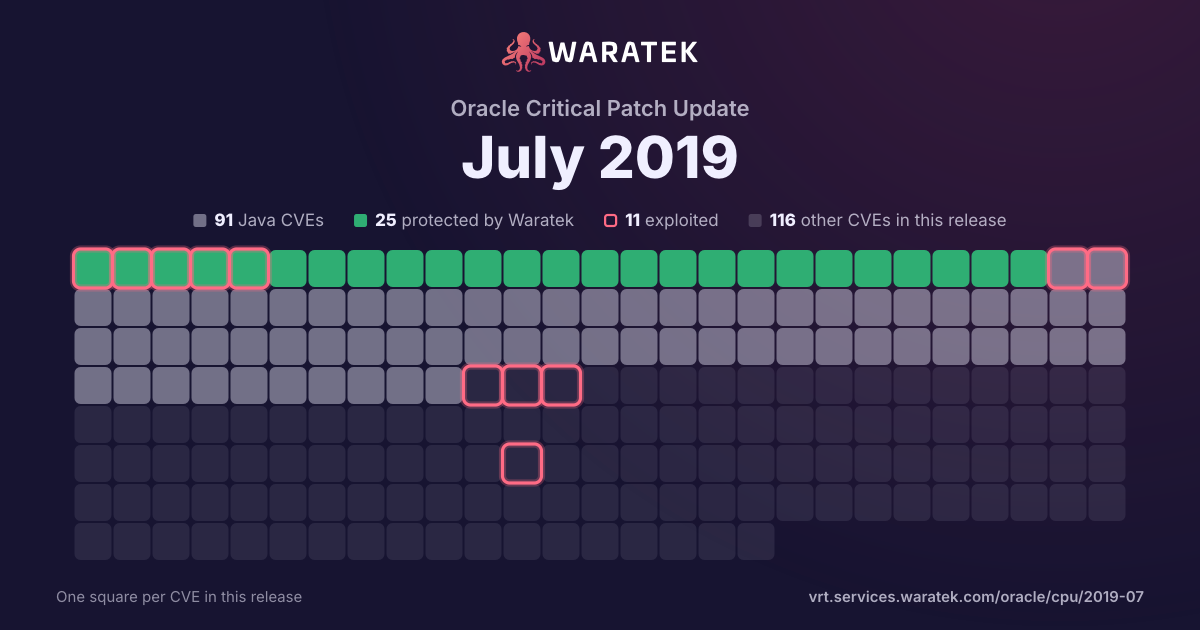
By status
25Protected by Waratek2Mitigation candidate64No exploit published55Outside Waratek scope61Not applicable
11Exploited, marked by the ring
No exploit published. For 58 of them, Oracle's security advisory is the source of public detail.
Protected by Waratek. Waratek RASP can block exploitation of these on systems that have not applied the patch yet.
Overview 18 matches · 12 in Waratek scope · 9 protected · 3 exploited · 1 CISA KEV · 4 public PoC · 5 EPSS ≥ 0.5
18matches
12in Waratek scope66.7%
9protected50.0%
3exploited16.7%
1CISA KEV5.6%
4public PoC22.2%
5EPSS ≥ 0.527.8%
Protected by Waratek
9
50.0%
Rule in development
0
0.0%
Mitigation candidate
0
0.0%
No exploit published
3
16.7%
Outside Waratek scope
5
27.8%
Not applicable
1
5.6%
Withdrawn CVE
0
0.0%
blocked by ARMR today
9
50.0%
partly blocked
0
0.0%
not blocked
9
50.0%
not established
0
0.0%
unrecorded
0
0.0%
Exploited
3
16.7%
Working exploit published
1
5.6%
Proof of concept only
0
0.0%
Forecast only
1
5.6%
No public exploit
13
72.2%
split by
peak 3 / quarter
Q4 161
Protected by Waratek1
Critical1
blocked by ARMR today1
No public exploit1
Q1 170
Q2 171
Protected by Waratek1
Critical1
blocked by ARMR today1
Working exploit published1
Q3 170
Q4 170
Q1 183
Protected by Waratek1
Outside Waratek scope2
Critical3
blocked by ARMR today1
not blocked2
No public exploit3
Q2 182
Protected by Waratek2
Critical2
blocked by ARMR today2
Forecast only1
No public exploit1
Q3 181
Outside Waratek scope1
Critical1
not blocked1
No public exploit1
Q4 181
Outside Waratek scope1
Critical1
not blocked1
No public exploit1
Q1 193
Protected by Waratek2
Outside Waratek scope1
Critical3
blocked by ARMR today2
not blocked1
Exploited1
No public exploit2
Q2 193
Protected by Waratek2
Not applicable1
Critical3
blocked by ARMR today2
not blocked1
Exploited2
No public exploit1
Q3 193
No exploit published3
Critical3
not blocked3
No public exploit3
Q4 16Q1 17Q2 17Q3 17Q4 17Q1 18Q2 18Q3 18Q4 18Q1 19Q2 19Q3 19
| CVE | Severity | Published▾ | Status | Exploitation | Description |
|---|---|---|---|---|---|
| CVE-2019-2856 | Critical | 2019-07-23 | No exploit published | No public exploit | Vulnerability in the Oracle WebLogic Server component of Oracle Fusion Middleware (subcomponent: Application Container - JavaEE). Supported versions that are affected is 12.2.1.3.0. Easily exploitable vulnerability allows unauthenticated attacker with network access via T3 to compromise Oracle WebLogic Server. Successful attacks of this vulnerability can result in takeover of Oracle WebLogic Server. CVSS 3.0 Base Score 9.8 (Confidentiality, Integrity and Availability impacts). CVSS Vector: (CVSS:3.0/AV:N/AC:L/PR:N/UI:N/S:U/C:H/I:H/A:H). |
| CVE-2019-2828 | Critical | 2019-07-23 | No exploit published | No public exploit | Vulnerability in the Oracle Field Service component of Oracle E-Business Suite (subcomponent: Wireless). Supported versions that are affected are 12.1.1 - 12.1.3 and 12.2.3 - 12.2.8. Easily exploitable vulnerability allows unauthenticated attacker with network access via HTTP to compromise Oracle Field Service. Successful attacks require human interaction from a person other than the attacker and while the vulnerability is in Oracle Field Service, attacks may significantly impact additional products. Successful attacks of this vulnerability can result in takeover of Oracle Field Service. CVSS 3.0 Base Score 9.6 (Confidentiality, Integrity and Availability impacts). CVSS Vector: (CVSS:3.0/AV:N/AC:L/PR:N/UI:R/S:C/C:H/I:H/A:H). |
| CVE-2019-2775 | Critical | 2019-07-23 | No exploit published | No public exploit | Vulnerability in the Oracle Payments component of Oracle E-Business Suite (subcomponent: File Transmission). Supported versions that are affected are 12.1.1 - 12.1.3 and 12.2.3 - 12.2.8. Easily exploitable vulnerability allows unauthenticated attacker with network access via HTTP to compromise Oracle Payments. Successful attacks of this vulnerability can result in unauthorized creation, deletion or modification access to critical data or all Oracle Payments accessible data and unauthorized ability to cause a hang or frequently repeatable crash (complete DOS) of Oracle Payments. CVSS 3.0 Base Score 9.1 (Integrity and Availability impacts). CVSS Vector: (CVSS:3.0/AV:N/AC:L/PR:N/UI:N/S:U/C:N/I:H/A:H). |
| CVE-2019-2729 | Critical | 2019-06-19 | Protected by Waratek | Exploited | Vulnerability in the Oracle WebLogic Server component of Oracle Fusion Middleware (subcomponent: Web Services). Supported versions that are affected are 10.3.6.0.0, 12.1.3.0.0 and 12.2.1.3.0. Easily exploitable vulnerability allows unauthenticated attacker with network access via HTTP to compromise Oracle WebLogic Server. Successful attacks of this vulnerability can result in takeover of Oracle WebLogic Server. CVSS 3.0 Base Score 9.8 (Confidentiality, Integrity and Availability impacts). CVSS Vector: (CVSS:3.0/AV:N/AC:L/PR:N/UI:N/S:U/C:H/I:H/A:H). |
| CVE-2019-5597 | Critical | 2019-05-15 | Not applicable | No public exploit | In FreeBSD 11.3-PRERELEASE and 12.0-STABLE before r347591, 11.2-RELEASE before 11.2-RELEASE-p10, and 12.0-RELEASE before 12.0-RELEASE-p4, a bug in the pf IPv6 fragment reassembly logic incorrectly uses the last extension header offset from the last received packet instead of the first packet allowing maliciously crafted IPv6 packets to cause a crash or potentially bypass the packet filter. |
| CVE-2019-2725 | Critical | 2019-04-26 | Protected by Waratek | Exploited | Vulnerability in the Oracle WebLogic Server component of Oracle Fusion Middleware (subcomponent: Web Services). Supported versions that are affected are 10.3.6.0.0 and 12.1.3.0.0. Easily exploitable vulnerability allows unauthenticated attacker with network access via HTTP to compromise Oracle WebLogic Server. Successful attacks of this vulnerability can result in takeover of Oracle WebLogic Server. CVSS 3.0 Base Score 9.8 (Confidentiality, Integrity and Availability impacts). CVSS Vector: (CVSS:3.0/AV:N/AC:L/PR:N/UI:N/S:U/C:H/I:H/A:H). |
| CVE-2019-0192 | Critical | 2019-03-07 | Protected by Waratek | Exploited | In Apache Solr versions 5.0.0 to 5.5.5 and 6.0.0 to 6.6.5, the Config API allows to configure the JMX server via an HTTP POST request. By pointing it to a malicious RMI server, an attacker could take advantage of Solr's unsafe deserialization to trigger remote code execution on the Solr side. |
| CVE-2019-3822 | Critical | 2019-02-06 | Outside Waratek scope | No public exploit | libcurl versions from 7.36.0 to before 7.64.0 are vulnerable to a stack-based buffer overflow. The function creating an outgoing NTLM type-3 header (`lib/vauth/ntlm.c:Curl_auth_create_ntlm_type3_message()`), generates the request HTTP header contents based on previously received data. The check that exists to prevent the local buffer from getting overflowed is implemented wrongly (using unsigned math) and as such it does not prevent the overflow from happening. This output data can grow larger than the local buffer if very large 'nt response' data is extracted from a previous NTLMv2 header provided by the malicious or broken HTTP server. Such a 'large value' needs to be around 1000 bytes or more. The actual payload data copied to the target buffer comes from the NTLMv2 type-2 response header. |
| CVE-2018-19362 | Critical | 2019-01-02 | Protected by Waratek | No public exploit | FasterXML jackson-databind 2.x before 2.9.8 might allow attackers to have unspecified impact by leveraging failure to block the jboss-common-core class from polymorphic deserialization. |
| CVE-2018-18311 | Critical | 2018-12-07 | Outside Waratek scope | No public exploit | Perl before 5.26.3 and 5.28.x before 5.28.1 has a buffer overflow via a crafted regular expression that triggers invalid write operations. |
| CVE-2018-11058 | Critical | 2018-09-14 | Outside Waratek scope | No public exploit | RSA BSAFE Micro Edition Suite, versions prior to 4.0.11 (in 4.0.x) and prior to 4.1.6 (in 4.1.x), and RSA BSAFE Crypto-C Micro Edition, version prior to 4.0.5.3 (in 4.0.x) contain a Buffer Over-Read vulnerability when parsing ASN.1 data. A remote attacker could use maliciously constructed ASN.1 data that would result in such issue. |
| CVE-2018-8013 | Critical | 2018-05-24 | Protected by Waratek | No public exploit | In Apache Batik 1.x before 1.10, when deserializing subclass of `AbstractDocument`, the class takes a string from the inputStream as the class name which then use it to call the no-arg constructor of the class. Fix was to check the class type before calling newInstance in deserialization. |
| CVE-2018-1275 | Critical | 2018-04-11 | Protected by Waratek | Forecast only | Spring Framework, versions 5.0 prior to 5.0.5 and versions 4.3 prior to 4.3.16 and older unsupported versions, allow applications to expose STOMP over WebSocket endpoints with a simple, in-memory STOMP broker through the spring-messaging module. A malicious user (or attacker) can craft a message to the broker that can lead to a remote code execution attack. This CVE addresses the partial fix for CVE-2018-1270 in the 4.3.x branch of the Spring Framework. |
| CVE-2018-1000120 | Critical | 2018-03-14 | Outside Waratek scope | No public exploit | A buffer overflow exists in curl 7.12.3 to and including curl 7.58.0 in the FTP URL handling that allows an attacker to cause a denial of service or worse. |
| CVE-2018-7489 | Critical | 2018-02-26 | Protected by Waratek | No public exploit | FasterXML jackson-databind before 2.7.9.3, 2.8.x before 2.8.11.1 and 2.9.x before 2.9.5 allows unauthenticated remote code execution because of an incomplete fix for the CVE-2017-7525 deserialization flaw. This is exploitable by sending maliciously crafted JSON input to the readValue method of the ObjectMapper, bypassing a blacklist that is ineffective if the c3p0 libraries are available in the classpath. |
| CVE-2016-6814 | Critical | 2018-01-18 | Outside Waratek scope | No public exploit | When an application with unsupported Codehaus versions of Groovy from 1.7.0 to 2.4.3, Apache Groovy 2.4.4 to 2.4.7 on classpath uses standard Java serialization mechanisms, e.g. to communicate between servers or to store local data, it was possible for an attacker to bake a special serialized object that will execute code directly when deserialized. All applications which rely on serialization and do not isolate the code which deserializes objects were subject to this vulnerability. |
| CVE-2017-5645 | Critical | 2017-04-17 | Protected by Waratek | Working exploit published | In Apache Log4j 2.x before 2.8.2, when using the TCP socket server or UDP socket server to receive serialized log events from another application, a specially crafted binary payload can be sent that, when deserialized, can execute arbitrary code. |
| CVE-2016-1000031 | Critical | 2016-10-25 | Protected by Waratek | No public exploit | Apache Commons FileUpload before 1.3.3 DiskFileItem File Manipulation Remote Code Execution |