
Oracle Critical Patch Update July 2019
Released July 2019 · Oracle's advisory ↗ · ← Critical Patch Update, April 2019 · Critical Patch Update, October 2019 →
207 CVEs in this release, one square each
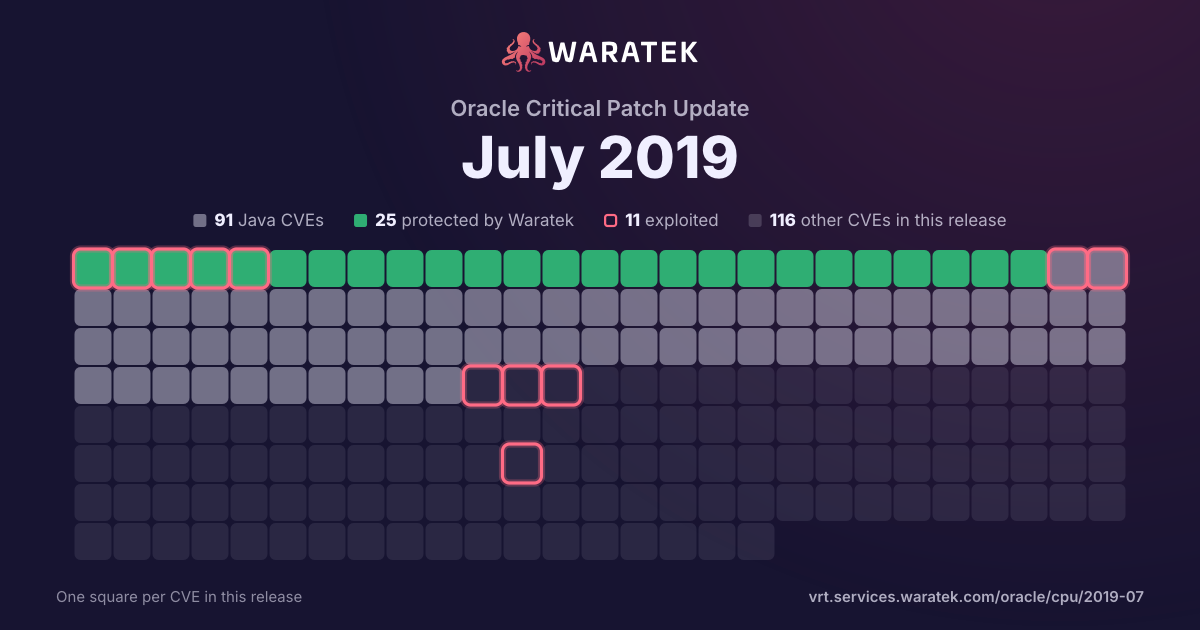
By status
25Protected by Waratek2Mitigation candidate64No exploit published55Outside Waratek scope61Not applicable
11Exploited, marked by the ring
No exploit published. For 58 of them, Oracle's security advisory is the source of public detail.
Protected by Waratek. Waratek RASP can block exploitation of these on systems that have not applied the patch yet.
Overview 12 matches · 3 in Waratek scope · 2 protected · 1 exploited · 0 CISA KEV · 4 public PoC · 2 EPSS ≥ 0.5
12matches
3in Waratek scope25.0%
2protected16.7%
1exploited8.3%
0CISA KEV0.0%
4public PoC33.3%
2EPSS ≥ 0.516.7%
Protected by Waratek
2
16.7%
Rule in development
0
0.0%
Mitigation candidate
0
0.0%
No exploit published
1
8.3%
Outside Waratek scope
6
50.0%
Not applicable
3
25.0%
Withdrawn CVE
0
0.0%
blocked by ARMR today
2
16.7%
partly blocked
0
0.0%
not blocked
10
83.3%
not established
0
0.0%
unrecorded
0
0.0%
split by
peak 5 / quarter
Q1 171
Outside Waratek scope1
Medium1
not blocked1
No public exploit1
Q2 170
Q3 171
Protected by Waratek1
Medium1
blocked by ARMR today1
No public exploit1
Q4 171
Not applicable1
Medium1
not blocked1
No public exploit1
Q1 183
Outside Waratek scope3
Medium3
not blocked3
Exploited1
Working exploit published1
Proof of concept only1
Q2 180
Q3 181
Not applicable1
Medium1
not blocked1
No public exploit1
Q4 185
Protected by Waratek1
No exploit published1
Outside Waratek scope2
Not applicable1
Medium5
blocked by ARMR today1
not blocked4
Working exploit published1
No public exploit4
Q1 17Q2 17Q3 17Q4 17Q1 18Q2 18Q3 18Q4 18
| CVE | Severity | Published▾ | Status | Exploitation | Description |
|---|---|---|---|---|---|
| CVE-2018-17197 | Medium | 2018-12-24 | No exploit published | No public exploit | A carefully crafted or corrupt sqlite file can cause an infinite loop in Apache Tika's SQLite3Parser in versions 1.8-1.19.1 of Apache Tika. |
| CVE-2018-1000873 | Medium | 2018-12-20 | Protected by Waratek | No public exploit | Fasterxml Jackson version Before 2.9.8 contains a CWE-20: Improper Input Validation vulnerability in Jackson-Modules-Java8 that can result in Causes a denial-of-service (DoS). This attack appear to be exploitable via The victim deserializes malicious input, specifically very large values in the nanoseconds field of a time value. This vulnerability appears to have been fixed in 2.9.8. |
| CVE-2018-17960 | Medium | 2018-11-14 | Not applicable | No public exploit | CKEditor 4.x before 4.11.0 allows user-assisted XSS involving a source-mode paste. |
| CVE-2018-0734 | Medium | 2018-10-30 | Outside Waratek scope | No public exploit | The OpenSSL DSA signature algorithm has been shown to be vulnerable to a timing side channel attack. An attacker could use variations in the signing algorithm to recover the private key. Fixed in OpenSSL 1.1.1a (Affected 1.1.1). Fixed in OpenSSL 1.1.0j (Affected 1.1.0-1.1.0i). Fixed in OpenSSL 1.0.2q (Affected 1.0.2-1.0.2p). |
| CVE-2018-11784 | Medium | 2018-10-04 | Outside Waratek scope | Working exploit published | When the default servlet in Apache Tomcat versions 9.0.0.M1 to 9.0.11, 8.5.0 to 8.5.33 and 7.0.23 to 7.0.90 returned a redirect to a directory (e.g. redirecting to '/foo/' when the user requested '/foo') a specially crafted URL could be used to cause the redirect to be generated to any URI of the attackers choice. |
| CVE-2016-9572 | Medium | 2018-08-01 | Not applicable | No public exploit | A NULL pointer dereference flaw was found in the way openjpeg 2.1.2 decoded certain input images. Due to a logic error in the code responsible for decoding the input image, an application using openjpeg to process image data could crash when processing a crafted image. |
| CVE-2018-1305 | Medium | 2018-02-23 | Outside Waratek scope | Proof of concept only | Security constraints defined by annotations of Servlets in Apache Tomcat 9.0.0.M1 to 9.0.4, 8.5.0 to 8.5.27, 8.0.0.RC1 to 8.0.49 and 7.0.0 to 7.0.84 were only applied once a Servlet had been loaded. Because security constraints defined in this way apply to the URL pattern and any URLs below that point, it was possible - depending on the order Servlets were loaded - for some security constraints not to be applied. This could have exposed resources to users who were not authorised to access them. |
| CVE-2015-9251 | Medium | 2018-01-18 | Outside Waratek scope | Exploited | jQuery before 3.0.0 is vulnerable to Cross-site Scripting (XSS) attacks when a cross-domain Ajax request is performed without the dataType option, causing text/javascript responses to be executed. |
| CVE-2017-5715 | Medium | 2018-01-04 | Outside Waratek scope | Working exploit published | Systems with microprocessors utilizing speculative execution and indirect branch prediction may allow unauthorized disclosure of information to an attacker with local user access via a side-channel analysis. |
| CVE-2017-3736 | Medium | 2017-11-02 | Not applicable | No public exploit | There is a carry propagating bug in the x86_64 Montgomery squaring procedure in OpenSSL before 1.0.2m and 1.1.0 before 1.1.0g. No EC algorithms are affected. Analysis suggests that attacks against RSA and DSA as a result of this defect would be very difficult to perform and are not believed likely. Attacks against DH are considered just feasible (although very difficult) because most of the work necessary to deduce information about a private key may be performed offline. The amount of resources required for such an attack would be very significant and likely only accessible to a limited number of attackers. An attacker would additionally need online access to an unpatched system using the target private key in a scenario with persistent DH parameters and a private key that is shared between multiple clients. This only affects processors that support the BMI1, BMI2 and ADX extensions like Intel Broadwell (5th generation) and later or AMD Ryzen. |
| CVE-2017-14735 | Medium | 2017-09-25 | Protected by Waratek | No public exploit | OWASP AntiSamy before 1.5.7 allows XSS via HTML5 entities, as demonstrated by use of : to construct a javascript: URL. |
| CVE-2016-7103 | Medium | 2017-03-15 | Outside Waratek scope | No public exploit | Cross-site scripting (XSS) vulnerability in jQuery UI before 1.12.0 might allow remote attackers to inject arbitrary web script or HTML via the closeText parameter of the dialog function. |