
Oracle Critical Patch Update July 2019
Released July 2019 · Oracle's advisory ↗ · ← Critical Patch Update, April 2019 · Critical Patch Update, October 2019 →
207 CVEs in this release, one square each
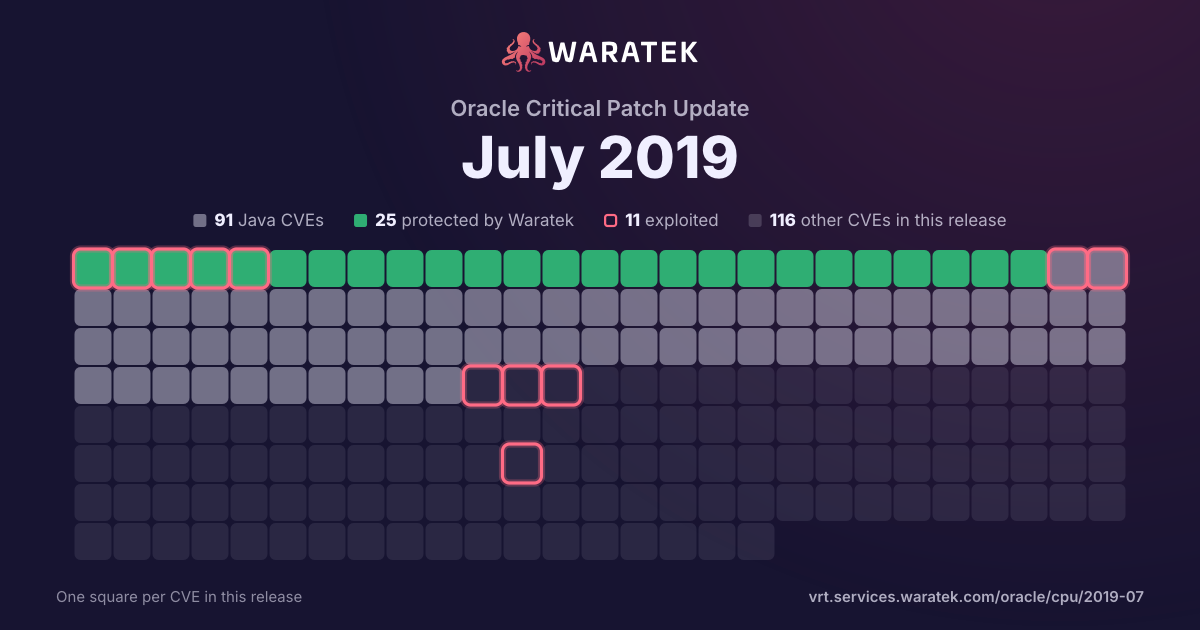
By status
25Protected by Waratek2Mitigation candidate64No exploit published55Outside Waratek scope61Not applicable
11Exploited, marked by the ring
No exploit published. For 58 of them, Oracle's security advisory is the source of public detail.
Protected by Waratek. Waratek RASP can block exploitation of these on systems that have not applied the patch yet.
Overview 7 matches · 2 in Waratek scope · 1 protected · 0 exploited · 0 CISA KEV · 1 public PoC · 1 EPSS ≥ 0.5
7matches
2in Waratek scope28.6%
1protected14.3%
0exploited0.0%
0CISA KEV0.0%
1public PoC14.3%
1EPSS ≥ 0.514.3%
Protected by Waratek
1
14.3%
Rule in development
0
0.0%
Mitigation candidate
0
0.0%
No exploit published
1
14.3%
Outside Waratek scope
4
57.1%
Not applicable
1
14.3%
Withdrawn CVE
0
0.0%
blocked by ARMR today
1
14.3%
partly blocked
0
0.0%
not blocked
6
85.7%
not established
0
0.0%
unrecorded
0
0.0%
Exploited
0
0.0%
Working exploit published
1
14.3%
Proof of concept only
0
0.0%
Forecast only
0
0.0%
No public exploit
6
85.7%
split by
peak 3 / month
Oct 183
Outside Waratek scope3
High1
Medium2
not blocked3
Working exploit published1
No public exploit2
Nov 181
Not applicable1
Medium1
not blocked1
No public exploit1
Dec 183
Protected by Waratek1
No exploit published1
Outside Waratek scope1
Critical1
Medium2
blocked by ARMR today1
not blocked2
No public exploit3
Oct 18Nov 18Dec 18
| CVE | Severity | Published▾ | Status | Exploitation | Description |
|---|---|---|---|---|---|
| CVE-2018-17197 | Medium | 2018-12-24 | No exploit published | No public exploit | A carefully crafted or corrupt sqlite file can cause an infinite loop in Apache Tika's SQLite3Parser in versions 1.8-1.19.1 of Apache Tika. |
| CVE-2018-1000873 | Medium | 2018-12-20 | Protected by Waratek | No public exploit | Fasterxml Jackson version Before 2.9.8 contains a CWE-20: Improper Input Validation vulnerability in Jackson-Modules-Java8 that can result in Causes a denial-of-service (DoS). This attack appear to be exploitable via The victim deserializes malicious input, specifically very large values in the nanoseconds field of a time value. This vulnerability appears to have been fixed in 2.9.8. |
| CVE-2018-18311 | Critical | 2018-12-07 | Outside Waratek scope | No public exploit | Perl before 5.26.3 and 5.28.x before 5.28.1 has a buffer overflow via a crafted regular expression that triggers invalid write operations. |
| CVE-2018-17960 | Medium | 2018-11-14 | Not applicable | No public exploit | CKEditor 4.x before 4.11.0 allows user-assisted XSS involving a source-mode paste. |
| CVE-2018-0734 | Medium | 2018-10-30 | Outside Waratek scope | No public exploit | The OpenSSL DSA signature algorithm has been shown to be vulnerable to a timing side channel attack. An attacker could use variations in the signing algorithm to recover the private key. Fixed in OpenSSL 1.1.1a (Affected 1.1.1). Fixed in OpenSSL 1.1.0j (Affected 1.1.0-1.1.0i). Fixed in OpenSSL 1.0.2q (Affected 1.0.2-1.0.2p). |
| CVE-2018-15756 | High | 2018-10-18 | Outside Waratek scope | No public exploit | Spring Framework, version 5.1, versions 5.0.x prior to 5.0.10, versions 4.3.x prior to 4.3.20, and older unsupported versions on the 4.2.x branch provide support for range requests when serving static resources through the ResourceHttpRequestHandler, or starting in 5.0 when an annotated controller returns an org.springframework.core.io.Resource. A malicious user (or attacker) can add a range header with a high number of ranges, or with wide ranges that overlap, or both, for a denial of service attack. This vulnerability affects applications that depend on either spring-webmvc or spring-webflux. Such applications must also have a registration for serving static resources (e.g. JS, CSS, images, and others), or have an annotated controller that returns an org.springframework.core.io.Resource. Spring Boot applications that depend on spring-boot-starter-web or spring-boot-starter-webflux are ready to serve static resources out of the box and are therefore vulnerable. |
| CVE-2018-11784 | Medium | 2018-10-04 | Outside Waratek scope | Working exploit published | When the default servlet in Apache Tomcat versions 9.0.0.M1 to 9.0.11, 8.5.0 to 8.5.33 and 7.0.23 to 7.0.90 returned a redirect to a directory (e.g. redirecting to '/foo/' when the user requested '/foo') a specially crafted URL could be used to cause the redirect to be generated to any URI of the attackers choice. |