
Oracle Critical Patch Update July 2019
Released July 2019 · Oracle's advisory ↗ · ← Critical Patch Update, April 2019 · Critical Patch Update, October 2019 →
207 CVEs in this release, one square each
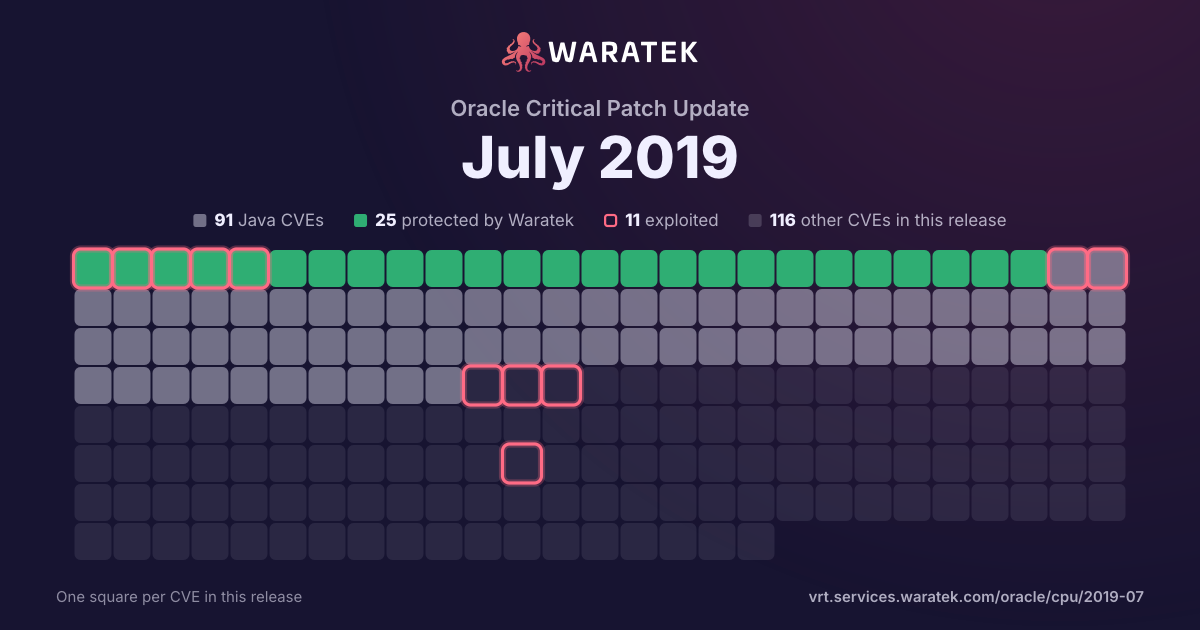
By status
25Protected by Waratek2Mitigation candidate64No exploit published55Outside Waratek scope61Not applicable
11Exploited, marked by the ring
No exploit published. For 58 of them, Oracle's security advisory is the source of public detail.
Protected by Waratek. Waratek RASP can block exploitation of these on systems that have not applied the patch yet.
Overview 6 matches · 1 in Waratek scope · 1 protected · 2 exploited · 0 CISA KEV · 3 EPSS ≥ 0.5
Protected by Waratek
1
16.7%
Rule in development
0
0.0%
Mitigation candidate
0
0.0%
No exploit published
0
0.0%
Outside Waratek scope
5
83.3%
Not applicable
0
0.0%
Withdrawn CVE
0
0.0%
blocked by ARMR today
1
16.7%
partly blocked
0
0.0%
not blocked
5
83.3%
not established
0
0.0%
unrecorded
0
0.0%
Exploited
2
33.3%
Working exploit published
3
50.0%
Proof of concept only
1
16.7%
Forecast only
0
0.0%
No public exploit
0
0.0%
split by
peak 3 / quarter
Q1 183
Outside Waratek scope3
Medium3
not blocked3
Exploited1
Working exploit published1
Proof of concept only1
Q2 180
Q3 180
Q4 181
Outside Waratek scope1
Medium1
not blocked1
Working exploit published1
Q1 190
Q2 191
Outside Waratek scope1
Medium1
not blocked1
Exploited1
Q3 191
Protected by Waratek1
Medium1
blocked by ARMR today1
Working exploit published1
Q1 18Q2 18Q3 18Q4 18Q1 19Q2 19Q3 19
| CVE | Severity | Published▾ | Status | Exploitation | Description |
|---|---|---|---|---|---|
| CVE-2019-2861 | Medium | 2019-07-23 | Protected by Waratek | Working exploit published | Vulnerability in the Oracle Hyperion Planning component of Oracle Hyperion (subcomponent: Security). The supported version that is affected is 11.1.2.4. Difficult to exploit vulnerability allows high privileged attacker with network access via HTTP to compromise Oracle Hyperion Planning. Successful attacks require human interaction from a person other than the attacker. Successful attacks of this vulnerability can result in unauthorized creation, deletion or modification access to critical data or all Oracle Hyperion Planning accessible data. CVSS 3.0 Base Score 4.2 (Integrity impacts). CVSS Vector: (CVSS:3.0/AV:N/AC:H/PR:H/UI:R/S:U/C:N/I:H/A:N). |
| CVE-2019-11358 | Medium | 2019-04-20 | Outside Waratek scope | Exploited | jQuery before 3.4.0, as used in Drupal, Backdrop CMS, and other products, mishandles jQuery.extend(true, {}, ...) because of Object.prototype pollution. If an unsanitized source object contained an enumerable __proto__ property, it could extend the native Object.prototype. |
| CVE-2018-11784 | Medium | 2018-10-04 | Outside Waratek scope | Working exploit published | When the default servlet in Apache Tomcat versions 9.0.0.M1 to 9.0.11, 8.5.0 to 8.5.33 and 7.0.23 to 7.0.90 returned a redirect to a directory (e.g. redirecting to '/foo/' when the user requested '/foo') a specially crafted URL could be used to cause the redirect to be generated to any URI of the attackers choice. |
| CVE-2018-1305 | Medium | 2018-02-23 | Outside Waratek scope | Proof of concept only | Security constraints defined by annotations of Servlets in Apache Tomcat 9.0.0.M1 to 9.0.4, 8.5.0 to 8.5.27, 8.0.0.RC1 to 8.0.49 and 7.0.0 to 7.0.84 were only applied once a Servlet had been loaded. Because security constraints defined in this way apply to the URL pattern and any URLs below that point, it was possible - depending on the order Servlets were loaded - for some security constraints not to be applied. This could have exposed resources to users who were not authorised to access them. |
| CVE-2015-9251 | Medium | 2018-01-18 | Outside Waratek scope | Exploited | jQuery before 3.0.0 is vulnerable to Cross-site Scripting (XSS) attacks when a cross-domain Ajax request is performed without the dataType option, causing text/javascript responses to be executed. |
| CVE-2017-5715 | Medium | 2018-01-04 | Outside Waratek scope | Working exploit published | Systems with microprocessors utilizing speculative execution and indirect branch prediction may allow unauthorized disclosure of information to an attacker with local user access via a side-channel analysis. |