
Oracle Critical Patch Update July 2019
Released July 2019 · Oracle's advisory ↗ · ← Critical Patch Update, April 2019 · Critical Patch Update, October 2019 →
207 CVEs in this release, one square each
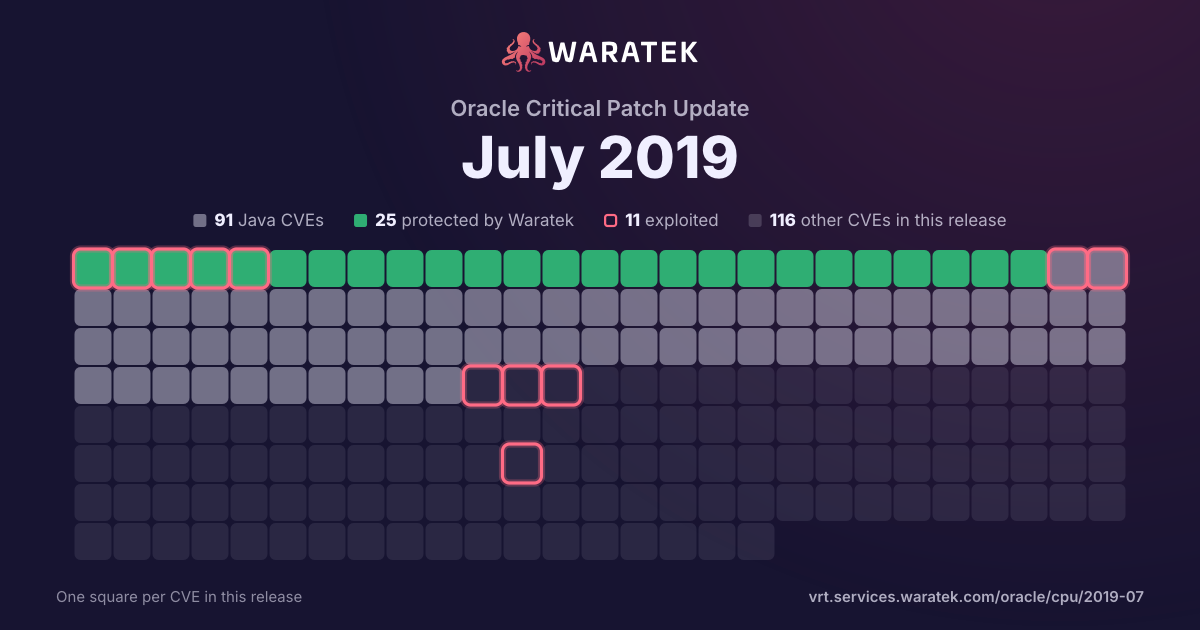
By status
25Protected by Waratek2Mitigation candidate64No exploit published55Outside Waratek scope61Not applicable
11Exploited, marked by the ring
No exploit published. For 58 of them, Oracle's security advisory is the source of public detail.
Protected by Waratek. Waratek RASP can block exploitation of these on systems that have not applied the patch yet.
Overview 14 matches · 8 in Waratek scope · 7 protected · 9 exploited · 2 CISA KEV · 10 EPSS ≥ 0.5
Protected by Waratek
7
50.0%
Rule in development
0
0.0%
Mitigation candidate
1
7.1%
No exploit published
0
0.0%
Outside Waratek scope
6
42.9%
Not applicable
0
0.0%
Withdrawn CVE
0
0.0%
blocked by ARMR today
7
50.0%
partly blocked
0
0.0%
not blocked
7
50.0%
not established
0
0.0%
unrecorded
0
0.0%
Exploited
9
64.3%
Working exploit published
4
28.6%
Proof of concept only
1
7.1%
Forecast only
0
0.0%
No public exploit
0
0.0%
split by
peak 5 / quarter
Q2 141
Protected by Waratek1
High1
blocked by ARMR today1
Exploited1
Q3 140
Q4 140
Q1 150
Q2 150
Q3 150
Q4 150
Q1 160
Q2 160
Q3 160
Q4 160
Q1 170
Q2 171
Protected by Waratek1
Critical1
blocked by ARMR today1
Working exploit published1
Q3 170
Q4 170
Q1 183
Outside Waratek scope3
Medium3
not blocked3
Exploited1
Working exploit published1
Proof of concept only1
Q2 180
Q3 180
Q4 181
Outside Waratek scope1
Medium1
not blocked1
Working exploit published1
Q1 191
Protected by Waratek1
Critical1
blocked by ARMR today1
Exploited1
Q2 195
Protected by Waratek3
Outside Waratek scope2
Critical2
High2
Medium1
blocked by ARMR today3
not blocked2
Exploited5
Q3 192
Protected by Waratek1
Mitigation candidate1
High1
Medium1
blocked by ARMR today1
not blocked1
Exploited1
Working exploit published1
Q3 14Q1 15Q3 15Q1 16Q3 16Q1 17Q3 17Q1 18Q3 18Q1 19Q3 19
| CVE | Severity | Published▾ | Status | Exploitation | Description |
|---|---|---|---|---|---|
| CVE-2019-2861 | Medium | 2019-07-23 | Protected by Waratek | Working exploit published | Vulnerability in the Oracle Hyperion Planning component of Oracle Hyperion (subcomponent: Security). The supported version that is affected is 11.1.2.4. Difficult to exploit vulnerability allows high privileged attacker with network access via HTTP to compromise Oracle Hyperion Planning. Successful attacks require human interaction from a person other than the attacker. Successful attacks of this vulnerability can result in unauthorized creation, deletion or modification access to critical data or all Oracle Hyperion Planning accessible data. CVSS 3.0 Base Score 4.2 (Integrity impacts). CVSS Vector: (CVSS:3.0/AV:N/AC:H/PR:H/UI:R/S:U/C:N/I:H/A:N). |
| CVE-2019-2767 | High | 2019-07-23 | Mitigation candidate | Exploited | Vulnerability in the BI Publisher (formerly XML Publisher) component of Oracle Fusion Middleware (subcomponent: BI Publisher Security). The supported version that is affected are 11.1.1.9.0, 12.2.1.3.0 and 12.2.1.4.0. Easily exploitable vulnerability allows unauthenticated attacker with network access via HTTP to compromise BI Publisher (formerly XML Publisher). While the vulnerability is in BI Publisher (formerly XML Publisher), attacks may significantly impact additional products. Successful attacks of this vulnerability can result in unauthorized update, insert or delete access to some of BI Publisher (formerly XML Publisher) accessible data as well as unauthorized read access to a subset of BI Publisher (formerly XML Publisher) accessible data. CVSS 3.0 Base Score 7.2 (Confidentiality and Integrity impacts). CVSS Vector: (CVSS:3.0/AV:N/AC:L/PR:N/UI:N/S:C/C:L/I:L/A:N). |
| CVE-2019-2729 | Critical | 2019-06-19 | Protected by Waratek | Exploited | Vulnerability in the Oracle WebLogic Server component of Oracle Fusion Middleware (subcomponent: Web Services). Supported versions that are affected are 10.3.6.0.0, 12.1.3.0.0 and 12.2.1.3.0. Easily exploitable vulnerability allows unauthenticated attacker with network access via HTTP to compromise Oracle WebLogic Server. Successful attacks of this vulnerability can result in takeover of Oracle WebLogic Server. CVSS 3.0 Base Score 9.8 (Confidentiality, Integrity and Availability impacts). CVSS Vector: (CVSS:3.0/AV:N/AC:L/PR:N/UI:N/S:U/C:H/I:H/A:H). |
| CVE-2019-2725 | Critical | 2019-04-26 | Protected by Waratek | Exploited | Vulnerability in the Oracle WebLogic Server component of Oracle Fusion Middleware (subcomponent: Web Services). Supported versions that are affected are 10.3.6.0.0 and 12.1.3.0.0. Easily exploitable vulnerability allows unauthenticated attacker with network access via HTTP to compromise Oracle WebLogic Server. Successful attacks of this vulnerability can result in takeover of Oracle WebLogic Server. CVSS 3.0 Base Score 9.8 (Confidentiality, Integrity and Availability impacts). CVSS Vector: (CVSS:3.0/AV:N/AC:L/PR:N/UI:N/S:U/C:H/I:H/A:H). |
| CVE-2019-11358 | Medium | 2019-04-20 | Outside Waratek scope | Exploited | jQuery before 3.4.0, as used in Drupal, Backdrop CMS, and other products, mishandles jQuery.extend(true, {}, ...) because of Object.prototype pollution. If an unsanitized source object contained an enumerable __proto__ property, it could extend the native Object.prototype. |
| CVE-2019-0232 | High | 2019-04-15 | Protected by Waratek | Exploited | When running on Windows with enableCmdLineArguments enabled, the CGI Servlet in Apache Tomcat 9.0.0.M1 to 9.0.17, 8.5.0 to 8.5.39 and 7.0.0 to 7.0.93 is vulnerable to Remote Code Execution due to a bug in the way the JRE passes command line arguments to Windows. The CGI Servlet is disabled by default. The CGI option enableCmdLineArguments is disable by default in Tomcat 9.0.x (and will be disabled by default in all versions in response to this vulnerability). For a detailed explanation of the JRE behaviour, see Markus Wulftange's blog (https://codewhitesec.blogspot.com/2016/02/java-and-command-line-injections-in-windows.html) and this archived MSDN blog (https://web.archive.org/web/20161228144344/https://blogs.msdn.microsoft.com/twistylittlepassagesallalike/2011/04/23/everyone-quotes-command-line-arguments-the-wrong-way/). |
| CVE-2019-0211 | High | 2019-04-08 | Outside Waratek scope | Exploited | In Apache HTTP Server 2.4 releases 2.4.17 to 2.4.38, with MPM event, worker or prefork, code executing in less-privileged child processes or threads (including scripts executed by an in-process scripting interpreter) could execute arbitrary code with the privileges of the parent process (usually root) by manipulating the scoreboard. Non-Unix systems are not affected. |
| CVE-2019-0192 | Critical | 2019-03-07 | Protected by Waratek | Exploited | In Apache Solr versions 5.0.0 to 5.5.5 and 6.0.0 to 6.6.5, the Config API allows to configure the JMX server via an HTTP POST request. By pointing it to a malicious RMI server, an attacker could take advantage of Solr's unsafe deserialization to trigger remote code execution on the Solr side. |
| CVE-2018-11784 | Medium | 2018-10-04 | Outside Waratek scope | Working exploit published | When the default servlet in Apache Tomcat versions 9.0.0.M1 to 9.0.11, 8.5.0 to 8.5.33 and 7.0.23 to 7.0.90 returned a redirect to a directory (e.g. redirecting to '/foo/' when the user requested '/foo') a specially crafted URL could be used to cause the redirect to be generated to any URI of the attackers choice. |
| CVE-2018-1305 | Medium | 2018-02-23 | Outside Waratek scope | Proof of concept only | Security constraints defined by annotations of Servlets in Apache Tomcat 9.0.0.M1 to 9.0.4, 8.5.0 to 8.5.27, 8.0.0.RC1 to 8.0.49 and 7.0.0 to 7.0.84 were only applied once a Servlet had been loaded. Because security constraints defined in this way apply to the URL pattern and any URLs below that point, it was possible - depending on the order Servlets were loaded - for some security constraints not to be applied. This could have exposed resources to users who were not authorised to access them. |
| CVE-2015-9251 | Medium | 2018-01-18 | Outside Waratek scope | Exploited | jQuery before 3.0.0 is vulnerable to Cross-site Scripting (XSS) attacks when a cross-domain Ajax request is performed without the dataType option, causing text/javascript responses to be executed. |
| CVE-2017-5715 | Medium | 2018-01-04 | Outside Waratek scope | Working exploit published | Systems with microprocessors utilizing speculative execution and indirect branch prediction may allow unauthorized disclosure of information to an attacker with local user access via a side-channel analysis. |
| CVE-2017-5645 | Critical | 2017-04-17 | Protected by Waratek | Working exploit published | In Apache Log4j 2.x before 2.8.2, when using the TCP socket server or UDP socket server to receive serialized log events from another application, a specially crafted binary payload can be sent that, when deserialized, can execute arbitrary code. |
| CVE-2014-0114 | High | 2014-04-30 | Protected by Waratek | Exploited | Apache Commons BeanUtils, as distributed in lib/commons-beanutils-1.8.0.jar in Apache Struts 1.x through 1.3.10 and in other products requiring commons-beanutils through 1.9.2, does not suppress the class property, which allows remote attackers to "manipulate" the ClassLoader and execute arbitrary code via the class parameter, as demonstrated by the passing of this parameter to the getClass method of the ActionForm object in Struts 1. |