
Oracle Critical Patch Update July 2019
Released July 2019 · Oracle's advisory ↗ · ← Critical Patch Update, April 2019 · Critical Patch Update, October 2019 →
207 CVEs in this release, one square each
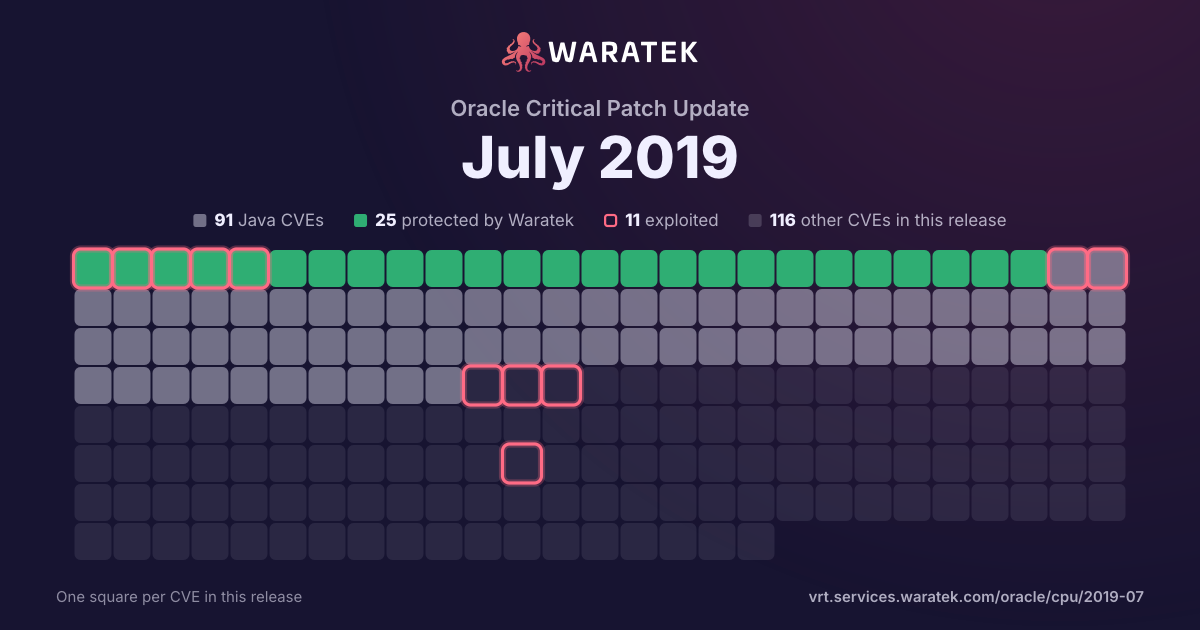
By status
25Protected by Waratek2Mitigation candidate64No exploit published55Outside Waratek scope61Not applicable
11Exploited, marked by the ring
No exploit published. For 58 of them, Oracle's security advisory is the source of public detail.
Protected by Waratek. Waratek RASP can block exploitation of these on systems that have not applied the patch yet.
Overview 4 matches · 1 CISA KEV
4matches
1CISA KEV25.0%
Protected by Waratek
4
100.0%
Rule in development
0
0.0%
Mitigation candidate
0
0.0%
No exploit published
0
0.0%
blocked by ARMR today
4
100.0%
partly blocked
0
0.0%
not blocked
0
0.0%
not established
0
0.0%
unrecorded
0
0.0%
Exploited
4
100.0%
Working exploit published
0
0.0%
Proof of concept only
0
0.0%
Forecast only
0
0.0%
No public exploit
0
0.0%
| CVE | Severity | Published▾ | Status | Exploitation | Description |
|---|---|---|---|---|---|
| CVE-2019-2729 | Critical | 2019-06-19 | Protected by Waratek | Exploited | Vulnerability in the Oracle WebLogic Server component of Oracle Fusion Middleware (subcomponent: Web Services). Supported versions that are affected are 10.3.6.0.0, 12.1.3.0.0 and 12.2.1.3.0. Easily exploitable vulnerability allows unauthenticated attacker with network access via HTTP to compromise Oracle WebLogic Server. Successful attacks of this vulnerability can result in takeover of Oracle WebLogic Server. CVSS 3.0 Base Score 9.8 (Confidentiality, Integrity and Availability impacts). CVSS Vector: (CVSS:3.0/AV:N/AC:L/PR:N/UI:N/S:U/C:H/I:H/A:H). |
| CVE-2019-2725 | Critical | 2019-04-26 | Protected by Waratek | Exploited | Vulnerability in the Oracle WebLogic Server component of Oracle Fusion Middleware (subcomponent: Web Services). Supported versions that are affected are 10.3.6.0.0 and 12.1.3.0.0. Easily exploitable vulnerability allows unauthenticated attacker with network access via HTTP to compromise Oracle WebLogic Server. Successful attacks of this vulnerability can result in takeover of Oracle WebLogic Server. CVSS 3.0 Base Score 9.8 (Confidentiality, Integrity and Availability impacts). CVSS Vector: (CVSS:3.0/AV:N/AC:L/PR:N/UI:N/S:U/C:H/I:H/A:H). |
| CVE-2019-0232 | High | 2019-04-15 | Protected by Waratek | Exploited | When running on Windows with enableCmdLineArguments enabled, the CGI Servlet in Apache Tomcat 9.0.0.M1 to 9.0.17, 8.5.0 to 8.5.39 and 7.0.0 to 7.0.93 is vulnerable to Remote Code Execution due to a bug in the way the JRE passes command line arguments to Windows. The CGI Servlet is disabled by default. The CGI option enableCmdLineArguments is disable by default in Tomcat 9.0.x (and will be disabled by default in all versions in response to this vulnerability). For a detailed explanation of the JRE behaviour, see Markus Wulftange's blog (https://codewhitesec.blogspot.com/2016/02/java-and-command-line-injections-in-windows.html) and this archived MSDN blog (https://web.archive.org/web/20161228144344/https://blogs.msdn.microsoft.com/twistylittlepassagesallalike/2011/04/23/everyone-quotes-command-line-arguments-the-wrong-way/). |
| CVE-2019-0192 | Critical | 2019-03-07 | Protected by Waratek | Exploited | In Apache Solr versions 5.0.0 to 5.5.5 and 6.0.0 to 6.6.5, the Config API allows to configure the JMX server via an HTTP POST request. By pointing it to a malicious RMI server, an attacker could take advantage of Solr's unsafe deserialization to trigger remote code execution on the Solr side. |