
Oracle Critical Patch Update July 2019
Released July 2019 · Oracle's advisory ↗ · ← Critical Patch Update, April 2019 · Critical Patch Update, October 2019 →
207 CVEs in this release, one square each
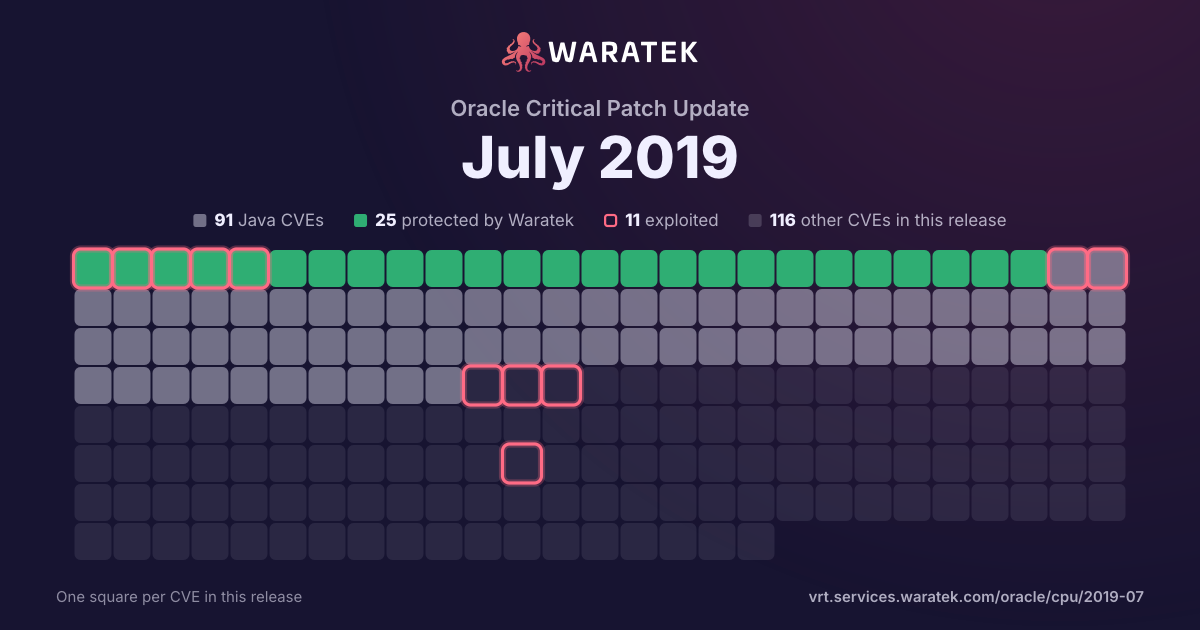
By status
25Protected by Waratek2Mitigation candidate64No exploit published55Outside Waratek scope61Not applicable
11Exploited, marked by the ring
No exploit published. For 58 of them, Oracle's security advisory is the source of public detail.
Protected by Waratek. Waratek RASP can block exploitation of these on systems that have not applied the patch yet.
Overview 5 matches · 0 protected · 0 exploited · 0 CISA KEV · 0 public PoC · 0 EPSS ≥ 0.5
5matches
0protected0.0%
0exploited0.0%
0CISA KEV0.0%
0public PoC0.0%
0EPSS ≥ 0.50.0%
Protected by Waratek
0
0.0%
Rule in development
0
0.0%
Mitigation candidate
0
0.0%
No exploit published
5
100.0%
blocked by ARMR today
0
0.0%
partly blocked
0
0.0%
not blocked
5
100.0%
not established
0
0.0%
unrecorded
0
0.0%
Exploited
0
0.0%
Working exploit published
0
0.0%
Proof of concept only
0
0.0%
Forecast only
0
0.0%
No public exploit
5
100.0%
split by
peak 2 / month
May 181
No exploit published1
High1
not blocked1
No public exploit1
Jun 180
Jul 181
No exploit published1
High1
not blocked1
No public exploit1
Aug 180
Sep 181
No exploit published1
High1
not blocked1
No public exploit1
Oct 180
Nov 180
Dec 180
Jan 190
Feb 190
Mar 190
Apr 190
May 190
Jun 190
Jul 192
No exploit published2
High2
not blocked2
No public exploit2
May 18Jul 18Sep 18Nov 18Jan 19Mar 19May 19Jul 19
| CVE | Severity | Published▾ | Status | Exploitation | Description |
|---|---|---|---|---|---|
| CVE-2019-2841 | High | 2019-07-23 | No exploit published | No public exploit | Vulnerability in the Oracle FLEXCUBE Investor Servicing component of Oracle Financial Services Applications (subcomponent: Infrastructure). Supported versions that are affected are 12.0.1, 12.0.3, 12.0.4, 12.1.0, 12.3.0, 12.4.0, 14.0.0 and 14.1.0. Easily exploitable vulnerability allows low privileged attacker with network access via HTTP to compromise Oracle FLEXCUBE Investor Servicing. Successful attacks of this vulnerability can result in unauthorized creation, deletion or modification access to critical data or all Oracle FLEXCUBE Investor Servicing accessible data as well as unauthorized access to critical data or complete access to all Oracle FLEXCUBE Investor Servicing accessible data. CVSS 3.0 Base Score 8.1 (Confidentiality and Integrity impacts). CVSS Vector: (CVSS:3.0/AV:N/AC:L/PR:L/UI:N/S:U/C:H/I:H/A:N). |
| CVE-2019-2754 | High | 2019-07-23 | No exploit published | No public exploit | Vulnerability in the Oracle FLEXCUBE Universal Banking component of Oracle Financial Services Applications (subcomponent: Infrastructure). Supported versions that are affected are 12.0.1-12.0.3, 12.1.0-12.4.0 and 14.0.0-14.2.0. Easily exploitable vulnerability allows low privileged attacker with network access via HTTP to compromise Oracle FLEXCUBE Universal Banking. Successful attacks of this vulnerability can result in unauthorized creation, deletion or modification access to critical data or all Oracle FLEXCUBE Universal Banking accessible data as well as unauthorized access to critical data or complete access to all Oracle FLEXCUBE Universal Banking accessible data. CVSS 3.0 Base Score 8.1 (Confidentiality and Integrity impacts). CVSS Vector: (CVSS:3.0/AV:N/AC:L/PR:L/UI:N/S:U/C:H/I:H/A:N). |
| CVE-2018-11775 | High | 2018-09-10 | No exploit published | No public exploit | TLS hostname verification when using the Apache ActiveMQ Client before 5.15.6 was missing which could make the client vulnerable to a MITM attack between a Java application using the ActiveMQ client and the ActiveMQ server. This is now enabled by default. |
| CVE-2018-8039 | High | 2018-07-02 | No exploit published | No public exploit | It is possible to configure Apache CXF to use the com.sun.net.ssl implementation via 'System.setProperty("java.protocol.handler.pkgs", "com.sun.net.ssl.internal.www.protocol");'. When this system property is set, CXF uses some reflection to try to make the HostnameVerifier work with the old com.sun.net.ssl.HostnameVerifier interface. However, the default HostnameVerifier implementation in CXF does not implement the method in this interface, and an exception is thrown. However, in Apache CXF prior to 3.2.5 and 3.1.16 the exception is caught in the reflection code and not properly propagated. What this means is that if you are using the com.sun.net.ssl stack with CXF, an error with TLS hostname verification will not be thrown, leaving a CXF client subject to man-in-the-middle attacks. |
| CVE-2018-1258 | High | 2018-05-11 | No exploit published | No public exploit | Spring Framework version 5.0.5 when used in combination with any versions of Spring Security contains an authorization bypass when using method security. An unauthorized malicious user can gain unauthorized access to methods that should be restricted. |