
Oracle Critical Patch Update July 2019
Released July 2019 · Oracle's advisory ↗ · ← Critical Patch Update, April 2019 · Critical Patch Update, October 2019 →
207 CVEs in this release, one square each
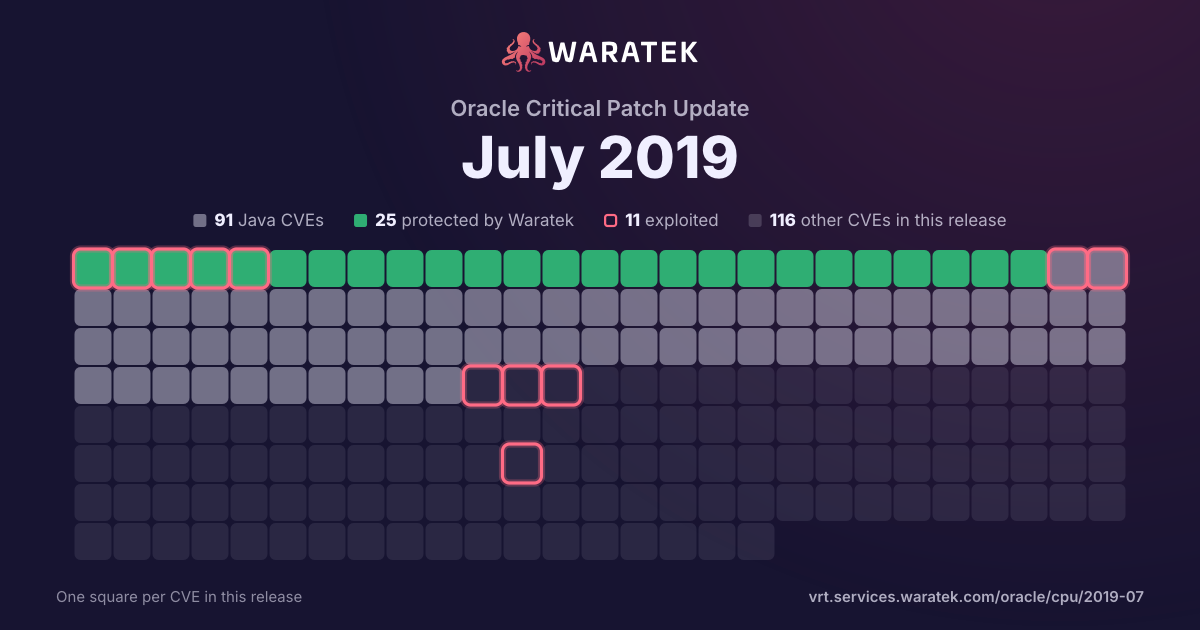
By status
26Protected by Waratek8Mitigation candidate69No exploit published9Outside Waratek scope95Not applicable
11Exploited, marked by the ring
No exploit published. For 59 of them, Oracle's security advisory is the source of public detail.
Protected by Waratek. Waratek RASP can block exploitation of these on systems that have not applied the patch yet.
Overview 3 matches · 1 protected · 0 exploited · 0 CISA KEV
Protected by Waratek
1
33.3%
Rule in development
0
0.0%
Mitigation candidate
2
66.7%
No exploit published
0
0.0%
blocked by ARMR today
1
33.3%
partly blocked
0
0.0%
not blocked
2
66.7%
not established
0
0.0%
unrecorded
0
0.0%
Exploited
0
0.0%
Working exploit published
3
100.0%
Proof of concept only
0
0.0%
Forecast only
0
0.0%
No public exploit
0
0.0%
split by
peak 1 / quarter
Q2 17Q3 17Q4 17Q1 18Q2 18Q3 18Q4 18
| CVE | Severity | Published▾ | Status | Exploitation | Description |
|---|---|---|---|---|---|
| CVE-2018-11784 | Medium | 2018-10-04 | Mitigation candidate | Working exploit published | When the default servlet in Apache Tomcat versions 9.0.0.M1 to 9.0.11, 8.5.0 to 8.5.33 and 7.0.23 to 7.0.90 returned a redirect to a directory (e.g. redirecting to '/foo/' when the user requested '/foo') a specially crafted URL could be used to cause the redirect to be generated to any URI of the attackers choice. |
| CVE-2017-5715 | Medium | 2018-01-04 | Mitigation candidate | Working exploit published | Systems with microprocessors utilizing speculative execution and indirect branch prediction may allow unauthorized disclosure of information to an attacker with local user access via a side-channel analysis. |
| CVE-2017-5645 | Critical | 2017-04-17 | Protected by Waratek | Working exploit published | In Apache Log4j 2.x before 2.8.2, when using the TCP socket server or UDP socket server to receive serialized log events from another application, a specially crafted binary payload can be sent that, when deserialized, can execute arbitrary code. |