
Oracle Critical Patch Update July 2019
Released July 2019 · Oracle's advisory ↗ · ← Critical Patch Update, April 2019 · Critical Patch Update, October 2019 →
207 CVEs in this release, one square each
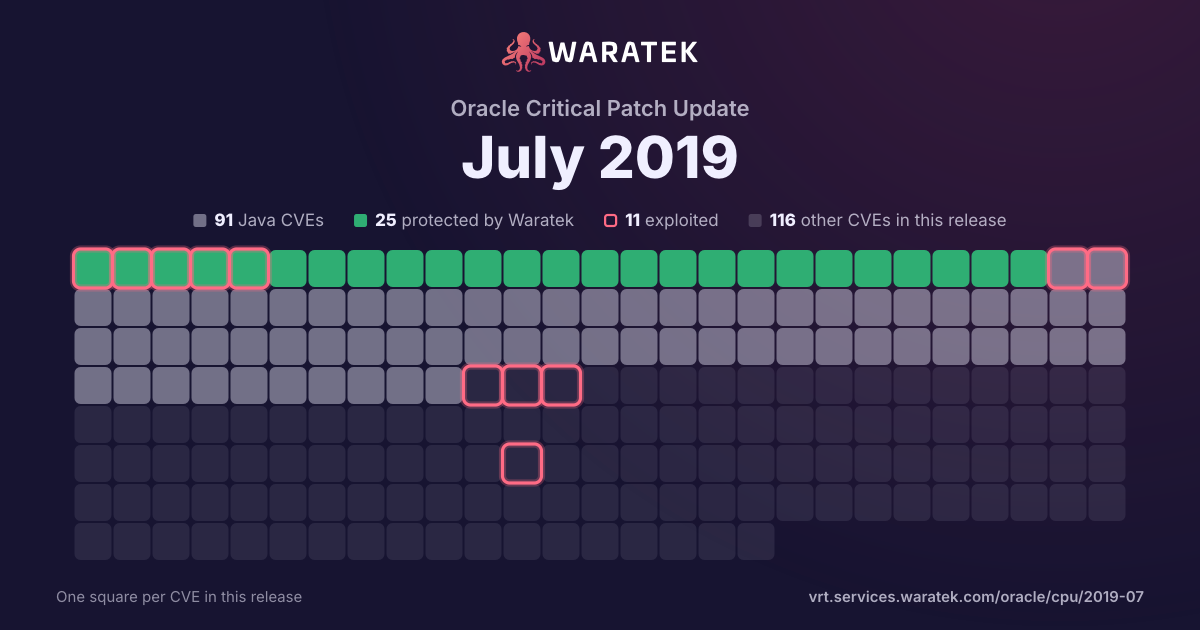
By status
26Protected by Waratek8Mitigation candidate69No exploit published9Outside Waratek scope95Not applicable
11Exploited, marked by the ring
No exploit published. For 59 of them, Oracle's security advisory is the source of public detail.
Protected by Waratek. Waratek RASP can block exploitation of these on systems that have not applied the patch yet.
Overview 7 matches · 0 protected · 1 exploited · 0 CISA KEV · 3 public PoC · 1 EPSS ≥ 0.5
Protected by Waratek
0
0.0%
Rule in development
0
0.0%
Mitigation candidate
3
42.9%
No exploit published
4
57.1%
blocked by ARMR today
0
0.0%
partly blocked
0
0.0%
not blocked
7
100.0%
not established
0
0.0%
unrecorded
0
0.0%
split by
peak 2 / month
Mar 171
No exploit published1
Medium1
not blocked1
No public exploit1
Apr 170
May 170
Jun 171
No exploit published1
High1
not blocked1
No public exploit1
Jul 170
Aug 170
Sep 170
Oct 170
Nov 170
Dec 170
Jan 182
Mitigation candidate2
Medium2
not blocked2
Exploited1
Working exploit published1
Feb 181
Mitigation candidate1
Medium1
not blocked1
Proof of concept only1
Mar 180
Apr 180
May 181
No exploit published1
High1
not blocked1
No public exploit1
Jun 181
No exploit published1
High1
not blocked1
No public exploit1
Apr 17Jun 17Aug 17Oct 17Dec 17Feb 18Apr 18Jun 18
| CVE | Severity | Published▾ | Status | Exploitation | Description |
|---|---|---|---|---|---|
| CVE-2018-1000180 | High | 2018-06-05 | No exploit published | No public exploit | Bouncy Castle BC 1.54 - 1.59, BC-FJA 1.0.0, BC-FJA 1.0.1 and earlier have a flaw in the Low-level interface to RSA key pair generator, specifically RSA Key Pairs generated in low-level API with added certainty may have less M-R tests than expected. This appears to be fixed in versions BC 1.60 beta 4 and later, BC-FJA 1.0.2 and later. |
| CVE-2018-1258 | High | 2018-05-11 | No exploit published | No public exploit | Spring Framework version 5.0.5 when used in combination with any versions of Spring Security contains an authorization bypass when using method security. An unauthorized malicious user can gain unauthorized access to methods that should be restricted. |
| CVE-2018-1305 | Medium | 2018-02-23 | Mitigation candidate | Proof of concept only | Security constraints defined by annotations of Servlets in Apache Tomcat 9.0.0.M1 to 9.0.4, 8.5.0 to 8.5.27, 8.0.0.RC1 to 8.0.49 and 7.0.0 to 7.0.84 were only applied once a Servlet had been loaded. Because security constraints defined in this way apply to the URL pattern and any URLs below that point, it was possible - depending on the order Servlets were loaded - for some security constraints not to be applied. This could have exposed resources to users who were not authorised to access them. |
| CVE-2015-9251 | Medium | 2018-01-18 | Mitigation candidate | Exploited | jQuery before 3.0.0 is vulnerable to Cross-site Scripting (XSS) attacks when a cross-domain Ajax request is performed without the dataType option, causing text/javascript responses to be executed. |
| CVE-2017-5715 | Medium | 2018-01-04 | Mitigation candidate | Working exploit published | Systems with microprocessors utilizing speculative execution and indirect branch prediction may allow unauthorized disclosure of information to an attacker with local user access via a side-channel analysis. |
| CVE-2017-5664 | High | 2017-06-06 | No exploit published | No public exploit | The error page mechanism of the Java Servlet Specification requires that, when an error occurs and an error page is configured for the error that occurred, the original request and response are forwarded to the error page. This means that the request is presented to the error page with the original HTTP method. If the error page is a static file, expected behaviour is to serve content of the file as if processing a GET request, regardless of the actual HTTP method. The Default Servlet in Apache Tomcat 9.0.0.M1 to 9.0.0.M20, 8.5.0 to 8.5.14, 8.0.0.RC1 to 8.0.43 and 7.0.0 to 7.0.77 did not do this. Depending on the original request this could lead to unexpected and undesirable results for static error pages including, if the DefaultServlet is configured to permit writes, the replacement or removal of the custom error page. Notes for other user provided error pages: (1) Unless explicitly coded otherwise, JSPs ignore the HTTP method. JSPs used as error pages must must ensure that they handle any error dispatch as a GET request, regardless of the actual method. (2) By default, the response generated by a Servlet does depend on the HTTP method. Custom Servlets used as error pages must ensure that they handle any error dispatch as a GET request, regardless of the actual method. |
| CVE-2016-7103 | Medium | 2017-03-15 | No exploit published | No public exploit | Cross-site scripting (XSS) vulnerability in jQuery UI before 1.12.0 might allow remote attackers to inject arbitrary web script or HTML via the closeText parameter of the dialog function. |