
WaratekVRT Sign in

Oracle Critical Patch Update July 2019

Released July 2019 · Oracle's advisory ↗ · ← Critical Patch Update, April 2019 · Critical Patch Update, October 2019 →

207 CVEs in this release, one square each
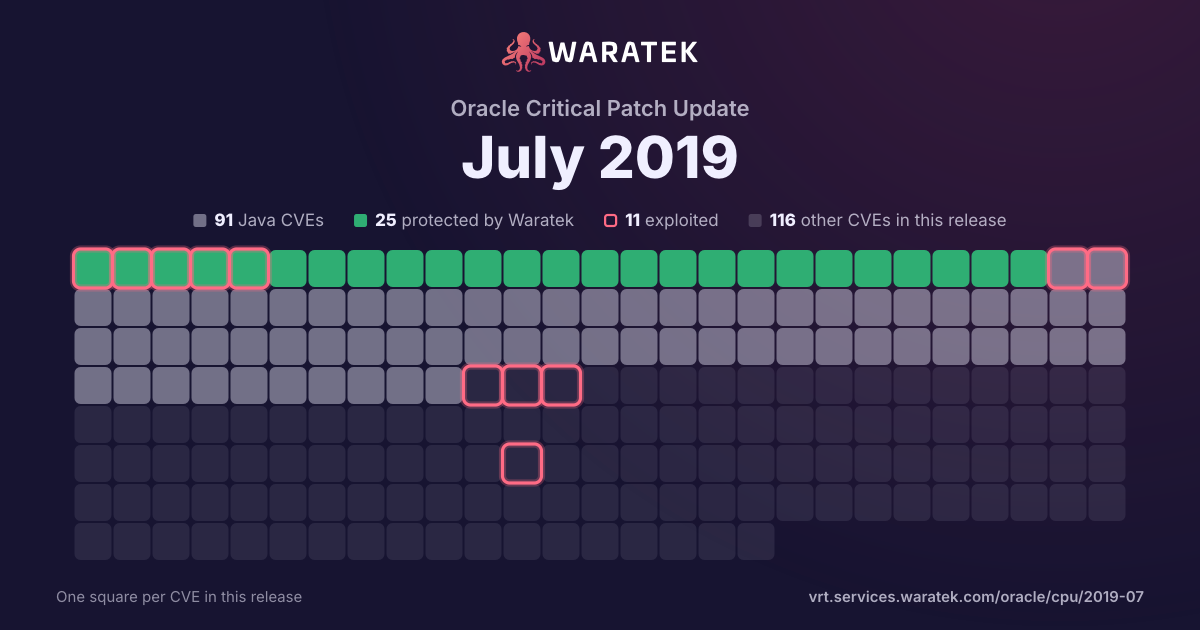
Protected by Waratek, exploitedProtected by Waratek, exploitedProtected by Waratek, exploitedProtected by Waratek, exploitedProtected by Waratek, exploitedProtected by WaratekProtected by WaratekProtected by WaratekProtected by WaratekProtected by WaratekProtected by WaratekProtected by WaratekProtected by WaratekProtected by WaratekProtected by WaratekProtected by WaratekProtected by WaratekProtected by WaratekProtected by WaratekProtected by WaratekProtected by WaratekProtected by WaratekProtected by WaratekProtected by WaratekProtected by WaratekMitigation candidate, exploitedMitigation candidate, exploitedNo exploit publishedNo exploit publishedNo exploit publishedNo exploit publishedNo exploit publishedNo exploit publishedNo exploit publishedNo exploit publishedNo exploit publishedNo exploit publishedNo exploit publishedNo exploit publishedNo exploit publishedNo exploit publishedNo exploit publishedNo exploit publishedNo exploit publishedNo exploit publishedNo exploit publishedNo exploit publishedNo exploit publishedNo exploit publishedNo exploit publishedNo exploit publishedNo exploit publishedNo exploit publishedNo exploit publishedNo exploit publishedNo exploit publishedNo exploit publishedNo exploit publishedNo exploit publishedNo exploit publishedNo exploit publishedNo exploit publishedNo exploit publishedNo exploit publishedNo exploit publishedNo exploit publishedNo exploit publishedNo exploit publishedNo exploit publishedNo exploit publishedNo exploit publishedNo exploit publishedNo exploit publishedNo exploit publishedNo exploit publishedNo exploit publishedNo exploit publishedNo exploit publishedNo exploit publishedNo exploit publishedNo exploit publishedNo exploit publishedNo exploit publishedNo exploit publishedNo exploit publishedNo exploit publishedNo exploit publishedNo exploit publishedNo exploit publishedNo exploit publishedNo exploit publishedOutside Waratek scope, exploitedOutside Waratek scope, exploitedOutside Waratek scope, exploitedOutside Waratek scopeOutside Waratek scopeOutside Waratek scopeOutside Waratek scopeOutside Waratek scopeOutside Waratek scopeOutside Waratek scopeOutside Waratek scopeOutside Waratek scopeOutside Waratek scopeOutside Waratek scopeOutside Waratek scopeOutside Waratek scopeOutside Waratek scopeOutside Waratek scopeOutside Waratek scopeOutside Waratek scopeOutside Waratek scopeOutside Waratek scopeOutside Waratek scopeOutside Waratek scopeOutside Waratek scopeOutside Waratek scopeOutside Waratek scopeOutside Waratek scopeOutside Waratek scopeOutside Waratek scopeOutside Waratek scopeOutside Waratek scopeOutside Waratek scopeOutside Waratek scopeOutside Waratek scopeOutside Waratek scopeOutside Waratek scopeOutside Waratek scopeOutside Waratek scopeOutside Waratek scopeOutside Waratek scopeOutside Waratek scopeOutside Waratek scopeOutside Waratek scopeOutside Waratek scopeOutside Waratek scopeOutside Waratek scopeOutside Waratek scopeOutside Waratek scopeOutside Waratek scopeOutside Waratek scopeOutside Waratek scopeOutside Waratek scopeOutside Waratek scopeOutside Waratek scopeNot applicable, exploitedNot applicableNot applicableNot applicableNot applicableNot applicableNot applicableNot applicableNot applicableNot applicableNot applicableNot applicableNot applicableNot applicableNot applicableNot applicableNot applicableNot applicableNot applicableNot applicableNot applicableNot applicableNot applicableNot applicableNot applicableNot applicableNot applicableNot applicableNot applicableNot applicableNot applicableNot applicableNot applicableNot applicableNot applicableNot applicableNot applicableNot applicableNot applicableNot applicableNot applicableNot applicableNot applicableNot applicableNot applicableNot applicableNot applicableNot applicableNot applicableNot applicableNot applicableNot applicableNot applicableNot applicableNot applicableNot applicableNot applicableNot applicableNot applicableNot applicableNot applicable
Share this chart Oracle Critical Patch Update July 2019, one square per CVE: 91 Java CVEs, 25 protected by Waratek, 11 exploited, 116 other CVEs in this release.

Download the image

By status

No exploit published. For 58 of them, Oracle's security advisory is the source of public detail.

Protected by Waratek. Waratek RASP can block exploitation of these on systems that have not applied the patch yet.

Reset
More filters (2)
Columns
Published from 2018-07-01✕Published to 2018-09-30✕
Overview 2 matches · 0 protected · 0 exploited · 0 CISA KEV · 0 public PoC · 0 EPSS ≥ 0.5
2matches 0protected0.0% 0exploited0.0% 0CISA KEV0.0% 0public PoC0.0% 0EPSS ≥ 0.50.0%
Protected by Waratek 0 0.0% Rule in development 0 0.0% Mitigation candidate 0 0.0% No exploit published 2 100.0%
Critical 0 0.0% High 2 100.0% Medium 0 0.0% Low 0 0.0% None 0 0.0% Unknown 0 0.0%
blocked by ARMR today 0 0.0% partly blocked 0 0.0% not blocked 2 100.0% not established 0 0.0% unrecorded 0 0.0%
Exploited 0 0.0% Working exploit published 0 0.0% Proof of concept only 0 0.0% Forecast only 0 0.0% No public exploit 2 100.0%
split by peak 1 / month
Jul 18Aug 18Sep 18
2 matches Sign in to download these CVEs as CSV or JSON, or to follow them in a feed.
CVE Severity Published▾ Status Exploitation Description
CVE-2018-11775 High 2018-09-10 No exploit published No public exploit TLS hostname verification when using the Apache ActiveMQ Client before 5.15.6 was missing which could make the client vulnerable to a MITM attack between a Java application using the ActiveMQ client and the ActiveMQ server. This is now enabled by default.
CVE-2018-8039 High 2018-07-02 No exploit published No public exploit It is possible to configure Apache CXF to use the com.sun.net.ssl implementation via 'System.setProperty("java.protocol.handler.pkgs", "com.sun.net.ssl.internal.www.protocol");'. When this system property is set, CXF uses some reflection to try to make the HostnameVerifier work with the old com.sun.net.ssl.HostnameVerifier interface. However, the default HostnameVerifier implementation in CXF does not implement the method in this interface, and an exception is thrown. However, in Apache CXF prior to 3.2.5 and 3.1.16 the exception is caught in the reflection code and not properly propagated. What this means is that if you are using the com.sun.net.ssl stack with CXF, an error with TLS hostname verification will not be thrown, leaving a CXF client subject to man-in-the-middle attacks.