
Oracle Critical Patch Update July 2019
Released July 2019 · Oracle's advisory ↗ · ← Critical Patch Update, April 2019 · Critical Patch Update, October 2019 →
207 CVEs in this release, one square each
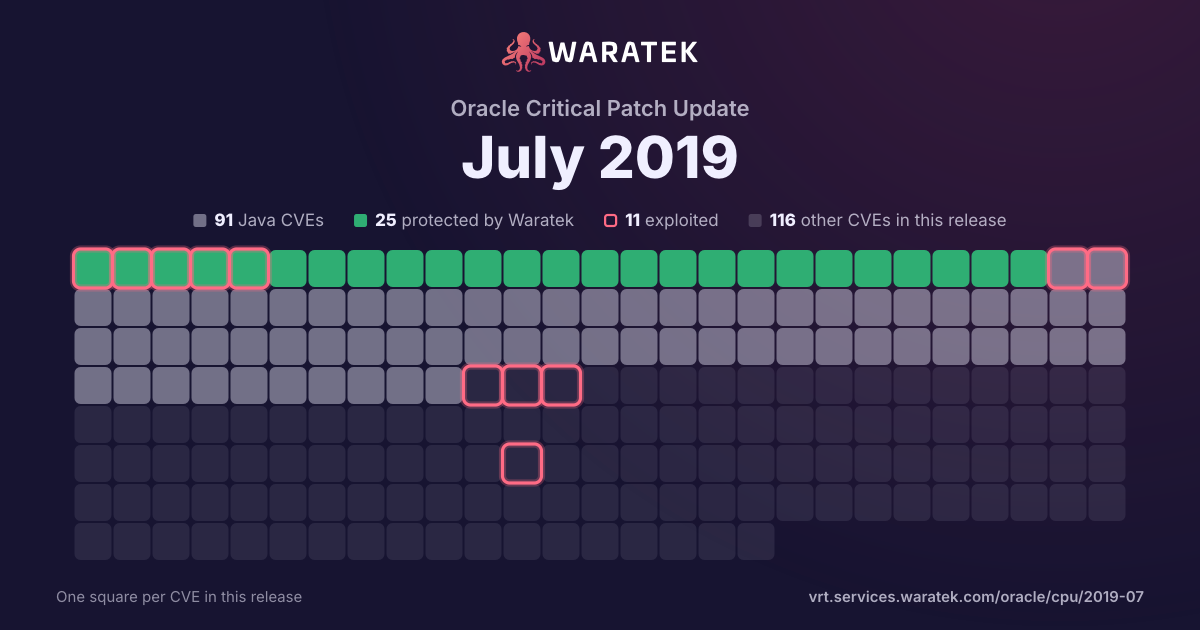
By status
26Protected by Waratek8Mitigation candidate69No exploit published9Outside Waratek scope95Not applicable
11Exploited, marked by the ring
No exploit published. For 59 of them, Oracle's security advisory is the source of public detail.
Protected by Waratek. Waratek RASP can block exploitation of these on systems that have not applied the patch yet.
Overview 15 matches · 4 protected · 3 exploited · 1 CISA KEV · 4 public PoC · 4 EPSS ≥ 0.5
Protected by Waratek
4
26.7%
Rule in development
0
0.0%
Mitigation candidate
3
20.0%
No exploit published
8
53.3%
blocked by ARMR today
4
26.7%
partly blocked
0
0.0%
not blocked
11
73.3%
not established
0
0.0%
unrecorded
0
0.0%
Exploited
3
20.0%
Working exploit published
1
6.7%
Proof of concept only
0
0.0%
Forecast only
0
0.0%
No public exploit
11
73.3%
split by
peak 6 / month
Sep 181
No exploit published1
Critical1
not blocked1
No public exploit1
Oct 182
Mitigation candidate1
No exploit published1
High1
Medium1
not blocked2
Working exploit published1
No public exploit1
Nov 180
Dec 180
Jan 191
Protected by Waratek1
Critical1
blocked by ARMR today1
No public exploit1
Feb 190
Mar 191
Protected by Waratek1
High1
blocked by ARMR today1
No public exploit1
Apr 193
Protected by Waratek1
Mitigation candidate2
High2
Medium1
blocked by ARMR today1
not blocked2
Exploited3
May 191
Protected by Waratek1
High1
blocked by ARMR today1
No public exploit1
Jun 190
Jul 196
No exploit published6
High5
Medium1
not blocked6
No public exploit6
Sep 18Oct 18Nov 18Dec 18Jan 19Feb 19Mar 19Apr 19May 19Jun 19Jul 19
| CVE | Severity | Published▾ | Status | Exploitation | Description |
|---|---|---|---|---|---|
| CVE-2019-2750 | High | 2019-07-23 | No exploit published | No public exploit | Vulnerability in the MICROS Retail-J component of Oracle Retail Applications (subcomponent: Internal Operations). Supported versions that are affected are 12.1.0, 12.1.1, 12.1.2 and 13.1. Easily exploitable vulnerability allows unauthenticated attacker with network access via HTTP to compromise MICROS Retail-J. Successful attacks of this vulnerability can result in unauthorized access to critical data or complete access to all MICROS Retail-J accessible data as well as unauthorized update, insert or delete access to some of MICROS Retail-J accessible data and unauthorized ability to cause a partial denial of service (partial DOS) of MICROS Retail-J. CVSS 3.0 Base Score 8.6 (Confidentiality, Integrity and Availability impacts). CVSS Vector: (CVSS:3.0/AV:N/AC:L/PR:N/UI:N/S:U/C:H/I:L/A:L). |
| CVE-2019-2561 | High | 2019-07-23 | No exploit published | No public exploit | Vulnerability in the Oracle Retail Xstore Office component of Oracle Retail Applications (subcomponent: Internal Operations). Supported versions that are affected are 7.0 and 7.1. Easily exploitable vulnerability allows unauthenticated attacker with network access via HTTP to compromise Oracle Retail Xstore Office. Successful attacks of this vulnerability can result in unauthorized access to critical data or complete access to all Oracle Retail Xstore Office accessible data as well as unauthorized update, insert or delete access to some of Oracle Retail Xstore Office accessible data. CVSS 3.0 Base Score 8.2 (Confidentiality and Integrity impacts). CVSS Vector: (CVSS:3.0/AV:N/AC:L/PR:N/UI:N/S:U/C:H/I:L/A:N). |
| CVE-2018-3316 | High | 2019-07-23 | No exploit published | No public exploit | Vulnerability in the Oracle Retail Customer Management and Segmentation Foundation component of Oracle Retail Applications (subcomponent: Segment). Supported versions that are affected are 16.0 and 17.0. Easily exploitable vulnerability allows low privileged attacker with network access via HTTP to compromise Oracle Retail Customer Management and Segmentation Foundation. Successful attacks of this vulnerability can result in unauthorized access to critical data or complete access to all Oracle Retail Customer Management and Segmentation Foundation accessible data as well as unauthorized update, insert or delete access to some of Oracle Retail Customer Management and Segmentation Foundation accessible data and unauthorized ability to cause a partial denial of service (partial DOS) of Oracle Retail Customer Management and Segmentation Foundation. CVSS 3.0 Base Score 7.6 (Confidentiality, Integrity and Availability impacts). CVSS Vector: (CVSS:3.0/AV:N/AC:L/PR:L/UI:N/S:U/C:H/I:L/A:L). |
| CVE-2018-3315 | High | 2019-07-23 | No exploit published | No public exploit | Vulnerability in the Oracle Retail Customer Management and Segmentation Foundation component of Oracle Retail Applications (subcomponent: Customer). Supported versions that are affected are 16.0 and 17.0. Difficult to exploit vulnerability allows low privileged attacker with network access via HTTP to compromise Oracle Retail Customer Management and Segmentation Foundation. While the vulnerability is in Oracle Retail Customer Management and Segmentation Foundation, attacks may significantly impact additional products. Successful attacks of this vulnerability can result in unauthorized creation, deletion or modification access to critical data or all Oracle Retail Customer Management and Segmentation Foundation accessible data as well as unauthorized access to critical data or complete access to all Oracle Retail Customer Management and Segmentation Foundation accessible data. CVSS 3.0 Base Score 8.2 (Confidentiality and Integrity impacts). CVSS Vector: (CVSS:3.0/AV:N/AC:H/PR:L/UI:N/S:C/C:H/I:H/A:N). |
| CVE-2018-3111 | High | 2019-07-23 | No exploit published | No public exploit | Vulnerability in the Oracle Retail Xstore Office component of Oracle Retail Applications (subcomponent: Internal Operations). The supported version that is affected is 7.1. Easily exploitable vulnerability allows unauthenticated attacker with network access via HTTP to compromise Oracle Retail Xstore Office. Successful attacks require human interaction from a person other than the attacker. Successful attacks of this vulnerability can result in unauthorized access to critical data or complete access to all Oracle Retail Xstore Office accessible data as well as unauthorized update, insert or delete access to some of Oracle Retail Xstore Office accessible data and unauthorized ability to cause a partial denial of service (partial DOS) of Oracle Retail Xstore Office. CVSS 3.0 Base Score 7.6 (Confidentiality, Integrity and Availability impacts). CVSS Vector: (CVSS:3.0/AV:N/AC:L/PR:N/UI:R/S:U/C:H/I:L/A:L). |
| CVE-2018-2883 | Medium | 2019-07-23 | No exploit published | No public exploit | Vulnerability in the Oracle Retail Xstore Office component of Oracle Retail Applications (subcomponent: Internal Operations). Supported versions that are affected are 7.0 and 7.1. Easily exploitable vulnerability allows low privileged attacker with network access via HTTP to compromise Oracle Retail Xstore Office. Successful attacks require human interaction from a person other than the attacker. Successful attacks of this vulnerability can result in unauthorized update, insert or delete access to some of Oracle Retail Xstore Office accessible data as well as unauthorized read access to a subset of Oracle Retail Xstore Office accessible data and unauthorized ability to cause a partial denial of service (partial DOS) of Oracle Retail Xstore Office. CVSS 3.0 Base Score 5.5 (Confidentiality, Integrity and Availability impacts). CVSS Vector: (CVSS:3.0/AV:N/AC:L/PR:L/UI:R/S:U/C:L/I:L/A:L). |
| CVE-2019-12086 | High | 2019-05-17 | Protected by Waratek | No public exploit | A Polymorphic Typing issue was discovered in FasterXML jackson-databind 2.x before 2.9.9. When Default Typing is enabled (either globally or for a specific property) for an externally exposed JSON endpoint, the service has the mysql-connector-java jar (8.0.14 or earlier) in the classpath, and an attacker can host a crafted MySQL server reachable by the victim, an attacker can send a crafted JSON message that allows them to read arbitrary local files on the server. This occurs because of missing com.mysql.cj.jdbc.admin.MiniAdmin validation. |
| CVE-2019-11358 | Medium | 2019-04-20 | Mitigation candidate | Exploited | jQuery before 3.4.0, as used in Drupal, Backdrop CMS, and other products, mishandles jQuery.extend(true, {}, ...) because of Object.prototype pollution. If an unsanitized source object contained an enumerable __proto__ property, it could extend the native Object.prototype. |
| CVE-2019-0232 | High | 2019-04-15 | Protected by Waratek | Exploited | When running on Windows with enableCmdLineArguments enabled, the CGI Servlet in Apache Tomcat 9.0.0.M1 to 9.0.17, 8.5.0 to 8.5.39 and 7.0.0 to 7.0.93 is vulnerable to Remote Code Execution due to a bug in the way the JRE passes command line arguments to Windows. The CGI Servlet is disabled by default. The CGI option enableCmdLineArguments is disable by default in Tomcat 9.0.x (and will be disabled by default in all versions in response to this vulnerability). For a detailed explanation of the JRE behaviour, see Markus Wulftange's blog (https://codewhitesec.blogspot.com/2016/02/java-and-command-line-injections-in-windows.html) and this archived MSDN blog (https://web.archive.org/web/20161228144344/https://blogs.msdn.microsoft.com/twistylittlepassagesallalike/2011/04/23/everyone-quotes-command-line-arguments-the-wrong-way/). |
| CVE-2019-0211 | High | 2019-04-08 | Mitigation candidate | Exploited | In Apache HTTP Server 2.4 releases 2.4.17 to 2.4.38, with MPM event, worker or prefork, code executing in less-privileged child processes or threads (including scripts executed by an in-process scripting interpreter) could execute arbitrary code with the privileges of the parent process (usually root) by manipulating the scoreboard. Non-Unix systems are not affected. |
| CVE-2018-12023 | High | 2019-03-21 | Protected by Waratek | No public exploit | An issue was discovered in FasterXML jackson-databind prior to 2.7.9.4, 2.8.11.2, and 2.9.6. When Default Typing is enabled (either globally or for a specific property), the service has the Oracle JDBC jar in the classpath, and an attacker can provide an LDAP service to access, it is possible to make the service execute a malicious payload. |
| CVE-2018-19362 | Critical | 2019-01-02 | Protected by Waratek | No public exploit | FasterXML jackson-databind 2.x before 2.9.8 might allow attackers to have unspecified impact by leveraging failure to block the jboss-common-core class from polymorphic deserialization. |
| CVE-2018-15756 | High | 2018-10-18 | No exploit published | No public exploit | Spring Framework, version 5.1, versions 5.0.x prior to 5.0.10, versions 4.3.x prior to 4.3.20, and older unsupported versions on the 4.2.x branch provide support for range requests when serving static resources through the ResourceHttpRequestHandler, or starting in 5.0 when an annotated controller returns an org.springframework.core.io.Resource. A malicious user (or attacker) can add a range header with a high number of ranges, or with wide ranges that overlap, or both, for a denial of service attack. This vulnerability affects applications that depend on either spring-webmvc or spring-webflux. Such applications must also have a registration for serving static resources (e.g. JS, CSS, images, and others), or have an annotated controller that returns an org.springframework.core.io.Resource. Spring Boot applications that depend on spring-boot-starter-web or spring-boot-starter-webflux are ready to serve static resources out of the box and are therefore vulnerable. |
| CVE-2018-11784 | Medium | 2018-10-04 | Mitigation candidate | Working exploit published | When the default servlet in Apache Tomcat versions 9.0.0.M1 to 9.0.11, 8.5.0 to 8.5.33 and 7.0.23 to 7.0.90 returned a redirect to a directory (e.g. redirecting to '/foo/' when the user requested '/foo') a specially crafted URL could be used to cause the redirect to be generated to any URI of the attackers choice. |
| CVE-2018-11058 | Critical | 2018-09-14 | No exploit published | No public exploit | RSA BSAFE Micro Edition Suite, versions prior to 4.0.11 (in 4.0.x) and prior to 4.1.6 (in 4.1.x), and RSA BSAFE Crypto-C Micro Edition, version prior to 4.0.5.3 (in 4.0.x) contain a Buffer Over-Read vulnerability when parsing ASN.1 data. A remote attacker could use maliciously constructed ASN.1 data that would result in such issue. |