
Oracle Critical Patch Update January 2019
Released January 2019 · Oracle's advisory ↗ · ← Critical Patch Update, October 2018 · Critical Patch Update, April 2019 →
198 CVEs in this release, one square each
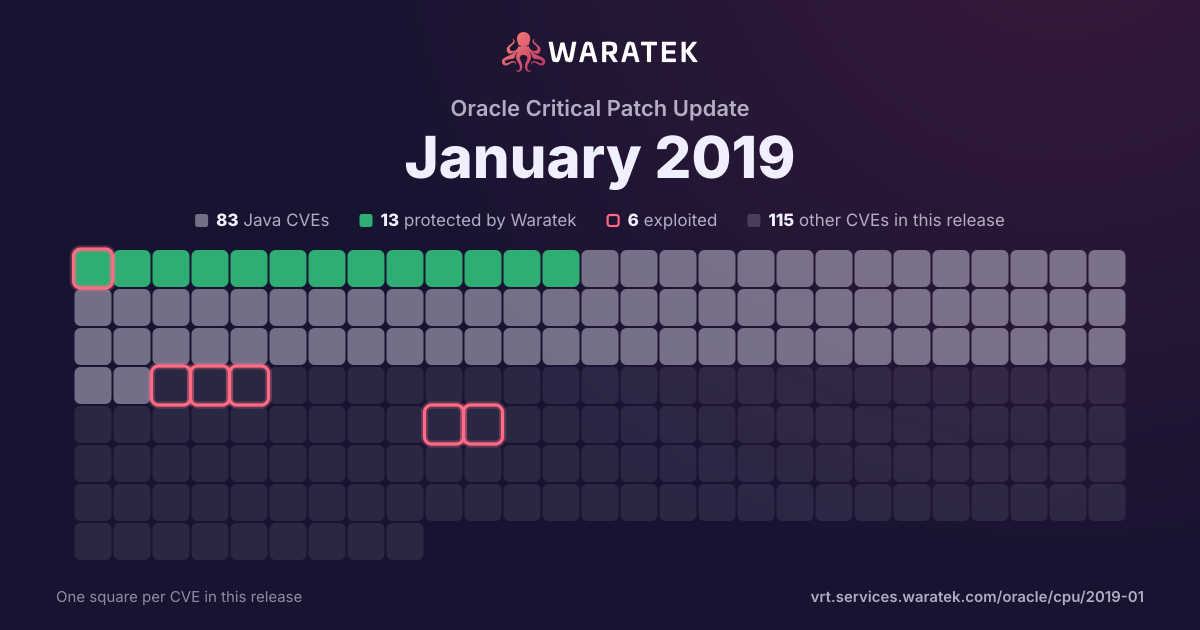
By status
13Protected by Waratek1Mitigation candidate69No exploit published34Outside Waratek scope81Not applicable
6Exploited, marked by the ring
No exploit published. For 67 of them, Oracle's security advisory is the source of public detail.
Protected by Waratek. Waratek RASP can block exploitation of these on systems that have not applied the patch yet.
Overview 2 matches · 1 exploited · 1 CISA KEV · 1 public PoC · 1 EPSS ≥ 0.5
Protected by Waratek
2
100.0%
Rule in development
0
0.0%
Mitigation candidate
0
0.0%
No exploit published
0
0.0%
blocked by ARMR today
2
100.0%
partly blocked
0
0.0%
not blocked
0
0.0%
not established
0
0.0%
unrecorded
0
0.0%
Exploited
1
50.0%
Working exploit published
0
0.0%
Proof of concept only
0
0.0%
Forecast only
0
0.0%
No public exploit
1
50.0%
split by
peak 2 / month
Aug 18
| CVE | Severity | Published▾ | Status | Exploitation | Description |
|---|---|---|---|---|---|
| CVE-2018-11776 | High | 2018-08-22 | Protected by Waratek | Exploited | Apache Struts versions 2.3 to 2.3.34 and 2.5 to 2.5.16 suffer from possible Remote Code Execution when alwaysSelectFullNamespace is true (either by user or a plugin like Convention Plugin) and then: results are used with no namespace and in same time, its upper package have no or wildcard namespace and similar to results, same possibility when using url tag which doesn't have value and action set and in same time, its upper package have no or wildcard namespace. |
| CVE-2018-1000632 | High | 2018-08-20 | Protected by Waratek | No public exploit | dom4j version prior to version 2.1.1 contains a CWE-91: XML Injection vulnerability in Class: Element. Methods: addElement, addAttribute that can result in an attacker tampering with XML documents through XML injection. This attack appear to be exploitable via an attacker specifying attributes or elements in the XML document. This vulnerability appears to have been fixed in 2.1.1 or later. |