
Oracle Critical Patch Update January 2019
Released January 2019 · Oracle's advisory ↗ · ← Critical Patch Update, October 2018 · Critical Patch Update, April 2019 →
198 CVEs in this release, one square each
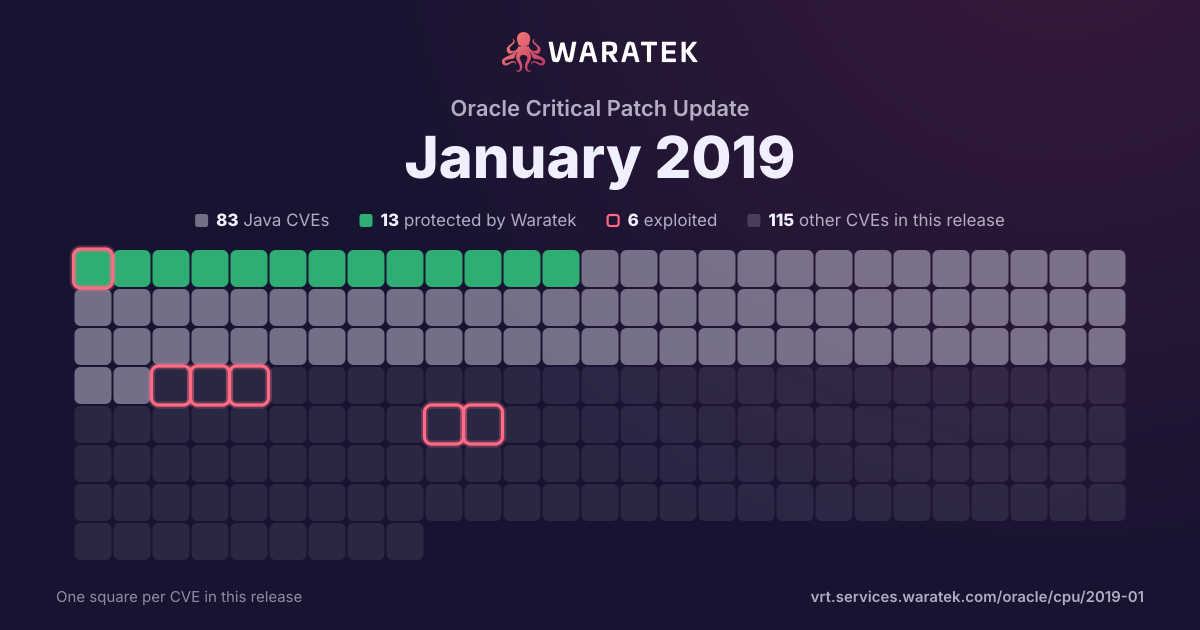
By status
13Protected by Waratek1Mitigation candidate69No exploit published34Outside Waratek scope81Not applicable
6Exploited, marked by the ring
No exploit published. For 67 of them, Oracle's security advisory is the source of public detail.
Protected by Waratek. Waratek RASP can block exploitation of these on systems that have not applied the patch yet.
Overview 11 matches · 4 in Waratek scope · 3 protected · 1 exploited · 0 CISA KEV · 2 public PoC · 2 EPSS ≥ 0.5
11matches
4in Waratek scope36.4%
3protected27.3%
1exploited9.1%
0CISA KEV0.0%
2public PoC18.2%
2EPSS ≥ 0.518.2%
Protected by Waratek
3
27.3%
Rule in development
0
0.0%
Mitigation candidate
0
0.0%
No exploit published
1
9.1%
Outside Waratek scope
0
0.0%
Not applicable
7
63.6%
Withdrawn CVE
0
0.0%
blocked by ARMR today
3
27.3%
partly blocked
0
0.0%
not blocked
8
72.7%
not established
0
0.0%
unrecorded
0
0.0%
Exploited
1
9.1%
Working exploit published
1
9.1%
Proof of concept only
0
0.0%
Forecast only
0
0.0%
No public exploit
9
81.8%
split by
peak 3 / month
Jan 171
Not applicable1
High1
not blocked1
No public exploit1
Feb 170
Mar 172
Not applicable2
High1
Medium1
not blocked2
No public exploit2
Apr 172
Protected by Waratek1
No exploit published1
Critical2
blocked by ARMR today1
not blocked1
Working exploit published1
No public exploit1
May 170
Jun 170
Jul 171
Protected by Waratek1
Critical1
blocked by ARMR today1
No public exploit1
Aug 172
Not applicable2
High2
not blocked2
No public exploit2
Sep 173
Protected by Waratek1
Not applicable2
High2
Medium1
blocked by ARMR today1
not blocked2
Exploited1
No public exploit2
Jan 17Feb 17Mar 17Apr 17May 17Jun 17Jul 17Aug 17Sep 17
| CVE | Severity | Published▾ | Status | Exploitation | Description |
|---|---|---|---|---|---|
| CVE-2017-14735 | Medium | 2017-09-25 | Protected by Waratek | No public exploit | OWASP AntiSamy before 1.5.7 allows XSS via HTML5 entities, as demonstrated by use of : to construct a javascript: URL. |
| CVE-2017-9798 | High | 2017-09-18 | Not applicable | Exploited | Apache httpd allows remote attackers to read secret data from process memory if the Limit directive can be set in a user's .htaccess file, or if httpd.conf has certain misconfigurations, aka Optionsbleed. This affects the Apache HTTP Server through 2.2.34 and 2.4.x through 2.4.27. The attacker sends an unauthenticated OPTIONS HTTP request when attempting to read secret data. This is a use-after-free issue and thus secret data is not always sent, and the specific data depends on many factors including configuration. Exploitation with .htaccess can be blocked with a patch to the ap_limit_section function in server/core.c. |
| CVE-2017-14229 | High | 2017-09-09 | Not applicable | No public exploit | There is an infinite loop in the jpc_dec_tileinit function in jpc/jpc_dec.c of Jasper 2.0.13. It will lead to a remote denial of service attack. |
| CVE-2017-13745 | High | 2017-08-29 | Not applicable | No public exploit | There is a reachable assertion abort in the function jpc_dec_process_sot() in jpc/jpc_dec.c in JasPer 2.0.12 that will lead to a remote denial of service attack by triggering an unexpected jpc_ppmstabtostreams return value, a different vulnerability than CVE-2018-9154. |
| CVE-2017-0379 | High | 2017-08-29 | Not applicable | No public exploit | Libgcrypt before 1.8.1 does not properly consider Curve25519 side-channel attacks, which makes it easier for attackers to discover a secret key, related to cipher/ecc.c and mpi/ec.c. |
| CVE-2016-4000 | Critical | 2017-07-06 | Protected by Waratek | No public exploit | Jython before 2.7.1rc1 allows attackers to execute arbitrary code via a crafted serialized PyFunction object. |
| CVE-2017-5645 | Critical | 2017-04-17 | Protected by Waratek | Working exploit published | In Apache Log4j 2.x before 2.8.2, when using the TCP socket server or UDP socket server to receive serialized log events from another application, a specially crafted binary payload can be sent that, when deserialized, can execute arbitrary code. |
| CVE-2015-8965 | Critical | 2017-04-06 | No exploit published | No public exploit | Rogue Wave JViews before 8.8 patch 21 and 8.9 before patch 1 allows remote attackers to execute arbitrary Java code that exists in the classpath, such as test code or administration code. The issue exists because the ilog.views.faces.IlvFacesController servlet in jviews-framework-all.jar does not require explicit configuration of servlets that can be called. |
| CVE-2016-9392 | Medium | 2017-03-23 | Not applicable | No public exploit | The calcstepsizes function in jpc_dec.c in JasPer before 1.900.17 allows remote attackers to cause a denial of service (assertion failure) via a crafted file. |
| CVE-2016-9389 | High | 2017-03-23 | Not applicable | No public exploit | The jpc_irct and jpc_iict functions in jpc_mct.c in JasPer before 1.900.14 allow remote attackers to cause a denial of service (assertion failure). |
| CVE-2016-5684 | High | 2017-01-06 | Not applicable | No public exploit | An exploitable out-of-bounds write vulnerability exists in the XMP image handling functionality of the FreeImage library. A specially crafted XMP file can cause an arbitrary memory overwrite resulting in code execution. An attacker can provide a malicious image to trigger this vulnerability. |