
Oracle Critical Patch Update January 2019
Released January 2019 · Oracle's advisory ↗ · ← Critical Patch Update, October 2018 · Critical Patch Update, April 2019 →
198 CVEs in this release, one square each
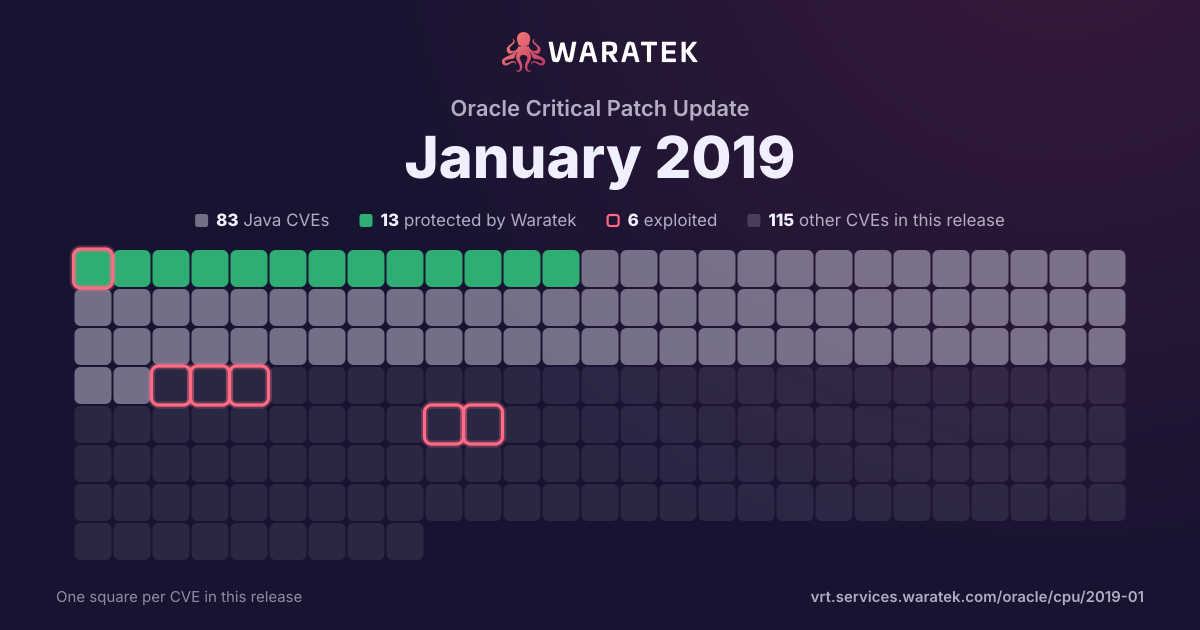
By status
13Protected by Waratek1Mitigation candidate69No exploit published34Outside Waratek scope81Not applicable
6Exploited, marked by the ring
No exploit published. For 67 of them, Oracle's security advisory is the source of public detail.
Protected by Waratek. Waratek RASP can block exploitation of these on systems that have not applied the patch yet.
Overview 19 matches · 4 in Waratek scope · 0 protected · 3 exploited · 0 CISA KEV · 3 public PoC · 2 EPSS ≥ 0.5
19matches
4in Waratek scope21.1%
0protected0.0%
3exploited15.8%
0CISA KEV0.0%
3public PoC15.8%
2EPSS ≥ 0.510.5%
Protected by Waratek
0
0.0%
Rule in development
0
0.0%
Mitigation candidate
0
0.0%
No exploit published
4
21.1%
Outside Waratek scope
5
26.3%
Not applicable
10
52.6%
Withdrawn CVE
0
0.0%
blocked by ARMR today
0
0.0%
partly blocked
0
0.0%
not blocked
19
100.0%
not established
0
0.0%
unrecorded
0
0.0%
Exploited
3
15.8%
Working exploit published
0
0.0%
Proof of concept only
0
0.0%
Forecast only
0
0.0%
No public exploit
16
84.2%
split by
peak 7 / quarter
Q3 161
Outside Waratek scope1
High1
not blocked1
No public exploit1
Q4 161
Outside Waratek scope1
Critical1
not blocked1
No public exploit1
Q1 173
Not applicable3
High2
Medium1
not blocked3
No public exploit3
Q2 171
No exploit published1
Critical1
not blocked1
No public exploit1
Q3 174
Not applicable4
High4
not blocked4
Exploited1
No public exploit3
Q4 170
Q1 182
Outside Waratek scope2
Critical1
Medium1
not blocked2
Exploited1
No public exploit1
Q2 187
No exploit published3
Outside Waratek scope1
Not applicable3
Critical2
High3
Medium2
not blocked7
Exploited1
No public exploit6
Q3 16Q4 16Q1 17Q2 17Q3 17Q4 17Q1 18Q2 18
| CVE | Severity | Published▾ | Status | Exploitation | Description |
|---|---|---|---|---|---|
| CVE-2017-7658 | Critical | 2018-06-26 | No exploit published | No public exploit | In Eclipse Jetty Server, versions 9.2.x and older, 9.3.x (all non HTTP/1.x configurations), and 9.4.x (all HTTP/1.x configurations), when presented with two content-lengths headers, Jetty ignored the second. When presented with a content-length and a chunked encoding header, the content-length was ignored (as per RFC 2616). If an intermediary decided on the shorter length, but still passed on the longer body, then body content could be interpreted by Jetty as a pipelined request. If the intermediary was imposing authorization, the fake pipelined request would bypass that authorization. |
| CVE-2018-0732 | High | 2018-06-12 | Not applicable | No public exploit | During key agreement in a TLS handshake using a DH(E) based ciphersuite a malicious server can send a very large prime value to the client. This will cause the client to spend an unreasonably long period of time generating a key for this prime resulting in a hang until the client has finished. This could be exploited in a Denial Of Service attack. Fixed in OpenSSL 1.1.0i-dev (Affected 1.1.0-1.1.0h). Fixed in OpenSSL 1.0.2p-dev (Affected 1.0.2-1.0.2o). |
| CVE-2018-1000180 | High | 2018-06-05 | No exploit published | No public exploit | Bouncy Castle BC 1.54 - 1.59, BC-FJA 1.0.0, BC-FJA 1.0.1 and earlier have a flaw in the Low-level interface to RSA key pair generator, specifically RSA Key Pairs generated in low-level API with added certainty may have less M-R tests than expected. This appears to be fixed in versions BC 1.60 beta 4 and later, BC-FJA 1.0.2 and later. |
| CVE-2018-1000300 | Critical | 2018-05-24 | Not applicable | No public exploit | curl version curl 7.54.1 to and including curl 7.59.0 contains a CWE-122: Heap-based Buffer Overflow vulnerability in denial of service and more that can result in curl might overflow a heap based memory buffer when closing down an FTP connection with very long server command replies.. This vulnerability appears to have been fixed in curl < 7.54.1 and curl >= 7.60.0. |
| CVE-2018-3639 | Medium | 2018-05-22 | Outside Waratek scope | Exploited | Systems with microprocessors utilizing speculative execution and speculative execution of memory reads before the addresses of all prior memory writes are known may allow unauthorized disclosure of information to an attacker with local user access via a side-channel analysis, aka Speculative Store Bypass (SSB), Variant 4. |
| CVE-2018-11212 | Medium | 2018-05-16 | Not applicable | No public exploit | An issue was discovered in libjpeg 9a and 9d. The alloc_sarray function in jmemmgr.c allows remote attackers to cause a denial of service (divide-by-zero error) via a crafted file. |
| CVE-2018-1258 | High | 2018-05-11 | No exploit published | No public exploit | Spring Framework version 5.0.5 when used in combination with any versions of Spring Security contains an authorization bypass when using method security. An unauthorized malicious user can gain unauthorized access to methods that should be restricted. |
| CVE-2016-6814 | Critical | 2018-01-18 | Outside Waratek scope | No public exploit | When an application with unsupported Codehaus versions of Groovy from 1.7.0 to 2.4.3, Apache Groovy 2.4.4 to 2.4.7 on classpath uses standard Java serialization mechanisms, e.g. to communicate between servers or to store local data, it was possible for an attacker to bake a special serialized object that will execute code directly when deserialized. All applications which rely on serialization and do not isolate the code which deserializes objects were subject to this vulnerability. |
| CVE-2015-9251 | Medium | 2018-01-18 | Outside Waratek scope | Exploited | jQuery before 3.0.0 is vulnerable to Cross-site Scripting (XSS) attacks when a cross-domain Ajax request is performed without the dataType option, causing text/javascript responses to be executed. |
| CVE-2017-9798 | High | 2017-09-18 | Not applicable | Exploited | Apache httpd allows remote attackers to read secret data from process memory if the Limit directive can be set in a user's .htaccess file, or if httpd.conf has certain misconfigurations, aka Optionsbleed. This affects the Apache HTTP Server through 2.2.34 and 2.4.x through 2.4.27. The attacker sends an unauthenticated OPTIONS HTTP request when attempting to read secret data. This is a use-after-free issue and thus secret data is not always sent, and the specific data depends on many factors including configuration. Exploitation with .htaccess can be blocked with a patch to the ap_limit_section function in server/core.c. |
| CVE-2017-14229 | High | 2017-09-09 | Not applicable | No public exploit | There is an infinite loop in the jpc_dec_tileinit function in jpc/jpc_dec.c of Jasper 2.0.13. It will lead to a remote denial of service attack. |
| CVE-2017-13745 | High | 2017-08-29 | Not applicable | No public exploit | There is a reachable assertion abort in the function jpc_dec_process_sot() in jpc/jpc_dec.c in JasPer 2.0.12 that will lead to a remote denial of service attack by triggering an unexpected jpc_ppmstabtostreams return value, a different vulnerability than CVE-2018-9154. |
| CVE-2017-0379 | High | 2017-08-29 | Not applicable | No public exploit | Libgcrypt before 1.8.1 does not properly consider Curve25519 side-channel attacks, which makes it easier for attackers to discover a secret key, related to cipher/ecc.c and mpi/ec.c. |
| CVE-2015-8965 | Critical | 2017-04-06 | No exploit published | No public exploit | Rogue Wave JViews before 8.8 patch 21 and 8.9 before patch 1 allows remote attackers to execute arbitrary Java code that exists in the classpath, such as test code or administration code. The issue exists because the ilog.views.faces.IlvFacesController servlet in jviews-framework-all.jar does not require explicit configuration of servlets that can be called. |
| CVE-2016-9392 | Medium | 2017-03-23 | Not applicable | No public exploit | The calcstepsizes function in jpc_dec.c in JasPer before 1.900.17 allows remote attackers to cause a denial of service (assertion failure) via a crafted file. |
| CVE-2016-9389 | High | 2017-03-23 | Not applicable | No public exploit | The jpc_irct and jpc_iict functions in jpc_mct.c in JasPer before 1.900.14 allow remote attackers to cause a denial of service (assertion failure). |
| CVE-2016-5684 | High | 2017-01-06 | Not applicable | No public exploit | An exploitable out-of-bounds write vulnerability exists in the XMP image handling functionality of the FreeImage library. A specially crafted XMP file can cause an arbitrary memory overwrite resulting in code execution. An attacker can provide a malicious image to trigger this vulnerability. |
| CVE-2015-1832 | Critical | 2016-10-03 | Outside Waratek scope | No public exploit | XML external entity (XXE) vulnerability in the SqlXmlUtil code in Apache Derby before 10.12.1.1, when a Java Security Manager is not in place, allows context-dependent attackers to read arbitrary files or cause a denial of service (resource consumption) via vectors involving XmlVTI and the XML datatype. |
| CVE-2016-0635 | High | 2016-07-21 | Outside Waratek scope | No public exploit | Unspecified vulnerability in the Enterprise Manager Ops Center component in Oracle Enterprise Manager Grid Control 12.1.4, 12.2.2, and 12.3.2; the Oracle Health Sciences Information Manager component in Oracle Health Sciences Applications 1.2.8.3, 2.0.2.3, and 3.0.1.0; the Oracle Healthcare Master Person Index component in Oracle Health Sciences Applications 2.0.12, 3.0.0, and 4.0.1; the Oracle Documaker component in Oracle Insurance Applications before 12.5; the Oracle Insurance Calculation Engine component in Oracle Insurance Applications 9.7.1, 10.1.2, and 10.2.2; the Oracle Insurance Policy Administration J2EE and Oracle Insurance Rules Palette components in Oracle Insurance Applications 9.6.1, 9.7.1, 10.0.1, 10.1.2, 10.2.0, and 10.2.2; the Oracle Retail Integration Bus component in Oracle Retail Applications 15.0; the Oracle Retail Order Broker component in Oracle Retail Applications 5.1, 5.2, and 15.0; the Primavera Contract Management component in Oracle Primavera Products Suite 14.2; the Primavera P6 Enterprise Project Portfolio Management component in Oracle Primavera Products Suite 8.2, 8.3, 8.4, 15.1, 15.2, and 16.1; the Oracle Financial Services Analytical Applications Infrastructure component in Oracle Financial Services Applications 8.0.0, 8.0.1, 8.0.2, and 8.0.3; the Oracle Commerce Guided Search / Oracle Commerce Experience Manager component in Oracle Commerce 3.1.1, 3.1.2, 11.0, 11.1, and 11.2; the Oracle Agile PLM component in Oracle Supply Chain Products Suite 9.3.4 and 9.3.5; the Oracle Communications BRM - Elastic Charging Engine 11.2.0.0.0 and 11.3.0.0.0; the Oracle Enterprise Repository Enterprise Repository 12.1.3.0.0; the Oracle Financial Services Behavior Detection Platform 8.0.1 and 8.0.2; the Oracle Hyperion Essbase 12.2.1.1; the Oracle Tuxedo System and Applications Monitor (TSAM) 11.1.1.2.0, 11.1.1.2.1, 11.1.1.2.1, 12.1.1.1.0, 12.1.3.0.0, and 12.2.2.0.0; the Oracle Communications WebRTC Session Controller component of Oracle Communications Applications (subcomponent: Security (Spring)) 7.0, 7.1 and 7.2; the Oracle Endeca Information Discovery Integrator 3.2; the Converged Commerce component of Oracle Retail Applications 16.0.1; the Oracle Identity Manager 11.1.2.3.0; Oracle Enterprise Manager for MySQL Database 12.1.0.4; Oracle Retail Invoice Matching 12.0, 13.0, 13.1, 13.2, 14.0, and 14.1; Oracle Communications Performance Intelligence Center (PIC) Software Prior to 10.2.1 and the Oracle Knowledge component of Oracle Siebel CRM (subcomponent: AnswerFlow (Spring Framework)) version 8.5.1.0 - 8.5.1.7 and 8.6.0 allows remote authenticated users to affect confidentiality, integrity, and availability via unknown vectors. |