
Oracle Critical Patch Update January 2019
Released January 2019 · Oracle's advisory ↗ · ← Critical Patch Update, October 2018 · Critical Patch Update, April 2019 →
198 CVEs in this release, one square each
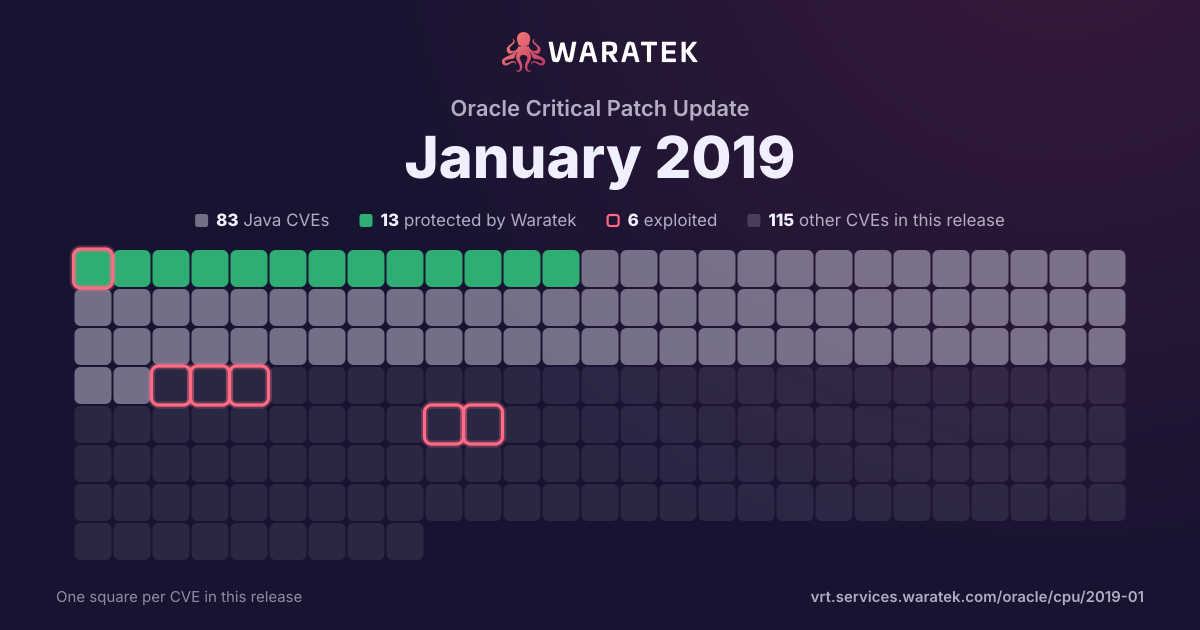
By status
13Protected by Waratek1Mitigation candidate69No exploit published34Outside Waratek scope81Not applicable
6Exploited, marked by the ring
No exploit published. For 67 of them, Oracle's security advisory is the source of public detail.
Protected by Waratek. Waratek RASP can block exploitation of these on systems that have not applied the patch yet.
Overview 109 matches · 47 in Waratek scope · 1 protected · 3 exploited · 0 CISA KEV · 5 public PoC · 3 EPSS ≥ 0.5
109matches
47in Waratek scope43.1%
1protected0.9%
3exploited2.8%
0CISA KEV0.0%
5public PoC4.6%
3EPSS ≥ 0.52.8%
Protected by Waratek
1
0.9%
Rule in development
0
0.0%
Mitigation candidate
1
0.9%
No exploit published
45
41.3%
Outside Waratek scope
22
20.2%
Not applicable
40
36.7%
Withdrawn CVE
0
0.0%
blocked by ARMR today
1
0.9%
partly blocked
0
0.0%
not blocked
108
99.1%
not established
0
0.0%
unrecorded
0
0.0%
split by
peak 99 / quarter
Q1 171
Not applicable1
Medium1
not blocked1
No public exploit1
Q2 170
Q3 171
Protected by Waratek1
Medium1
blocked by ARMR today1
No public exploit1
Q4 170
Q1 181
Outside Waratek scope1
Medium1
not blocked1
Exploited1
Q2 182
Outside Waratek scope1
Not applicable1
Medium2
not blocked2
Exploited1
No public exploit1
Q3 182
Outside Waratek scope1
Not applicable1
Medium2
not blocked2
Exploited1
No public exploit1
Q4 183
Outside Waratek scope2
Not applicable1
Medium3
not blocked3
Working exploit published1
No public exploit2
Q1 1999
Mitigation candidate1
No exploit published45
Outside Waratek scope17
Not applicable36
Medium99
not blocked99
Working exploit published1
Proof of concept only1
No public exploit97
Q1 17Q2 17Q3 17Q4 17Q1 18Q2 18Q3 18Q4 18Q1 19
| CVE | Severity | Published▾ | Status | Exploitation | Description |
|---|---|---|---|---|---|
| CVE-2018-3147 | Medium | 2018-10-17 | Not applicable | No public exploit | Vulnerability in the Oracle Outside In Technology component of Oracle Fusion Middleware (subcomponent: Outside In Filters). The supported version that is affected are 8.5.3 and 8.5.4. Easily exploitable vulnerability allows unauthenticated attacker with network access via HTTP to compromise Oracle Outside In Technology. Successful attacks require human interaction from a person other than the attacker. Successful attacks of this vulnerability can result in unauthorized read access to a subset of Oracle Outside In Technology accessible data. Note: Outside In Technology is a suite of software development kits (SDKs). The protocol and CVSS score depend on the software that uses the Outside In Technology code. The CVSS score assumes that the software passes data received over a network directly to Outside In Technology code, but if data is not received over a network the CVSS score may be lower. CVSS 3.0 Base Score 4.3 (Confidentiality impacts). CVSS Vector: (CVSS:3.0/AV:N/AC:L/PR:N/UI:R/S:U/C:L/I:N/A:N). |
| CVE-2018-11784 | Medium | 2018-10-04 | Outside Waratek scope | Working exploit published | When the default servlet in Apache Tomcat versions 9.0.0.M1 to 9.0.11, 8.5.0 to 8.5.33 and 7.0.23 to 7.0.90 returned a redirect to a directory (e.g. redirecting to '/foo/' when the user requested '/foo') a specially crafted URL could be used to cause the redirect to be generated to any URI of the attackers choice. |
| CVE-2018-11763 | Medium | 2018-09-25 | Outside Waratek scope | Exploited | In Apache HTTP Server 2.4.17 to 2.4.34, by sending continuous, large SETTINGS frames a client can occupy a connection, server thread and CPU time without any connection timeout coming to effect. This affects only HTTP/2 connections. A possible mitigation is to not enable the h2 protocol. |
| CVE-2018-3646 | Medium | 2018-08-14 | Not applicable | No public exploit | Systems with microprocessors utilizing speculative execution and address translations may allow unauthorized disclosure of information residing in the L1 data cache to an attacker with local user access with guest OS privilege via a terminal page fault and a side-channel analysis. |
| CVE-2018-3639 | Medium | 2018-05-22 | Outside Waratek scope | Exploited | Systems with microprocessors utilizing speculative execution and speculative execution of memory reads before the addresses of all prior memory writes are known may allow unauthorized disclosure of information to an attacker with local user access via a side-channel analysis, aka Speculative Store Bypass (SSB), Variant 4. |
| CVE-2018-11212 | Medium | 2018-05-16 | Not applicable | No public exploit | An issue was discovered in libjpeg 9a and 9d. The alloc_sarray function in jmemmgr.c allows remote attackers to cause a denial of service (divide-by-zero error) via a crafted file. |
| CVE-2015-9251 | Medium | 2018-01-18 | Outside Waratek scope | Exploited | jQuery before 3.0.0 is vulnerable to Cross-site Scripting (XSS) attacks when a cross-domain Ajax request is performed without the dataType option, causing text/javascript responses to be executed. |
| CVE-2017-14735 | Medium | 2017-09-25 | Protected by Waratek | No public exploit | OWASP AntiSamy before 1.5.7 allows XSS via HTML5 entities, as demonstrated by use of : to construct a javascript: URL. |
| CVE-2016-9392 | Medium | 2017-03-23 | Not applicable | No public exploit | The calcstepsizes function in jpc_dec.c in JasPer before 1.900.17 allows remote attackers to cause a denial of service (assertion failure) via a crafted file. |