
Oracle Critical Patch Update January 2019
Released January 2019 · Oracle's advisory ↗ · ← Critical Patch Update, October 2018 · Critical Patch Update, April 2019 →
198 CVEs in this release, one square each
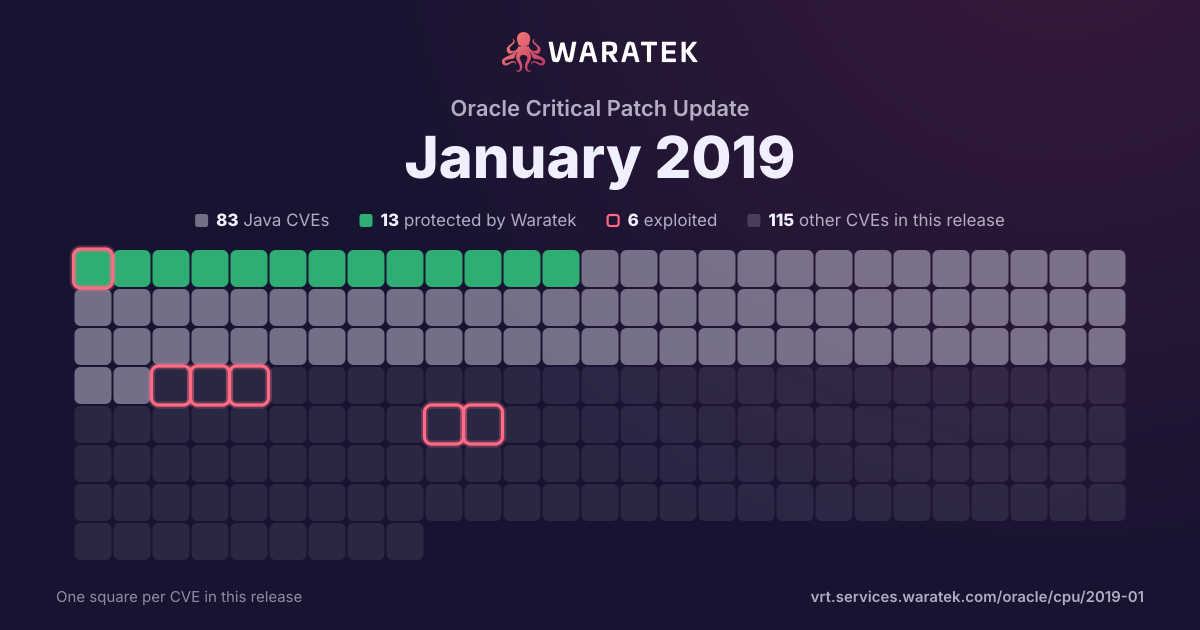
By status
13Protected by Waratek1Mitigation candidate69No exploit published34Outside Waratek scope81Not applicable
6Exploited, marked by the ring
No exploit published. For 67 of them, Oracle's security advisory is the source of public detail.
Protected by Waratek. Waratek RASP can block exploitation of these on systems that have not applied the patch yet.
Overview 9 matches · 5 protected · 1 exploited · 1 CISA KEV · 1 public PoC · 2 EPSS ≥ 0.5
Protected by Waratek
5
55.6%
Rule in development
0
0.0%
Mitigation candidate
0
0.0%
No exploit published
4
44.4%
blocked by ARMR today
5
55.6%
partly blocked
0
0.0%
not blocked
4
44.4%
not established
0
0.0%
unrecorded
0
0.0%
Exploited
1
11.1%
Working exploit published
0
0.0%
Proof of concept only
0
0.0%
Forecast only
1
11.1%
No public exploit
7
77.8%
split by
peak 2 / month
Feb 181
Protected by Waratek1
Critical1
blocked by ARMR today1
No public exploit1
Mar 180
Apr 181
Protected by Waratek1
Critical1
blocked by ARMR today1
Forecast only1
May 182
Protected by Waratek1
No exploit published1
Critical1
High1
blocked by ARMR today1
not blocked1
No public exploit2
Jun 182
No exploit published2
Critical1
High1
not blocked2
No public exploit2
Jul 180
Aug 182
Protected by Waratek2
High2
blocked by ARMR today2
Exploited1
No public exploit1
Sep 181
No exploit published1
High1
not blocked1
No public exploit1
Feb 18Mar 18Apr 18May 18Jun 18Jul 18Aug 18Sep 18
| CVE | Severity | Published▾ | Status | Exploitation | Description |
|---|---|---|---|---|---|
| CVE-2018-11775 | High | 2018-09-10 | No exploit published | No public exploit | TLS hostname verification when using the Apache ActiveMQ Client before 5.15.6 was missing which could make the client vulnerable to a MITM attack between a Java application using the ActiveMQ client and the ActiveMQ server. This is now enabled by default. |
| CVE-2018-11776 | High | 2018-08-22 | Protected by Waratek | Exploited | Apache Struts versions 2.3 to 2.3.34 and 2.5 to 2.5.16 suffer from possible Remote Code Execution when alwaysSelectFullNamespace is true (either by user or a plugin like Convention Plugin) and then: results are used with no namespace and in same time, its upper package have no or wildcard namespace and similar to results, same possibility when using url tag which doesn't have value and action set and in same time, its upper package have no or wildcard namespace. |
| CVE-2018-1000632 | High | 2018-08-20 | Protected by Waratek | No public exploit | dom4j version prior to version 2.1.1 contains a CWE-91: XML Injection vulnerability in Class: Element. Methods: addElement, addAttribute that can result in an attacker tampering with XML documents through XML injection. This attack appear to be exploitable via an attacker specifying attributes or elements in the XML document. This vulnerability appears to have been fixed in 2.1.1 or later. |
| CVE-2017-7658 | Critical | 2018-06-26 | No exploit published | No public exploit | In Eclipse Jetty Server, versions 9.2.x and older, 9.3.x (all non HTTP/1.x configurations), and 9.4.x (all HTTP/1.x configurations), when presented with two content-lengths headers, Jetty ignored the second. When presented with a content-length and a chunked encoding header, the content-length was ignored (as per RFC 2616). If an intermediary decided on the shorter length, but still passed on the longer body, then body content could be interpreted by Jetty as a pipelined request. If the intermediary was imposing authorization, the fake pipelined request would bypass that authorization. |
| CVE-2018-1000180 | High | 2018-06-05 | No exploit published | No public exploit | Bouncy Castle BC 1.54 - 1.59, BC-FJA 1.0.0, BC-FJA 1.0.1 and earlier have a flaw in the Low-level interface to RSA key pair generator, specifically RSA Key Pairs generated in low-level API with added certainty may have less M-R tests than expected. This appears to be fixed in versions BC 1.60 beta 4 and later, BC-FJA 1.0.2 and later. |
| CVE-2018-8013 | Critical | 2018-05-24 | Protected by Waratek | No public exploit | In Apache Batik 1.x before 1.10, when deserializing subclass of `AbstractDocument`, the class takes a string from the inputStream as the class name which then use it to call the no-arg constructor of the class. Fix was to check the class type before calling newInstance in deserialization. |
| CVE-2018-1258 | High | 2018-05-11 | No exploit published | No public exploit | Spring Framework version 5.0.5 when used in combination with any versions of Spring Security contains an authorization bypass when using method security. An unauthorized malicious user can gain unauthorized access to methods that should be restricted. |
| CVE-2018-1275 | Critical | 2018-04-11 | Protected by Waratek | Forecast only | Spring Framework, versions 5.0 prior to 5.0.5 and versions 4.3 prior to 4.3.16 and older unsupported versions, allow applications to expose STOMP over WebSocket endpoints with a simple, in-memory STOMP broker through the spring-messaging module. A malicious user (or attacker) can craft a message to the broker that can lead to a remote code execution attack. This CVE addresses the partial fix for CVE-2018-1270 in the 4.3.x branch of the Spring Framework. |
| CVE-2017-15095 | Critical | 2018-02-06 | Protected by Waratek | No public exploit | A deserialization flaw was discovered in the jackson-databind in versions before 2.8.10 and 2.9.1, which could allow an unauthenticated user to perform code execution by sending the maliciously crafted input to the readValue method of the ObjectMapper. This issue extends the previous flaw CVE-2017-7525 by blacklisting more classes that could be used maliciously. |