
Oracle Critical Patch Update July 2018
Released July 2018 · Oracle's advisory ↗ · ← Critical Patch Update, April 2018 · Critical Patch Update, October 2018 →
247 CVEs in this release, one square each
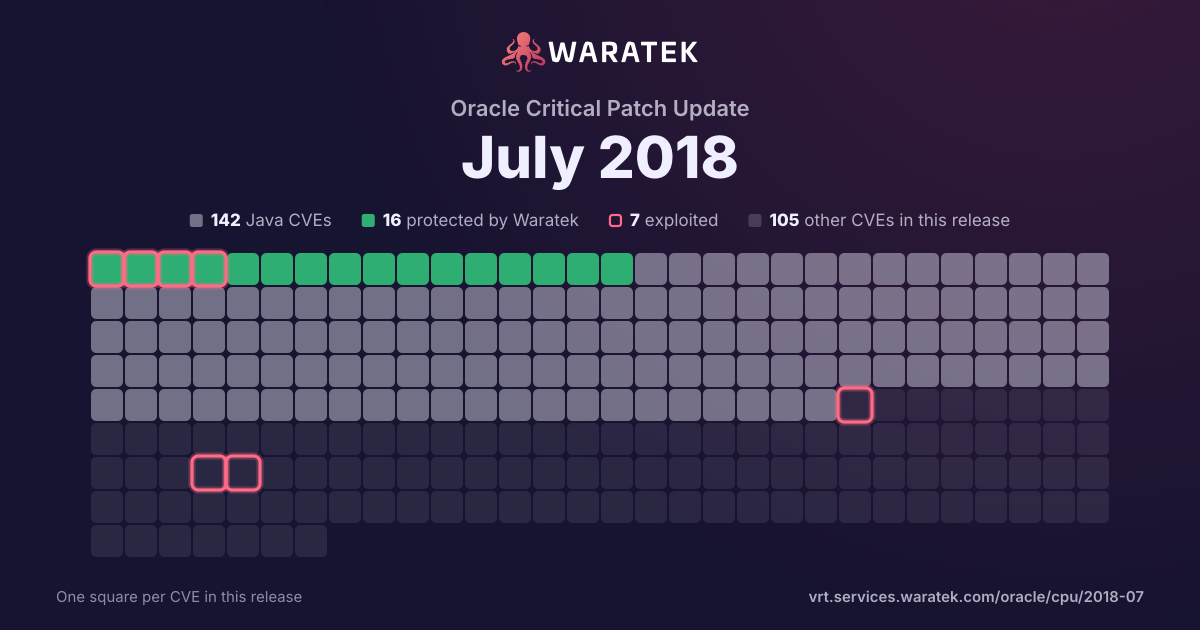
By status
16Protected by Waratek126No exploit published41Outside Waratek scope64Not applicable
7Exploited, marked by the ring
No exploit published. For 125 of them, Oracle's security advisory is the source of public detail.
Protected by Waratek. Waratek RASP can block exploitation of these on systems that have not applied the patch yet.
Overview 2 matches · 0 in Waratek scope · 0 protected · 0 exploited · 0 CISA KEV · 0 public PoC · 0 EPSS ≥ 0.5
2matches
0in Waratek scope0.0%
0protected0.0%
0exploited0.0%
0CISA KEV0.0%
0public PoC0.0%
0EPSS ≥ 0.50.0%
Protected by Waratek
0
0.0%
Rule in development
0
0.0%
Mitigation candidate
0
0.0%
No exploit published
0
0.0%
Outside Waratek scope
1
50.0%
Not applicable
1
50.0%
Withdrawn CVE
0
0.0%
blocked by ARMR today
0
0.0%
partly blocked
0
0.0%
not blocked
2
100.0%
not established
0
0.0%
unrecorded
0
0.0%
Exploited
0
0.0%
Working exploit published
0
0.0%
Proof of concept only
0
0.0%
Forecast only
0
0.0%
No public exploit
2
100.0%
split by
peak 1 / month
Aug 15Sep 15Oct 15Nov 15Dec 15Jan 16Feb 16
| CVE | Severity | Published▾ | Status | Exploitation | Description |
|---|---|---|---|---|---|
| CVE-2016-0714 | High | 2016-02-25 | Outside Waratek scope | No public exploit | The session-persistence implementation in Apache Tomcat 6.x before 6.0.45, 7.x before 7.0.68, 8.x before 8.0.31, and 9.x before 9.0.0.M2 mishandles session attributes, which allows remote authenticated users to bypass intended SecurityManager restrictions and execute arbitrary code in a privileged context via a web application that places a crafted object in a session. |
| CVE-2015-5600 | High | 2015-08-03 | Not applicable | No public exploit | The kbdint_next_device function in auth2-chall.c in sshd in OpenSSH through 6.9 does not properly restrict the processing of keyboard-interactive devices within a single connection, which makes it easier for remote attackers to conduct brute-force attacks or cause a denial of service (CPU consumption) via a long and duplicative list in the ssh -oKbdInteractiveDevices option, as demonstrated by a modified client that provides a different password for each pam element on this list. |