
Oracle Critical Patch Update July 2018
Released July 2018 · Oracle's advisory ↗ · ← Critical Patch Update, April 2018 · Critical Patch Update, October 2018 →
247 CVEs in this release, one square each
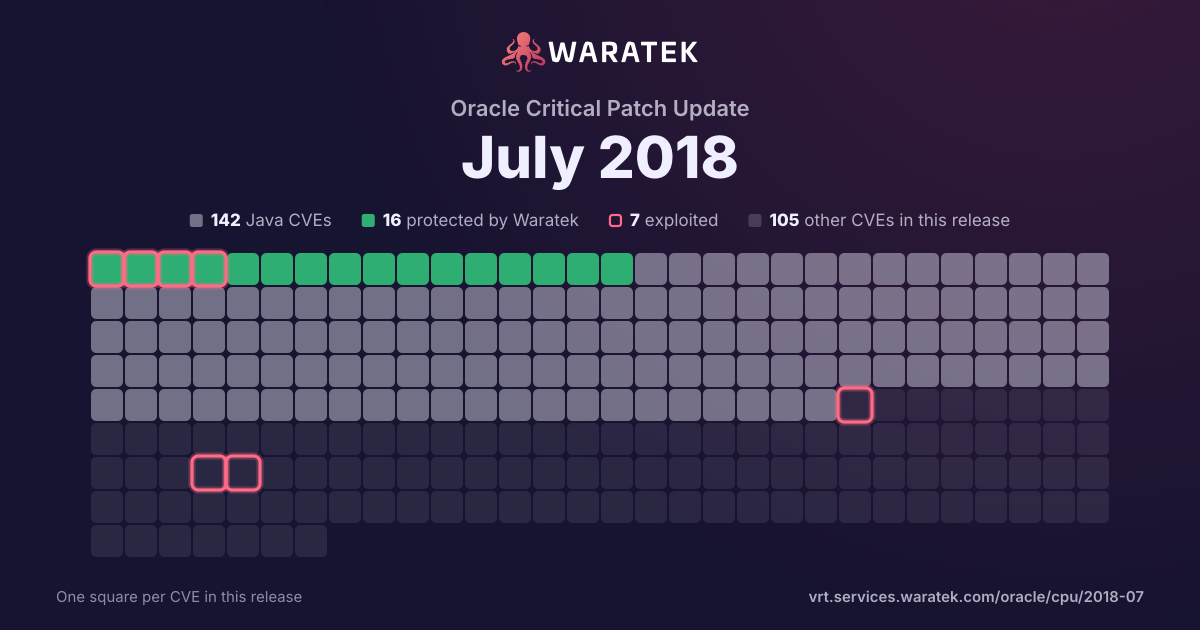
By status
16Protected by Waratek126No exploit published41Outside Waratek scope64Not applicable
7Exploited, marked by the ring
No exploit published. For 125 of them, Oracle's security advisory is the source of public detail.
Protected by Waratek. Waratek RASP can block exploitation of these on systems that have not applied the patch yet.
Overview 15 matches · 3 in Waratek scope · 2 protected · 3 exploited · 1 CISA KEV · 6 public PoC · 4 EPSS ≥ 0.5
15matches
3in Waratek scope20.0%
2protected13.3%
3exploited20.0%
1CISA KEV6.7%
6public PoC40.0%
4EPSS ≥ 0.526.7%
Protected by Waratek
3
20.0%
Rule in development
0
0.0%
Mitigation candidate
0
0.0%
No exploit published
0
0.0%
Outside Waratek scope
4
26.7%
Not applicable
8
53.3%
Withdrawn CVE
0
0.0%
blocked by ARMR today
2
13.3%
partly blocked
1
6.7%
not blocked
12
80.0%
not established
0
0.0%
unrecorded
0
0.0%
Exploited
3
20.0%
Working exploit published
3
20.0%
Proof of concept only
0
0.0%
Forecast only
0
0.0%
No public exploit
9
60.0%
split by
peak 3 / month
Jan 171
Not applicable1
Medium1
not blocked1
No public exploit1
Feb 171
Not applicable1
High1
not blocked1
Working exploit published1
Mar 171
Outside Waratek scope1
Medium1
not blocked1
No public exploit1
Apr 172
Protected by Waratek1
Not applicable1
Critical1
High1
blocked by ARMR today1
not blocked1
Working exploit published1
No public exploit1
May 171
Outside Waratek scope1
Critical1
not blocked1
No public exploit1
Jun 171
Outside Waratek scope1
High1
not blocked1
No public exploit1
Jul 170
Aug 172
Outside Waratek scope1
Not applicable1
High1
Medium1
not blocked2
No public exploit2
Sep 172
Not applicable2
High1
Medium1
not blocked2
Exploited1
Working exploit published1
Oct 171
Protected by Waratek1
High1
partly blocked1
Exploited1
Nov 173
Protected by Waratek1
Not applicable2
Critical2
Medium1
blocked by ARMR today1
not blocked2
Exploited1
No public exploit2
Jan 17Feb 17Mar 17Apr 17May 17Jun 17Jul 17Aug 17Sep 17Oct 17Nov 17
| CVE | Severity | Published▾ | Status | Exploitation | Description |
|---|---|---|---|---|---|
| CVE-2017-5533 | Critical | 2017-11-15 | Not applicable | No public exploit | A vulnerability in the server content cache of TIBCO JasperReports Server, TIBCO JasperReports Server Community Edition, TIBCO JasperReports Server for ActiveMatrix BPM, TIBCO Jaspersoft for AWS with Multi-Tenancy, and TIBCO Jaspersoft Reporting and Analytics for AWS contains a vulnerability which fails to prevent remote access to all the contents of the web application, including key configuration files. Affected releases are TIBCO JasperReports Server 6.4.0, TIBCO JasperReports Server Community Edition 6.4.0, TIBCO JasperReports Server for ActiveMatrix BPM 6.4.0, TIBCO Jaspersoft for AWS with Multi-Tenancy 6.4.0, TIBCO Jaspersoft Reporting and Analytics for AWS 6.4.0. |
| CVE-2015-7501 | Critical | 2017-11-09 | Protected by Waratek | Exploited | Red Hat JBoss A-MQ 6.x; BPM Suite (BPMS) 6.x; BRMS 6.x and 5.x; Data Grid (JDG) 6.x; Data Virtualization (JDV) 6.x and 5.x; Enterprise Application Platform 6.x, 5.x, and 4.3.x; Fuse 6.x; Fuse Service Works (FSW) 6.x; Operations Network (JBoss ON) 3.x; Portal 6.x; SOA Platform (SOA-P) 5.x; Web Server (JWS) 3.x; Red Hat OpenShift/xPAAS 3.x; and Red Hat Subscription Asset Manager 1.3 allow remote attackers to execute arbitrary commands via a crafted serialized Java object, related to the Apache Commons Collections (ACC) library. |
| CVE-2017-3736 | Medium | 2017-11-02 | Not applicable | No public exploit | There is a carry propagating bug in the x86_64 Montgomery squaring procedure in OpenSSL before 1.0.2m and 1.1.0 before 1.1.0g. No EC algorithms are affected. Analysis suggests that attacks against RSA and DSA as a result of this defect would be very difficult to perform and are not believed likely. Attacks against DH are considered just feasible (although very difficult) because most of the work necessary to deduce information about a private key may be performed offline. The amount of resources required for such an attack would be very significant and likely only accessible to a limited number of attackers. An attacker would additionally need online access to an unpatched system using the target private key in a scenario with persistent DH parameters and a private key that is shared between multiple clients. This only affects processors that support the BMI1, BMI2 and ADX extensions like Intel Broadwell (5th generation) and later or AMD Ryzen. |
| CVE-2017-12617 | High | 2017-10-04 | Protected by Waratek | Exploited | When running Apache Tomcat versions 9.0.0.M1 to 9.0.0, 8.5.0 to 8.5.22, 8.0.0.RC1 to 8.0.46 and 7.0.0 to 7.0.81 with HTTP PUTs enabled (e.g. via setting the readonly initialisation parameter of the Default servlet to false) it was possible to upload a JSP file to the server via a specially crafted request. This JSP could then be requested and any code it contained would be executed by the server. |
| CVE-2017-9798 | High | 2017-09-18 | Not applicable | Exploited | Apache httpd allows remote attackers to read secret data from process memory if the Limit directive can be set in a user's .htaccess file, or if httpd.conf has certain misconfigurations, aka Optionsbleed. This affects the Apache HTTP Server through 2.2.34 and 2.4.x through 2.4.27. The attacker sends an unauthenticated OPTIONS HTTP request when attempting to read secret data. This is a use-after-free issue and thus secret data is not always sent, and the specific data depends on many factors including configuration. Exploitation with .htaccess can be blocked with a patch to the ap_limit_section function in server/core.c. |
| CVE-2017-0785 | Medium | 2017-09-14 | Not applicable | Working exploit published | A information disclosure vulnerability in the Android system (bluetooth). Product: Android. Versions: 4.4.4, 5.0.2, 5.1.1, 6.0, 6.0.1, 7.0, 7.1.1, 7.1.2, 8.0. Android ID: A-63146698. |
| CVE-2017-0379 | High | 2017-08-29 | Not applicable | No public exploit | Libgcrypt before 1.8.1 does not properly consider Curve25519 side-channel attacks, which makes it easier for attackers to discover a secret key, related to cipher/ecc.c and mpi/ec.c. |
| CVE-2017-3633 | Medium | 2017-08-08 | Outside Waratek scope | No public exploit | Vulnerability in the MySQL Server component of Oracle MySQL (subcomponent: Server: Memcached). Supported versions that are affected are 5.6.36 and earlier and 5.7.18 and earlier. Difficult to exploit vulnerability allows unauthenticated attacker with network access via Memcached to compromise MySQL Server. Successful attacks of this vulnerability can result in unauthorized ability to cause a hang or frequently repeatable crash (complete DOS) of MySQL Server as well as unauthorized update, insert or delete access to some of MySQL Server accessible data. CVSS 3.0 Base Score 6.5 (Integrity and Availability impacts). CVSS Vector: (CVSS:3.0/AV:N/AC:H/PR:N/UI:N/S:U/C:N/I:L/A:H). |
| CVE-2017-5664 | High | 2017-06-06 | Outside Waratek scope | No public exploit | The error page mechanism of the Java Servlet Specification requires that, when an error occurs and an error page is configured for the error that occurred, the original request and response are forwarded to the error page. This means that the request is presented to the error page with the original HTTP method. If the error page is a static file, expected behaviour is to serve content of the file as if processing a GET request, regardless of the actual HTTP method. The Default Servlet in Apache Tomcat 9.0.0.M1 to 9.0.0.M20, 8.5.0 to 8.5.14, 8.0.0.RC1 to 8.0.43 and 7.0.0 to 7.0.77 did not do this. Depending on the original request this could lead to unexpected and undesirable results for static error pages including, if the DefaultServlet is configured to permit writes, the replacement or removal of the custom error page. Notes for other user provided error pages: (1) Unless explicitly coded otherwise, JSPs ignore the HTTP method. JSPs used as error pages must must ensure that they handle any error dispatch as a GET request, regardless of the actual method. (2) By default, the response generated by a Servlet does depend on the HTTP method. Custom Servlets used as error pages must ensure that they handle any error dispatch as a GET request, regardless of the actual method. |
| CVE-2016-9843 | Critical | 2017-05-23 | Outside Waratek scope | No public exploit | The crc32_big function in crc32.c in zlib 1.2.8 might allow context-dependent attackers to have unspecified impact via vectors involving big-endian CRC calculation. |
| CVE-2017-5662 | High | 2017-04-18 | Not applicable | No public exploit | In Apache Batik before 1.9, files lying on the filesystem of the server which uses batik can be revealed to arbitrary users who send maliciously formed SVG files. The file types that can be shown depend on the user context in which the exploitable application is running. If the user is root a full compromise of the server - including confidential or sensitive files - would be possible. XXE can also be used to attack the availability of the server via denial of service as the references within a xml document can trivially trigger an amplification attack. |
| CVE-2017-5645 | Critical | 2017-04-17 | Protected by Waratek | Working exploit published | In Apache Log4j 2.x before 2.8.2, when using the TCP socket server or UDP socket server to receive serialized log events from another application, a specially crafted binary payload can be sent that, when deserialized, can execute arbitrary code. |
| CVE-2016-7103 | Medium | 2017-03-15 | Outside Waratek scope | No public exploit | Cross-site scripting (XSS) vulnerability in jQuery UI before 1.12.0 might allow remote attackers to inject arbitrary web script or HTML via the closeText parameter of the dialog function. |
| CVE-2017-6074 | High | 2017-02-18 | Not applicable | Working exploit published | The dccp_rcv_state_process function in net/dccp/input.c in the Linux kernel through 4.9.11 mishandles DCCP_PKT_REQUEST packet data structures in the LISTEN state, which allows local users to obtain root privileges or cause a denial of service (double free) via an application that makes an IPV6_RECVPKTINFO setsockopt system call. |
| CVE-2016-4055 | Medium | 2017-01-23 | Not applicable | No public exploit | The duration function in the moment package before 2.11.2 for Node.js allows remote attackers to cause a denial of service (CPU consumption) via a long string, aka a "regular expression Denial of Service (ReDoS)." |