
Oracle Critical Patch Update July 2018
Released July 2018 · Oracle's advisory ↗ · ← Critical Patch Update, April 2018 · Critical Patch Update, October 2018 →
247 CVEs in this release, one square each
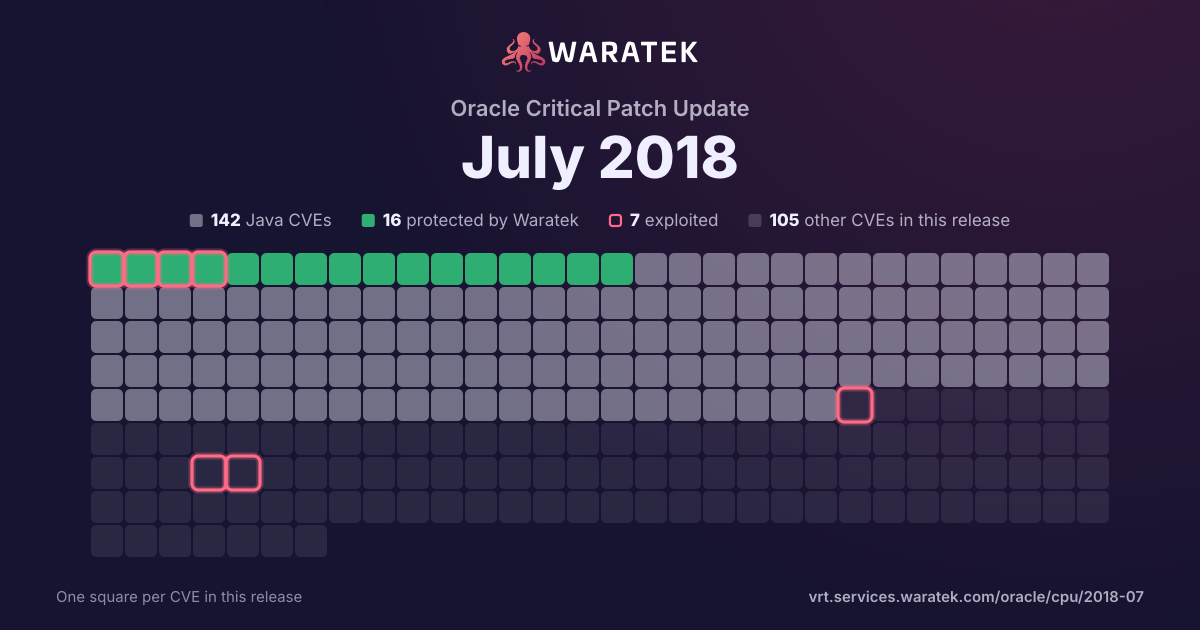
By status
16Protected by Waratek126No exploit published41Outside Waratek scope64Not applicable
7Exploited, marked by the ring
No exploit published. For 125 of them, Oracle's security advisory is the source of public detail.
Protected by Waratek. Waratek RASP can block exploitation of these on systems that have not applied the patch yet.
Overview 3 matches · 0 in Waratek scope · 0 protected · 0 exploited · 0 CISA KEV · 1 public PoC · 0 EPSS ≥ 0.5
3matches
0in Waratek scope0.0%
0protected0.0%
0exploited0.0%
0CISA KEV0.0%
1public PoC33.3%
0EPSS ≥ 0.50.0%
Protected by Waratek
0
0.0%
Rule in development
0
0.0%
Mitigation candidate
0
0.0%
No exploit published
0
0.0%
Outside Waratek scope
1
33.3%
Not applicable
2
66.7%
Withdrawn CVE
0
0.0%
blocked by ARMR today
0
0.0%
partly blocked
0
0.0%
not blocked
3
100.0%
not established
0
0.0%
unrecorded
0
0.0%
Exploited
0
0.0%
Working exploit published
1
33.3%
Proof of concept only
0
0.0%
Forecast only
0
0.0%
No public exploit
2
66.7%
| CVE | Severity | Published▾ | Status | Exploitation | Description |
|---|---|---|---|---|---|
| CVE-2016-7103 | Medium | 2017-03-15 | Outside Waratek scope | No public exploit | Cross-site scripting (XSS) vulnerability in jQuery UI before 1.12.0 might allow remote attackers to inject arbitrary web script or HTML via the closeText parameter of the dialog function. |
| CVE-2017-6074 | High | 2017-02-18 | Not applicable | Working exploit published | The dccp_rcv_state_process function in net/dccp/input.c in the Linux kernel through 4.9.11 mishandles DCCP_PKT_REQUEST packet data structures in the LISTEN state, which allows local users to obtain root privileges or cause a denial of service (double free) via an application that makes an IPV6_RECVPKTINFO setsockopt system call. |
| CVE-2016-4055 | Medium | 2017-01-23 | Not applicable | No public exploit | The duration function in the moment package before 2.11.2 for Node.js allows remote attackers to cause a denial of service (CPU consumption) via a long string, aka a "regular expression Denial of Service (ReDoS)." |