
Oracle Critical Patch Update July 2018
Released July 2018 · Oracle's advisory ↗ · ← Critical Patch Update, April 2018 · Critical Patch Update, October 2018 →
247 CVEs in this release, one square each
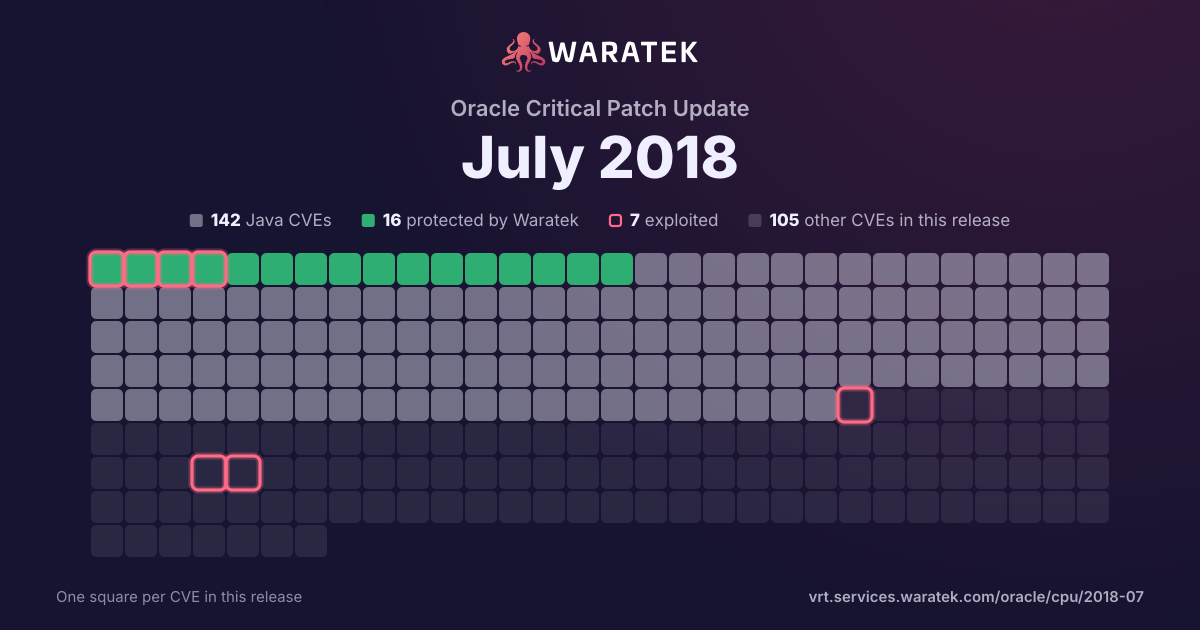
By status
16Protected by Waratek126No exploit published41Outside Waratek scope64Not applicable
7Exploited, marked by the ring
No exploit published. For 125 of them, Oracle's security advisory is the source of public detail.
Protected by Waratek. Waratek RASP can block exploitation of these on systems that have not applied the patch yet.
Overview 78 matches · 30 in Waratek scope · 0 protected · 2 exploited · 1 CISA KEV · 4 public PoC · 2 EPSS ≥ 0.5
78matches
30in Waratek scope38.5%
0protected0.0%
2exploited2.6%
1CISA KEV1.3%
4public PoC5.1%
2EPSS ≥ 0.52.6%
Protected by Waratek
0
0.0%
Rule in development
0
0.0%
Mitigation candidate
0
0.0%
No exploit published
30
38.5%
Outside Waratek scope
8
10.3%
Not applicable
40
51.3%
Withdrawn CVE
0
0.0%
blocked by ARMR today
0
0.0%
partly blocked
0
0.0%
not blocked
78
100.0%
not established
0
0.0%
unrecorded
0
0.0%
Exploited
2
2.6%
Working exploit published
2
2.6%
Proof of concept only
0
0.0%
Forecast only
0
0.0%
No public exploit
74
94.9%
split by
peak 67 / quarter
Q3 151
Not applicable1
High1
not blocked1
No public exploit1
Q4 150
Q1 161
Outside Waratek scope1
High1
not blocked1
No public exploit1
Q2 161
Not applicable1
High1
not blocked1
No public exploit1
Q3 161
Not applicable1
High1
not blocked1
No public exploit1
Q4 161
Outside Waratek scope1
High1
not blocked1
Exploited1
Q1 171
Not applicable1
High1
not blocked1
Working exploit published1
Q2 172
Outside Waratek scope1
Not applicable1
High2
not blocked2
No public exploit2
Q3 172
Not applicable2
High2
not blocked2
Exploited1
No public exploit1
Q4 170
Q1 181
Not applicable1
High1
not blocked1
No public exploit1
Q2 180
Q3 1867
No exploit published30
Outside Waratek scope5
Not applicable32
High67
not blocked67
Working exploit published1
No public exploit66
Q3 15Q1 16Q3 16Q1 17Q3 17Q1 18Q3 18
| CVE | Severity | Published▾ | Status | Exploitation | Description |
|---|---|---|---|---|---|
| CVE-2018-3104 | High | 2018-07-18 | Not applicable | No public exploit | Vulnerability in the Oracle Outside In Technology component of Oracle Fusion Middleware (subcomponent: Outside In Filters). The supported version that is affected is 8.5.3. Easily exploitable vulnerability allows unauthenticated attacker with network access via HTTP to compromise Oracle Outside In Technology. Successful attacks require human interaction from a person other than the attacker. Successful attacks of this vulnerability can result in unauthorized access to critical data or complete access to all Oracle Outside In Technology accessible data and unauthorized ability to cause a partial denial of service (partial DOS) of Oracle Outside In Technology. Note: Outside In Technology is a suite of software development kits (SDKs). The protocol and CVSS score depend on the software that uses the Outside In Technology code. The CVSS score assumes that the software passes data received over a network directly to Outside In Technology code, but if data is not received over a network the CVSS score may be lower. CVSS 3.0 Base Score 7.1 (Confidentiality and Availability impacts). CVSS Vector: (CVSS:3.0/AV:N/AC:L/PR:N/UI:R/S:U/C:H/I:N/A:L). |
| CVE-2018-3103 | High | 2018-07-18 | Not applicable | No public exploit | Vulnerability in the Oracle Outside In Technology component of Oracle Fusion Middleware (subcomponent: Outside In Filters). The supported version that is affected is 8.5.3. Easily exploitable vulnerability allows unauthenticated attacker with network access via HTTP to compromise Oracle Outside In Technology. Successful attacks require human interaction from a person other than the attacker. Successful attacks of this vulnerability can result in unauthorized access to critical data or complete access to all Oracle Outside In Technology accessible data and unauthorized ability to cause a partial denial of service (partial DOS) of Oracle Outside In Technology. Note: Outside In Technology is a suite of software development kits (SDKs). The protocol and CVSS score depend on the software that uses the Outside In Technology code. The CVSS score assumes that the software passes data received over a network directly to Outside In Technology code, but if data is not received over a network the CVSS score may be lower. CVSS 3.0 Base Score 7.1 (Confidentiality and Availability impacts). CVSS Vector: (CVSS:3.0/AV:N/AC:L/PR:N/UI:R/S:U/C:H/I:N/A:L). |
| CVE-2018-3102 | High | 2018-07-18 | Not applicable | No public exploit | Vulnerability in the Oracle Outside In Technology component of Oracle Fusion Middleware (subcomponent: Outside In Filters). The supported version that is affected is 8.5.3. Easily exploitable vulnerability allows unauthenticated attacker with network access via HTTP to compromise Oracle Outside In Technology. Successful attacks require human interaction from a person other than the attacker. Successful attacks of this vulnerability can result in unauthorized access to critical data or complete access to all Oracle Outside In Technology accessible data and unauthorized ability to cause a partial denial of service (partial DOS) of Oracle Outside In Technology. Note: Outside In Technology is a suite of software development kits (SDKs). The protocol and CVSS score depend on the software that uses the Outside In Technology code. The CVSS score assumes that the software passes data received over a network directly to Outside In Technology code, but if data is not received over a network the CVSS score may be lower. CVSS 3.0 Base Score 7.1 (Confidentiality and Availability impacts). CVSS Vector: (CVSS:3.0/AV:N/AC:L/PR:N/UI:R/S:U/C:H/I:N/A:L). |
| CVE-2018-3099 | High | 2018-07-18 | Not applicable | No public exploit | Vulnerability in the Oracle Outside In Technology component of Oracle Fusion Middleware (subcomponent: Outside In Filters). The supported version that is affected is 8.5.3. Easily exploitable vulnerability allows unauthenticated attacker with network access via HTTP to compromise Oracle Outside In Technology. Successful attacks require human interaction from a person other than the attacker. Successful attacks of this vulnerability can result in unauthorized access to critical data or complete access to all Oracle Outside In Technology accessible data and unauthorized ability to cause a partial denial of service (partial DOS) of Oracle Outside In Technology. Note: Outside In Technology is a suite of software development kits (SDKs). The protocol and CVSS score depend on the software that uses the Outside In Technology code. The CVSS score assumes that the software passes data received over a network directly to Outside In Technology code, but if data is not received over a network the CVSS score may be lower. CVSS 3.0 Base Score 7.1 (Confidentiality and Availability impacts). CVSS Vector: (CVSS:3.0/AV:N/AC:L/PR:N/UI:R/S:U/C:H/I:N/A:L). |
| CVE-2018-3098 | High | 2018-07-18 | Not applicable | No public exploit | Vulnerability in the Oracle Outside In Technology component of Oracle Fusion Middleware (subcomponent: Outside In Filters). The supported version that is affected is 8.5.3. Easily exploitable vulnerability allows unauthenticated attacker with network access via HTTP to compromise Oracle Outside In Technology. Successful attacks require human interaction from a person other than the attacker. Successful attacks of this vulnerability can result in unauthorized access to critical data or complete access to all Oracle Outside In Technology accessible data and unauthorized ability to cause a partial denial of service (partial DOS) of Oracle Outside In Technology. Note: Outside In Technology is a suite of software development kits (SDKs). The protocol and CVSS score depend on the software that uses the Outside In Technology code. The CVSS score assumes that the software passes data received over a network directly to Outside In Technology code, but if data is not received over a network the CVSS score may be lower. CVSS 3.0 Base Score 7.1 (Confidentiality and Availability impacts). CVSS Vector: (CVSS:3.0/AV:N/AC:L/PR:N/UI:R/S:U/C:H/I:N/A:L). |
| CVE-2018-3097 | High | 2018-07-18 | Not applicable | No public exploit | Vulnerability in the Oracle Outside In Technology component of Oracle Fusion Middleware (subcomponent: Outside In Filters). The supported version that is affected is 8.5.3. Easily exploitable vulnerability allows unauthenticated attacker with network access via HTTP to compromise Oracle Outside In Technology. Successful attacks require human interaction from a person other than the attacker. Successful attacks of this vulnerability can result in unauthorized access to critical data or complete access to all Oracle Outside In Technology accessible data and unauthorized ability to cause a partial denial of service (partial DOS) of Oracle Outside In Technology. Note: Outside In Technology is a suite of software development kits (SDKs). The protocol and CVSS score depend on the software that uses the Outside In Technology code. The CVSS score assumes that the software passes data received over a network directly to Outside In Technology code, but if data is not received over a network the CVSS score may be lower. CVSS 3.0 Base Score 7.1 (Confidentiality and Availability impacts). CVSS Vector: (CVSS:3.0/AV:N/AC:L/PR:N/UI:R/S:U/C:H/I:N/A:L). |
| CVE-2018-3096 | High | 2018-07-18 | Not applicable | No public exploit | Vulnerability in the Oracle Outside In Technology component of Oracle Fusion Middleware (subcomponent: Outside In Filters). The supported version that is affected is 8.5.3. Easily exploitable vulnerability allows unauthenticated attacker with network access via HTTP to compromise Oracle Outside In Technology. Successful attacks require human interaction from a person other than the attacker. Successful attacks of this vulnerability can result in unauthorized access to critical data or complete access to all Oracle Outside In Technology accessible data and unauthorized ability to cause a partial denial of service (partial DOS) of Oracle Outside In Technology. Note: Outside In Technology is a suite of software development kits (SDKs). The protocol and CVSS score depend on the software that uses the Outside In Technology code. The CVSS score assumes that the software passes data received over a network directly to Outside In Technology code, but if data is not received over a network the CVSS score may be lower. CVSS 3.0 Base Score 7.1 (Confidentiality and Availability impacts). CVSS Vector: (CVSS:3.0/AV:N/AC:L/PR:N/UI:R/S:U/C:H/I:N/A:L). |
| CVE-2018-3095 | High | 2018-07-18 | Not applicable | No public exploit | Vulnerability in the Oracle Outside In Technology component of Oracle Fusion Middleware (subcomponent: Outside In Filters). The supported version that is affected is 8.5.3. Easily exploitable vulnerability allows unauthenticated attacker with network access via HTTP to compromise Oracle Outside In Technology. Successful attacks require human interaction from a person other than the attacker. Successful attacks of this vulnerability can result in unauthorized access to critical data or complete access to all Oracle Outside In Technology accessible data and unauthorized ability to cause a partial denial of service (partial DOS) of Oracle Outside In Technology. Note: Outside In Technology is a suite of software development kits (SDKs). The protocol and CVSS score depend on the software that uses the Outside In Technology code. The CVSS score assumes that the software passes data received over a network directly to Outside In Technology code, but if data is not received over a network the CVSS score may be lower. CVSS 3.0 Base Score 7.1 (Confidentiality and Availability impacts). CVSS Vector: (CVSS:3.0/AV:N/AC:L/PR:N/UI:R/S:U/C:H/I:N/A:L). |
| CVE-2018-3094 | High | 2018-07-18 | Not applicable | No public exploit | Vulnerability in the Oracle Outside In Technology component of Oracle Fusion Middleware (subcomponent: Outside In Filters). The supported version that is affected is 8.5.3. Easily exploitable vulnerability allows unauthenticated attacker with network access via HTTP to compromise Oracle Outside In Technology. Successful attacks require human interaction from a person other than the attacker. Successful attacks of this vulnerability can result in unauthorized access to critical data or complete access to all Oracle Outside In Technology accessible data and unauthorized ability to cause a partial denial of service (partial DOS) of Oracle Outside In Technology. Note: Outside In Technology is a suite of software development kits (SDKs). The protocol and CVSS score depend on the software that uses the Outside In Technology code. The CVSS score assumes that the software passes data received over a network directly to Outside In Technology code, but if data is not received over a network the CVSS score may be lower. CVSS 3.0 Base Score 7.1 (Confidentiality and Availability impacts). CVSS Vector: (CVSS:3.0/AV:N/AC:L/PR:N/UI:R/S:U/C:H/I:N/A:L). |
| CVE-2018-3093 | High | 2018-07-18 | Not applicable | No public exploit | Vulnerability in the Oracle Outside In Technology component of Oracle Fusion Middleware (subcomponent: Outside In Filters). The supported version that is affected is 8.5.3. Easily exploitable vulnerability allows unauthenticated attacker with network access via HTTP to compromise Oracle Outside In Technology. Successful attacks require human interaction from a person other than the attacker. Successful attacks of this vulnerability can result in unauthorized access to critical data or complete access to all Oracle Outside In Technology accessible data and unauthorized ability to cause a partial denial of service (partial DOS) of Oracle Outside In Technology. Note: Outside In Technology is a suite of software development kits (SDKs). The protocol and CVSS score depend on the software that uses the Outside In Technology code. The CVSS score assumes that the software passes data received over a network directly to Outside In Technology code, but if data is not received over a network the CVSS score may be lower. CVSS 3.0 Base Score 7.1 (Confidentiality and Availability impacts). CVSS Vector: (CVSS:3.0/AV:N/AC:L/PR:N/UI:R/S:U/C:H/I:N/A:L). |
| CVE-2018-3092 | High | 2018-07-18 | Not applicable | No public exploit | Vulnerability in the Oracle Outside In Technology component of Oracle Fusion Middleware (subcomponent: Outside In Filters). The supported version that is affected is 8.5.3. Easily exploitable vulnerability allows unauthenticated attacker with network access via HTTP to compromise Oracle Outside In Technology. Successful attacks require human interaction from a person other than the attacker. Successful attacks of this vulnerability can result in unauthorized access to critical data or complete access to all Oracle Outside In Technology accessible data and unauthorized ability to cause a partial denial of service (partial DOS) of Oracle Outside In Technology. Note: Outside In Technology is a suite of software development kits (SDKs). The protocol and CVSS score depend on the software that uses the Outside In Technology code. The CVSS score assumes that the software passes data received over a network directly to Outside In Technology code, but if data is not received over a network the CVSS score may be lower. CVSS 3.0 Base Score 7.1 (Confidentiality and Availability impacts). CVSS Vector: (CVSS:3.0/AV:N/AC:L/PR:N/UI:R/S:U/C:H/I:N/A:L). |
| CVE-2018-3090 | High | 2018-07-18 | Not applicable | No public exploit | Vulnerability in the Oracle VM VirtualBox component of Oracle Virtualization (subcomponent: Core). The supported version that is affected is Prior to 5.2.16. Easily exploitable vulnerability allows unauthenticated attacker with logon to the infrastructure where Oracle VM VirtualBox executes to compromise Oracle VM VirtualBox. Successful attacks require human interaction from a person other than the attacker and while the vulnerability is in Oracle VM VirtualBox, attacks may significantly impact additional products. Successful attacks of this vulnerability can result in takeover of Oracle VM VirtualBox. CVSS 3.0 Base Score 8.6 (Confidentiality, Integrity and Availability impacts). CVSS Vector: (CVSS:3.0/AV:L/AC:L/PR:N/UI:R/S:C/C:H/I:H/A:H). |
| CVE-2018-3089 | High | 2018-07-18 | Not applicable | No public exploit | Vulnerability in the Oracle VM VirtualBox component of Oracle Virtualization (subcomponent: Core). The supported version that is affected is Prior to 5.2.16. Easily exploitable vulnerability allows unauthenticated attacker with logon to the infrastructure where Oracle VM VirtualBox executes to compromise Oracle VM VirtualBox. Successful attacks require human interaction from a person other than the attacker and while the vulnerability is in Oracle VM VirtualBox, attacks may significantly impact additional products. Successful attacks of this vulnerability can result in takeover of Oracle VM VirtualBox. CVSS 3.0 Base Score 8.6 (Confidentiality, Integrity and Availability impacts). CVSS Vector: (CVSS:3.0/AV:L/AC:L/PR:N/UI:R/S:C/C:H/I:H/A:H). |
| CVE-2018-3088 | High | 2018-07-18 | Not applicable | No public exploit | Vulnerability in the Oracle VM VirtualBox component of Oracle Virtualization (subcomponent: Core). The supported version that is affected is Prior to 5.2.16. Easily exploitable vulnerability allows unauthenticated attacker with logon to the infrastructure where Oracle VM VirtualBox executes to compromise Oracle VM VirtualBox. Successful attacks require human interaction from a person other than the attacker and while the vulnerability is in Oracle VM VirtualBox, attacks may significantly impact additional products. Successful attacks of this vulnerability can result in takeover of Oracle VM VirtualBox. CVSS 3.0 Base Score 8.6 (Confidentiality, Integrity and Availability impacts). CVSS Vector: (CVSS:3.0/AV:L/AC:L/PR:N/UI:R/S:C/C:H/I:H/A:H). |
| CVE-2018-3087 | High | 2018-07-18 | Not applicable | No public exploit | Vulnerability in the Oracle VM VirtualBox component of Oracle Virtualization (subcomponent: Core). The supported version that is affected is Prior to 5.2.16. Easily exploitable vulnerability allows unauthenticated attacker with logon to the infrastructure where Oracle VM VirtualBox executes to compromise Oracle VM VirtualBox. Successful attacks require human interaction from a person other than the attacker and while the vulnerability is in Oracle VM VirtualBox, attacks may significantly impact additional products. Successful attacks of this vulnerability can result in takeover of Oracle VM VirtualBox. CVSS 3.0 Base Score 8.6 (Confidentiality, Integrity and Availability impacts). CVSS Vector: (CVSS:3.0/AV:L/AC:L/PR:N/UI:R/S:C/C:H/I:H/A:H). |
| CVE-2018-3086 | High | 2018-07-18 | Not applicable | No public exploit | Vulnerability in the Oracle VM VirtualBox component of Oracle Virtualization (subcomponent: Core). The supported version that is affected is Prior to 5.2.16. Easily exploitable vulnerability allows unauthenticated attacker with logon to the infrastructure where Oracle VM VirtualBox executes to compromise Oracle VM VirtualBox. Successful attacks require human interaction from a person other than the attacker and while the vulnerability is in Oracle VM VirtualBox, attacks may significantly impact additional products. Successful attacks of this vulnerability can result in takeover of Oracle VM VirtualBox. CVSS 3.0 Base Score 8.6 (Confidentiality, Integrity and Availability impacts). CVSS Vector: (CVSS:3.0/AV:L/AC:L/PR:N/UI:R/S:C/C:H/I:H/A:H). |
| CVE-2018-3085 | High | 2018-07-18 | Not applicable | No public exploit | Vulnerability in the Oracle VM VirtualBox component of Oracle Virtualization (subcomponent: Core). The supported version that is affected is Prior to 5.2.16. Easily exploitable vulnerability allows unauthenticated attacker with logon to the infrastructure where Oracle VM VirtualBox executes to compromise Oracle VM VirtualBox. Successful attacks require human interaction from a person other than the attacker and while the vulnerability is in Oracle VM VirtualBox, attacks may significantly impact additional products. Successful attacks of this vulnerability can result in unauthorized creation, deletion or modification access to critical data or all Oracle VM VirtualBox accessible data as well as unauthorized read access to a subset of Oracle VM VirtualBox accessible data and unauthorized ability to cause a hang or frequently repeatable crash (complete DOS) of Oracle VM VirtualBox. CVSS 3.0 Base Score 8.5 (Confidentiality, Integrity and Availability impacts). CVSS Vector: (CVSS:3.0/AV:L/AC:L/PR:N/UI:R/S:C/C:L/I:H/A:H). |
| CVE-2018-3064 | High | 2018-07-18 | Outside Waratek scope | No public exploit | Vulnerability in the MySQL Server component of Oracle MySQL (subcomponent: InnoDB). Supported versions that are affected are 5.6.40 and prior, 5.7.22 and prior and 8.0.11 and prior. Easily exploitable vulnerability allows low privileged attacker with network access via multiple protocols to compromise MySQL Server. Successful attacks of this vulnerability can result in unauthorized ability to cause a hang or frequently repeatable crash (complete DOS) of MySQL Server as well as unauthorized update, insert or delete access to some of MySQL Server accessible data. CVSS 3.0 Base Score 7.1 (Integrity and Availability impacts). CVSS Vector: (CVSS:3.0/AV:N/AC:L/PR:L/UI:N/S:U/C:N/I:L/A:H). |
| CVE-2018-3057 | High | 2018-07-18 | Not applicable | No public exploit | Vulnerability in the Sun ZFS Storage Appliance Kit (AK) component of Oracle Sun Systems Products Suite (subcomponent: API frameworks). The supported version that is affected is Prior to 8.7.18. Easily exploitable vulnerability allows high privileged attacker with logon to the infrastructure where Sun ZFS Storage Appliance Kit (AK) executes to compromise Sun ZFS Storage Appliance Kit (AK). While the vulnerability is in Sun ZFS Storage Appliance Kit (AK), attacks may significantly impact additional products. Successful attacks of this vulnerability can result in takeover of Sun ZFS Storage Appliance Kit (AK). CVSS 3.0 Base Score 8.2 (Confidentiality, Integrity and Availability impacts). CVSS Vector: (CVSS:3.0/AV:L/AC:L/PR:H/UI:N/S:C/C:H/I:H/A:H). |
| CVE-2018-3055 | High | 2018-07-18 | Not applicable | No public exploit | Vulnerability in the Oracle VM VirtualBox component of Oracle Virtualization (subcomponent: Core). The supported version that is affected is Prior to 5.2.16. Easily exploitable vulnerability allows unauthenticated attacker with logon to the infrastructure where Oracle VM VirtualBox executes to compromise Oracle VM VirtualBox. Successful attacks require human interaction from a person other than the attacker and while the vulnerability is in Oracle VM VirtualBox, attacks may significantly impact additional products. Successful attacks of this vulnerability can result in unauthorized ability to cause a hang or frequently repeatable crash (complete DOS) of Oracle VM VirtualBox and unauthorized read access to a subset of Oracle VM VirtualBox accessible data. CVSS 3.0 Base Score 7.1 (Confidentiality and Availability impacts). CVSS Vector: (CVSS:3.0/AV:L/AC:L/PR:N/UI:R/S:C/C:L/I:N/A:H). |
| CVE-2018-3051 | High | 2018-07-18 | No exploit published | No public exploit | Vulnerability in the Oracle FLEXCUBE Enterprise Limits and Collateral Management component of Oracle Financial Services Applications (subcomponent: Infrastructure). Supported versions that are affected are 12.3.0, 14.0.0 and 14.1.0. Easily exploitable vulnerability allows low privileged attacker with network access via HTTP to compromise Oracle FLEXCUBE Enterprise Limits and Collateral Management. Successful attacks of this vulnerability can result in unauthorized creation, deletion or modification access to critical data or all Oracle FLEXCUBE Enterprise Limits and Collateral Management accessible data as well as unauthorized access to critical data or complete access to all Oracle FLEXCUBE Enterprise Limits and Collateral Management accessible data. CVSS 3.0 Base Score 8.1 (Confidentiality and Integrity impacts). CVSS Vector: (CVSS:3.0/AV:N/AC:L/PR:L/UI:N/S:U/C:H/I:H/A:N). |
| CVE-2018-3050 | High | 2018-07-18 | No exploit published | No public exploit | Vulnerability in the Oracle Banking Corporate Lending component of Oracle Financial Services Applications (subcomponent: Core module). Supported versions that are affected are 12.3.0, 12.4.0, 12.5.0, 14.0.0 and 14.1.0. Easily exploitable vulnerability allows low privileged attacker with network access via HTTP to compromise Oracle Banking Corporate Lending. Successful attacks of this vulnerability can result in unauthorized creation, deletion or modification access to critical data or all Oracle Banking Corporate Lending accessible data as well as unauthorized access to critical data or complete access to all Oracle Banking Corporate Lending accessible data. CVSS 3.0 Base Score 8.1 (Confidentiality and Integrity impacts). CVSS Vector: (CVSS:3.0/AV:N/AC:L/PR:L/UI:N/S:U/C:H/I:H/A:N). |
| CVE-2018-3035 | High | 2018-07-18 | No exploit published | No public exploit | Vulnerability in the Oracle FLEXCUBE Investor Servicing component of Oracle Financial Services Applications (subcomponent: Infrastructure). Supported versions that are affected are 12.0.4, 12.1.0, 12.3.0 and 12.4.0. Easily exploitable vulnerability allows low privileged attacker with network access via HTTP to compromise Oracle FLEXCUBE Investor Servicing. Successful attacks of this vulnerability can result in unauthorized creation, deletion or modification access to critical data or all Oracle FLEXCUBE Investor Servicing accessible data as well as unauthorized access to critical data or complete access to all Oracle FLEXCUBE Investor Servicing accessible data. CVSS 3.0 Base Score 8.1 (Confidentiality and Integrity impacts). CVSS Vector: (CVSS:3.0/AV:N/AC:L/PR:L/UI:N/S:U/C:H/I:H/A:N). |
| CVE-2018-3027 | High | 2018-07-18 | No exploit published | No public exploit | Vulnerability in the Oracle Banking Payments component of Oracle Financial Services Applications (subcomponent: Payments Core). Supported versions that are affected are 12.2.0, 12.3.0, 12.4.0, 12.5.0 and 14.1.0. Easily exploitable vulnerability allows low privileged attacker with network access via HTTP to compromise Oracle Banking Payments. Successful attacks of this vulnerability can result in unauthorized creation, deletion or modification access to critical data or all Oracle Banking Payments accessible data as well as unauthorized access to critical data or complete access to all Oracle Banking Payments accessible data. CVSS 3.0 Base Score 8.1 (Confidentiality and Integrity impacts). CVSS Vector: (CVSS:3.0/AV:N/AC:L/PR:L/UI:N/S:U/C:H/I:H/A:N). |
| CVE-2018-3018 | High | 2018-07-18 | No exploit published | No public exploit | Vulnerability in the Oracle iStore component of Oracle E-Business Suite (subcomponent: Shopping Cart). Supported versions that are affected are 12.1.1, 12.1.2, 12.1.3, 12.2.3, 12.2.4, 12.2.5, 12.2.6 and 12.2.7. Easily exploitable vulnerability allows unauthenticated attacker with network access via HTTP to compromise Oracle iStore. Successful attacks require human interaction from a person other than the attacker and while the vulnerability is in Oracle iStore, attacks may significantly impact additional products. Successful attacks of this vulnerability can result in unauthorized access to critical data or complete access to all Oracle iStore accessible data as well as unauthorized update, insert or delete access to some of Oracle iStore accessible data. CVSS 3.0 Base Score 8.2 (Confidentiality and Integrity impacts). CVSS Vector: (CVSS:3.0/AV:N/AC:L/PR:N/UI:R/S:C/C:H/I:L/A:N). |
| CVE-2018-3017 | High | 2018-07-18 | No exploit published | No public exploit | Vulnerability in the Oracle CRM Technical Foundation component of Oracle E-Business Suite (subcomponent: Preferences). Supported versions that are affected are 12.1.1, 12.1.2, 12.1.3, 12.2.3, 12.2.4, 12.2.5, 12.2.6 and 12.2.7. Easily exploitable vulnerability allows unauthenticated attacker with network access via HTTP to compromise Oracle CRM Technical Foundation. Successful attacks require human interaction from a person other than the attacker and while the vulnerability is in Oracle CRM Technical Foundation, attacks may significantly impact additional products. Successful attacks of this vulnerability can result in unauthorized access to critical data or complete access to all Oracle CRM Technical Foundation accessible data as well as unauthorized update, insert or delete access to some of Oracle CRM Technical Foundation accessible data. CVSS 3.0 Base Score 8.2 (Confidentiality and Integrity impacts). CVSS Vector: (CVSS:3.0/AV:N/AC:L/PR:N/UI:R/S:C/C:H/I:L/A:N). |
| CVE-2018-3015 | High | 2018-07-18 | No exploit published | No public exploit | Vulnerability in the Oracle FLEXCUBE Universal Banking component of Oracle Financial Services Applications (subcomponent: Infrastructure). Supported versions that are affected are 11.3.0, 11.4.0, 12.0.1, 12.0.2, 12.0.3, 12.1.0, 12.2.0, 12.3.0, 12.4.0, 14.0.0 and 14.1.0. Easily exploitable vulnerability allows low privileged attacker with network access via HTTP to compromise Oracle FLEXCUBE Universal Banking. Successful attacks of this vulnerability can result in unauthorized creation, deletion or modification access to critical data or all Oracle FLEXCUBE Universal Banking accessible data as well as unauthorized access to critical data or complete access to all Oracle FLEXCUBE Universal Banking accessible data. CVSS 3.0 Base Score 8.1 (Confidentiality and Integrity impacts). CVSS Vector: (CVSS:3.0/AV:N/AC:L/PR:L/UI:N/S:U/C:H/I:H/A:N). |
| CVE-2018-3012 | High | 2018-07-18 | No exploit published | No public exploit | Vulnerability in the Oracle Trade Management component of Oracle E-Business Suite (subcomponent: User Interface). Supported versions that are affected are 12.1.1, 12.1.2, 12.1.3, 12.2.3, 12.2.4, 12.2.5, 12.2.6 and 12.2.7. Easily exploitable vulnerability allows unauthenticated attacker with network access via HTTP to compromise Oracle Trade Management. Successful attacks require human interaction from a person other than the attacker and while the vulnerability is in Oracle Trade Management, attacks may significantly impact additional products. Successful attacks of this vulnerability can result in unauthorized access to critical data or complete access to all Oracle Trade Management accessible data as well as unauthorized update, insert or delete access to some of Oracle Trade Management accessible data. CVSS 3.0 Base Score 8.2 (Confidentiality and Integrity impacts). CVSS Vector: (CVSS:3.0/AV:N/AC:L/PR:N/UI:R/S:C/C:H/I:L/A:N). |
| CVE-2018-3010 | High | 2018-07-18 | Not applicable | No public exploit | Vulnerability in the Oracle Outside In Technology component of Oracle Fusion Middleware (subcomponent: Outside In Filters). The supported version that is affected is 8.5.3. Easily exploitable vulnerability allows unauthenticated attacker with network access via HTTP to compromise Oracle Outside In Technology. Successful attacks require human interaction from a person other than the attacker. Successful attacks of this vulnerability can result in unauthorized access to critical data or complete access to all Oracle Outside In Technology accessible data and unauthorized ability to cause a partial denial of service (partial DOS) of Oracle Outside In Technology. Note: Outside In Technology is a suite of software development kits (SDKs). The protocol and CVSS score depend on the software that uses the Outside In Technology code. The CVSS score assumes that the software passes data received over a network directly to Outside In Technology code, but if data is not received over a network the CVSS score may be lower. CVSS 3.0 Base Score 7.1 (Confidentiality and Availability impacts). CVSS Vector: (CVSS:3.0/AV:N/AC:L/PR:N/UI:R/S:U/C:H/I:N/A:L). |
| CVE-2018-3009 | High | 2018-07-18 | Not applicable | No public exploit | Vulnerability in the Oracle Outside In Technology component of Oracle Fusion Middleware (subcomponent: Outside In Filters). The supported version that is affected is 8.5.3. Easily exploitable vulnerability allows unauthenticated attacker with network access via HTTP to compromise Oracle Outside In Technology. Successful attacks require human interaction from a person other than the attacker. Successful attacks of this vulnerability can result in unauthorized access to critical data or complete access to all Oracle Outside In Technology accessible data and unauthorized ability to cause a partial denial of service (partial DOS) of Oracle Outside In Technology. Note: Outside In Technology is a suite of software development kits (SDKs). The protocol and CVSS score depend on the software that uses the Outside In Technology code. The CVSS score assumes that the software passes data received over a network directly to Outside In Technology code, but if data is not received over a network the CVSS score may be lower. CVSS 3.0 Base Score 7.1 (Confidentiality and Availability impacts). CVSS Vector: (CVSS:3.0/AV:N/AC:L/PR:N/UI:R/S:U/C:H/I:N/A:L). |
| CVE-2018-3008 | High | 2018-07-18 | No exploit published | No public exploit | Vulnerability in the Oracle Marketing component of Oracle E-Business Suite (subcomponent: User Interface). Supported versions that are affected are 12.1.1, 12.1.2 and 12.1.3. Easily exploitable vulnerability allows unauthenticated attacker with network access via HTTP to compromise Oracle Marketing. Successful attacks require human interaction from a person other than the attacker and while the vulnerability is in Oracle Marketing, attacks may significantly impact additional products. Successful attacks of this vulnerability can result in unauthorized access to critical data or complete access to all Oracle Marketing accessible data as well as unauthorized update, insert or delete access to some of Oracle Marketing accessible data. CVSS 3.0 Base Score 8.2 (Confidentiality and Integrity impacts). CVSS Vector: (CVSS:3.0/AV:N/AC:L/PR:N/UI:R/S:C/C:H/I:L/A:N). |
| CVE-2018-3007 | High | 2018-07-18 | Outside Waratek scope | No public exploit | Vulnerability in the Oracle Tuxedo component of Oracle Fusion Middleware (subcomponent: Core). Supported versions that are affected are 12.1.1, 12.1.3 and 12.2.2. Easily exploitable vulnerability allows unauthenticated attacker with network access via Jolt to compromise Oracle Tuxedo. While the vulnerability is in Oracle Tuxedo, attacks may significantly impact additional products. Successful attacks of this vulnerability can result in unauthorized access to critical data or complete access to all Oracle Tuxedo accessible data. CVSS 3.0 Base Score 8.6 (Confidentiality impacts). CVSS Vector: (CVSS:3.0/AV:N/AC:L/PR:N/UI:N/S:C/C:H/I:N/A:N). |
| CVE-2018-3002 | High | 2018-07-18 | Not applicable | No public exploit | Vulnerability in the Oracle Hospitality Cruise Fleet Management System component of Oracle Hospitality Applications (subcomponent: Fleet Management System Suite). The supported version that is affected is 9.x. Easily exploitable vulnerability allows unauthenticated attacker with logon to the infrastructure where Oracle Hospitality Cruise Fleet Management System executes to compromise Oracle Hospitality Cruise Fleet Management System. While the vulnerability is in Oracle Hospitality Cruise Fleet Management System, attacks may significantly impact additional products. Successful attacks of this vulnerability can result in unauthorized access to critical data or complete access to all Oracle Hospitality Cruise Fleet Management System accessible data. CVSS 3.0 Base Score 7.1 (Confidentiality impacts). CVSS Vector: (CVSS:3.0/AV:L/AC:L/PR:N/UI:N/S:C/C:H/I:N/A:N). |
| CVE-2018-3000 | High | 2018-07-18 | No exploit published | No public exploit | Vulnerability in the Oracle Hospitality Cruise Shipboard Property Management System component of Oracle Hospitality Applications (subcomponent: SPMS Suite). The supported version that is affected is 8.x. Easily exploitable vulnerability allows unauthenticated attacker with logon to the infrastructure where Oracle Hospitality Cruise Shipboard Property Management System executes to compromise Oracle Hospitality Cruise Shipboard Property Management System. While the vulnerability is in Oracle Hospitality Cruise Shipboard Property Management System, attacks may significantly impact additional products. Successful attacks of this vulnerability can result in unauthorized access to critical data or complete access to all Oracle Hospitality Cruise Shipboard Property Management System accessible data. CVSS 3.0 Base Score 7.1 (Confidentiality impacts). CVSS Vector: (CVSS:3.0/AV:L/AC:L/PR:N/UI:N/S:C/C:H/I:N/A:N). |
| CVE-2018-2997 | High | 2018-07-18 | No exploit published | No public exploit | Vulnerability in the Oracle Scripting component of Oracle E-Business Suite (subcomponent: Script Author). Supported versions that are affected are 12.1.1, 12.1.2 and 12.1.3. Easily exploitable vulnerability allows unauthenticated attacker with network access via HTTP to compromise Oracle Scripting. Successful attacks require human interaction from a person other than the attacker and while the vulnerability is in Oracle Scripting, attacks may significantly impact additional products. Successful attacks of this vulnerability can result in unauthorized access to critical data or complete access to all Oracle Scripting accessible data as well as unauthorized update, insert or delete access to some of Oracle Scripting accessible data. CVSS 3.0 Base Score 8.2 (Confidentiality and Integrity impacts). CVSS Vector: (CVSS:3.0/AV:N/AC:L/PR:N/UI:R/S:C/C:H/I:L/A:N). |
| CVE-2018-2996 | High | 2018-07-18 | No exploit published | No public exploit | Vulnerability in the Oracle Applications Manager component of Oracle E-Business Suite (subcomponent: Oracle Diagnostics Interfaces). Supported versions that are affected are 12.1.3, 12.2.3, 12.2.4, 12.2.5, 12.2.6 and 12.2.7. Easily exploitable vulnerability allows unauthenticated attacker with network access via HTTP to compromise Oracle Applications Manager. Successful attacks of this vulnerability can result in unauthorized access to critical data or complete access to all Oracle Applications Manager accessible data. CVSS 3.0 Base Score 7.5 (Confidentiality impacts). CVSS Vector: (CVSS:3.0/AV:N/AC:L/PR:N/UI:N/S:U/C:H/I:N/A:N). |
| CVE-2018-2995 | High | 2018-07-18 | No exploit published | No public exploit | Vulnerability in the Oracle iStore component of Oracle E-Business Suite (subcomponent: Shopping Cart). Supported versions that are affected are 12.1.1, 12.1.2, 12.1.3, 12.2.3, 12.2.4, 12.2.5, 12.2.6 and 12.2.7. Easily exploitable vulnerability allows unauthenticated attacker with network access via HTTP to compromise Oracle iStore. Successful attacks require human interaction from a person other than the attacker and while the vulnerability is in Oracle iStore, attacks may significantly impact additional products. Successful attacks of this vulnerability can result in unauthorized access to critical data or complete access to all Oracle iStore accessible data as well as unauthorized update, insert or delete access to some of Oracle iStore accessible data. CVSS 3.0 Base Score 8.2 (Confidentiality and Integrity impacts). CVSS Vector: (CVSS:3.0/AV:N/AC:L/PR:N/UI:R/S:C/C:H/I:L/A:N). |
| CVE-2018-2993 | High | 2018-07-18 | No exploit published | No public exploit | Vulnerability in the Oracle CRM Technical Foundation component of Oracle E-Business Suite (subcomponent: Preferences). Supported versions that are affected are 12.1.1, 12.1.2, 12.1.3, 12.2.3, 12.2.4, 12.2.5, 12.2.6 and 12.2.7. Easily exploitable vulnerability allows unauthenticated attacker with network access via HTTP to compromise Oracle CRM Technical Foundation. Successful attacks require human interaction from a person other than the attacker and while the vulnerability is in Oracle CRM Technical Foundation, attacks may significantly impact additional products. Successful attacks of this vulnerability can result in unauthorized access to critical data or complete access to all Oracle CRM Technical Foundation accessible data as well as unauthorized update, insert or delete access to some of Oracle CRM Technical Foundation accessible data. CVSS 3.0 Base Score 8.2 (Confidentiality and Integrity impacts). CVSS Vector: (CVSS:3.0/AV:N/AC:L/PR:N/UI:R/S:C/C:H/I:L/A:N). |
| CVE-2018-2992 | High | 2018-07-18 | Not applicable | No public exploit | Vulnerability in the Oracle Outside In Technology component of Oracle Fusion Middleware (subcomponent: Outside In Filters). The supported version that is affected is 8.5.3. Easily exploitable vulnerability allows unauthenticated attacker with network access via HTTP to compromise Oracle Outside In Technology. Successful attacks require human interaction from a person other than the attacker. Successful attacks of this vulnerability can result in unauthorized access to critical data or complete access to all Oracle Outside In Technology accessible data and unauthorized ability to cause a partial denial of service (partial DOS) of Oracle Outside In Technology. Note: Outside In Technology is a suite of software development kits (SDKs). The protocol and CVSS score depend on the software that uses the Outside In Technology code. The CVSS score assumes that the software passes data received over a network directly to Outside In Technology code, but if data is not received over a network the CVSS score may be lower. CVSS 3.0 Base Score 7.1 (Confidentiality and Availability impacts). CVSS Vector: (CVSS:3.0/AV:N/AC:L/PR:N/UI:R/S:U/C:H/I:N/A:L). |
| CVE-2018-2991 | High | 2018-07-18 | No exploit published | No public exploit | Vulnerability in the Oracle Trade Management component of Oracle E-Business Suite (subcomponent: User Interface). Supported versions that are affected are 12.1.1, 12.1.2, 12.1.3, 12.2.3, 12.2.4, 12.2.5, 12.2.6 and 12.2.7. Easily exploitable vulnerability allows unauthenticated attacker with network access via HTTP to compromise Oracle Trade Management. Successful attacks require human interaction from a person other than the attacker and while the vulnerability is in Oracle Trade Management, attacks may significantly impact additional products. Successful attacks of this vulnerability can result in unauthorized access to critical data or complete access to all Oracle Trade Management accessible data as well as unauthorized update, insert or delete access to some of Oracle Trade Management accessible data. CVSS 3.0 Base Score 8.2 (Confidentiality and Integrity impacts). CVSS Vector: (CVSS:3.0/AV:N/AC:L/PR:N/UI:R/S:C/C:H/I:L/A:N). |
| CVE-2018-2990 | High | 2018-07-18 | No exploit published | No public exploit | Vulnerability in the PeopleSoft Enterprise PeopleTools component of Oracle PeopleSoft Products (subcomponent: Integration Broker). Supported versions that are affected are 8.55 and 8.56. Difficult to exploit vulnerability allows unauthenticated attacker with network access via HTTP to compromise PeopleSoft Enterprise PeopleTools. Successful attacks of this vulnerability can result in unauthorized creation, deletion or modification access to critical data or all PeopleSoft Enterprise PeopleTools accessible data as well as unauthorized access to critical data or complete access to all PeopleSoft Enterprise PeopleTools accessible data. CVSS 3.0 Base Score 7.4 (Confidentiality and Integrity impacts). CVSS Vector: (CVSS:3.0/AV:N/AC:H/PR:N/UI:N/S:U/C:H/I:H/A:N). |
| CVE-2018-2989 | High | 2018-07-18 | No exploit published | No public exploit | Vulnerability in the Oracle iLearning component of Oracle iLearning (subcomponent: Learner Administration). The supported version that is affected is 6.2. Easily exploitable vulnerability allows unauthenticated attacker with network access via HTTP to compromise Oracle iLearning. Successful attacks require human interaction from a person other than the attacker and while the vulnerability is in Oracle iLearning, attacks may significantly impact additional products. Successful attacks of this vulnerability can result in unauthorized access to critical data or complete access to all Oracle iLearning accessible data as well as unauthorized update, insert or delete access to some of Oracle iLearning accessible data. CVSS 3.0 Base Score 8.2 (Confidentiality and Integrity impacts). CVSS Vector: (CVSS:3.0/AV:N/AC:L/PR:N/UI:R/S:C/C:H/I:L/A:N). |
| CVE-2018-2984 | High | 2018-07-18 | Not applicable | No public exploit | Vulnerability in the Oracle Hospitality Cruise Fleet Management System component of Oracle Hospitality Applications (subcomponent: Gangway Activity Web App). The supported version that is affected is 9.x. Easily exploitable vulnerability allows low privileged attacker with network access via HTTP to compromise Oracle Hospitality Cruise Fleet Management System. Successful attacks of this vulnerability can result in unauthorized creation, deletion or modification access to critical data or all Oracle Hospitality Cruise Fleet Management System accessible data as well as unauthorized access to critical data or complete access to all Oracle Hospitality Cruise Fleet Management System accessible data. CVSS 3.0 Base Score 8.1 (Confidentiality and Integrity impacts). CVSS Vector: (CVSS:3.0/AV:N/AC:L/PR:L/UI:N/S:U/C:H/I:H/A:N). |
| CVE-2018-2978 | High | 2018-07-18 | Not applicable | No public exploit | Vulnerability in the Oracle Hospitality Simphony component of Oracle Hospitality Applications (subcomponent: Import/Export). Supported versions that are affected are 2.8, 2.9 and 2.10. Difficult to exploit vulnerability allows low privileged attacker with network access via HTTP to compromise Oracle Hospitality Simphony. Successful attacks of this vulnerability can result in unauthorized creation, deletion or modification access to critical data or all Oracle Hospitality Simphony accessible data as well as unauthorized access to critical data or complete access to all Oracle Hospitality Simphony accessible data and unauthorized ability to cause a partial denial of service (partial DOS) of Oracle Hospitality Simphony. CVSS 3.0 Base Score 7.1 (Confidentiality, Integrity and Availability impacts). CVSS Vector: (CVSS:3.0/AV:N/AC:H/PR:L/UI:N/S:U/C:H/I:H/A:L). |
| CVE-2018-2976 | High | 2018-07-18 | No exploit published | No public exploit | Vulnerability in the Enterprise Manager Ops Center component of Oracle Enterprise Manager Products Suite (subcomponent: Networking). The supported version that is affected is 12.2.2. Easily exploitable vulnerability allows unauthenticated attacker with network access via HTTP to compromise Enterprise Manager Ops Center. Successful attacks of this vulnerability can result in unauthorized access to critical data or complete access to all Enterprise Manager Ops Center accessible data as well as unauthorized update, insert or delete access to some of Enterprise Manager Ops Center accessible data. CVSS 3.0 Base Score 8.2 (Confidentiality and Integrity impacts). CVSS Vector: (CVSS:3.0/AV:N/AC:L/PR:N/UI:N/S:U/C:H/I:L/A:N). |
| CVE-2018-2966 | High | 2018-07-18 | No exploit published | No public exploit | Vulnerability in the Primavera Unifier component of Oracle Construction and Engineering Suite (subcomponent: Core). Supported versions that are affected are 16.x, 17.x and 18.x. Easily exploitable vulnerability allows unauthenticated attacker with network access via HTTP to compromise Primavera Unifier. Successful attacks require human interaction from a person other than the attacker and while the vulnerability is in Primavera Unifier, attacks may significantly impact additional products. Successful attacks of this vulnerability can result in unauthorized creation, deletion or modification access to critical data or all Primavera Unifier accessible data. CVSS 3.0 Base Score 7.4 (Integrity impacts). CVSS Vector: (CVSS:3.0/AV:N/AC:L/PR:N/UI:R/S:C/C:N/I:H/A:N). |
| CVE-2018-2964 | High | 2018-07-18 | Outside Waratek scope | No public exploit | Vulnerability in the Java SE component of Oracle Java SE (subcomponent: Deployment). Supported versions that are affected are Java SE: 8u172 and 10.0.1. Difficult to exploit vulnerability allows unauthenticated attacker with network access via multiple protocols to compromise Java SE. Successful attacks require human interaction from a person other than the attacker and while the vulnerability is in Java SE, attacks may significantly impact additional products. Successful attacks of this vulnerability can result in takeover of Java SE. Note: This vulnerability applies to Java deployments, typically in clients running sandboxed Java Web Start applications or sandboxed Java applets, that load and run untrusted code (e.g., code that comes from the internet) and rely on the Java sandbox for security. This vulnerability does not apply to Java deployments, typically in servers, that load and run only trusted code (e.g., code installed by an administrator). CVSS 3.0 Base Score 8.3 (Confidentiality, Integrity and Availability impacts). CVSS Vector: (CVSS:3.0/AV:N/AC:H/PR:N/UI:R/S:C/C:H/I:H/A:H). |
| CVE-2018-2958 | High | 2018-07-18 | No exploit published | No public exploit | Vulnerability in the BI Publisher component of Oracle Fusion Middleware (subcomponent: BI Publisher Security). Supported versions that are affected are 11.1.1.7.0, 11.1.1.9.0, 12.2.1.2.0 and 12.2.1.3.0. Easily exploitable vulnerability allows unauthenticated attacker with network access via HTTP to compromise BI Publisher. Successful attacks of this vulnerability can result in unauthorized creation, deletion or modification access to critical data or all BI Publisher accessible data as well as unauthorized read access to a subset of BI Publisher accessible data. CVSS 3.0 Base Score 8.2 (Confidentiality and Integrity impacts). CVSS Vector: (CVSS:3.0/AV:N/AC:L/PR:N/UI:N/S:U/C:L/I:H/A:N). |
| CVE-2018-2957 | High | 2018-07-18 | No exploit published | No public exploit | Vulnerability in the Oracle Hospitality OPERA 5 Property Services component of Oracle Hospitality Applications (subcomponent: Logging). The supported version that is affected is 5.5.x. Easily exploitable vulnerability allows unauthenticated attacker with network access via HTTP to compromise Oracle Hospitality OPERA 5 Property Services. Successful attacks of this vulnerability can result in unauthorized access to critical data or complete access to all Oracle Hospitality OPERA 5 Property Services accessible data. CVSS 3.0 Base Score 7.5 (Confidentiality impacts). CVSS Vector: (CVSS:3.0/AV:N/AC:L/PR:N/UI:N/S:U/C:H/I:N/A:N). |
| CVE-2018-2956 | High | 2018-07-18 | No exploit published | No public exploit | Vulnerability in the Oracle Hospitality OPERA 5 Property Services component of Oracle Hospitality Applications (subcomponent: Integration). The supported version that is affected is 5.5.x. Difficult to exploit vulnerability allows unauthenticated attacker with logon to the infrastructure where Oracle Hospitality OPERA 5 Property Services executes to compromise Oracle Hospitality OPERA 5 Property Services. While the vulnerability is in Oracle Hospitality OPERA 5 Property Services, attacks may significantly impact additional products. Successful attacks of this vulnerability can result in takeover of Oracle Hospitality OPERA 5 Property Services. CVSS 3.0 Base Score 8.1 (Confidentiality, Integrity and Availability impacts). CVSS Vector: (CVSS:3.0/AV:L/AC:H/PR:N/UI:N/S:C/C:H/I:H/A:H). |
| CVE-2018-2954 | High | 2018-07-18 | No exploit published | No public exploit | Vulnerability in the Oracle Order Management component of Oracle E-Business Suite (subcomponent: Product Diagnostic Tools). Supported versions that are affected are 12.1.1, 12.1.2, 12.1.3, 12.2.3, 12.2.4, 12.2.5, 12.2.6 and 12.2.7. Difficult to exploit vulnerability allows low privileged attacker with logon to the infrastructure where Oracle Order Management executes to compromise Oracle Order Management. Successful attacks of this vulnerability can result in takeover of Oracle Order Management. CVSS 3.0 Base Score 7.0 (Confidentiality, Integrity and Availability impacts). CVSS Vector: (CVSS:3.0/AV:L/AC:H/PR:L/UI:N/S:U/C:H/I:H/A:H). |
| CVE-2018-2953 | High | 2018-07-18 | No exploit published | No public exploit | Vulnerability in the Oracle One-to-One Fulfillment component of Oracle E-Business Suite (subcomponent: Print Server). Supported versions that are affected are 12.1.1, 12.1.2, 12.1.3, 12.2.3, 12.2.4, 12.2.5, 12.2.6 and 12.2.7. Easily exploitable vulnerability allows unauthenticated attacker with network access via HTTP to compromise Oracle One-to-One Fulfillment. Successful attacks require human interaction from a person other than the attacker and while the vulnerability is in Oracle One-to-One Fulfillment, attacks may significantly impact additional products. Successful attacks of this vulnerability can result in unauthorized access to critical data or complete access to all Oracle One-to-One Fulfillment accessible data as well as unauthorized update, insert or delete access to some of Oracle One-to-One Fulfillment accessible data. CVSS 3.0 Base Score 8.2 (Confidentiality and Integrity impacts). CVSS Vector: (CVSS:3.0/AV:N/AC:L/PR:N/UI:R/S:C/C:H/I:L/A:N). |
| CVE-2018-2944 | High | 2018-07-18 | No exploit published | No public exploit | Vulnerability in the JD Edwards EnterpriseOne Tools component of Oracle JD Edwards Products (subcomponent: Monitoring and Diagnostics). The supported version that is affected is 9.2. Easily exploitable vulnerability allows unauthenticated attacker with network access via HTTP to compromise JD Edwards EnterpriseOne Tools. Successful attacks of this vulnerability can result in unauthorized access to critical data or complete access to all JD Edwards EnterpriseOne Tools accessible data. CVSS 3.0 Base Score 7.5 (Confidentiality impacts). CVSS Vector: (CVSS:3.0/AV:N/AC:L/PR:N/UI:N/S:U/C:H/I:N/A:N). |
| CVE-2018-2942 | High | 2018-07-18 | No exploit published | No public exploit | Vulnerability in the Java SE component of Oracle Java SE (subcomponent: Windows DLL). Supported versions that are affected are Java SE: 7u181 and 8u172. Difficult to exploit vulnerability allows unauthenticated attacker with network access via multiple protocols to compromise Java SE. Successful attacks require human interaction from a person other than the attacker and while the vulnerability is in Java SE, attacks may significantly impact additional products. Successful attacks of this vulnerability can result in takeover of Java SE. Note: Applies to client and server deployment of Java. This vulnerability can be exploited through sandboxed Java Web Start applications and sandboxed Java applets. It can also be exploited by supplying data to APIs in the specified Component without using sandboxed Java Web Start applications or sandboxed Java applets, such as through a web service. CVSS 3.0 Base Score 8.3 (Confidentiality, Integrity and Availability impacts). CVSS Vector: (CVSS:3.0/AV:N/AC:H/PR:N/UI:R/S:C/C:H/I:H/A:H). |
| CVE-2018-2941 | High | 2018-07-18 | Outside Waratek scope | No public exploit | Vulnerability in the Java SE component of Oracle Java SE (subcomponent: JavaFX). Supported versions that are affected are Java SE: 7u181, 8u172 and 10.0.1. Difficult to exploit vulnerability allows unauthenticated attacker with network access via multiple protocols to compromise Java SE. Successful attacks require human interaction from a person other than the attacker and while the vulnerability is in Java SE, attacks may significantly impact additional products. Successful attacks of this vulnerability can result in takeover of Java SE. Note: This vulnerability applies to Java deployments, typically in clients running sandboxed Java Web Start applications or sandboxed Java applets, that load and run untrusted code (e.g., code that comes from the internet) and rely on the Java sandbox for security. This vulnerability does not apply to Java deployments, typically in servers, that load and run only trusted code (e.g., code installed by an administrator). CVSS 3.0 Base Score 8.3 (Confidentiality, Integrity and Availability impacts). CVSS Vector: (CVSS:3.0/AV:N/AC:H/PR:N/UI:R/S:C/C:H/I:H/A:H). |
| CVE-2018-2939 | High | 2018-07-18 | Outside Waratek scope | No public exploit | Vulnerability in the Core RDBMS component of Oracle Database Server. Supported versions that are affected are 11.2.0.4, 12.1.0.2, 12.2.0.1, 18.1 and 18.2. Easily exploitable vulnerability allows low privileged attacker having Local Logon privilege with logon to the infrastructure where Core RDBMS executes to compromise Core RDBMS. While the vulnerability is in Core RDBMS, attacks may significantly impact additional products. Successful attacks of this vulnerability can result in unauthorized creation, deletion or modification access to critical data or all Core RDBMS accessible data and unauthorized ability to cause a hang or frequently repeatable crash (complete DOS) of Core RDBMS. CVSS 3.0 Base Score 8.4 (Integrity and Availability impacts). CVSS Vector: (CVSS:3.0/AV:L/AC:L/PR:L/UI:N/S:C/C:N/I:H/A:H). |
| CVE-2018-2935 | High | 2018-07-18 | No exploit published | No public exploit | Vulnerability in the Oracle WebLogic Server component of Oracle Fusion Middleware (subcomponent: JSF). Supported versions that are affected are 10.3.6.0, 12.1.3.0, 12.2.1.2 and 12.2.1.3. Easily exploitable vulnerability allows unauthenticated attacker with network access via HTTP to compromise Oracle WebLogic Server. Successful attacks require human interaction from a person other than the attacker. Successful attacks of this vulnerability can result in unauthorized creation, deletion or modification access to critical data or all Oracle WebLogic Server accessible data as well as unauthorized access to critical data or complete access to all Oracle WebLogic Server accessible data and unauthorized ability to cause a partial denial of service (partial DOS) of Oracle WebLogic Server. CVSS 3.0 Base Score 8.3 (Confidentiality, Integrity and Availability impacts). CVSS Vector: (CVSS:3.0/AV:N/AC:L/PR:N/UI:R/S:U/C:H/I:H/A:L). |
| CVE-2018-2932 | High | 2018-07-18 | Not applicable | No public exploit | Vulnerability in the Oracle SuperCluster Specific Software component of Oracle Sun Systems Products Suite (subcomponent: SuperCluster Virtual Assistant). The supported version that is affected is Prior to 2.5.0. Difficult to exploit vulnerability allows unauthenticated attacker with network access via multiple protocols to compromise Oracle SuperCluster Specific Software. Successful attacks require human interaction from a person other than the attacker. Successful attacks of this vulnerability can result in unauthorized access to critical data or complete access to all Oracle SuperCluster Specific Software accessible data as well as unauthorized update, insert or delete access to some of Oracle SuperCluster Specific Software accessible data and unauthorized ability to cause a hang or frequently repeatable crash (complete DOS) of Oracle SuperCluster Specific Software. CVSS 3.0 Base Score 7.1 (Confidentiality, Integrity and Availability impacts). CVSS Vector: (CVSS:3.0/AV:N/AC:H/PR:N/UI:R/S:U/C:H/I:L/A:H). |
| CVE-2018-2928 | High | 2018-07-18 | Not applicable | No public exploit | Vulnerability in the Solaris component of Oracle Sun Systems Products Suite (subcomponent: RAD). The supported version that is affected is 11.3. Easily exploitable vulnerability allows unauthenticated attacker with network access via multiple protocols to compromise Solaris. Successful attacks require human interaction from a person other than the attacker. Successful attacks of this vulnerability can result in unauthorized creation, deletion or modification access to critical data or all Solaris accessible data as well as unauthorized access to critical data or complete access to all Solaris accessible data. CVSS 3.0 Base Score 8.1 (Confidentiality and Integrity impacts). CVSS Vector: (CVSS:3.0/AV:N/AC:L/PR:N/UI:R/S:U/C:H/I:H/A:N). |
| CVE-2018-2926 | High | 2018-07-18 | Not applicable | No public exploit | Vulnerability in the Solaris component of Oracle Sun Systems Products Suite (subcomponent: NVIDIA-GFX Kernel driver). The supported version that is affected is 11.3. Easily exploitable vulnerability allows low privileged attacker with network access via ISCSI to compromise Solaris. Successful attacks of this vulnerability can result in unauthorized ability to cause a hang or frequently repeatable crash (complete DOS) of Solaris as well as unauthorized update, insert or delete access to some of Solaris accessible data and unauthorized read access to a subset of Solaris accessible data. CVSS 3.0 Base Score 7.6 (Confidentiality, Integrity and Availability impacts). CVSS Vector: (CVSS:3.0/AV:N/AC:L/PR:L/UI:N/S:U/C:L/I:L/A:H). |
| CVE-2018-2920 | High | 2018-07-18 | Not applicable | No public exploit | Vulnerability in the Sun ZFS Storage Appliance Kit (AK) component of Oracle Sun Systems Products Suite (subcomponent: API frameworks). The supported version that is affected is Prior to 8.7.19. Easily exploitable vulnerability allows low privileged attacker with network access via multiple protocols to compromise Sun ZFS Storage Appliance Kit (AK). While the vulnerability is in Sun ZFS Storage Appliance Kit (AK), attacks may significantly impact additional products. Successful attacks of this vulnerability can result in unauthorized update, insert or delete access to some of Sun ZFS Storage Appliance Kit (AK) accessible data as well as unauthorized read access to a subset of Sun ZFS Storage Appliance Kit (AK) accessible data and unauthorized ability to cause a partial denial of service (partial DOS) of Sun ZFS Storage Appliance Kit (AK). CVSS 3.0 Base Score 7.4 (Confidentiality, Integrity and Availability impacts). CVSS Vector: (CVSS:3.0/AV:N/AC:L/PR:L/UI:N/S:C/C:L/I:L/A:L). |
| CVE-2018-2918 | High | 2018-07-18 | Not applicable | No public exploit | Vulnerability in the Sun ZFS Storage Appliance Kit (AK) component of Oracle Sun Systems Products Suite (subcomponent: API frameworks). The supported version that is affected is Prior to 8.7.18. Difficult to exploit vulnerability allows unauthenticated attacker with network access via multiple protocols to compromise Sun ZFS Storage Appliance Kit (AK). Successful attacks require human interaction from a person other than the attacker. Successful attacks of this vulnerability can result in takeover of Sun ZFS Storage Appliance Kit (AK). CVSS 3.0 Base Score 7.5 (Confidentiality, Integrity and Availability impacts). CVSS Vector: (CVSS:3.0/AV:N/AC:H/PR:N/UI:R/S:U/C:H/I:H/A:H). |
| CVE-2018-2908 | High | 2018-07-18 | Not applicable | No public exploit | Vulnerability in the Solaris component of Oracle Sun Systems Products Suite (subcomponent: Kernel). The supported version that is affected is 11.3. Easily exploitable vulnerability allows low privileged attacker with network access via RPC to compromise Solaris. While the vulnerability is in Solaris, attacks may significantly impact additional products. Successful attacks of this vulnerability can result in unauthorized ability to cause a hang or frequently repeatable crash (complete DOS) of Solaris. CVSS 3.0 Base Score 7.7 (Availability impacts). CVSS Vector: (CVSS:3.0/AV:N/AC:L/PR:L/UI:N/S:C/C:N/I:N/A:H). |
| CVE-2018-2907 | High | 2018-07-18 | No exploit published | No public exploit | Vulnerability in the Hyperion Financial Reporting component of Oracle Hyperion (subcomponent: Security Models). The supported version that is affected is 11.1.2. Easily exploitable vulnerability allows unauthenticated attacker with network access via HTTP to compromise Hyperion Financial Reporting. While the vulnerability is in Hyperion Financial Reporting, attacks may significantly impact additional products. Successful attacks of this vulnerability can result in unauthorized access to critical data or complete access to all Hyperion Financial Reporting accessible data. CVSS 3.0 Base Score 8.6 (Confidentiality impacts). CVSS Vector: (CVSS:3.0/AV:N/AC:L/PR:N/UI:N/S:C/C:H/I:N/A:N). |
| CVE-2018-2900 | High | 2018-07-18 | No exploit published | No public exploit | Vulnerability in the BI Publisher component of Oracle Fusion Middleware (subcomponent: Layout Tools). The supported version that is affected is 11.1.1.7.0. Easily exploitable vulnerability allows unauthenticated attacker with network access via HTTP to compromise BI Publisher. Successful attacks of this vulnerability can result in unauthorized creation, deletion or modification access to critical data or all BI Publisher accessible data as well as unauthorized read access to a subset of BI Publisher accessible data. CVSS 3.0 Base Score 8.2 (Confidentiality and Integrity impacts). CVSS Vector: (CVSS:3.0/AV:N/AC:L/PR:N/UI:N/S:U/C:L/I:H/A:N). |
| CVE-2018-2892 | High | 2018-07-18 | Not applicable | Working exploit published | Vulnerability in the Solaris component of Oracle Sun Systems Products Suite (subcomponent: Availability Suite Service). Supported versions that are affected are 10 and 11.3. Easily exploitable vulnerability allows low privileged attacker with logon to the infrastructure where Solaris executes to compromise Solaris. Successful attacks of this vulnerability can result in takeover of Solaris. CVSS 3.0 Base Score 7.8 (Confidentiality, Integrity and Availability impacts). CVSS Vector: (CVSS:3.0/AV:L/AC:L/PR:L/UI:N/S:U/C:H/I:H/A:H). |
| CVE-2018-2882 | High | 2018-07-18 | No exploit published | No public exploit | Vulnerability in the MICROS Retail-J component of Oracle Retail Applications (subcomponent: Interfaces). Supported versions that are affected are 10.2.x, 11.0.x, 12.0.x,12.1.x, 12.1.1.x,12.1.2.x and 13.1.x. Easily exploitable vulnerability allows low privileged attacker with network access via HTTP to compromise MICROS Retail-J. While the vulnerability is in MICROS Retail-J, attacks may significantly impact additional products. Successful attacks of this vulnerability can result in unauthorized creation, deletion or modification access to critical data or all MICROS Retail-J accessible data. CVSS 3.0 Base Score 7.7 (Integrity impacts). CVSS Vector: (CVSS:3.0/AV:N/AC:L/PR:L/UI:N/S:C/C:N/I:H/A:N). |
| CVE-2018-1171 | High | 2018-03-19 | Not applicable | No public exploit | This vulnerability allows local attackers to escalate privileges on vulnerable installations of Joyent SmartOS release-20170803-20170803T064301Z. An attacker must first obtain the ability to execute low-privileged code on the target system in order to exploit this vulnerability. The specific flaw exists within the DTrace DOF files. The issue results from the lack of proper validation of user-supplied data, which can result in a write past the end of an allocated object. An attacker can leverage this vulnerability to execute code under the context of the host OS. Was ZDI-CAN-5106. |
| CVE-2017-9798 | High | 2017-09-18 | Not applicable | Exploited | Apache httpd allows remote attackers to read secret data from process memory if the Limit directive can be set in a user's .htaccess file, or if httpd.conf has certain misconfigurations, aka Optionsbleed. This affects the Apache HTTP Server through 2.2.34 and 2.4.x through 2.4.27. The attacker sends an unauthenticated OPTIONS HTTP request when attempting to read secret data. This is a use-after-free issue and thus secret data is not always sent, and the specific data depends on many factors including configuration. Exploitation with .htaccess can be blocked with a patch to the ap_limit_section function in server/core.c. |
| CVE-2017-0379 | High | 2017-08-29 | Not applicable | No public exploit | Libgcrypt before 1.8.1 does not properly consider Curve25519 side-channel attacks, which makes it easier for attackers to discover a secret key, related to cipher/ecc.c and mpi/ec.c. |
| CVE-2017-5664 | High | 2017-06-06 | Outside Waratek scope | No public exploit | The error page mechanism of the Java Servlet Specification requires that, when an error occurs and an error page is configured for the error that occurred, the original request and response are forwarded to the error page. This means that the request is presented to the error page with the original HTTP method. If the error page is a static file, expected behaviour is to serve content of the file as if processing a GET request, regardless of the actual HTTP method. The Default Servlet in Apache Tomcat 9.0.0.M1 to 9.0.0.M20, 8.5.0 to 8.5.14, 8.0.0.RC1 to 8.0.43 and 7.0.0 to 7.0.77 did not do this. Depending on the original request this could lead to unexpected and undesirable results for static error pages including, if the DefaultServlet is configured to permit writes, the replacement or removal of the custom error page. Notes for other user provided error pages: (1) Unless explicitly coded otherwise, JSPs ignore the HTTP method. JSPs used as error pages must must ensure that they handle any error dispatch as a GET request, regardless of the actual method. (2) By default, the response generated by a Servlet does depend on the HTTP method. Custom Servlets used as error pages must ensure that they handle any error dispatch as a GET request, regardless of the actual method. |
| CVE-2017-5662 | High | 2017-04-18 | Not applicable | No public exploit | In Apache Batik before 1.9, files lying on the filesystem of the server which uses batik can be revealed to arbitrary users who send maliciously formed SVG files. The file types that can be shown depend on the user context in which the exploitable application is running. If the user is root a full compromise of the server - including confidential or sensitive files - would be possible. XXE can also be used to attack the availability of the server via denial of service as the references within a xml document can trivially trigger an amplification attack. |
| CVE-2017-6074 | High | 2017-02-18 | Not applicable | Working exploit published | The dccp_rcv_state_process function in net/dccp/input.c in the Linux kernel through 4.9.11 mishandles DCCP_PKT_REQUEST packet data structures in the LISTEN state, which allows local users to obtain root privileges or cause a denial of service (double free) via an application that makes an IPV6_RECVPKTINFO setsockopt system call. |
| CVE-2016-5195 | High | 2016-11-10 | Outside Waratek scope | Exploited | Race condition in mm/gup.c in the Linux kernel 2.x through 4.x before 4.8.3 allows local users to gain privileges by leveraging incorrect handling of a copy-on-write (COW) feature to write to a read-only memory mapping, as exploited in the wild in October 2016, aka "Dirty COW." |
| CVE-2016-3506 | High | 2016-07-21 | Not applicable | No public exploit | Unspecified vulnerability in the JDBC component in Oracle Database Server 11.2.0.4, 12.1.0.1, and 12.1.0.2; the Oracle Retail Xstore Point of Service 5.5, 6.0, 6.5, 7.0, 7.1, 15.0, and 16.0; the Oracle Retail Warehouse Management System 14.04, 14.1.3, and 15.0.1; the Oracle Retail Workforce Management 1.60.7, and 1.64.0; the Oracle Retail Clearance Optimization Engine 13.4; the Oracle Retail Markdown Optimization 13.4 and 14.0; and Oracle Retail Merchandising System 16.0 allows remote attackers to affect confidentiality, integrity, and availability via unknown vectors. |
| CVE-2016-2176 | High | 2016-05-05 | Not applicable | No public exploit | The X509_NAME_oneline function in crypto/x509/x509_obj.c in OpenSSL before 1.0.1t and 1.0.2 before 1.0.2h allows remote attackers to obtain sensitive information from process stack memory or cause a denial of service (buffer over-read) via crafted EBCDIC ASN.1 data. |
| CVE-2016-0714 | High | 2016-02-25 | Outside Waratek scope | No public exploit | The session-persistence implementation in Apache Tomcat 6.x before 6.0.45, 7.x before 7.0.68, 8.x before 8.0.31, and 9.x before 9.0.0.M2 mishandles session attributes, which allows remote authenticated users to bypass intended SecurityManager restrictions and execute arbitrary code in a privileged context via a web application that places a crafted object in a session. |
| CVE-2015-5600 | High | 2015-08-03 | Not applicable | No public exploit | The kbdint_next_device function in auth2-chall.c in sshd in OpenSSH through 6.9 does not properly restrict the processing of keyboard-interactive devices within a single connection, which makes it easier for remote attackers to conduct brute-force attacks or cause a denial of service (CPU consumption) via a long and duplicative list in the ssh -oKbdInteractiveDevices option, as demonstrated by a modified client that provides a different password for each pam element on this list. |