
Oracle Critical Patch Update July 2018
Released July 2018 · Oracle's advisory ↗ · ← Critical Patch Update, April 2018 · Critical Patch Update, October 2018 →
247 CVEs in this release, one square each
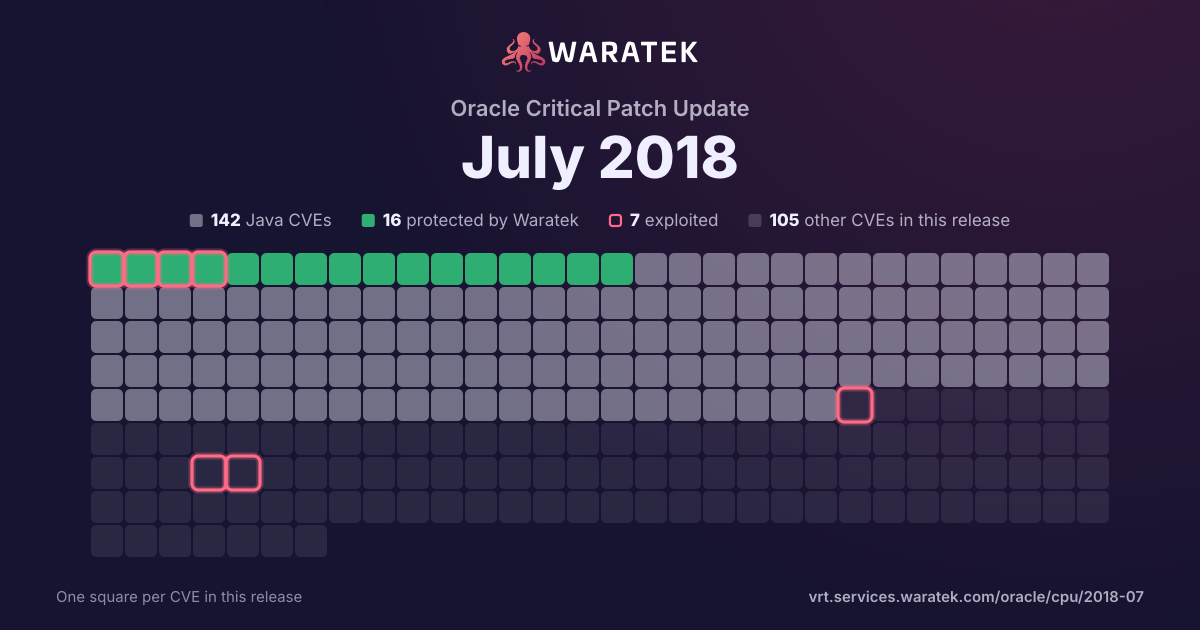
By status
16Protected by Waratek126No exploit published41Outside Waratek scope64Not applicable
7Exploited, marked by the ring
No exploit published. For 125 of them, Oracle's security advisory is the source of public detail.
Protected by Waratek. Waratek RASP can block exploitation of these on systems that have not applied the patch yet.
Overview 219 matches · 134 in Waratek scope · 8 protected · 2 exploited · 0 CISA KEV · 6 public PoC · 4 EPSS ≥ 0.5
219matches
134in Waratek scope61.2%
8protected3.7%
2exploited0.9%
0CISA KEV0.0%
6public PoC2.7%
4EPSS ≥ 0.51.8%
Protected by Waratek
9
4.1%
Rule in development
0
0.0%
Mitigation candidate
0
0.0%
No exploit published
125
57.1%
Outside Waratek scope
34
15.5%
Not applicable
51
23.3%
Withdrawn CVE
0
0.0%
blocked by ARMR today
8
3.7%
partly blocked
1
0.5%
not blocked
210
95.9%
not established
0
0.0%
unrecorded
0
0.0%
split by
peak 205 / month
Jan 182
Outside Waratek scope2
Critical1
Medium1
not blocked2
Working exploit published1
No public exploit1
Feb 184
Protected by Waratek3
Outside Waratek scope1
Critical3
Medium1
blocked by ARMR today3
not blocked1
Proof of concept only2
No public exploit2
Mar 182
Not applicable2
High1
Medium1
not blocked2
No public exploit2
Apr 181
Protected by Waratek1
Critical1
blocked by ARMR today1
Forecast only1
May 182
Protected by Waratek1
Not applicable1
Critical2
blocked by ARMR today1
not blocked1
No public exploit2
Jun 180
Jul 18205
Protected by Waratek4
No exploit published122
Outside Waratek scope31
Not applicable48
Critical6
High67
Medium120
Low12
blocked by ARMR today3
partly blocked1
not blocked201
Exploited2
Working exploit published1
No public exploit202
Aug 183
No exploit published3
Medium3
not blocked3
No public exploit3
Jan 18Feb 18Mar 18Apr 18May 18Jun 18Jul 18Aug 18
| CVE | Severity | Published▾ | Status | Exploitation | Description |
|---|---|---|---|---|---|
| CVE-2018-2893 | Critical | 2018-07-18 | Protected by Waratek | Exploited | Vulnerability in the Oracle WebLogic Server component of Oracle Fusion Middleware (subcomponent: WLS Core Components). Supported versions that are affected are 10.3.6.0, 12.1.3.0, 12.2.1.2 and 12.2.1.3. Easily exploitable vulnerability allows unauthenticated attacker with network access via T3 to compromise Oracle WebLogic Server. Successful attacks of this vulnerability can result in takeover of Oracle WebLogic Server. CVSS 3.0 Base Score 9.8 (Confidentiality, Integrity and Availability impacts). CVSS Vector: (CVSS:3.0/AV:N/AC:L/PR:N/UI:N/S:U/C:H/I:H/A:H). |
| CVE-2018-2892 | High | 2018-07-18 | Not applicable | Working exploit published | Vulnerability in the Solaris component of Oracle Sun Systems Products Suite (subcomponent: Availability Suite Service). Supported versions that are affected are 10 and 11.3. Easily exploitable vulnerability allows low privileged attacker with logon to the infrastructure where Solaris executes to compromise Solaris. Successful attacks of this vulnerability can result in takeover of Solaris. CVSS 3.0 Base Score 7.8 (Confidentiality, Integrity and Availability impacts). CVSS Vector: (CVSS:3.0/AV:L/AC:L/PR:L/UI:N/S:U/C:H/I:H/A:H). |
| CVE-2018-2891 | Medium | 2018-07-18 | No exploit published | No public exploit | Vulnerability in the Oracle Retail Bulk Data Integration component of Oracle Retail Applications (subcomponent: BDI Job Scheduler). The supported version that is affected is 16.0. Easily exploitable vulnerability allows unauthenticated attacker with network access via HTTP to compromise Oracle Retail Bulk Data Integration. Successful attacks require human interaction from a person other than the attacker and while the vulnerability is in Oracle Retail Bulk Data Integration, attacks may significantly impact additional products. Successful attacks of this vulnerability can result in unauthorized update, insert or delete access to some of Oracle Retail Bulk Data Integration accessible data as well as unauthorized read access to a subset of Oracle Retail Bulk Data Integration accessible data. CVSS 3.0 Base Score 6.1 (Confidentiality and Integrity impacts). CVSS Vector: (CVSS:3.0/AV:N/AC:L/PR:N/UI:R/S:C/C:L/I:L/A:N). |
| CVE-2018-2888 | Medium | 2018-07-18 | No exploit published | No public exploit | Vulnerability in the MICROS Retail-J component of Oracle Retail Applications (subcomponent: Back Office). Supported versions that are affected are 10.2.x, 11.0.x, 12.0.x, 12.1.x, 12.1.1.x,12.1.2.x and 13.1.x. Difficult to exploit vulnerability allows physical access to compromise MICROS Retail-J. Successful attacks require human interaction from a person other than the attacker and while the vulnerability is in MICROS Retail-J, attacks may significantly impact additional products. Successful attacks of this vulnerability can result in unauthorized creation, deletion or modification access to critical data or all MICROS Retail-J accessible data as well as unauthorized access to critical data or complete access to all MICROS Retail-J accessible data and unauthorized ability to cause a partial denial of service (partial DOS) of MICROS Retail-J. CVSS 3.0 Base Score 6.7 (Confidentiality, Integrity and Availability impacts). CVSS Vector: (CVSS:3.0/AV:P/AC:H/PR:H/UI:R/S:C/C:H/I:H/A:L). |
| CVE-2018-2882 | High | 2018-07-18 | No exploit published | No public exploit | Vulnerability in the MICROS Retail-J component of Oracle Retail Applications (subcomponent: Interfaces). Supported versions that are affected are 10.2.x, 11.0.x, 12.0.x,12.1.x, 12.1.1.x,12.1.2.x and 13.1.x. Easily exploitable vulnerability allows low privileged attacker with network access via HTTP to compromise MICROS Retail-J. While the vulnerability is in MICROS Retail-J, attacks may significantly impact additional products. Successful attacks of this vulnerability can result in unauthorized creation, deletion or modification access to critical data or all MICROS Retail-J accessible data. CVSS 3.0 Base Score 7.7 (Integrity impacts). CVSS Vector: (CVSS:3.0/AV:N/AC:L/PR:L/UI:N/S:C/C:N/I:H/A:N). |
| CVE-2018-2881 | Medium | 2018-07-18 | No exploit published | No public exploit | Vulnerability in the MICROS Retail-J component of Oracle Retail Applications (subcomponent: Database). Supported versions that are affected are 11.0.x, 12.0.x, 12.1.x, 12.1.1.x, 12.1.2.x and 13.1.x. Easily exploitable vulnerability allows low privileged attacker with network access via HTTP to compromise MICROS Retail-J. Successful attacks of this vulnerability can result in unauthorized update, insert or delete access to some of MICROS Retail-J accessible data as well as unauthorized read access to a subset of MICROS Retail-J accessible data and unauthorized ability to cause a partial denial of service (partial DOS) of MICROS Retail-J. CVSS 3.0 Base Score 6.3 (Confidentiality, Integrity and Availability impacts). CVSS Vector: (CVSS:3.0/AV:N/AC:L/PR:L/UI:N/S:U/C:L/I:L/A:L). |
| CVE-2018-2767 | Low | 2018-07-18 | Outside Waratek scope | No public exploit | Vulnerability in the MySQL Server component of Oracle MySQL (subcomponent: Server: Security: Encryption). Supported versions that are affected are 5.5.60 and prior, 5.6.40 and prior and 5.7.22 and prior. Difficult to exploit vulnerability allows low privileged attacker with network access via multiple protocols to compromise MySQL Server. Successful attacks of this vulnerability can result in unauthorized read access to a subset of MySQL Server accessible data. CVSS 3.0 Base Score 3.1 (Confidentiality impacts). CVSS Vector: (CVSS:3.0/AV:N/AC:H/PR:L/UI:N/S:U/C:L/I:N/A:N). |
| CVE-2018-2598 | Low | 2018-07-18 | Not applicable | No public exploit | Vulnerability in the MySQL Workbench component of Oracle MySQL (subcomponent: Workbench: Security: Encryption). Supported versions that are affected are 6.3.10 and earlier. Difficult to exploit vulnerability allows unauthenticated attacker with network access via multiple protocols to compromise MySQL Workbench. Successful attacks of this vulnerability can result in unauthorized read access to a subset of MySQL Workbench accessible data. CVSS 3.0 Base Score 3.7 (Confidentiality impacts). CVSS Vector: (CVSS:3.0/AV:N/AC:H/PR:N/UI:N/S:U/C:L/I:N/A:N). |
| CVE-2018-8013 | Critical | 2018-05-24 | Protected by Waratek | No public exploit | In Apache Batik 1.x before 1.10, when deserializing subclass of `AbstractDocument`, the class takes a string from the inputStream as the class name which then use it to call the no-arg constructor of the class. Fix was to check the class type before calling newInstance in deserialization. |
| CVE-2018-1000300 | Critical | 2018-05-24 | Not applicable | No public exploit | curl version curl 7.54.1 to and including curl 7.59.0 contains a CWE-122: Heap-based Buffer Overflow vulnerability in denial of service and more that can result in curl might overflow a heap based memory buffer when closing down an FTP connection with very long server command replies.. This vulnerability appears to have been fixed in curl < 7.54.1 and curl >= 7.60.0. |
| CVE-2018-1275 | Critical | 2018-04-11 | Protected by Waratek | Forecast only | Spring Framework, versions 5.0 prior to 5.0.5 and versions 4.3 prior to 4.3.16 and older unsupported versions, allow applications to expose STOMP over WebSocket endpoints with a simple, in-memory STOMP broker through the spring-messaging module. A malicious user (or attacker) can craft a message to the broker that can lead to a remote code execution attack. This CVE addresses the partial fix for CVE-2018-1270 in the 4.3.x branch of the Spring Framework. |
| CVE-2018-0739 | Medium | 2018-03-27 | Not applicable | No public exploit | Constructed ASN.1 types with a recursive definition (such as can be found in PKCS7) could eventually exceed the stack given malicious input with excessive recursion. This could result in a Denial Of Service attack. There are no such structures used within SSL/TLS that come from untrusted sources so this is considered safe. Fixed in OpenSSL 1.1.0h (Affected 1.1.0-1.1.0g). Fixed in OpenSSL 1.0.2o (Affected 1.0.2b-1.0.2n). |
| CVE-2018-1171 | High | 2018-03-19 | Not applicable | No public exploit | This vulnerability allows local attackers to escalate privileges on vulnerable installations of Joyent SmartOS release-20170803-20170803T064301Z. An attacker must first obtain the ability to execute low-privileged code on the target system in order to exploit this vulnerability. The specific flaw exists within the DTrace DOF files. The issue results from the lack of proper validation of user-supplied data, which can result in a write past the end of an allocated object. An attacker can leverage this vulnerability to execute code under the context of the host OS. Was ZDI-CAN-5106. |
| CVE-2018-7489 | Critical | 2018-02-26 | Protected by Waratek | No public exploit | FasterXML jackson-databind before 2.7.9.3, 2.8.x before 2.8.11.1 and 2.9.x before 2.9.5 allows unauthenticated remote code execution because of an incomplete fix for the CVE-2017-7525 deserialization flaw. This is exploitable by sending maliciously crafted JSON input to the readValue method of the ObjectMapper, bypassing a blacklist that is ineffective if the c3p0 libraries are available in the classpath. |
| CVE-2018-1305 | Medium | 2018-02-23 | Outside Waratek scope | Proof of concept only | Security constraints defined by annotations of Servlets in Apache Tomcat 9.0.0.M1 to 9.0.4, 8.5.0 to 8.5.27, 8.0.0.RC1 to 8.0.49 and 7.0.0 to 7.0.84 were only applied once a Servlet had been loaded. Because security constraints defined in this way apply to the URL pattern and any URLs below that point, it was possible - depending on the order Servlets were loaded - for some security constraints not to be applied. This could have exposed resources to users who were not authorised to access them. |
| CVE-2017-7525 | Critical | 2018-02-06 | Protected by Waratek | Proof of concept only | A deserialization flaw was discovered in the jackson-databind, versions before 2.6.7.1, 2.7.9.1 and 2.8.9, which could allow an unauthenticated user to perform code execution by sending the maliciously crafted input to the readValue method of the ObjectMapper. |
| CVE-2017-15095 | Critical | 2018-02-06 | Protected by Waratek | No public exploit | A deserialization flaw was discovered in the jackson-databind in versions before 2.8.10 and 2.9.1, which could allow an unauthenticated user to perform code execution by sending the maliciously crafted input to the readValue method of the ObjectMapper. This issue extends the previous flaw CVE-2017-7525 by blacklisting more classes that could be used maliciously. |
| CVE-2016-6814 | Critical | 2018-01-18 | Outside Waratek scope | No public exploit | When an application with unsupported Codehaus versions of Groovy from 1.7.0 to 2.4.3, Apache Groovy 2.4.4 to 2.4.7 on classpath uses standard Java serialization mechanisms, e.g. to communicate between servers or to store local data, it was possible for an attacker to bake a special serialized object that will execute code directly when deserialized. All applications which rely on serialization and do not isolate the code which deserializes objects were subject to this vulnerability. |
| CVE-2017-5715 | Medium | 2018-01-04 | Outside Waratek scope | Working exploit published | Systems with microprocessors utilizing speculative execution and indirect branch prediction may allow unauthorized disclosure of information to an attacker with local user access via a side-channel analysis. |