
Oracle Critical Patch Update July 2018
Released July 2018 · Oracle's advisory ↗ · ← Critical Patch Update, April 2018 · Critical Patch Update, October 2018 →
247 CVEs in this release, one square each
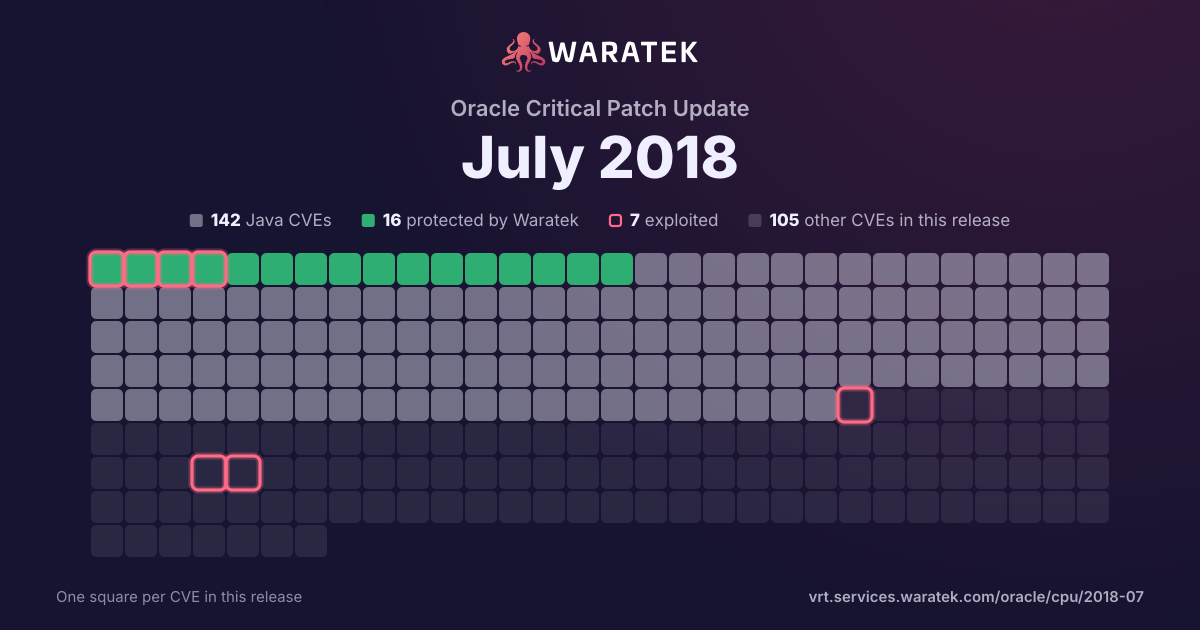
By status
16Protected by Waratek126No exploit published41Outside Waratek scope64Not applicable
7Exploited, marked by the ring
No exploit published. For 125 of them, Oracle's security advisory is the source of public detail.
Protected by Waratek. Waratek RASP can block exploitation of these on systems that have not applied the patch yet.
Overview 2 matches · 0 in Waratek scope · 0 protected · 1 CISA KEV
Protected by Waratek
0
0.0%
Rule in development
0
0.0%
Mitigation candidate
0
0.0%
No exploit published
0
0.0%
Outside Waratek scope
1
50.0%
Not applicable
1
50.0%
Withdrawn CVE
0
0.0%
blocked by ARMR today
0
0.0%
partly blocked
0
0.0%
not blocked
2
100.0%
not established
0
0.0%
unrecorded
0
0.0%
Exploited
2
100.0%
Working exploit published
0
0.0%
Proof of concept only
0
0.0%
Forecast only
0
0.0%
No public exploit
0
0.0%
split by
peak 1 / quarter
Q1 15Q2 15Q3 15Q4 15Q1 16Q2 16Q3 16Q4 16
| CVE | Severity | Published▾ | Status | Exploitation | Description |
|---|---|---|---|---|---|
| CVE-2016-5195 | High | 2016-11-10 | Outside Waratek scope | Exploited | Race condition in mm/gup.c in the Linux kernel 2.x through 4.x before 4.8.3 allows local users to gain privileges by leveraging incorrect handling of a copy-on-write (COW) feature to write to a read-only memory mapping, as exploited in the wild in October 2016, aka "Dirty COW." |
| CVE-2015-0204 | Medium | 2015-01-09 | Not applicable | Exploited | The ssl3_get_key_exchange function in s3_clnt.c in OpenSSL before 0.9.8zd, 1.0.0 before 1.0.0p, and 1.0.1 before 1.0.1k allows remote SSL servers to conduct RSA-to-EXPORT_RSA downgrade attacks and facilitate brute-force decryption by offering a weak ephemeral RSA key in a noncompliant role, related to the "FREAK" issue. NOTE: the scope of this CVE is only client code based on OpenSSL, not EXPORT_RSA issues associated with servers or other TLS implementations. |