
Oracle Critical Patch Update April 2018
Released April 2018 · Oracle's advisory ↗ · ← Critical Patch Update, January 2018 · Critical Patch Update, July 2018 →
165 CVEs in this release, one square each
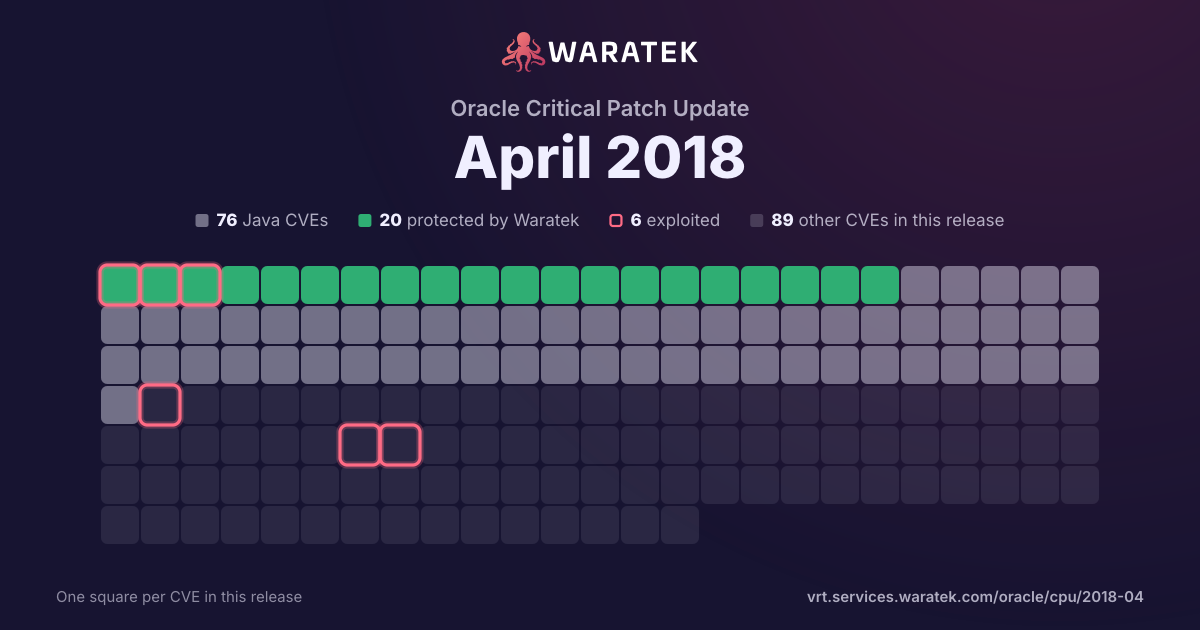
By status
20Protected by Waratek2Mitigation candidate54No exploit published30Outside Waratek scope59Not applicable
6Exploited, marked by the ring
No exploit published. For 52 of them, Oracle's security advisory is the source of public detail.
Protected by Waratek. Waratek RASP can block exploitation of these on systems that have not applied the patch yet.
Overview 6 matches · 2 in Waratek scope · 1 protected · 3 exploited · 2 CISA KEV · 3 public PoC · 4 EPSS ≥ 0.5
6matches
2in Waratek scope33.3%
1protected16.7%
3exploited50.0%
2CISA KEV33.3%
3public PoC50.0%
4EPSS ≥ 0.566.7%
Protected by Waratek
2
33.3%
Rule in development
0
0.0%
Mitigation candidate
0
0.0%
No exploit published
0
0.0%
Outside Waratek scope
0
0.0%
Not applicable
4
66.7%
Withdrawn CVE
0
0.0%
blocked by ARMR today
1
16.7%
partly blocked
1
16.7%
not blocked
4
66.7%
not established
0
0.0%
unrecorded
0
0.0%
Exploited
3
50.0%
Working exploit published
0
0.0%
Proof of concept only
0
0.0%
Forecast only
1
16.7%
No public exploit
2
33.3%
split by
peak 2 / month
Oct 172
Protected by Waratek1
Not applicable1
High2
partly blocked1
not blocked1
Exploited1
No public exploit1
Nov 172
Protected by Waratek1
Not applicable1
Critical1
Medium1
blocked by ARMR today1
not blocked1
Exploited1
No public exploit1
Dec 172
Not applicable2
High1
Medium1
not blocked2
Exploited1
Forecast only1
Oct 17Nov 17Dec 17
| CVE | Severity | Published▾ | Status | Exploitation | Description |
|---|---|---|---|---|---|
| CVE-2017-17562 | High | 2017-12-12 | Not applicable | Exploited | Embedthis GoAhead before 3.6.5 allows remote code execution if CGI is enabled and a CGI program is dynamically linked. This is a result of initializing the environment of forked CGI scripts using untrusted HTTP request parameters in the cgiHandler function in cgi.c. When combined with the glibc dynamic linker, this behaviour can be abused for remote code execution using special parameter names such as LD_PRELOAD. An attacker can POST their shared object payload in the body of the request, and reference it using /proc/self/fd/0. |
| CVE-2017-3737 | Medium | 2017-12-07 | Not applicable | Forecast only | OpenSSL 1.0.2 (starting from version 1.0.2b) introduced an "error state" mechanism. The intent was that if a fatal error occurred during a handshake then OpenSSL would move into the error state and would immediately fail if you attempted to continue the handshake. This works as designed for the explicit handshake functions (SSL_do_handshake(), SSL_accept() and SSL_connect()), however due to a bug it does not work correctly if SSL_read() or SSL_write() is called directly. In that scenario, if the handshake fails then a fatal error will be returned in the initial function call. If SSL_read()/SSL_write() is subsequently called by the application for the same SSL object then it will succeed and the data is passed without being decrypted/encrypted directly from the SSL/TLS record layer. In order to exploit this issue an application bug would have to be present that resulted in a call to SSL_read()/SSL_write() being issued after having already received a fatal error. OpenSSL version 1.0.2b-1.0.2m are affected. Fixed in OpenSSL 1.0.2n. OpenSSL 1.1.0 is not affected. |
| CVE-2015-7501 | Critical | 2017-11-09 | Protected by Waratek | Exploited | Red Hat JBoss A-MQ 6.x; BPM Suite (BPMS) 6.x; BRMS 6.x and 5.x; Data Grid (JDG) 6.x; Data Virtualization (JDV) 6.x and 5.x; Enterprise Application Platform 6.x, 5.x, and 4.3.x; Fuse 6.x; Fuse Service Works (FSW) 6.x; Operations Network (JBoss ON) 3.x; Portal 6.x; SOA Platform (SOA-P) 5.x; Web Server (JWS) 3.x; Red Hat OpenShift/xPAAS 3.x; and Red Hat Subscription Asset Manager 1.3 allow remote attackers to execute arbitrary commands via a crafted serialized Java object, related to the Apache Commons Collections (ACC) library. |
| CVE-2017-3736 | Medium | 2017-11-02 | Not applicable | No public exploit | There is a carry propagating bug in the x86_64 Montgomery squaring procedure in OpenSSL before 1.0.2m and 1.1.0 before 1.1.0g. No EC algorithms are affected. Analysis suggests that attacks against RSA and DSA as a result of this defect would be very difficult to perform and are not believed likely. Attacks against DH are considered just feasible (although very difficult) because most of the work necessary to deduce information about a private key may be performed offline. The amount of resources required for such an attack would be very significant and likely only accessible to a limited number of attackers. An attacker would additionally need online access to an unpatched system using the target private key in a scenario with persistent DH parameters and a private key that is shared between multiple clients. This only affects processors that support the BMI1, BMI2 and ADX extensions like Intel Broadwell (5th generation) and later or AMD Ryzen. |
| CVE-2017-13082 | High | 2017-10-17 | Not applicable | No public exploit | Wi-Fi Protected Access (WPA and WPA2) that supports IEEE 802.11r allows reinstallation of the Pairwise Transient Key (PTK) Temporal Key (TK) during the fast BSS transmission (FT) handshake, allowing an attacker within radio range to replay, decrypt, or spoof frames. |
| CVE-2017-12617 | High | 2017-10-04 | Protected by Waratek | Exploited | When running Apache Tomcat versions 9.0.0.M1 to 9.0.0, 8.5.0 to 8.5.22, 8.0.0.RC1 to 8.0.46 and 7.0.0 to 7.0.81 with HTTP PUTs enabled (e.g. via setting the readonly initialisation parameter of the Default servlet to false) it was possible to upload a JSP file to the server via a specially crafted request. This JSP could then be requested and any code it contained would be executed by the server. |