
Oracle Critical Patch Update April 2018
Released April 2018 · Oracle's advisory ↗ · ← Critical Patch Update, January 2018 · Critical Patch Update, July 2018 →
165 CVEs in this release, one square each
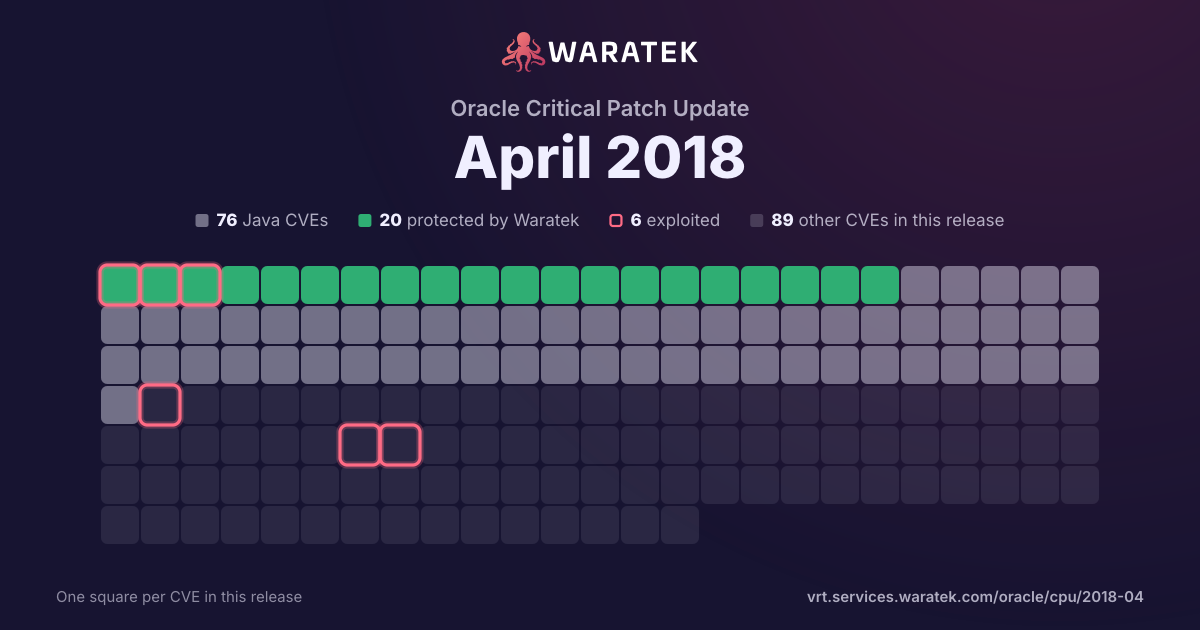
By status
20Protected by Waratek2Mitigation candidate54No exploit published30Outside Waratek scope59Not applicable
6Exploited, marked by the ring
No exploit published. For 52 of them, Oracle's security advisory is the source of public detail.
Protected by Waratek. Waratek RASP can block exploitation of these on systems that have not applied the patch yet.
Overview 4 matches · 0 in Waratek scope · 0 protected · 2 exploited · 1 CISA KEV · 2 public PoC
Protected by Waratek
0
0.0%
Rule in development
0
0.0%
Mitigation candidate
0
0.0%
No exploit published
0
0.0%
Outside Waratek scope
0
0.0%
Not applicable
4
100.0%
Withdrawn CVE
0
0.0%
blocked by ARMR today
0
0.0%
partly blocked
0
0.0%
not blocked
4
100.0%
not established
0
0.0%
unrecorded
0
0.0%
Exploited
2
50.0%
Working exploit published
0
0.0%
Proof of concept only
0
0.0%
Forecast only
2
50.0%
No public exploit
0
0.0%
split by
peak 2 / month
Oct 16Dec 16Feb 17Apr 17Jun 17Aug 17Oct 17Dec 17
| CVE | Severity | Published▾ | Status | Exploitation | Description |
|---|---|---|---|---|---|
| CVE-2017-17562 | High | 2017-12-12 | Not applicable | Exploited | Embedthis GoAhead before 3.6.5 allows remote code execution if CGI is enabled and a CGI program is dynamically linked. This is a result of initializing the environment of forked CGI scripts using untrusted HTTP request parameters in the cgiHandler function in cgi.c. When combined with the glibc dynamic linker, this behaviour can be abused for remote code execution using special parameter names such as LD_PRELOAD. An attacker can POST their shared object payload in the body of the request, and reference it using /proc/self/fd/0. |
| CVE-2017-3737 | Medium | 2017-12-07 | Not applicable | Forecast only | OpenSSL 1.0.2 (starting from version 1.0.2b) introduced an "error state" mechanism. The intent was that if a fatal error occurred during a handshake then OpenSSL would move into the error state and would immediately fail if you attempted to continue the handshake. This works as designed for the explicit handshake functions (SSL_do_handshake(), SSL_accept() and SSL_connect()), however due to a bug it does not work correctly if SSL_read() or SSL_write() is called directly. In that scenario, if the handshake fails then a fatal error will be returned in the initial function call. If SSL_read()/SSL_write() is subsequently called by the application for the same SSL object then it will succeed and the data is passed without being decrypted/encrypted directly from the SSL/TLS record layer. In order to exploit this issue an application bug would have to be present that resulted in a call to SSL_read()/SSL_write() being issued after having already received a fatal error. OpenSSL version 1.0.2b-1.0.2m are affected. Fixed in OpenSSL 1.0.2n. OpenSSL 1.1.0 is not affected. |
| CVE-2017-9798 | High | 2017-09-18 | Not applicable | Exploited | Apache httpd allows remote attackers to read secret data from process memory if the Limit directive can be set in a user's .htaccess file, or if httpd.conf has certain misconfigurations, aka Optionsbleed. This affects the Apache HTTP Server through 2.2.34 and 2.4.x through 2.4.27. The attacker sends an unauthenticated OPTIONS HTTP request when attempting to read secret data. This is a use-after-free issue and thus secret data is not always sent, and the specific data depends on many factors including configuration. Exploitation with .htaccess can be blocked with a patch to the ap_limit_section function in server/core.c. |
| CVE-2016-6304 | High | 2016-09-26 | Not applicable | Forecast only | Multiple memory leaks in t1_lib.c in OpenSSL before 1.0.1u, 1.0.2 before 1.0.2i, and 1.1.0 before 1.1.0a allow remote attackers to cause a denial of service (memory consumption) via large OCSP Status Request extensions. |